
Analizador de reglas YARA para mejorar la calidad y el rendimiento de las reglas
Las reglas YARA pueden ser sintácticamente correctas pero aún así disfuncionales. yaraQA intenta encontrar e informar estos problemas al autor o mantenedor de un conjunto de reglas YARA.
Los problemas que yaraQA intenta detectar son, por ejemplo:
2 of them en la condición)$ = "\\Debug\\" fullword)$ = "AA"; se pueden excluir del análisis usando --ignore-performance)Voy a ampliar el conjunto de pruebas con el tiempo. Cada versión menor incluirá nuevas características o nuevas pruebas.
pip install -r requirements.txt
usage: yaraQA.py [-h] [-f yara files [yara files ...]] [-d yara files [yara files ...]] [-o outfile] [-b baseline] [-l level]
[--ignore-performance] [--debug]
YARA RULE ANALYZER
optional arguments:
-h, --help show this help message and exit
-f yara files [yara files ...]
Path to input files (one or more YARA rules, separated by space)
-d yara files [yara files ...]
Path to input directory (YARA rules folders, separated by space)
-o outfile Output file that lists the issues (JSON, default: 'yaraQA-issues.json')
-b baseline Use a issues baseline (issues found and reviewed before) to filter issues
-l level Minium level to show (1=informational, 2=warning, 3=critical)
--ignore-performance Suppress performance-related rule issues
--debug Debug output
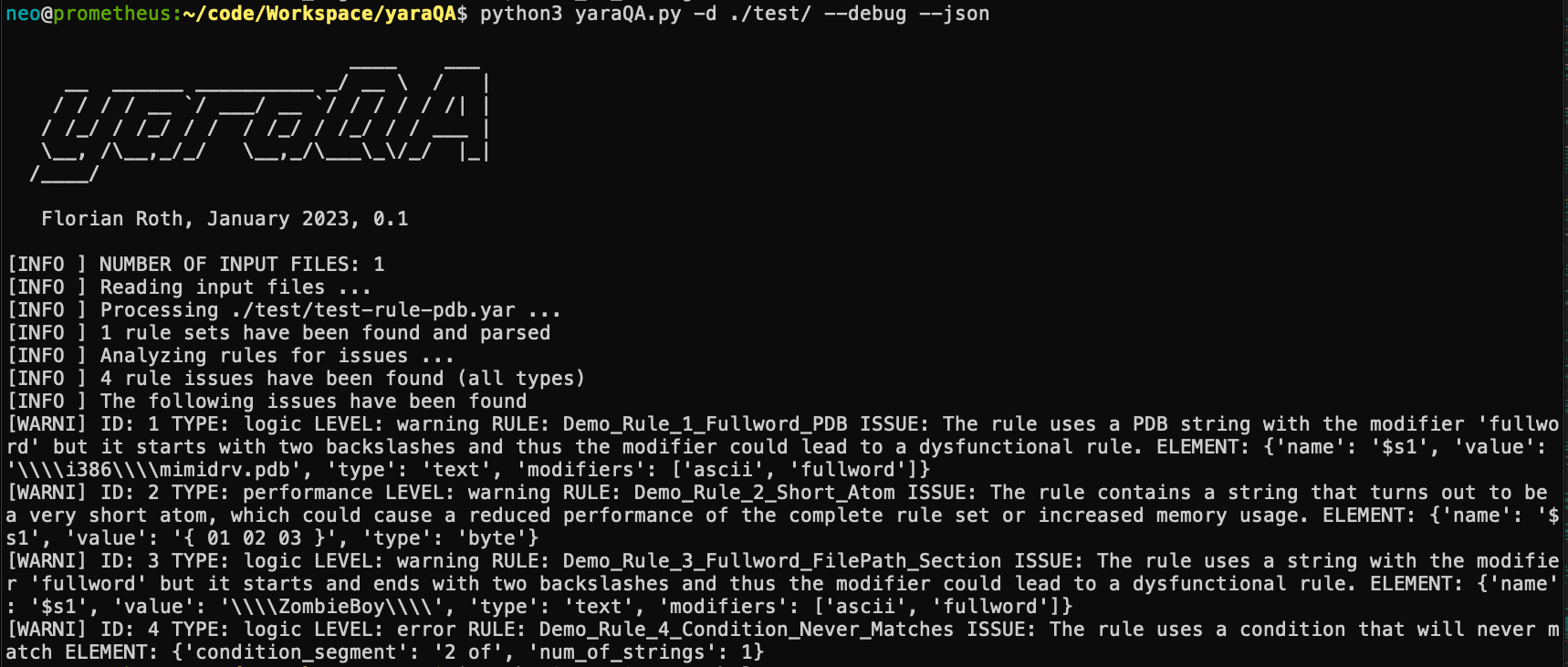
python3 yaraQA.py -d ./test/
Suprime todos los problemas de rendimiento y solo muestra problemas de detección/lógica.
python3 yaraQA.py -d ./test/ --ignore-performance
Suprime todos los problemas de carácter informativo.
python3 yaraQA.py -d ./test/ -level 2
Usa una línea base para ver solo los problemas nuevos (no los que ya has revisado). El archivo de línea base es una salida JSON antigua de un estado revisado.
python3 yaraQA.py -d ./test/ -b yaraQA-reviewed-issues.json
Las reglas de ejemplo con problemas se pueden encontrar en la carpeta ./test.
yaraQA escribe los problemas detectados en un archivo llamado yaraQA-issues.json por defecto.
Esta lista muestra un ejemplo de la salida generada por yaraQA en formato JSON:
[
{
"rule": "Demo_Rule_1_Fullword_PDB",
"id": "SM1",
"issue": "The rule uses a PDB string with the modifier 'wide'. PDB strings are always included as ASCII strings. The 'wide' keyword is unneeded.",
"element": {
"name": "$s1",
"value": "\\\\i386\\\\mimidrv.pdb",
"type": "text",
"modifiers": [
"ascii",
"wide",
"fullword"
]
},
"level": "info",
"type": "logic",
"recommendation": "Remove the 'wide' modifier"
},
{
"rule": "Demo_Rule_1_Fullword_PDB",
"id": "SM2",
"issue": "The rule uses a PDB string with the modifier 'fullword' but it starts with two backslashes and thus the modifier could lead to a dysfunctional rule.",
"element": {
"name": "$s1",
"value": "\\\\i386\\\\mimidrv.pdb",
"type": "text",
"modifiers": [
"ascii",
"wide",
"fullword"
]
},
"level": "warning",
"type": "logic",
"recommendation": "Remove the 'fullword' modifier"
},
{
"rule": "Demo_Rule_2_Short_Atom",
"id": "PA2",
"issue": "The rule contains a string that turns out to be a very short atom, which could cause a reduced performance of the complete rule set or increased memory usage.",
"element": {
"name": "$s1",
"value": "{ 01 02 03 }",
"type": "byte"
},
"level": "warning",
"type": "performance",
"recommendation": "Try to avoid using such short atoms, by e.g. adding a few more bytes to the beginning or the end (e.g. add a binary 0 in front or a space after the string). Every additional byte helps."
},
{
"rule": "Demo_Rule_3_Fullword_FilePath_Section",
"id": "SM3",
"issue": "The rule uses a string with the modifier 'fullword' but it starts and ends with two backslashes and thus the modifier could lead to a dysfunctional rule.",
"element": {
"name": "$s1",
"value": "\\\\ZombieBoy\\\\",
"type": "text",
"modifiers": [
"ascii",
"fullword"
]
},
"level": "warning",
"type": "logic",
"recommendation": "Remove the 'fullword' modifier"
},
{
"rule": "Demo_Rule_4_Condition_Never_Matches",
"id": "CE1",
"issue": "The rule uses a condition that will never match",
"element": {
"condition_segment": "2 of",
"num_of_strings": 1
},
"level": "error",
"type": "logic",
"recommendation": "Fix the condition"
},
{
"rule": "Demo_Rule_5_Condition_Short_String_At_Pos",
"id": "PA1",
"issue": "This rule looks for a short string at a particular position. A short string represents a short atom and could be rewritten to an expression using uint(x) at position.",
"element": {
"condition_segment": "$mz at 0",
"string": "$mz",
"value": "MZ"
},
"level": "warning",
"type": "performance",
"recommendation": ""
},
{
"rule": "Demo_Rule_5_Condition_Short_String_At_Pos",
"id": "PA2",
"issue": "The rule contains a string that turns out to be a very short atom, which could cause a reduced performance of the complete rule set or increased memory usage.",
"element": {
"name": "$mz",
"value": "MZ",
"type": "text",
"modifiers": [
"ascii"
]
},
"level": "warning",
"type": "performance",
"recommendation": "Try to avoid using such short atoms, by e.g. adding a few more bytes to the beginning or the end (e.g. add a binary 0 in front or a space after the string). Every additional byte helps."
},
{
"rule": "Demo_Rule_6_Condition_Short_Byte_At_Pos",
"id": "PA1",
"issue": "This rule looks for a short string at a particular position. A short string represents a short atom and could be rewritten to an expression using uint(x) at position.",
"element": {
"condition_segment": "$mz at 0",
"string": "$mz",
"value": "{ 4d 5a }"
},
"level": "warning",
"type": "performance",
"recommendation": ""
},
{
"rule": "Demo_Rule_6_Condition_Short_Byte_At_Pos",
"id": "PA2",
"issue": "The rule contains a string that turns out to be a very short atom, which could cause a reduced performance of the complete rule set or increased memory usage.",
"element": {
"name": "$mz",
"value": "{ 4d 5a }",
"type": "byte"
},
"level": "warning",
"type": "performance",
"recommendation": "Try to avoid using such short atoms, by e.g. adding a few more bytes to the beginning or the end (e.g. add a binary 0 in front or a space after the string). Every additional byte helps."
},
{
"rule": "Demo_Rule_6_Condition_Short_Byte_At_Pos",
"id": "SM3",
"issue": "The rule uses a string with the modifier 'fullword' but it starts and ends with two backslashes and thus the modifier could lead to a dysfunctional rule.",
"element": {
"name": "$s1",
"value": "\\\\Section\\\\in\\\\Path\\\\",
"type": "text",
"modifiers": [
"ascii",
"fullword"
]
},
"level": "warning",
"type": "logic",
"recommendation": "Remove the 'fullword' modifier"
}
]
