
Skip to content
KitploitKITPLOIT
ToolsExploitsBlog
Log in
Submit
ToolsExploitsBlog
Submit

Hacking, PenTest, and Cybersecurity Tools for Your Security Arsenal!

Kitploit is a directory of hacking, cybersecurity, and pentesting tools. Discover the latest project updates to find vulnerabilities, analyze systems, automate testing, and strengthen your security.

FeedsContactPrivacy© 2026 Kitploit

Tool Directory

Categories

View all categories
Loading categories
CVE-2023-25194 — CVE-2023-25194 Scan | Kitploit
Tools/GitHubGitHub/yongye-security/cve-2023-25194
ReconnaissanceVulnerability ScannersExploitationWeb Application ExploitationPenetration Testing
GitHubyongye-security/cve-2023-25194

CVE-2023-25194

CVE-2023-25194 Scan

View Repository
2202 years agoNot yet reviewed
Share

This tool is intended for security testing purposes only. Do not engage in any illegal activities. Any consequences resulting from misuse are solely your responsibility.

The CVE-2023-25194 detection tool utilizes JNDI to load the response content returned by the DNS log platform to determine the presence of vulnerabilities. The logic for determining the response content involves successful utilization of the content received through testing. Some response contents can establish connections with the target via the DNS log platform, but they are ultimately ignored as they cannot be exploited.

python3 CVE-2023-25194_Scan.py -h

_______    ________    ___   ____ ___  _____      ___   _____________  __ __
  / ____/ |  / / ____/   |__ \ / __ \__ \|__  /     |__ \ / ____<  / __ \/ // /
 / /    | | / / __/________/ // / / /_/ / /_ <________/ //___ \ / / /_/ / // /_
/ /___  | |/ / /__/_____/ __// /_/ / __/___/ /_____/ __/____/ // /\__, /__  __/
\____/  |___/_____/    /____/\____/____/____/     /____/_____//_//____/  /_/

                                                    PowerBy:YongYe__Security

usage: CVE-2023-25194_Scan.py [-h] (-u URL | -f FILE)

Send POST requests to URLs

options:
  -h, --help            show this help message and exit
  -u URL, --url URL     URL, Single target detection
  -f FILE, --file FILE  URL File, Batch scan

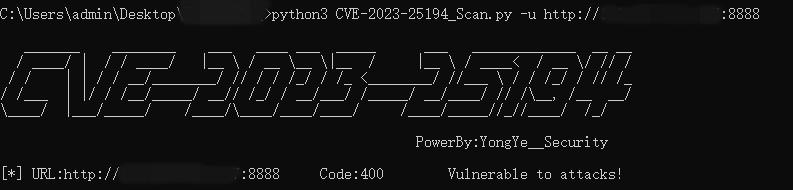
Single target exploitation

python3 CVE-2023-25194_Scan.py -u http://127.0.0.1:8080
image

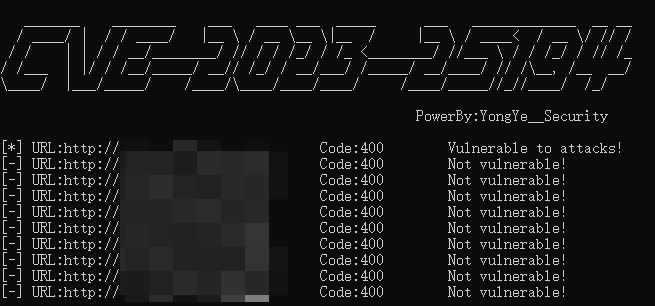
Batch target scanning

The URLs with vulnerabilities will be stored in the file "result.txt" in the current directory.

python3 CVE-2023-25194_Scan.py -f url.txt
image

If necessary, you can modify the actual DNS log platform address in line 34 of the code. However, not changing it will not affect the program's execution.


Download Tool

Most Popular

View all →

Discover the most used tools by our community.

  • 1

    OsintHunter

    letox4/osinthunter

    🎯 The ultimate OSINT toolkit: investigation graph, confidence scoring, alias families, map, timeline and reports. 49 modules, 400+ sites, no API keys required.

    1.0k
  • 2

    ghostlock-app

    yukonga/ghostlock-app

    GhostLock One-Tap Execution App (CVE-2026-43499)

    647
  • 3

    looking-glass

    anonghosty/looking-glass

    CSIRT platform that ingests Shadowserver reports into MongoDB and replays them as interactive maps, analysis, findings, advisories and executive dashboards.

    421
  • 4

    jumpserver

    jumpserver/jumpserver

    JumpServer is an open-source Privileged Access Management (PAM) platform that provides DevOps and IT teams with on-demand and secure access to SSH, RDP, Kubernetes, Database and RemoteApp endpoints through a web browser.

    389
  • 5

    ARTEX

    baarai/artex

    LLM multi-agent autonomous penetration testing platform with planner/worker agents, asset and exploration graphs, MITM traffic recording, and vulnerability retesting.

    333
  • 6

    SafeLine

    chaitin/safeline

    Self-hosted WAF and reverse proxy that filters malicious HTTP traffic, blocks SQL injection, XSS, and bot attacks, with rate limiting and dynamic HTML/JS encryption.

    331

Explore all tools

Browse our collection of tools

View all tools →



