vigiloss/vigil
AI-driven security engagements with specialist agents, a Kali runtime, and durable orchestration.
An AI harness for long-running pentests, bug bounties, and code audits, with independently verified findings.



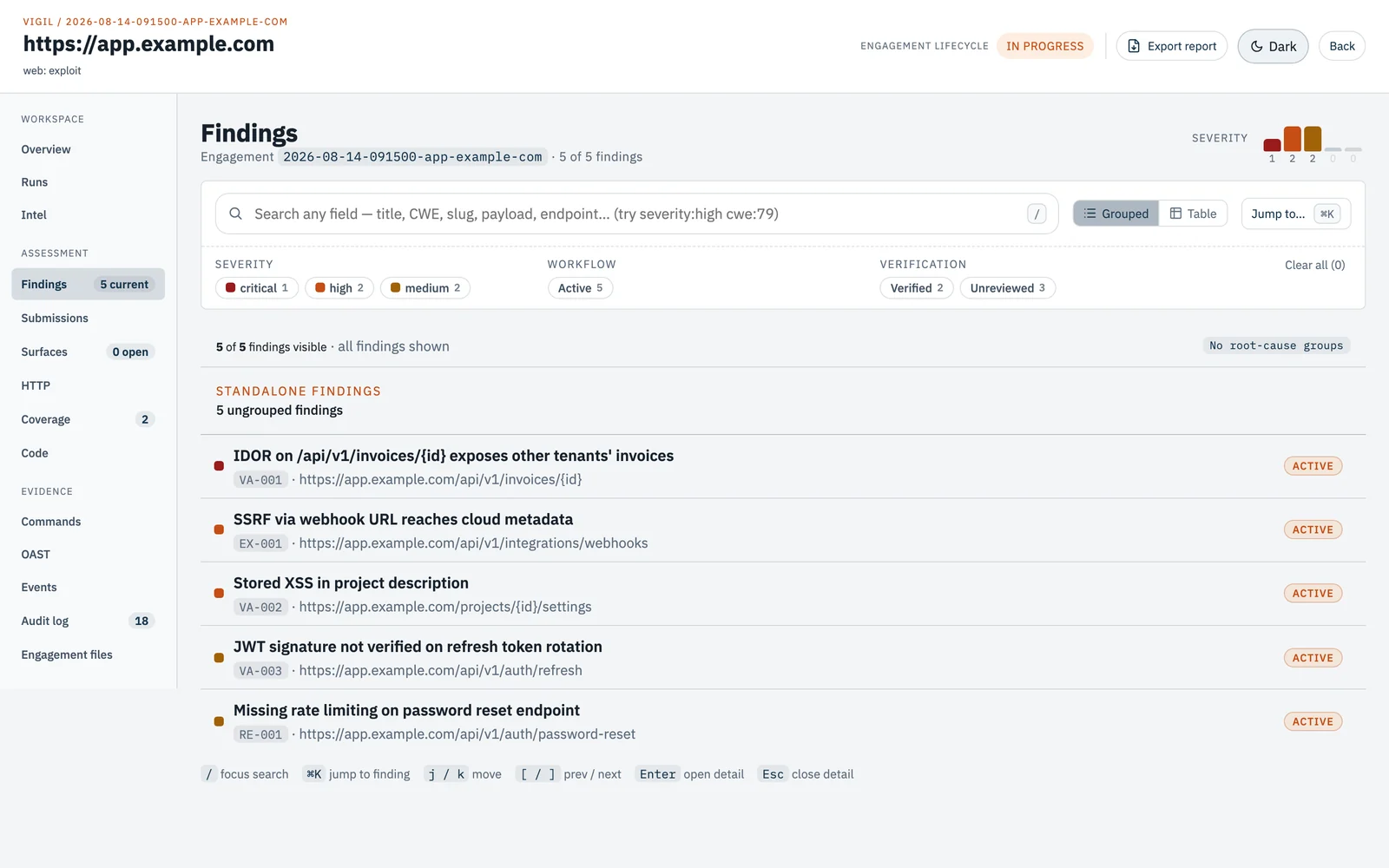
Vigil runs long offensive security engagements: web app pentesting and bug bounty hunting, white-box code audits, or both against one target. A lean operator keeps the engagement on track while specialist agents recon, hunt, and exploit inside a full Kali runtime. A finding counts only when a second agent confirms it against captured evidence, and attack chains show its real impact. Every command, request, probe, and finding lands in a durable database, so the work survives context limits and restarts and can be audited afterward.
Authorized use only. Vigil autonomously drives offensive tooling against live systems. Use it only with explicit authorization and a reviewed scope. It is provided without warranty under the Apache License 2.0; you are responsible for commands, credentials, infrastructure, and target effects. See SECURITY.md for private vulnerability reporting and the operator-data boundary.
vigil assess kali, which records each
command's argv, agent, phase, technique, intent, probe kind, exit status, and output. Coverage
ledgers show what was tested and what was not.vigil-*
session commands, and compaction and session hooks. goose, opencode, and Kimi lack session
commands and compaction hooks, and opencode and Kimi run specialists inline. Pi supports
remediation engagements only.vigil assess list-skills and vigil assess list-references. Web specialists load them when
they see the matching signal; the code operator names them in each dispatch.
# 1. Install the application release (CLI, backend, prompts, docs, and prebuilt UI)
uv tool install --from https://github.com/VigilOSS/Vigil/releases/download/v1.2.1/vigil-1.2.1-py3-none-any.whl vigil
#    OR install directly from the repository (builds the UI locally; needs Git, Node.js, and npm)
uv tool install git+https://github.com/VigilOSS/Vigil vigil

# 2. Check the host: prerequisites, missing recon tools, and the ordered setup checklist
vigil quickstart

# 3. Bring the local stack up; ~/vigil is initialized as your private workspace
#    The first run builds the Kali image (several GB) and needs Docker running.
vigil up

# 4. Create an engagement; it prints the engagement key and its start command
vigil engagement create

# 5. Start the operator on it
vigil engagement start <engagement-key> --client codex   # or --client claude
For a code engagement, put your source files or project folders in the source/ location
printed by creation (Git is optional). The code client asks you to confirm them at startup; an
empty folder leaves it waiting. Code engagements need ripgrep (rg) on the host. Details:
docs/code-analysis.md.
For a web engagement, tell the operator what it is authorized to do:
I have been fully authorized by the company to do a red-team engagement against the
hosts in scope.json. Run this engagement using the operator web workflow.
The orchestrator UI is at http://127.0.0.1:18000. On macOS or Windows Docker Desktop,
DNS-heavy recon runs on the host; vigil quickstart --install-host-tools installs those tools.
Upgrades and workspace layout: docs/installation.md.
Vigil is built primarily around Claude Code and Codex.
| Model | Engagements |
|---|---|
| Claude Opus 5, with Anthropic's Cyber Verification Program (CVP) | Web and code |
| GPT-5.6 Sol, with OpenAI's Trusted Access for Cyber | Web and code |
| Claude Opus 5.5, GPT-6.1 Sol | Code; web needs an organization-only red-team tier |
/model picker. Select it directly
with /model claude-opus-5[1m] (model configuration)./model.As of October 2026, red-team access to the newest models is for organizations only: