 rorywag/hayabusa-bulk-runner
Bulk-run Hayabusa across a folder of KAPE collections, one run per host, with per-host reports and a cross-host triage dashboard

A PowerShell wrapper that runs Hayabusa across a folder of KAPE collections, one run per host, and rolls the results up into a single cross-host triage view.
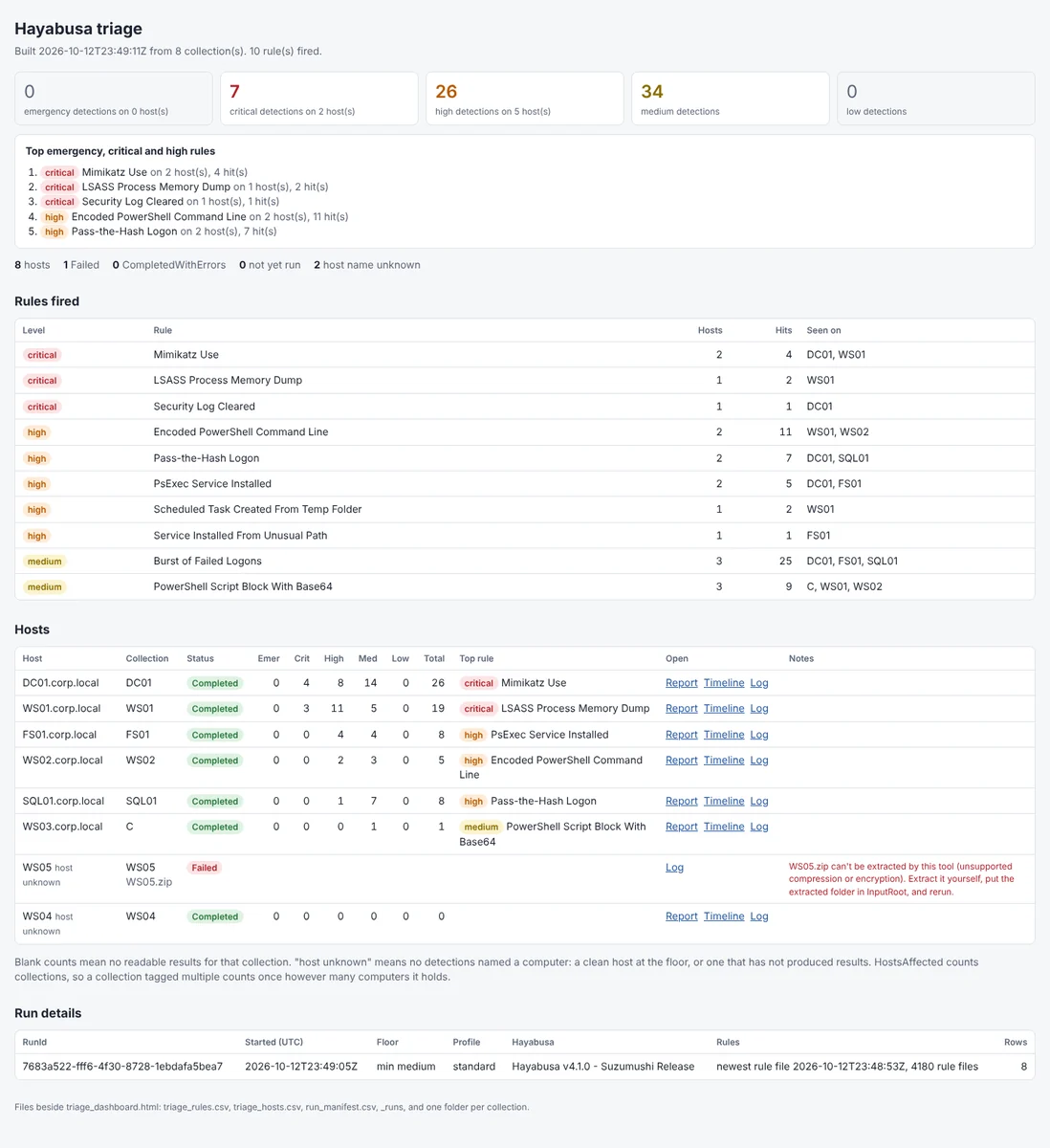
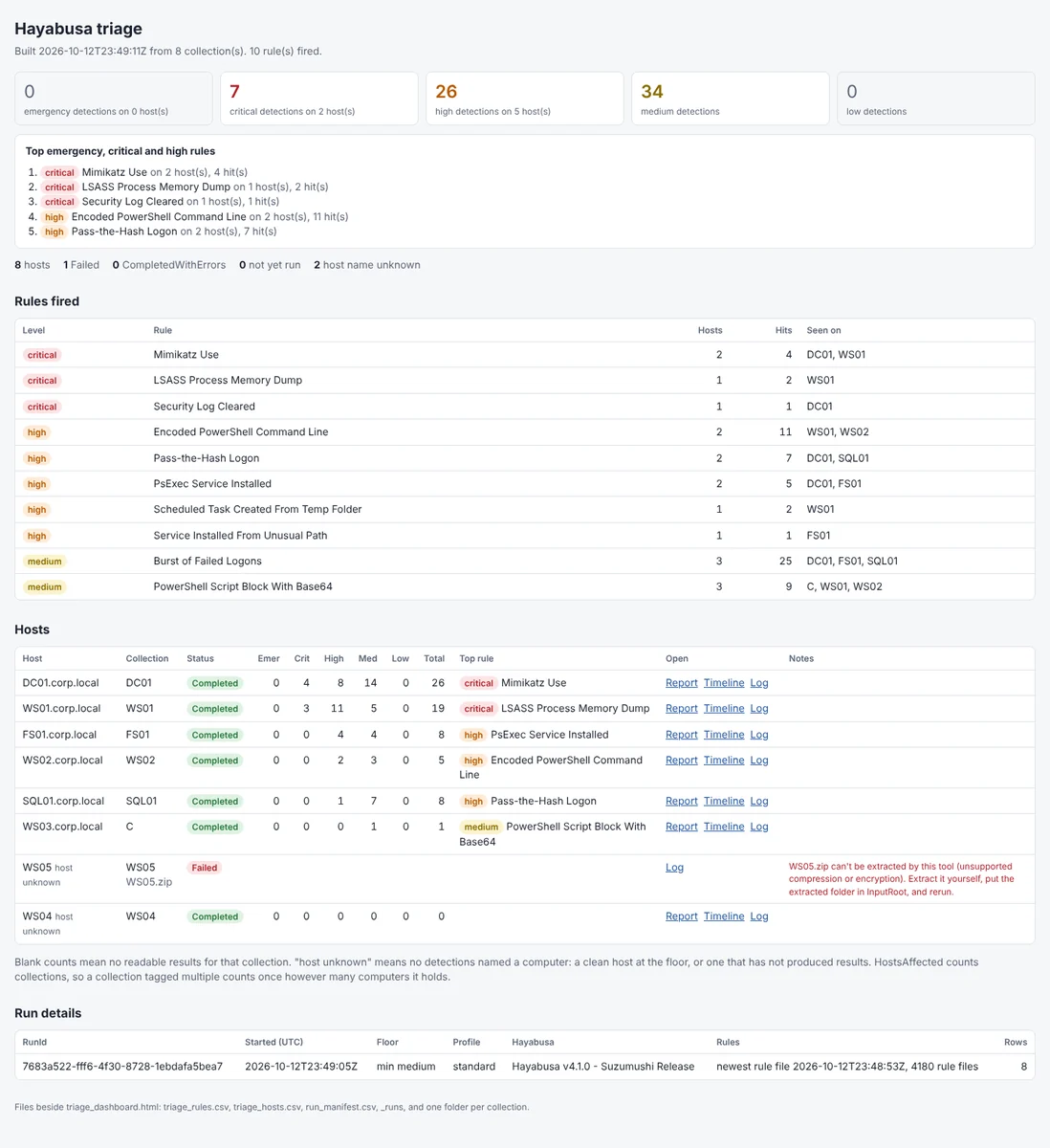
Hayabusa already takes a whole directory with -d, and its HTML summary breaks the results down by computer. A folder of KAPE collections still leaves two jobs to do by hand. Each ZIP has to be extracted and each disk image mounted before Hayabusa can read it, and a run over all of them gives one combined output, with no report or timeline of its own for each host. This does that part. Point it at a folder with one entry per host and you get, for each host, Hayabusa's HTML alert report, a CSV timeline and a log, plus a dashboard showing which hosts are worst and which rules fired where.
Full usage reference: docs/USAGE.md
The dashboard after a run over eight hosts, with the severity floor at medium:
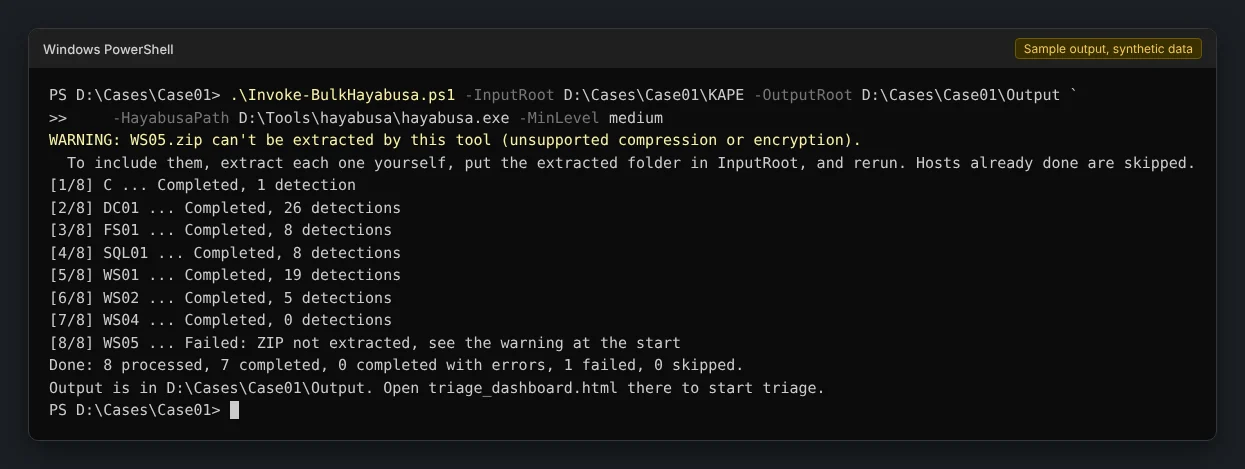
The console during the same run:
Computer field, so loose output that KAPE named after a drive still lands under the right host.Pre-release. It's been run against real Hayabusa 4.1.0 and KAPE images and ZIPs on Windows, and the test suite runs in CI on Windows PowerShell 5.1, PowerShell 7 on Windows, and PowerShell 7 on Linux. Two behaviours still need the right evidence to confirm, listed under Not yet confirmed on Windows. Check that list before relying on one of them in a report.
hayabusa.exe update-rules once at the start of the engagement and leave the rules alone until it's finished, so every host is checked against the same set.Clone the repository, or download it as a ZIP from GitHub and extract it:
git clone https://github.com/rorywag/Hayabusa-Bulk-Runner.git
Keep the lib folder beside the two scripts, since they load everything from it. Windows marks files from a downloaded ZIP as coming from the internet. The Process-scope execution policy shown below already allows them, so there's nothing to unblock.
.\Invoke-BulkHayabusa.ps1 -InputRoot D:\Cases\Case01\KAPE -OutputRoot D:\Cases\Case01\Output -HayabusaPath D:\Tools\hayabusa\hayabusa.exe
It prints one line per host as it goes, then a short summary and where to look:
[1/4] DC01 ... Completed, 12 detections
[2/4] FS02 ... Completed, 6 detections
WARNING: [3/4] WS03 ... Failed: Hayabusa exited with code 2. See D:\Cases\Case01\Output\WS03\WS03_hayabusa.log. No CSV was written.
[4/4] WS04 ... skipped, already Completed
Done: 3 processed, 2 completed, 0 completed with errors, 1 failed, 1 skipped.
Output is in D:\Cases\Case01\Output. Open triage_dashboard.html there to start triage.
In a fresh PowerShell window the script may be blocked by the execution policy. This allows it for that window only, and changes nothing on the machine:
Set-ExecutionPolicy -Scope Process -ExecutionPolicy Bypass
.\Invoke-BulkHayabusa.ps1 -Help, or -h, prints a short usage summary. For the full parameter list, worked examples, the input and output model and the engagement config, see docs/USAGE.md.
The evidence is only ever read.
OutputRoot\_diff with the evidence image as its parent. Windows replays the journal into the child and the parent is only read, checked on KAPE output with the parent's hash the same before and after.OutputRoot\_work. The ZIP itself is only read._work, _mnt and _diff folders, plus a host's own previous report and timeline just before that host is rerun. If a dismount fails, everything after it is left in place and the error says what's still there.docs/USAGE.md covers the rest:
See SECURITY.md for how to report a vulnerability privately.
MIT. See LICENSE.
This tool is independent and is not affiliated with or endorsed by Yamato Security. It runs Hayabusa as a separate external program and includes none of its code. Hayabusa is published by Yamato Security under the GNU AGPL-3.0, and its detection rules under their own licences. Download Hayabusa and its rules from Yamato Security.
