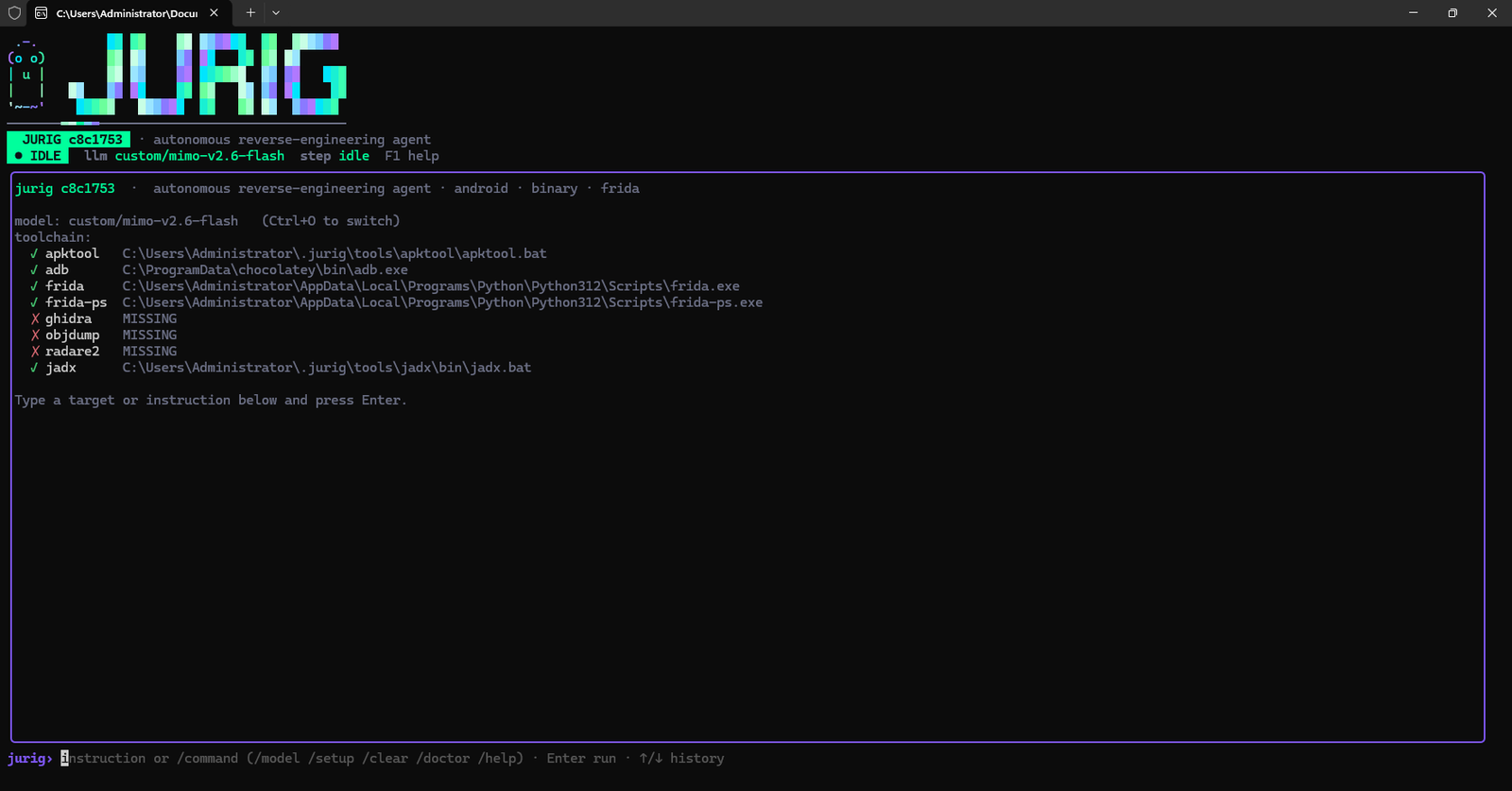

 reverserid/jurig
a fully autonomous AI agent for reverse engineering
 .-.         ██ ██    ██ ██████  ██  ██████
(o o)        ██ ██    ██ ██   ██ ██ ██
| u |        ██ ██    ██ ██████  ██ ██   ███
|   |   ██   ██ ██    ██ ██   ██ ██ ██    ██
'~-~'    █████   ██████  ██   ██ ██  ██████
        autonomous reverse-engineering agent · android · binary · frida
Jurig (Sundanese: ghost) — an autonomous AI agent that haunts your binaries. In the TUI the ghost blinks, bobs, and shimmers while it works.
Fully autonomous, AI-agentic reverse-engineering framework with a TUI. Android-first (APK/DEX) plus native binaries. Written in Go, no MCP — every tool is a native subprocess wrapper around a portable RE binary.

| Concern | Choice |
|---|---|
| Language / TUI | Go + Bubble Tea + Lipgloss + Glamour (markdown reports) |
| Agent | Own plan→act→observe loop (internal/agent) — no framework lock-in |
| Tools | Native Go subprocess wrappers (internal/tools) — no MCP |
| LLM | One wire format (Anthropic Messages protocol) behind a router |
| Providers | anthropic (direct), openrouter (Anthropic "skin"), claude-cli (subscription) |
| Portable tools | internal/portable resolves bundled binaries → PATH; installs from a catalog |
Two wire protocols behind one router:
anthropic kind — native Messages API (/v1/messages).openai kind — OpenAI Chat Completions (/chat/completions) with an
internal Messages↔OpenAI translator (tool-calls included). Covers any
OpenAI-compatible endpoint.Presets shipped (config.json → providers):
| Provider | Kind | Endpoint | Key env |
|---|---|---|---|
| mimo (default) | openai | token-plan-sgp.xiaomimimo.com/v1 | MIMO_API_KEY |
| anthropic | anthropic | api.anthropic.com | ANTHROPIC_API_KEY |
| openrouter | openai | openrouter.ai/api/v1 | OPENROUTER_API_KEY |
| ollama (local) | openai | localhost:11434/v1 | — (local) |
| kimi | openai | api.kimi.com/coding/v1 | KIMI_API_KEY |
| moonshot | openai | api.moonshot.ai/v1 | MOONSHOT_API_KEY |
| dashscope / Qwen (Alibaba) | openai | dashscope-intl…/compatible-mode/v1 | DASHSCOPE_API_KEY |
| custom (any OpenAI-compat) | openai | you set base_url | CUSTOM_API_KEY |
| claude-cli (subscription) | claude-cli | claude binary | — |
Pick provider+model live in the TUI with Ctrl+O, or set
JURIG_PROVIDER + JURIG_MODEL, or edit active in config.json. Add models
by extending a provider's models list. Point any provider at a different base
URL (e.g. a self-hosted gateway) via base_url.
Ollama: ollama serve + ollama pull qwen2.5-coder:14b, then Ctrl+O →
pick ollama/…. No key needed.
claude-cli (Claude Code subscription): Anthropic blocks subscription auth in
third-party HTTP harnesses (Apr 2026), so this path shells out to the claude
binary. Advisory/chat only — no native tool-calling; use an openai/anthropic
provider for the full autonomous tool loop.
custom — one generic provider for ANY OpenAI-compatible endpoint. Jurig
ships no hardcoded gateway; you fill the base URL yourself in the setup wizard
(/setup) or in config.json. Works for:
npx 9router) or OmniRoute,
which front Cursor / Claude Code / Codex accounts on http://localhost:20128/v1.Set base_url (e.g. http://localhost:20128/v1) and, if the endpoint needs one,
api_key (or the CUSTOM_API_KEY env / CUSTOM_BASE_URL for the URL). A
localhost gateway is treated as ready without a key. The custom provider is
marked auto_models, so the picker (Ctrl+O) fetches the live catalog from the
endpoint's /models on open — press r to refresh any provider's list. For a
subscription router, model ids carry a route prefix (cu/ Cursor, cc/ Claude
Code, cx/ Codex) — the auto-loaded list shows the exact ids.
Using subscriptions outside their official clients may violate ToS — your account, your risk.
go build -o jurig ./cmd/jurig
No flags needed. First run (or when the active provider has no key) launches an
interactive setup wizard: pick provider (OpenRouter / Kimi / Qwen / Ollama /
Anthropic / Claude subscription) → key → model → optional tool pre-install →
saved to ~/.jurig/config.json.
./jurig                              # first run → wizard, then TUI
./jurig setup                        # re-run the wizard anytime
./jurig doctor                       # show provider + toolchain status
./jurig install jadx                 # pre-warm a tool (also auto-installs on demand)
./jurig -p "analyze ./app.apk"       # headless one-shot (skips wizard; needs a key set)
./jurig -target ./work/app -p "..."  # pin a per-target work dir
| Key | Action |
|---|---|
| Enter | run instruction / submit |
| ↑ / ↓ | prompt history |
| PgUp / PgDn | scroll transcript |
| Ctrl+F | search transcript (Enter = next match) |
| Ctrl+O | switch provider / model |
| F1 | help overlay |
| Ctrl+C | abort run / quit |
When the agent asks a scoping question, an answer menu appears: ↑/↓ move, Space or 1-9 toggle (multi-select), Enter confirm.
Session resume: the conversation + prompt history persist to
<work_dir>/session.json and auto-restore on next launch (--fresh starts clean).
Code cards: whenever the agent reads a source file, the TUI shows a small syntax-highlighted preview — the model still receives the full file.
Recon & triage
| Tool | Purpose |
|---|---|
manifest | parse AndroidManifest → package, permissions, exported components |
url_extract | pull + dedupe all URLs → API/host map |
secret_scan | categorized hardcoded-secret scan (AWS/GCP/JWT/keys/AES…) |
native_libs | list lib/<abi>/*.so + ABIs (JNI surface) |
search_code | regex grep over sources — locate before reading |
ask_user | agent asks the operator (multi-select menu) |
Static
| Tool | Purpose |
|---|---|
jadx | APK/DEX/XAPK → Java (auto-extracts bundles, rich summary) |
apktool | APK → smali + decoded manifest |
radare2 / ghidra | native binary disasm / headless decompile |
elf_info / pe_info | parse ELF/PE headers, symbols, imports (native) |
hexdump / strings | raw bytes / printable strings |
unzip | native zip/apk/xapk/apks extraction (no shell) |
Dynamic & network
| Tool | Purpose |
|---|---|
adb | device control |
frida_ps | list device apps/processes |
frida | run a custom Frida JS script |
frida_preset | built-in: ssl_unpin, list_classes, dump_class, hook, trace_http |
proxy | native Go MITM proxy (goproxy) — capture live HTTPS traffic |
http_request | replay/test discovered API endpoints |
download | fetch a URL to the work dir |
Live network capture: proxy start spins up an in-process MITM proxy and
exports a CA. The agent points the device at it (adb) + installs the CA + runs
frida_preset ssl_unpin, then reads flows with proxy flows. Captured
requests/responses stream live in a NET side-panel in the TUI (shown when
the terminal is wide enough — the layout is fully responsive).
Filesystem / shell: read_file, write_file, list_dir, shell (PowerShell default on Windows).
Header shows live token usage (Nk↑ Nk↓) as the agent runs.
