 neitzert/picard
Protocol-Introspecting Chunk Adapter for Resilient Data

Protocol-Introspecting Chunk Adapter for Resilient Data
For the self-taught, the unconventional, and anyone who was ever told to stay in their lane. Keep building, keep exploring.
This release is dedicated to Sir Patrick Stewart (1940–2026), who spent thirty-five years making a starship captain the most compelling argument for curiosity, decency, and the refusal to accept unnecessary limits.
PICARD encrypts your data, slices it into chunks, and scatters those chunks across whatever protocol endpoints you configure: DNS TXT records, social media APIs, MQTT brokers, S3 buckets, Bluetooth advertisements, or all of the above at once. Pull it back and it reassembles. With multi-adapter scatter, no single endpoint holds enough ciphertext to reconstruct anything. No central server. No monthly storage fees. It mounts as a regular filesystem.
Not efficient. Protocol-agnostic.
[!IMPORTANT] Research project. PICARD is a working computer science experiment, not a production storage system. Read the research and legal notice before you proceed.
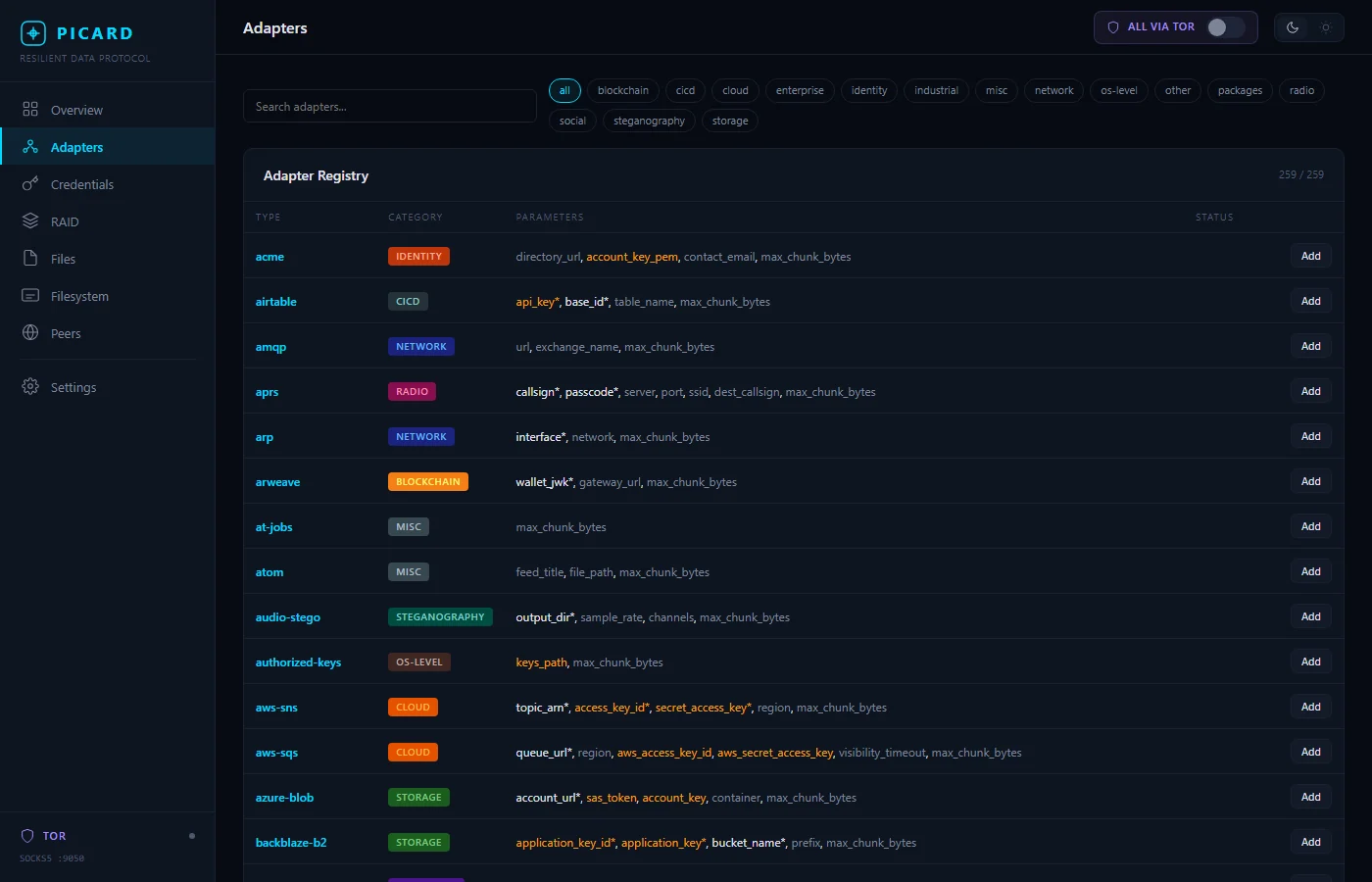
10,064 adapters -- up from 505. 22,102 tests. This release multiplies the adapter catalogue roughly twentyfold and folds in a full security and core-hardening review of everything underneath it.
Fifteen waves of new adapters extend coverage across SaaS platforms, DNS providers, cloud infrastructure, IoT and embedded, messaging, blockchain and DeFi, cipher and encoding substrates, file-format steganography, media platforms, developer tools, academic, legal, civic, pharma, manufacturing, AI platforms, security tools, game platforms, analog and physical channels, and hundreds of niche protocols. The tier tables further down show representative adapters; run picard adapters for the full list, and see docs/adapters.md for the adapter guide.
The Tier 3 cloud and SaaS adapters are no longer thin stubs. Over 7,000 now make real HTTP calls through aiohttp against the provider's actual API. They are credential-gated: the matching live tests are skipped unless you supply an account, and without credentials the adapter behaves as before.
picard wizard <url> generates a working adapter from an OpenAPI or Swagger spec (parsed directly, no LLM needed), or from a REST documentation page or an RFC (via an OpenAI-compatible or Anthropic LLM). It is also in the dashboard, as the picard_wizard MCP tool, and as the adapter-from-spec skill._API_DOCS_URL, _API_VERSION, _LAST_VERIFIED, _AUTH_TYPE, and a content-hash fingerprint of their API docs. adapter_docs_checker.py fetches the live docs, strips structural noise so nav and footer edits do not flip the hash, and flags real spec changes; the picard_adapter_docs_status MCP tool and the update-adapter skill drive verification waves.A full SAST pass (Bufo-Hirsutus, Semgrep, Trivy) and a manual review of the core landed in this release:
style-src-attr 'none'). Injected markup can neither run script nor restyle the page.reassemble() trusts only the manifest, XML parsing uses defusedxml, and no service binds to 0.0.0.0 or ships a default secret on a non-loopback host.rotate-key) and reseal, and a key-ring salt stored in the index so data sealed by one process is readable by the next.rm_mode = purge | tombstone, rm --keep-history, and trash, undelete, purge, and prune.PICARD_PASSPHRASE, then the system keyring, then a prompt. A sealed store refuses to start a background service unattended, and tells you what to run.PICARD_MCP_READONLY=1 for agents that should look but not touch.mv is a single transaction and now moves a directory's children, and recover skips operations whose owning process is still alive.recover cleans up a killed put's chunks, including sealed chunks, which it finds by recomputing their correlation tag, across RAID pools and from the index's chunk log. picard gc is the backstop for chunks that no file references, reporting by default and deleting only when asked.505 adapters -- up from 264. 4,159 tests. Five additions in this release:
A new erasure RAID level wraps zfec to provide configurable k-of-m shard recovery. Any k of m shards reconstruct the original block; the remaining m-k are parity. Tolerates up to m-k simultaneous adapter failures with (m/k - 1) storage overhead.
[[raid]]
level     = "erasure"
erasure_k = 4
erasure_m = 6
adapters  = ["s3", "dns", "redis", "dropbox", "onedrive", "matrix"]
Install the optional dependency: pip install 'picard-store[erasure]'
Ten new adapters push storage into places that were never designed to hold data: kernel state, circulating packets, process memory, hardware telemetry. None of these leave ciphertext at rest in the conventional sense.
[!WARNING] Platform-specific, privilege-hungry, and ranging from "genuinely useful" to "demonstration only." Read the adapter source before use.