Awesome Reverse Engineering 
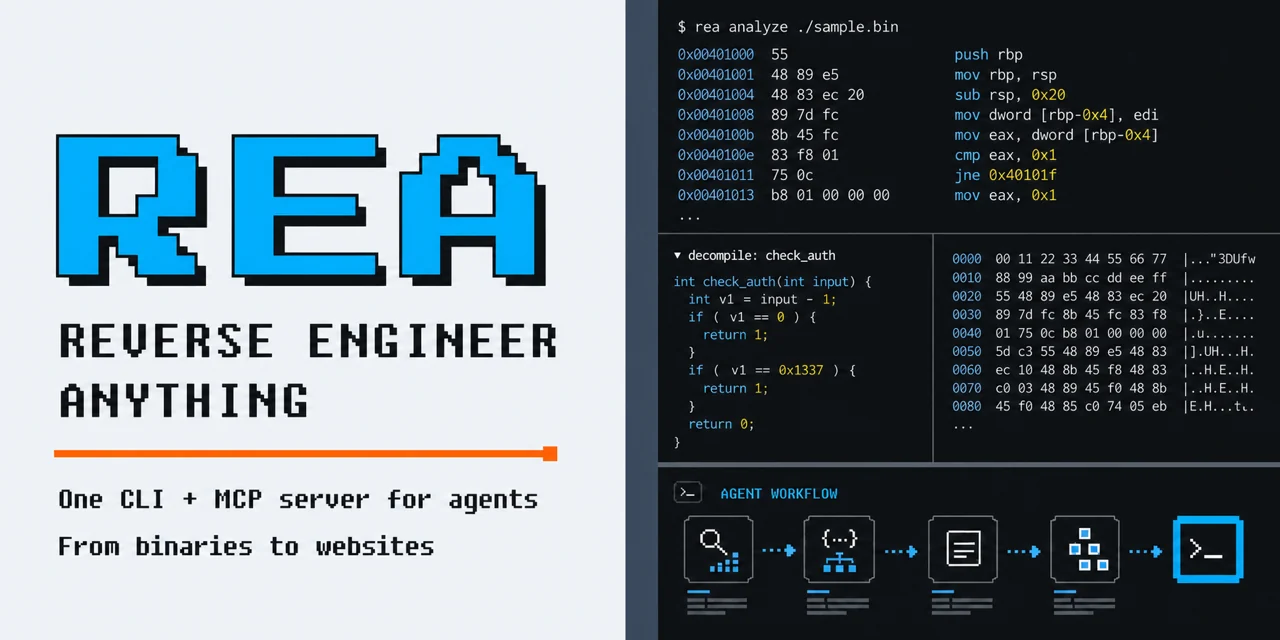
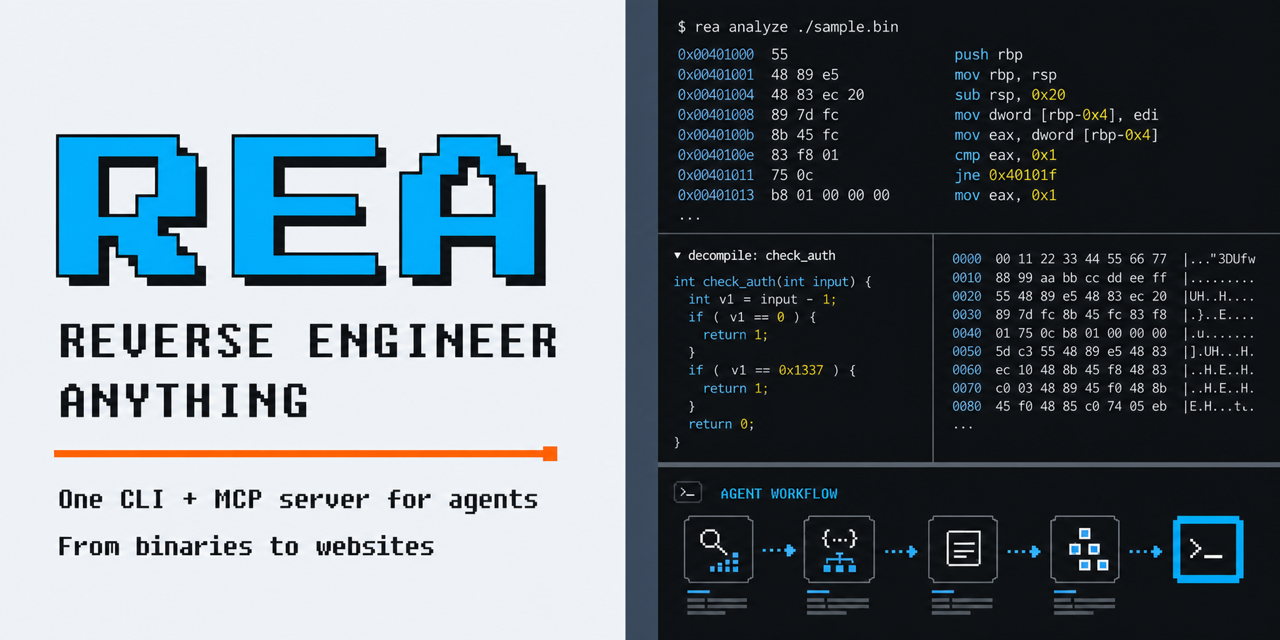
Featured: REA — Agent-oriented reverse-engineering tools, from application behavior to native binaries. By the creators of awesome-reverse-engineering.
A curated starting point for understanding binaries, applications, firmware, file formats, and protocols.
Find a tool by the work you need to do. Each entry describes its purpose; commercial tools are marked commercial. This is an initial selection, open to additions and corrections.
Start here
| Your task | Start with |
|---|
| Learn assembly and reversing fundamentals | Learning |
| Identify an executable and its capabilities | File identification and triage |
| Read native code or step through it | Native analysis and Debuggers |
| Trace calls or instrument a running program | Dynamic instrumentation and tracing |
| Bypass anti-debugging, unpack or rebuild imports | Deobfuscation and anti-analysis |
| Examine a suspicious file, process, or memory image | Malware analysis |
| Inspect an APK, .NET assembly, or Java program | Android and managed code |
| Inspect an iOS app, macOS binary, or Apple firmware | iOS and macOS |
| Unpack a Python, Go, Flutter, or Hermes binary | Language runtimes and packagers |
| Understand browser behavior or an undocumented protocol | Web and protocols |
| Extract firmware or inspect a binary format | Firmware and hardware and File formats |
| Reconstruct game memory structures, assets, or bytecode | Game reverse engineering |
| Compare builds or audit binary diffs | Binary diffing and patch analysis |
| Solve constraints, explore states, or lift semantics | Symbolic execution and formal analysis and Instruction lifting and semantics |
| Accelerate an investigation with AI agents | AI-assisted analysis |
Contents
Learning
- Azeria Labs - ARM assembly tutorials with exercises for learning registers, memory, and calling conventions.
- Compiler Explorer - Compiles code in the browser with many compilers and shows the generated assembly, for seeing how source constructs and optimization levels translate to machine code.
- Corkami - Visual references and posters explaining binary formats and file structures, including executable-format layouts.
- Corkami PoCs - Minimal and unusual executable and document samples for studying file-format edge cases and parser behavior.
- Hextree - Hands-on mobile and hardware reverse-engineering courses and interactive labs; Commercial, with some free content.
- Malware Analysis Training - Windows malware-analysis course with programming, Windows-internals, and reversing exercises; labs need a suitable Windows analysis environment.
- Malware Unicorn RE101 - Introductory Windows malware-reversing workshop covering x86 assembly, triage, and debugging; its VM-based lab instructions use older software images.
- Nightmare - Course built from annotated CTF challenges, progressing from assembly and reversing basics to binary exploitation.
- OpenSecurityTraining2 - Structured courses in assembly, architecture, debugging, and reverse engineering.
- pwn.college - Free courses with hands-on challenges in Linux, assembly, reverse engineering, and binary exploitation, run in a browser-accessible environment.
- Reverse Engineering by Kevin Thomas - Annotated assembly and reverse-engineering lessons across x86, x64, ARM, AVR, and RISC-V, with lesson-specific toolchain and hardware requirements.
- Reverse Engineering for Beginners - Free book connecting compiled C and C++ examples to assembly across several architectures.
- RPISEC Modern Binary Exploitation - Course materials and labs covering reverse engineering, memory corruption, and exploitation; no commits since December 2021, so labs may need older toolchains.
Books
- Hacking the Xbox - Introduction to hardware reverse engineering through the original Xbox's security design; free PDF edition released by the author.
- Practical Binary Analysis - Covers ELF and PE internals, disassembly, binary instrumentation, taint analysis, and symbolic execution, with tools built in the exercises.
- Practical Malware Analysis - Hands-on introduction to static and dynamic Windows malware analysis with lab exercises; published in 2012, so some tooling chapters are dated.
- The Ghidra Book - Guide to Ghidra's disassembler, decompiler, scripting, and extension APIs; the 2026 second edition covers BSim and PyGhidra.
File identification and triage
 morluto/awesome-reverse-engineering