WinDbg x64 extension that disassembles live functions and uses an LLM to produce verified pseudocode.
This project is a Windows x64 WinDbg extension skeleton that resolves a function by name or address, reconstructs a deterministic control-flow view, and asks an LLM directly from the extension to produce pseudocode.
src/extension: WinDbg extension DLL and !decomp command.src/shared: JSON, analyzer, protocol, and verifier code shared by the extension.scripts: build and vendor-copy helpers.third_party/dbgeng: optional vendored dbgeng.h and dbgeng.lib copy.third_party/zydis: vendored stable Zydis source tree used by default when present.xmm0 through xmm3, with vector zero-idiom guards to avoid false incoming arguments/deobf:on|off control over whether recovered obfuscation facts may guide pseudo-C rewriteLoad the extension from the build output, then run !decomp against a symbol or an address:
.load C:\path\to\decomp.dll
!decomp /doctor
!decomp module!FunctionName
!decomp 0x7ffb`12345678
Use /doctor when setup looks wrong or before enabling an LLM provider:
!decomp /doctor
!decomp /doctor:net
/doctor does not require a target and does not call the provider. It reports config path/load status, provider/model/endpoint summary, auth presence without secrets, timeout/token/chunking settings, DML support, session class/qualifier, processor type, and PDB caveats./doctor:net is accepted as an explicit network-check request, but currently reports that provider ping is skipped. The extension does not perform a network probe from doctor mode.Targets can be public/private symbols, exported function names, or addresses. If the target resolves to an address inside a function, the extension tries to recover the containing function range from symbols, unwind data, and control-flow heuristics. Put quotes around targets that contain spaces:
!decomp "my module!Function With Spaces"
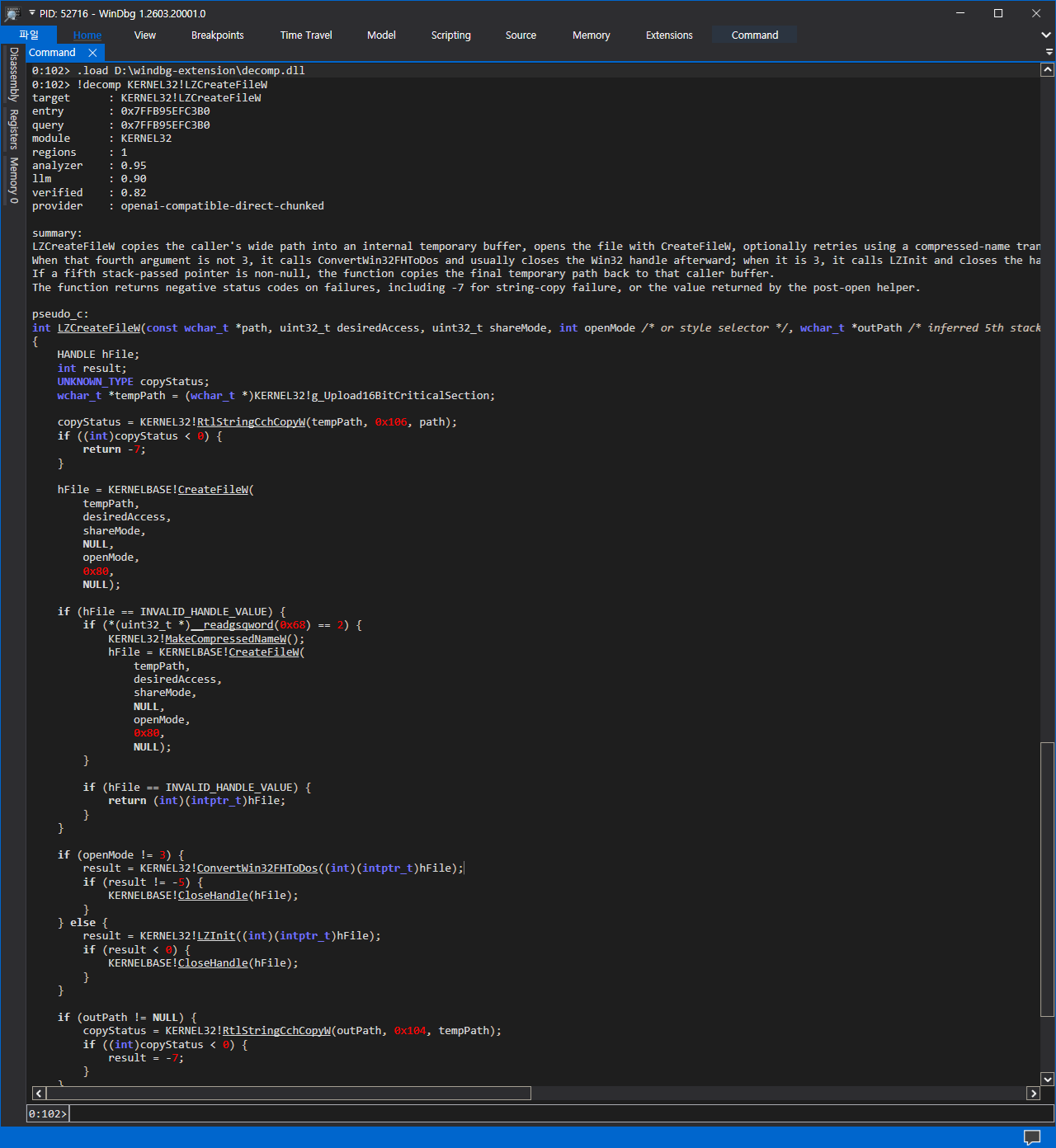
The normal command path performs local analysis, builds analyzer facts, optionally calls the configured LLM endpoint, verifies the response against recovered evidence, and prints pseudo-C plus confidence, warnings, and uncertainty notes:
!decomp ntdll!RtlAllocateHeap
!decomp kernel32!Sleep
!decomp game.exe!CheckIntegrity
Normal, brief, and explain output include a compact progress stream even without /verbose. Long LLM runs show local-analysis completion, chunk progress, retry notices, merge start, verification, and the Ctrl+Break cancellation hint. Machine-readable modes such as /view:json, /view:facts, /view:prompt, and /view:data suppress progress lines and DML helper links so scripts receive only the requested payload.
Use /view:* to choose what you want to see. This keeps the command surface small: one option controls all output modes.
!decomp /view:brief module!HotPath
!decomp /view:explain module!BranchyFunction
!decomp /view:json module!FunctionName
!decomp /view:facts module!FunctionName
!decomp /view:prompt module!FunctionName
!decomp /view:data module!FunctionName
!decomp /view:analyzer module!FunctionName
!decomp /view:plan module!FunctionName
brief prints target, confidence, summary, and the first uncertainty or verifier warning.explain adds evidence, control-flow, type-hint, observed-behavior, and call-target sections.json prints machine-readable request and response JSON.facts prints only analyzer facts and disables the LLM path.prompt prints the exact system prompt, user prompt, and prompt facts. It disables the LLM call.data prints a stable JSON snapshot intended for WinDbg JavaScript/NatVis-style automation.analyzer renders the deterministic analyzer-only pseudo-code path without calling the LLM.plan performs local analysis and prints a preflight plan without calling the LLM or updating the result cache. It includes target/module/range counts, PDB availability, session policy, estimated chunking, prompt-size-relevant counts, and practical recommendations.Use /verbose when a command appears stuck or when you want to see the full progress stream:
!decomp /verbose module!SlowFunction
!decomp /verbose /view:json module!SlowFunction
/verbose prints local stages such as target resolution, function range recovery, byte reads, disassembly, analyzer fact construction, PDB/session enrichment, pseudo-code tokenization, and verifier results./verbose also prints prompt sizes, request token budgets, HTTP connection/send/receive stages, response chunk sizes, finish reason, extracted model JSON preview, retry attempts, and verifier-feedback retry decisions./verbose replaces the compact progress stream with the full trace. Use it when the compact progress lines are not enough to diagnose where time is going.!decomp command, press Ctrl+Break in WinDbg to request cancellation. The extension checks for interrupts between local analysis stages and while waiting for the LLM worker, then asks the active synchronous HTTP I/O to stop.Legacy aliases such as /brief, /explain, /json, /facts-only, /debug-prompt, /data-model, /dx, and /no-llm still work for old scripts, but new examples use /view:*.
Window viewer:
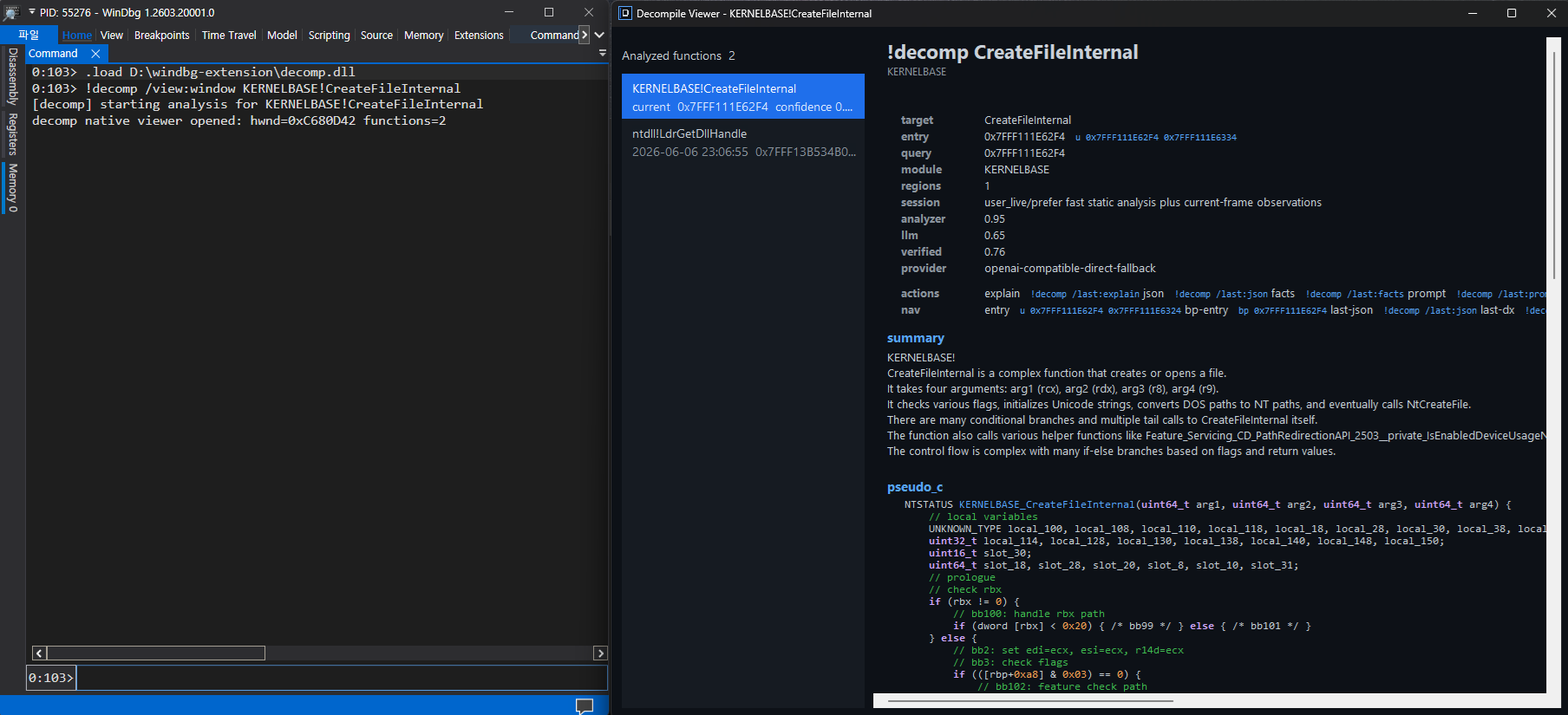
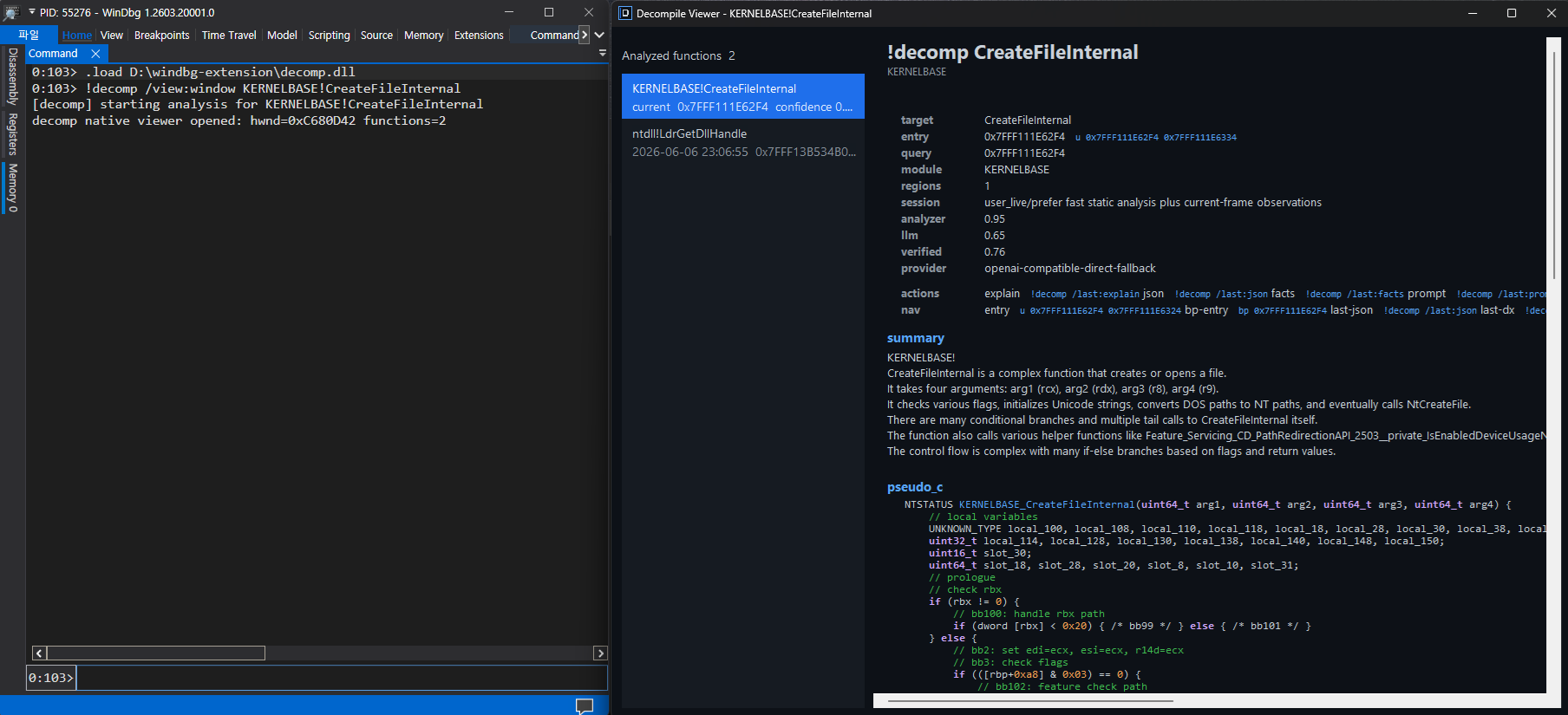
!decomp /view:window module!FunctionName
!decomp /view:window /view:explain module!FunctionName
/view:window runs the normal !decomp result path for the target and opens the full rendered result in a separate viewer./view:json, /view:facts, /view:prompt, and /view:data remain machine-readable console outputs and are not redirected to the viewer.Large functions:
!decomp /limit:deep module!LargeFunction
!decomp /limit:huge module!VeryLargeFunction
!decomp /limit:12000 module!VeryLargeFunction
!decomp /timeout:120000 module!SlowFunction
/limit:deep raises the instruction cap to 8192./limit:huge raises the instruction cap to 16384./limit:N sets an explicit instruction cap./timeout:MS overrides the request timeout for this invocation.decomp.llm.json; the command-line instruction cap controls how much local code the extension attempts to recover before prompting./deep, /huge, and /maxinsn:N remain supported.Obfuscation-aware decompilation:
!decomp /deobf:on module!FlattenedFunction
!decomp /deobf:off module!FlattenedFunction
!decomp /view:facts /deobf:off module!FlattenedFunction
/deobf:on is the default. The analyzer still emits raw facts, but high-confidence OLLVM-style dispatcher recovery, opaque dead-edge proof, substitution idioms, and semantic CFG overlays may guide prompt facts, merge policy, verifier conflict policy, and structured pseudo-C recovery./deobf:off keeps obfuscation, semantic_control_flow, and deobfuscation_readiness facts visible, but disables rewrite safe actions, keeps control-flow structuring on the raw CFG, and tells prompt/merge/verifier paths to preserve the raw obfuscated shape./deobf:off when you want to inspect the dispatcher, bogus branch, or substitution surface directly instead of asking the extension to recover a deobfuscated structure./deobfuscation:on|off is accepted as a longer alias.Cache and replay helpers:
!decomp /view:json module!FunctionName
!decomp /last:json
!decomp /view:explain module!FunctionName
!decomp /last:explain
!decomp /view:facts module!FunctionName
!decomp /last:facts
!decomp /view:data module!FunctionName
!decomp /last:data
!decomp /view:prompt module!FunctionName
!decomp /last:prompt
!decomp /history
!decomp /refresh module!FunctionName
!decomp /last:2:explain
!decomp /last:2:json
/last:json prints the previous request/response JSON without re-running analysis./last:explain re-renders the previous full result with the explain section without re-running analysis or calling the LLM./last:facts prints the analyzer facts from the previous result without re-running analysis./last:data prints the previous data-model snapshot without re-running analysis./last:prompt prints the previous prompt dump without re-running analysis./history lists the in-memory result ring buffer. Index 1 is the newest result./refresh <target> bypasses persistent artifact replay for that target, runs fresh local analysis and LLM analysis, and replaces the saved artifact after a successful LLM-backed result./last:N:explain, /last:N:json, /last:N:facts, /last:N:data, and replay an older cached result by history index without re-running local analysis or calling the LLM.DML navigation:
actions row with clickable explain, json, facts, prompt, data-model, and history links for the same target.nav row with entry disassembly, entry breakpoint, and last-artifact replay links.Session-aware and observed-behavior details:
/view:json, /view:facts, /view:prompt, and normal LLM mode include session_policy.session_policy records the debug class, qualifier, execution kind, analysis strategy, dump/live/kernel flags, and whether TTD support appears loaded.observed_behavior records the current rip, rsp, return address when readable, Microsoft x64 register argument samples (rcx, rdx, r8, r9), repeated memory-access hotspots, and suggested TTD commands.ttdext.dll or is loaded in the debugger process, the extension adds suggested queries instead of silently pretending trace data was already collected.User correction switches let you patch analyzer facts from the command line when the debugger lacks enough semantic information:
!decomp /fix:noreturn:FatalError module!FunctionName
!decomp /fix:type:rcx=MY_TYPE* module!FunctionName
!decomp /fix:field:[rcx+18h]=uint32_t module!FunctionName
!decomp /fix:rename:v3=request module!FunctionName
!decomp /fix:clear
/fix:noreturn:name treats matching calls as no-return for fallback disassembly, CFG recovery, ABI facts, and verifier checks./fix:type:expr=TYPE adds a high-confidence user type hint./fix:field:expr=TYPE adds a high-confidence user field hint./fix:rename:old=new adds a rename hint and applies the rename to the final pseudocode identifiers./fix:clear clears all session-persistent correction overrides.The environment variable DECOMP_NORETURN_OVERRIDES remains supported. Command-line /fix:noreturn: values are layered on top of the original environment value for the current WinDbg session.
Correction switches are session-persistent:
/fix:noreturn:, /fix:type:, /fix:field:, and /fix:rename: are remembered by the loaded extension and reused by later !decomp runs./fix:clear clears all session-persistent corrections and restores the no-return environment override to its original value from extension load time./noreturn:, /type:, /field:, /rename:, and /clear-overrides remain supported.Malformed correction values are ignored and reported in uncertainties rather than being cached. For example, /fix:type:rcx is ignored because it does not contain an expr=TYPE pair.
Recommended investigation workflow:
!decomp /view:facts target to confirm the function range, blocks, calls, imports, PDB data, and session facts look reasonable.!decomp /view:plan target to estimate chunking, prompt size, timeout risk, and symbol quality before spending an LLM request.!decomp /view:prompt target when prompt size, language, or evidence selection looks wrong.!decomp target for the full verified pseudo-C result.!decomp /refresh target when an existing persistent artifact is being replayed but you need a fresh analysis.!decomp /view:explain target and inspect verifier warnings, evidence coverage, and suggested fixes./fix:noreturn:, /fix:type:, /fix:field:, or /fix:rename: and re-run the same target./history and indexed replay when comparing several recent results.Recent analyzer facts are intentionally carried through /view:json, /view:facts, /view:prompt, and normal LLM mode. High-value fields to inspect first:
stack_pointer records per-instruction stack deltas, frame-relative aliases, and confidence.call_arguments records recovered register and stack arguments at call sites, including nearby cross-block stack stores when evidence is strong enough.pdb.prototype_parameters records structured prototype parameter names, types, ordinals, ABI locations, and source confidence.control_flow includes loop induction variables, initial values, steps, bounds, direction, switch table address, case targets, default target, range bounds, signedness, and index expression when recovered.callee_summaries and call-target facts include direct, indirect, and virtual-call/vtable candidates plus known Win32/NT/Rtl memory, allocation, release, and status semantics.obfuscation exposes OLLVM-style flattening dispatcher candidates, state variables, recovered semantic edges, opaque predicates, and scalar substitution idioms.semantic_control_flow exposes recovered live/dead edges that are derived from obfuscation facts and remain available for inspection even when /deobf:off is used.deobfuscation_readiness exposes enabled, safe rewrite actions, blocked assumptions, priority fact paths, counts, and confidence. When disabled, it records the policy decision and blocks deobfuscated control-flow rewrite.Fastest path is to vendor the header and import library into the project.
Expected vendor layout:
third_party\dbgeng\inc\dbgeng.h
third_party\dbgeng\lib\dbgeng.lib
You can copy them manually, or use the helper script.
powershell -ExecutionPolicy Bypass -File .\scripts\Prepare-DbgengVendor.ps1 `
-SourceRoot 'C:\Program Files (x86)\Windows Kits\10\Debuggers\x64'
powershell -ExecutionPolicy Bypass -File .\scripts\Prepare-DbgengVendor.ps1 `
-HeaderPath 'C:\Program Files (x86)\Windows Kits\10\Debuggers\x64\sdk\inc\dbgeng.h' `
-LibraryPath 'C:\Program Files (x86)\Windows Kits\10\Debuggers\x64\dbgeng.lib'
Once third_party\dbgeng exists, Build.ps1 will prefer it automatically and you usually do not need DEBUGGERS_ROOT.
The repository can use either:
third_party\zydis sourceFetchContentDefault behavior is auto, which prefers third_party\zydis when present and falls back to fetching Zydis during CMake configure.
Expected vendor layout:
third_party\zydis\CMakeLists.txt
third_party\zydis\include\Zydis\Zydis.h
third_party\zydis\dependencies\zycore\CMakeLists.txt
Refresh or create the vendor copy:
powershell -ExecutionPolicy Bypass -File .\scripts\Prepare-ZydisVendor.ps1
You can also vendor from an already-downloaded local source tree:
powershell -ExecutionPolicy Bypass -File .\scripts\Prepare-ZydisVendor.ps1 `
-SourcePath 'C:\path\to\zydis'
Recommended path is a Visual Studio Developer PowerShell or Developer Command Prompt.
The built decomp.dll now embeds a Windows file version taken from version.txt.
powershell -ExecutionPolicy Bypass -File .\scripts\Build.ps1 -Reconfigure
cmake --build build --config Debug
ctest --test-dir build -C Debug --output-on-failure
cmake --build build --config Release
ctest --test-dir build -C Release --output-on-failure
decomp_snapshot_tests covers the analyzer/protocol/verifier contracts for recovered stack arguments, SIMD/FP ABI inputs, vector zero-idiom suppression, loop induction preference, switch metadata, virtual-call metadata, OLLVM-style obfuscation facts, /deobf:off policy, known API summaries, prompt fact selection, and verifier grounding checks.
powershell -ExecutionPolicy Bypass -File .\scripts\Build-Legacy.ps1 -Reconfigure
powershell -ExecutionPolicy Bypass -File .\scripts\Invoke-ReleaseBuild.ps1
This script increments the last component in version.txt by 1, forces a reconfigure, and then builds the Release DLL. For example, 1.0.0.7 becomes 1.0.0.8.
-Configuration Release|Debug-Clean-Reconfigure-ConfigureOnly-Verbose-ZydisSource Auto|Vendor|Fetch-ZydisVendorDir 'C:\path\to\zydis'-DebuggersRoot 'C:\Program Files (x86)\Windows Kits\10\Debuggers\x64'-DbgengIncludeDir 'E:\works\windbg_llm_decomp_2\windbg_llm_decomp\third_party\dbgeng\inc'-DbgengLibrary 'E:\works\windbg_llm_decomp_2\windbg_llm_decomp\third_party\dbgeng\lib\dbgeng.lib'powershell -ExecutionPolicy Bypass -File .\scripts\Build.ps1 `
-Configuration Release `
-ZydisSource Vendor `
-Reconfigure `
-Verbose
powershell -ExecutionPolicy Bypass -File .\scripts\Build.ps1 `
-Configuration Release `
-DbgengIncludeDir 'E:\works\windbg_llm_decomp_2\windbg_llm_decomp\third_party\dbgeng\inc' `
-DbgengLibrary 'E:\works\windbg_llm_decomp_2\windbg_llm_decomp\third_party\dbgeng\lib\dbgeng.lib' `
-Reconfigure
The build script automatically tries to locate:
cmake.exe from PATH, standalone CMake, or Visual Studio bundled CMakethird_party\dbgeng under the project rootDEBUGGERS_ROOT from environment variables or common Windows Kits locationsZydis source selection works like this:
Auto: prefer third_party\zydis, otherwise fetch Zydis during configureVendor: require a usable third_party\zydis tree or the path passed by -ZydisVendorDirFetch: ignore the vendor tree and always let CMake download ZydisDEBUGGERS_ROOT may point to a debugger root that uses one of these layouts:
sdk\inc\dbgeng.h and sdk\lib\dbgeng.libsdk\inc\dbgeng.h and sdk\lib\amd64\dbgeng.libsdk\inc\dbgeng.h and sdk\lib\x64\dbgeng.libsdk\inc\dbgeng.h and dbgeng.libinc\dbgeng.h and lib\dbgeng.libinc\dbgeng.h and lib\amd64\dbgeng.libinc\dbgeng.h and lib\x64\dbgeng.libIf your installation does not match those layouts, pass the CMake paths directly:
cmake -S . -B build-manual -G "Visual Studio 17 2022" -A x64 `
-DDBGENG_INCLUDE_DIR='E:\works\windbg_llm_decomp_2\windbg_llm_decomp\third_party\dbgeng\inc' `
-DDBGENG_LIBRARY='E:\works\windbg_llm_decomp_2\windbg_llm_decomp\third_party\dbgeng\lib\dbgeng.lib'
cmake --build build-manual --config Release
If your dbgeng.h is too old and the build fails on GetSymbolEntryOffsetRegions or GetSymbolEntryString, use Build-Legacy.ps1 or pass the CMake option manually.
With DECOMP_USE_SYMBOL_ENTRY_APIS=OFF, the extension falls back to:
GetFunctionEntryByOffset for x64 unwind-based range recoveryGetNameByOffset plus heuristic disassembly if unwind metadata is missingThe extension automatically consumes symbols and type information that WinDbg has already loaded for the target modules.
There are two practical levels of PDB enrichment:
How this affects pseudocode generation:
arg1 to PDB names such as ctxctx->Statestate == StateRunningImportant limitations:
Current behavior is automatic. There is no separate config switch for PDB usage; the quality depends on what WinDbg has already loaded and whether the current scope can be matched to the target function.
Place decomp.llm.json beside decomp.dll.
This file is not only for network LLM settings.
provider, endpoint, model, token budgets, and chunking settings affect the LLM path.display_language affects the natural language used in summaries and uncertainties.syntax_highlighting affects pseudo-code rendering in WinDbg when DML-aware output is available.display_language and syntax_highlighting are still used for /view:analyzer and mock-provider output.Example:
{
"provider": "openai-compatible",
"endpoint": "https://api.openai.com/v1/chat/completions",
"model": "gpt-5.4-2026-03-05",
"api_key_env": "OPENAI_API_KEY",
"timeout_ms": 120000,
"max_completion_tokens": 12000,
"force_chunked": false,
"chunk_trigger_instructions": 900,
"chunk_trigger_blocks": 36,
"chunk_block_limit": 24,
"chunk_count_limit": 16,
"chunk_completion_tokens": 6000,
"merge_completion_tokens": 12000,
"display_language": {
"mode": "auto",
"tag": "en-US",
"name": "English"
},
"syntax_highlighting": {
"keyword_color": "warnfg",
"type_color": "emphfg",
"function_name_color": "srcid",
"identifier_color": "wfg",
"number_color": "changed",
"string_color": "srcstr",
"char_color": "srcchar",
"comment_color": "subfg",
"preprocessor_color": "verbfg",
"operator_color": "srcannot",
"punctuation_color": "srcpair"
}
}
ChatGPT subscription example:
{
"provider": "chatgpt",
"model": "gpt-5.5",
"chatgpt_auth_file": "%USERPROFILE%\\.codex\\auth.json",
"timeout_ms": 120000,
"max_completion_tokens": 12000,
"force_chunked": false,
"chunk_trigger_instructions": 900,
"chunk_trigger_blocks": 36,
"chunk_block_limit": 24,
"chunk_count_limit": 16,
"chunk_completion_tokens": 6000,
"merge_completion_tokens": 12000,
"reasoning_effort": "medium"
}
For provider: "chatgpt", endpoint is optional and defaults to https://chatgpt.com/backend-api/codex/responses. A base URL such as https://chatgpt.com/backend-api/codex is also accepted and normalized to /responses. The extension reads tokens.access_token and tokens.refresh_token from the configured auth file, refreshes expired JWT access tokens through OpenAI OAuth, and writes the refreshed token set back to that file. The default auth file is %USERPROFILE%\.codex\auth.json, so a Codex CLI ChatGPT login can be reused directly. The extension does not launch a browser or start an OAuth login flow from inside WinDbg; if the auth file is missing, invalid, or no longer refreshable, run codex login outside WinDbg and retry !decomp. For one-off tests, use access_token or access_token_env instead of an auth file. , , , and are reserved for OpenAI-compatible API-key providers and are ignored by the ChatGPT provider.
Supported keys:
providerendpointmodelapi_keyapi_key_envaccess_tokenaccess_token_envchatgpt_auth_filereasoning_efforttimeout_msmax_completion_tokensforce_chunkedchunk_trigger_instructionschunk_trigger_blocksSupported display_language keys:
modetagnamedisplay_language.mode accepts:
autofixedSupported syntax_highlighting keys:
keyword_colortype_colorfunction_name_coloridentifier_colornumber_colorstring_colorchar_colorcomment_colorpreprocessor_coloroperator_colorpunctuation_colorHow syntax_highlighting color values work:
<col fg="...">.verbfg, warnfg, emphfg, srcid, and similar names do not map to one universal color across every machine.#FF8800. The effective color comes from WinDbg, not from decomp.llm.json.Practical consequence:
syntax_highlighting rather than assuming the extension is ignoring your setting.When highlighting is visible:
/view:json output is not DML-rendered. Instead, it carries pseudo_c_tokens so external tools can apply their own syntax highlighting.Common DML foreground slots:
wfg
Default window foreground text.normfg
Normal command window text.emphfg
Emphasized text. Microsoft documents this as light blue by default, but the exact appearance still depends on theme.warnfg
Warning text.errfg
Error text.verbfg
Verbose text.changed
Changed data. Microsoft documents this as red by default.Common source-oriented DML foreground slots:
srcnum
Numeric constants.srcchar
Character constants.srcstr
String constants.srcid
Identifiers.srckw
Keywords.srcpair
Brace or matching-symbol pairs.srccmnt
Comments.srcdrct
Directives.srcspid
Special identifiers.srcannot
Source annotations or annotation-like elements.Examples:
verbfg means "Verbose foreground slot", not "a specific named blue".warnfg means "Warning foreground slot", not "always yellow or orange".function_name_color: "srcid" means "render function names using WinDbg's identifier slot".If you are tuning colors on a dark theme:
function_name_color: "emphfg" or function_name_color: "verbfg" if function names look too dim with srcid.identifier_color: "normfg" or identifier_color: "wfg" for general symbols that should stay readable but not overpower keywords.comment_color: "subfg" if you want comments to recede without disappearing entirely.Official reference:
The checked-in decomp.llm.json.example contains only valid top-level settings that the extension actually reads.
Reference-only examples:
Follow the PC UI language:
{
"display_language": {
"mode": "auto"
}
}
Force English:
{
"display_language": {
"mode": "fixed",
"tag": "en-US",
"name": "English"
}
}
Force Korean:
{
"display_language": {
"mode": "fixed",
"tag": "ko-KR",
"name": "Korean"
}
}
Dark syntax-highlighting preset:
{
"syntax_highlighting": {
"keyword_color": "warnfg",
"type_color": "emphfg",
"function_name_color": "srcid",
"identifier_color": "wfg",
"number_color": "changed",
"string_color": "verbfg",
"char_color": "srcchar",
"comment_color": "subfg",
"preprocessor_color": "normfg",
"operator_color": "srcannot",
"punctuation_color": "srcpair"
}
}
Light syntax-highlighting preset:
{
"syntax_highlighting": {
"keyword_color": "emphfg",
"type_color": "warnfg",
"function_name_color": "srcid",
"identifier_color": "normfg",
"number_color": "changed",
"string_color": "verbfg",
"char_color": "srcchar",
"comment_color": "subfg",
"preprocessor_color": "srcannot",
"operator_color": "wfg",
"punctuation_color": "subfg"
}
}
Example /view:json response details:
pseudo_c and pseudo_c_tokens.pseudo_c_tokens is a deterministic token stream suitable for external syntax highlighting.preferred_natural_language_tag and preferred_natural_language_name, which reflect the resolved display language after applying display_language.mode.ir_values, block_value_states, control_flow, and abi.ir_values exposes SSA-like value ids, definition sites, targets, canonical expressions, use links, constant/copy flags, and dead-definition hints.block_value_states exposes per-basic-block live-in/live-out reaching definitions, canonical values, storage class, convergence state, and confidence.Optional environment overrides:
DECOMP_LLM_PROVIDERDECOMP_LLM_ENDPOINTDECOMP_LLM_MODELDECOMP_LLM_API_KEYOPENAI_API_KEYDECOMP_LLM_CHATGPT_ACCESS_TOKENDECOMP_LLM_CODEX_ACCESS_TOKENKERNFORGE_CODEX_ACCESS_TOKENDECOMP_LLM_CHATGPT_AUTH_FILEDECOMP_LLM_CODEX_AUTH_FILEKERNFORGE_CODEX_AUTH_FILEDECOMP_LLM_REASONING_EFFORTDECOMP_LLM_TIMEOUT_MSQuality-first note:
/view:analyzer, /view:json, and normal LLM mode all share the same P0 evidence base.max_completion_tokens=12000, chunk_completion_tokens=6000, and merge_completion_tokens=12000, with force_chunked=false and chunk triggers around 900 instructions or 36 blocks.force_chunked=true for chunk-pipeline stress tests only. Quality-focused decompilation of flattened or dispatcher-heavy functions usually needs a single prompt until the function is large enough to exceed the configured chunk triggers.Build.ps1 or Build-Legacy.ps1.decomp.llm.json beside the built decomp.dll..load C:\path\to\decomp.dll
!decomp /view:analyzer ntdll!RtlAllocateHeap
!decomp /view:facts kernel32!Sleep
Then validate LLM mode:
!decomp ntdll!RtlAllocateHeap
!decomp /view:json ntdll!RtlAllocateHeap
!decomp 0x7ffb`12345678
Expected checks:
target, entry, and module should resolve consistentlyregions should be non-zero for normal functions/view:analyzer should still print analyzer confidence and pseudocode stubsummary, pseudo_c, pseudo_c_tokens, and verified/view:json output should include preferred_natural_language_tag and preferred_natural_language_name in the serialized request/view:json should also include pdb.prototype, , and possibly $env:DECOMP_LLM_PROVIDER = "chatgpt"
$env:DECOMP_LLM_MODEL = "gpt-5.5"
$env:DECOMP_LLM_CHATGPT_AUTH_FILE = "$env:USERPROFILE\.codex\auth.json"
$env:DECOMP_LLM_TIMEOUT_MS = "120000"
If the auth file contains a refresh token, the extension refreshes an expired access token before sending the request. DECOMP_LLM_CHATGPT_ACCESS_TOKEN can be used for a temporary bearer token, but the auth-file path is better for normal WinDbg sessions because it survives token expiry. The extension never opens a browser during !decomp; run codex login outside WinDbg when an interactive ChatGPT login is needed.
$env:DECOMP_LLM_ENDPOINT = "http://127.0.0.1:11434/v1/chat/completions"
$env:DECOMP_LLM_MODEL = "qwen2.5-coder:14b"
$env:DECOMP_LLM_API_KEY = "ollama"
$env:DECOMP_LLM_ENDPOINT = "http://127.0.0.1:1234/v1/chat/completions"
$env:DECOMP_LLM_MODEL = "local-model"
$env:DECOMP_LLM_API_KEY = "lm-studio"
$env:DECOMP_LLM_ENDPOINT = "http://127.0.0.1:8000/v1/chat/completions"
$env:DECOMP_LLM_MODEL = "Qwen/Qwen2.5-Coder-14B-Instruct"
$env:DECOMP_LLM_API_KEY = "local"
/last:N:prompt/last:* modes are terminal replay commands. If a target is present in the same command, the cached artifact is replayed and no local analysis or LLM request is started for that target.artifact folder beside the loaded decomp.dll. The operator does not need a separate save command.request, response, data_model, debug_prompt, and a kernel_build object with Win32/KD version values, build string, optional NtBuildLab, and a build fingerprint.!decomp <target> command automatically checks the artifact\<kernel_build>\... path after target resolution and function RVA recovery. If the saved kernel_build matches the current OS build, the extension replays the artifact without reading function bytes, running local analyzer passes, or calling the LLM./last:* views, so clicking explain, json, facts, prompt, or data-model does not start a new decompile run./last-json, /last-explain, /last-facts, /last-data-model, /last-dx, and /last-prompt remain supported.TTDReplay.dlldx @$cursession.TTD.Calls(...)/last:N:*/view:json or /last:json when filing bugs or comparing behavior across builds.dbgeng.h and dbgeng.libapi_keyapi_key_envDECOMP_LLM_API_KEYOPENAI_API_KEYchunk_block_limitchunk_count_limitchunk_completion_tokensmerge_completion_tokensdisplay_languagesyntax_highlightingstack_pointer exposes per-instruction stack deltas, frame-relative aliases, raw base/offsets, and confidence.control_flow exposes structured region candidates such as natural_loop, if_else_candidate, and switch_candidate with block evidence, loop induction metadata, switch table/default/range metadata, signedness, index expressions, and confidence.abi exposes Microsoft x64 shadow-space assumptions, home-slot evidence, frame/prolog/epilog recognition, no-return call evidence, tail-call candidates, thunk candidates, import-wrapper candidates, and recovered call arguments from registers and stack stores.type_hints, idioms, and callee_summaries.type_hints exposes pointer, local, field-offset, array-like, enum-like, bitflag-like, and vtable-candidate evidence with source and confidence. When PDB data is available, scoped params/locals, field hints, and enum constants are also promoted into this unified type-hint stream.idioms exposes higher-level replacements for recognized helper calls and compiler patterns such as memory copy/fill, string copy, security cookie checks, stack probes, allocation/free helpers, aggregate initializers, and RIP-relative global/import loads.callee_summaries exposes direct and indirect callee return-type, parameter-model, side-effect, memory-effect, ownership, source, and confidence hints; symbol/type-enriched call targets replace the initial heuristic summaries when WinDbg can resolve them, and virtual-call candidates include target expressions plus vtable offsets when recovered.analyzer_skeleton and graph_summary so the model refines an evidence-backed draft instead of starting from a blank page.graph_summary provides entry block, control-flow regions, normalized conditions, and representative high-signal blocks with an explicit truncation policy. Prompt fact selection now ranks high-signal entries and uses spread sampling to keep large fact sets representative.evidence_graph exposes high-signal fact nodes and provenance edges so IR values, block value states, memory accesses, call targets, type hints, PDB hints, and observed behavior can be traced back to instruction and block evidence.obfuscation, semantic_control_flow, and deobfuscation_readiness expose OLLVM-style recovery facts and whether deobfuscation rewrite guidance is enabled for the current command.warnings plus structured issues entries. Each issue carries severity, code, message, and optional evidence so tools can filter errors such as branch.true_target_not_successor separately from lower-risk warnings.suggested fixes section. These are conservative /fix:* commands derived from verifier issues, PDB-backed rename opportunities, or repeated observed memory hotspots. DML-aware output renders immediately applicable suggestions as clickable rerun links for the same target; placeholder field-type suggestions remain plain text until TYPE is replaced.session_policy and observed_behavior expose WinDbg-specific context such as live/dump/kernel/TTD-like policy, current-frame register argument samples, memory hotspots, and suggested trace queries.pdb object when symbol/type data is available.pdb.availability reports the enrichment level such as none, symbols, typed, or scoped.pdb.params, pdb.locals, pdb.field_hints, pdb.enum_hints, and pdb.source_locations are intended as machine-readable semantic hints for external tooling or offline analysis.DECOMP_LLM_MAX_COMPLETION_TOKENSDECOMP_LLM_FORCE_CHUNKEDDECOMP_LLM_CHUNK_TRIGGER_INSTRUCTIONSDECOMP_LLM_CHUNK_TRIGGER_BLOCKSDECOMP_LLM_CHUNK_BLOCK_LIMITDECOMP_LLM_CHUNK_COUNT_LIMITDECOMP_LLM_CHUNK_COMPLETION_TOKENSDECOMP_LLM_MERGE_COMPLETION_TOKENSDECOMP_NORETURN_OVERRIDES
Comma- or semicolon-separated function-name fragments treated as no-return targets during fallback disassembly, CFG successor recovery, ABI facts, and verifier checks. Example: DECOMP_NORETURN_OVERRIDES=MyAbort;PanicAndExit.timeout_ms high for cloud models. 120000 is a safer starting point than 15000.chunk_count_limit before shrinking /limit:N./view:analyzer or the mock provider, display_language and syntax_highlighting still affect what the user sees.pdb.paramspdb.locals/view:json may include pdb.field_hints and pdb.enum_hints