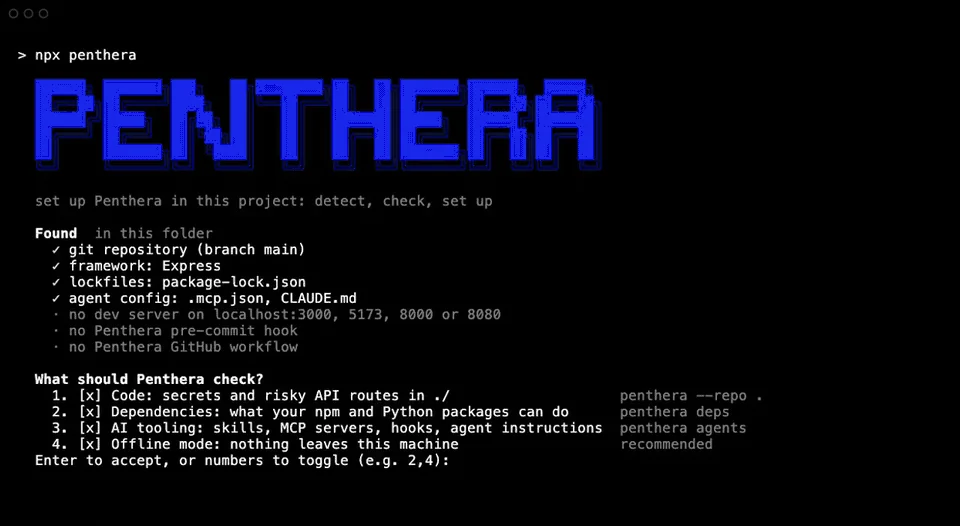
Offline cyber security agent for your apps and AI coding tools. Open R&D: measured in public, improved every release.
The security review you never had time for. Offline, rule-based, and you can verify every finding yourself.
penthera.org: check your live site in a few seconds. Passive, nothing stored.
Daily notes from Penthera: x.com/penthera_org
Who builds it: Daan van der Zwaag, part-time and in the open.
How it compares: next to Snyk, Socket, Semgrep, ZAP and GitHub.
New in 2.4: penthera --card makes a security receipt of your repo to post, every surface counts one set of problems with the same words, and 13 ways to hide a finding or stall a scan are closed (what changed).
From your coding agent: add Penthera (one line per agent), then say "Hey Claude, run Penthera on this repo."
132 readable rules · 6 read-only MCP tools · 0 runtime dependencies · 0 requests past loopback in the benchmark · MIT, no telemetry




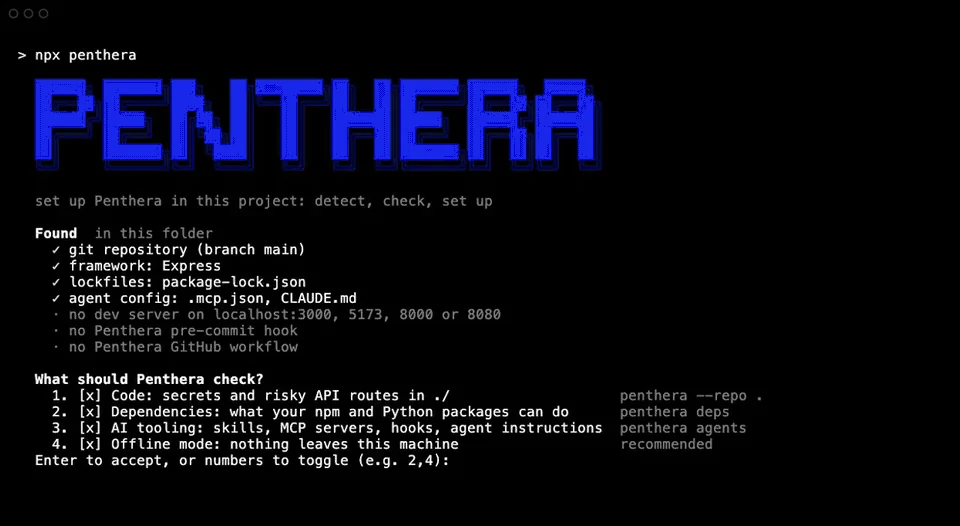
penthera ui, Simple, dark | penthera ui, Advanced, light |
|---|---|
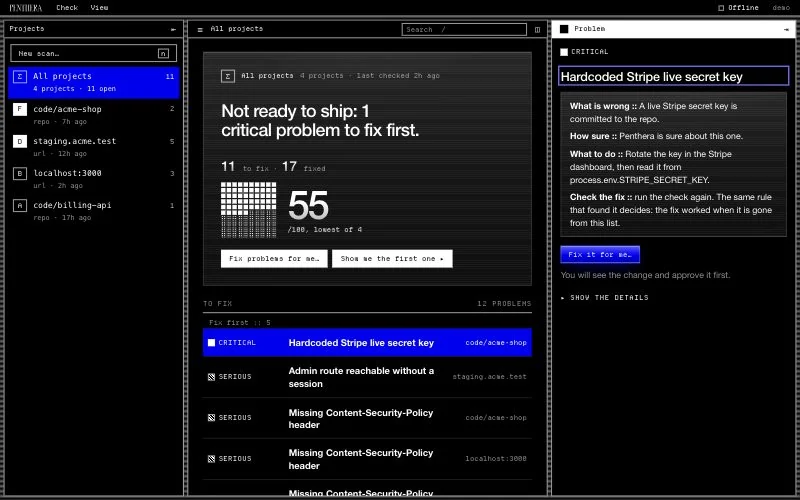 | 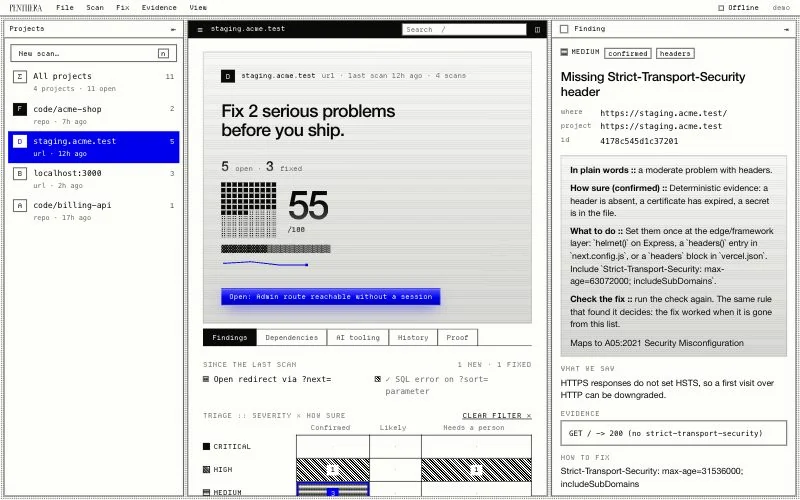 |
Penthera checks your app, its dependencies and your AI coding tools on your own
machine. It fixes what it can, with your approval. Every finding comes from a
rule you can read, with its evidence at file:line. A model may propose; a rule
decides.
It is also an open R&D project. We measure every check in public and publish the results, good or bad, so you can see how far to trust it.
It finds known classes of problems, not novel ones. It does not replace a human pentester.
You need Node.js 22 or later. No install, no account.
Building with Cursor, Claude Code, Codex, VS Code, Windsurf, Gemini CLI, Zed, JetBrains or Kiro, or an app builder such as Lovable, Bolt, Base44, Replit or v0? Penthera in your coding tool has the setup for each.
In your terminal. Run this in your project folder:
npx penthera
It detects your setup offline, asks what to check, and gives you a grade per area and the three things to fix first. It scans your running app only after you confirm the app is yours. Nothing is committed or pushed (guided start).
In your coding agent. Pick yours, then ask "scan my app for security issues". The MCP lines pin the version.
| Agent | Run this |
|---|---|
| Claude Code, plugin (skill only, runs the CLI) | claude plugin marketplace add danoszz/penthera, then claude plugin install penthera@penthera |
| Claude Code, MCP server only | claude mcp add penthera -- npx -y [email protected] mcp |
| Codex | codex mcp add penthera -- npx -y [email protected] mcp |
| GitHub Copilot CLI | copilot plugin marketplace add danoszz/penthera, then copilot plugin install penthera@penthera |
| GitHub Copilot in VS Code | the code --add-mcp line in mcp.md |
| Gemini CLI | gemini extensions install https://github.com/danoszz/penthera |
| Cursor, Windsurf | the JSON in mcp.md |
| Any agent that reads skills | npx skills add danoszz/penthera |
The skill tells your agent how to run Penthera; the MCP server gives it six read-only tools. More routes: skill.md, mcp.md.
Where AI fits. Rules decide every finding and every exit code. A model may only propose:
| Role | Who | How |
|---|---|---|
| Decides | Penthera's rules, always | Every finding, every exit code |
| Looks further (optional) | A model, with --ai | Proposes problems no rule describes; the rules check each one, and unchecked ones are listed apart and never fail CI (AI mode) |
| Fixes | Your own coding agent | Through the MCP server, the skill or penthera fix --plan |
To run it in a container:
docker build -t penthera . && docker run --rm penthera https://your-app.example.
We test Penthera on public datasets that other people built, next to the free open-source tools that do the same job, scored the same way. Each dataset was split in half before we looked: we improved Penthera on one half and scored it once on the other, sealed half. The rules for scoring and ranking were written down before that run (protocol).