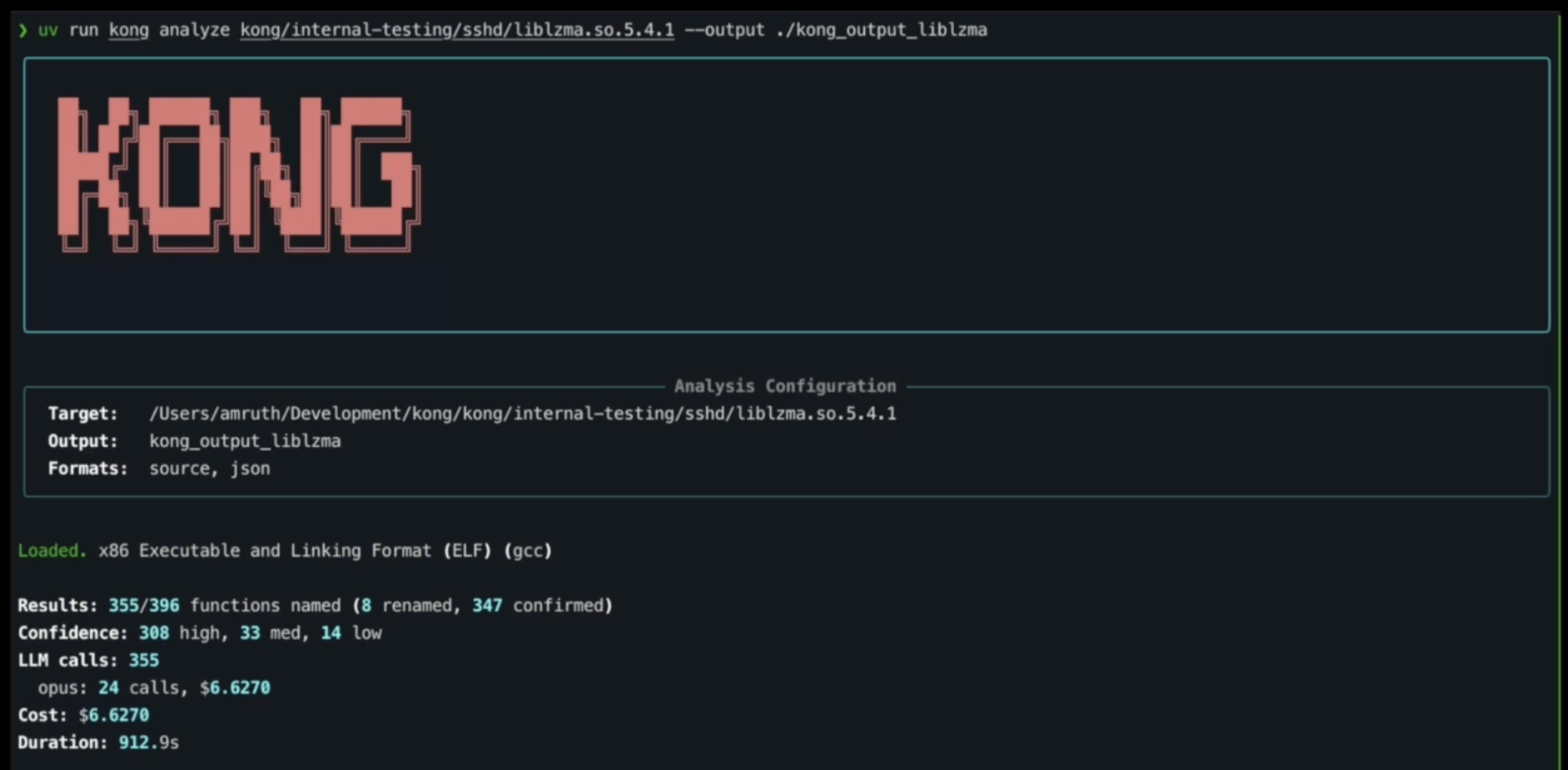
The world's first agentic reverse engineer.

LLM orchestration for reverse engineering binaries
Most tasks follow a linear relationship: the more difficult a task, the longer it usually takes. Reverse engineering (and binary analysis) is a task in which the actual difficulty is somewhat trivial, but the time-to-execute can be on the order of hours (and days!), even for a binary with a couple hundred functions.
Kong automates the mechanical layer, using an NSA-grade reverse engineering framework. Kong can take a fully obfuscated, stripped binary and run a full analysis pipeline: triaging functions, building call-graph context, recovering types and symbols through LLM-guided decompilation, and writing the results back into Ghidra's program database. The output is a binary where some FUN_00401a30 is now parse_http_header, with recovered structs, parameter names, and calling conventions.
Why this exists
Stripped binaries lose all the context that makes code readable: function names, type information, variable names, struct layouts. Recovering that context is the bulk of the work in most RE tasks, and it's largely pattern matching: recognizing standard library functions, inferring types from usage, propagating names through call graphs.
LLMs are good at exactly this kind of pattern matching. But pointing an LLM at raw decompiler output and asking "what does this do?" gives you mediocre results. The model lacks calling context, cross-reference information, and the broader picture of how the binary is structured. In addition, most obfuscated binaries introduce extreme techniques in order to prevent reverse engineering.
Kong solves this by building rich context windows from Ghidra's program analysis (call graphs, cross-references, string references, data flow) before ever touching the LLM, then orchestrating the analysis in dependency order so each function benefits from its callees already being named. Additionally, Kong introduces its own, first-of-its-kind, agentic deobfuscation pipeline.
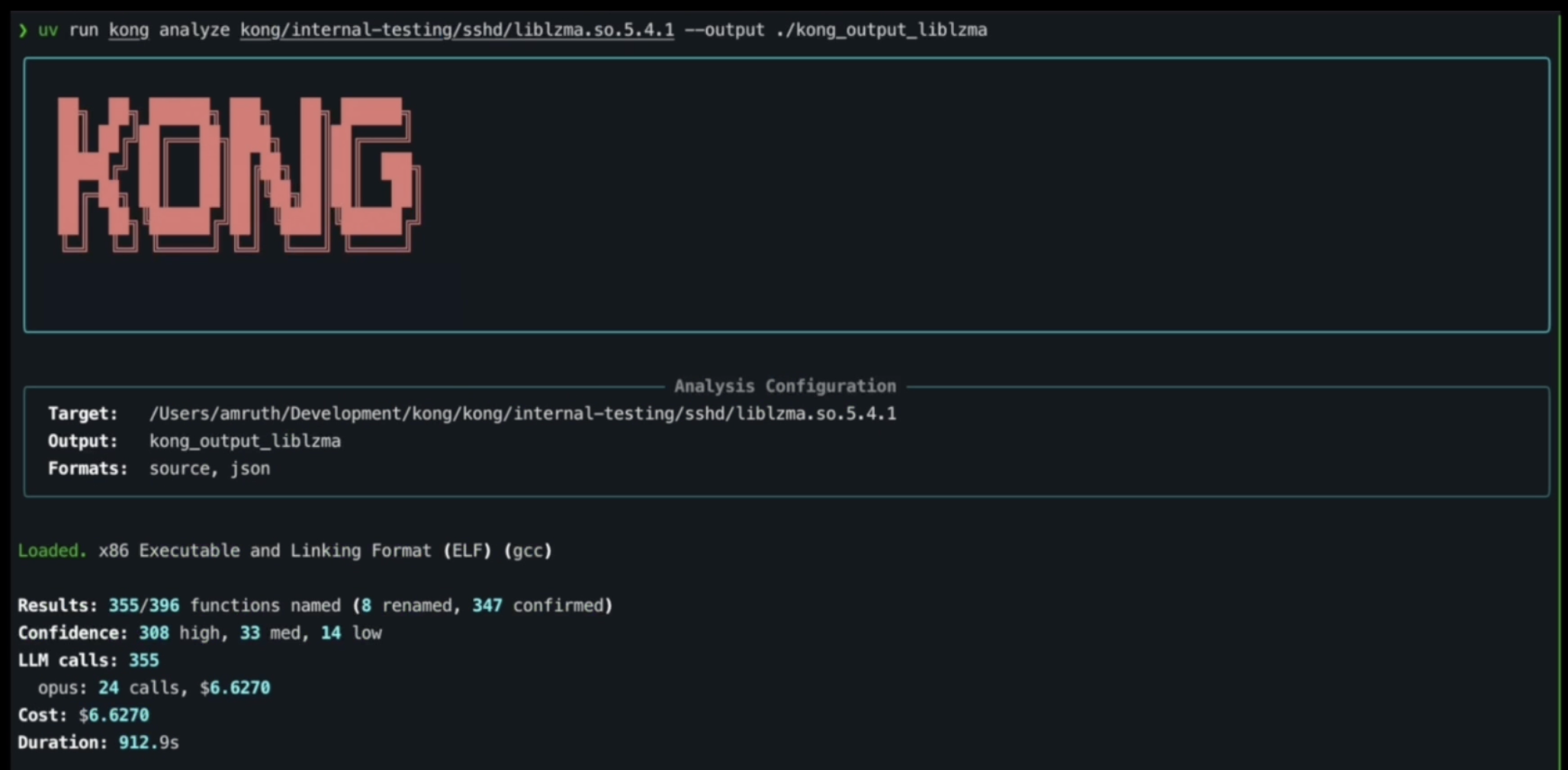
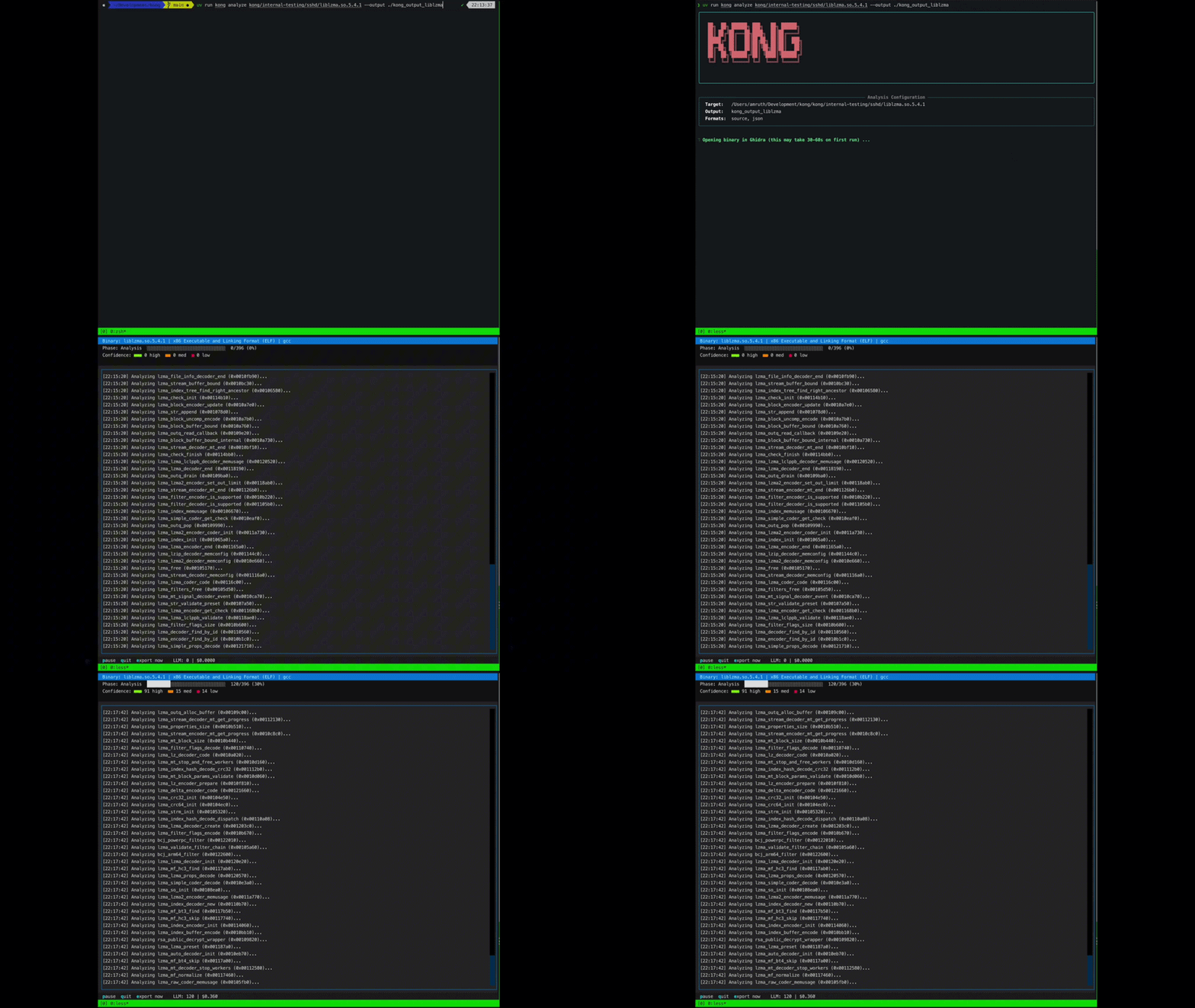
Kong works with most Ghidra-decompilable binaries (for now, more to come).
| C | C++ | Go | Rust | |
|---|---|---|---|---|
| x86 | High | High | Medium | Medium |
| x86-64 | High | High | Medium | Medium |
| ARM (32-bit) | High | High | Medium | Low |
| AArch64 | High | High | Medium | Low |
| MIPS | Medium | Medium | Low | Low |
| PowerPC | Medium | Medium | Low | Low |
High: Kong reliably decompiles, deobfuscates, and recovers names, types, and structure.
Medium: Decompilation is usable but noisier. Expect partial recovery and lower confidence scores.
Low: Decompilation has significant gaps and results will stay incomplete, noisy, or unreadable.
Note: Binary size scales positively with function count, LLM cost, and time to completion. However, binary size also scales negatively with confidence, so keep this in mind when analyzing larger binaries.
Kong uses a five-phase pipeline orchestrated by a supervisor that coordinates triage, parallel analysis, and post-processing:
                    ┌──────────────────────┐
                    │       Triage         │
                    │  enumerate, classify,│
                    │  build call graph,   │
                    │  match signatures    │
                    └──────────┬───────────┘
                               │
                               ▼
              ┌────────────────┼────────────────┐
              │                │                │
              ▼                ▼                ▼
     ┌──────────────┐ ┌──────────────┐ ┌──────────────┐
     │   Analyze    │ │   Analyze    │ │     ...      │
     │  (leaf fns)  │ │ (next tier)  │ │              │
     └──────┬───────┘ └──────┬───────┘ └──────┬───────┘
            │                │                │
            └────────┬───────┴────────────────┘
                     │
                     ▼
            ┌──────────────────────┐
            │      Cleanup         │
            │  normalize, dedupe   │
            └──────────┬───────────┘
                       │
                       ▼
            ┌──────────────────────┐
            │     Synthesis        │
            │  unify names, build  │
            │  structs, deobfuscate│
            └──────────┬───────────┘
                       │
                       ▼
            ┌──────────────────────┐
            │       Export         │
            │  analysis.json +     │
            │  Ghidra writeback    │
            └──────────────────────┘
Triage enumerates all functions in the binary, classifies them by size (trivial / small / medium / large), builds the call graph, detects the source language, and runs signature matching against known standard library and crypto functions. Functions matched by signature are marked as resolved and skip LLM analysis entirely.