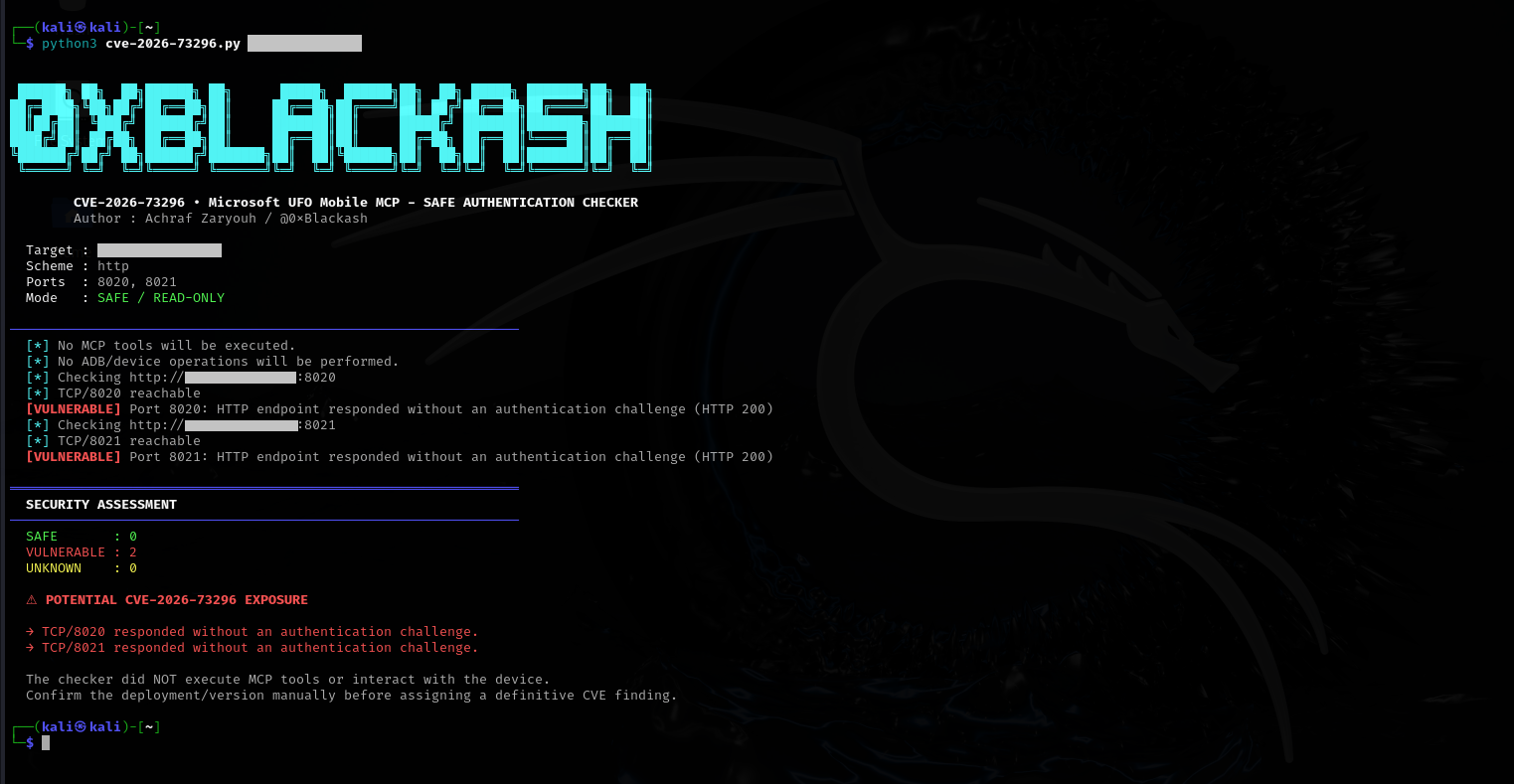
 0xblackash/cve-2026-73296
Non-destructive security assessment tool for CVE-2026-73296, checking authentication boundaries on exposed Mobile MCP HTTP servers (ports 8020/8021) to detect potential unauthorized Android device access.

UFO-Vuln 💥





Unauthenticated Mobile MCP access can expose Android screen data and provide remote UI-control capabilities through ADB.
This repository is intended for authorized security research, vulnerability validation, defensive testing, and controlled laboratory environments only.
The included checker is designed to perform non-destructive authentication-boundary checks.
It does not:
CVE: CVE-2026-73296
Product: Microsoft UFO
Component: Mobile MCP HTTP Servers
Severity: Critical
CVSS v3.1: 9.4
Affected versions: <= v3.0.7
Officially patched versions: None listed by the Microsoft UFO advisory at the time of this documentation.
CWE:
The vulnerability affects UFO's Mobile MCP data-collection and action servers when they are exposed over a network without appropriate authentication.
The official advisory identifies the vulnerable implementation as:
ufo/client/mcp/http_servers/mobile_mcp_server.py
The affected services expose Streamable HTTP MCP interfaces that can interact with an ADB-connected Android device.
If the services are remotely reachable and authentication is not enforced, an unauthenticated network client may be able to access sensitive device information and invoke Android UI-control functionality.
Microsoft UFO is an AI-agent framework designed for intelligent automation and multi-device orchestration.
Its Mobile MCP functionality provides MCP servers for interacting with Android devices through ADB.
The vulnerable configuration exposes two important network services:
| Service | Port | Function |
|---|---|---|
| Mobile Data Collection MCP | 8020 | Android information and screen data |
| Mobile Action MCP | 8021 | Android interaction and control |
In affected versions, the Mobile MCP servers could be created without an authentication provider or request-level authorization check.
Consequently:
Remote Client
      │
      │ HTTP / MCP
      ▼
┌──────────────────────┐
│ Mobile MCP Server    │
│                      │
│ Authentication:      │
└──────────┬───────────┘
           │
           ▼
      ADB Interface
           │
           ▼
    Android Device
The security boundary between the remote network client and the ADB-backed functionality is therefore insufficiently protected.
9.4 CRITICAL
Vector:
CVSS:3.1/AV:N/AC:L/PR:N/UI:N/S:U/C:H/I:H/A:L
| Metric | Value |
|---|---|
| Attack Vector | Network |
| Attack Complexity | Low |
| Privileges Required | None |
| User Interaction | None |
| Scope | Unchanged |
| Confidentiality | High |
| Integrity | High |
| Availability | Low |
The vulnerability is particularly significant because exploitation does not inherently require:
The official advisory states that a network client able to reach the exposed service can initialize an MCP session and invoke its tools without presenting a credential.
According to the official Microsoft UFO security advisory:
Affected:
    <= v3.0.7

Patched:
    None listed
The official repository currently lists 3.0.7 as a release.
Important: Do not claim that
3.0.8is an officially patched release unless Microsoft publishes that information. The official security advisory currently lists no patched version.
The vulnerable functionality is implemented in:
ufo/client/mcp/http_servers/mobile_mcp_server.py
Important functions identified by the official advisory include:
create_mobile_data_collection_server
capture_screenshot
get_ui_tree
get_device_info
get_mobile_app_target_info
get_app_window_controls_target_info
create_mobile_action_server
tap
swipe
type_text
launch_app
press_key
click_control
The two HTTP services are associated with:
TCP/8020
TCP/8021
The advisory specifically identifies these services as the Mobile data-collection and action MCP servers.
The fundamental security problem is:
Powerful functionality
        +
Network exposure
        +
Missing authentication
        =
Unauthorized access
At the affected implementation, the Mobile MCP FastMCP servers were constructed without an authentication provider or equivalent request-level authorization enforcement.
Conceptually:
mcp = FastMCP(
    "Mobile MCP Server",
    host=host,
    port=port,
)
The problem is not simply the existence of MCP.
The problem is that a network-accessible interface exposes security-sensitive operations without requiring the caller to establish an authenticated identity.
A simplified attack chain looks like this:
┌───────────────────┐
│ Unauthenticated   │
│ Network Client    │
└─────────┬─────────┘
          │
          │ HTTP
          ▼
┌─────────────────────────┐
│ Mobile MCP :8020/:8021  │
│                         │
│ Authentication missing  │
└───────────┬─────────────┘
            │
            │ MCP Tool
            ▼
┌─────────────────────────┐
│ Mobile MCP Tool         │
└───────────┬─────────────┘
            │
            │ ADB operation
            ▼
┌─────────────────────────┐
│ Android Device / ADB    │
└─────────────────────────┘
The important security transition is:
Unauthenticated network request
              ↓
       MCP functionality
              ↓
       ADB-backed action
              ↓
       Android device
The data-collection server can expose functionality associated with:
capture_screenshot
get_ui_tree
get_device_info
get_mobile_app_target_info
get_app_window_controls_target_info
Potentially exposed information includes:
This creates a significant confidentiality risk.
The action server exposes functionality associated with:
tap
swipe
type_text
launch_app
press_key
click_control
These operations can provide a remote caller with Android UI interaction capabilities.
