
Skip to content
KitploitKITPLOIT
ToolsExploitsBlog
Log in
Submit
ToolsExploitsBlog
Submit

Hacking, PenTest, and Cybersecurity Tools for Your Security Arsenal!

Kitploit is a directory of hacking, cybersecurity, and pentesting tools. Discover the latest project updates to find vulnerabilities, analyze systems, automate testing, and strengthen your security.

FeedsContactPrivacyΒ© 2026 Kitploit

Tool Directory

Categories

View all categories
Loading categories
CVE-2022-22965 β€” Provides a detailed Spring4Shell (CVE-2022-22965) write-up covering root cause, exploitation conditions, impact, CVSS, and mitigation for vulnerable Spring apps. | Kitploit
Tools/GitHubGitHub/0xblackash/cve-2022-22965
Vulnerability AnalysisExploitationWeb Application ExploitationWeb SecurityPenetration TestingLearning & Education
GitHub0xblackash/cve-2022-22965

CVE-2022-22965

Provides a detailed Spring4Shell (CVE-2022-22965) write-up covering root cause, exploitation conditions, impact, CVSS, and mitigation for vulnerable Spring apps.

View Repository
1318 months agoNot yet reviewed

Most Popular

View all β†’

Discover the most used tools by our community.

  • 1

    OsintHunter

    letox4/osinthunter

    🎯 The ultimate OSINT toolkit: investigation graph, confidence scoring, alias families, map, timeline and reports. 49 modules, 400+ sites, no API keys required.

    1.0k
  • 2

    ghostlock-app

    yukonga/ghostlock-app

    GhostLock One-Tap Execution App (CVE-2026-43499)

    647
  • 3

    looking-glass

    anonghosty/looking-glass

    CSIRT platform that ingests Shadowserver reports into MongoDB and replays them as interactive maps, analysis, findings, advisories and executive dashboards.

    421
  • 4

    jumpserver

    jumpserver/jumpserver

    JumpServer is an open-source Privileged Access Management (PAM) platform that provides DevOps and IT teams with on-demand and secure access to SSH, RDP, Kubernetes, Database and RemoteApp endpoints through a web browser.

    389
  • 5

    ARTEX

    baarai/artex

    LLM multi-agent autonomous penetration testing platform with planner/worker agents, asset and exploration graphs, MITM traffic recording, and vulnerability retesting.

    333
  • 6

    SafeLine

    chaitin/safeline

    Self-hosted WAF and reverse proxy that filters malicious HTTP traffic, blocks SQL injection, XSS, and bot attacks, with rate limiting and dynamic HTML/JS encryption.

    331

Explore all tools

Browse our collection of tools

View all tools β†’
Share

🚨 CVE-2022-22965 β€” "Spring4Shell"

1_N9RLjiAn_OcNxyjJD_5ZJQ

CVE Severity CVSS Platform Framework

Critical Remote Code Execution (RCE) vulnerability

Publicly disclosed: March 31, 2022


πŸ“– Table of Contents

  • Overview
  • Affected Components
  • Technical Root Cause
  • Exploitation Conditions
  • Impact
  • Severity & CVSS
  • Mitigation & Patching
  • Timeline
  • Comparison with Log4Shell
  • Summary

πŸ”Ž Overview

Spring4Shell is the nickname for CVE-2022-22965, a vulnerability in Spring’s data binding mechanism that could allow attackers to achieve Remote Code Execution (RCE).

It primarily affected applications using:

  • :contentReference[oaicite:1]{index=1}
  • Packaged as a WAR file
  • Deployed on :contentReference[oaicite:2]{index=2}
  • Running on :contentReference[oaicite:3]{index=3} 9 or later

🧠 Technical Root Cause

Spring MVC automatically maps HTTP request parameters to Java object fields β€” a process called data binding.

Under certain conditions, attackers could:

  1. Manipulate object properties through crafted HTTP parameters
  2. Access internal class loader properties
  3. Modify Tomcat configuration
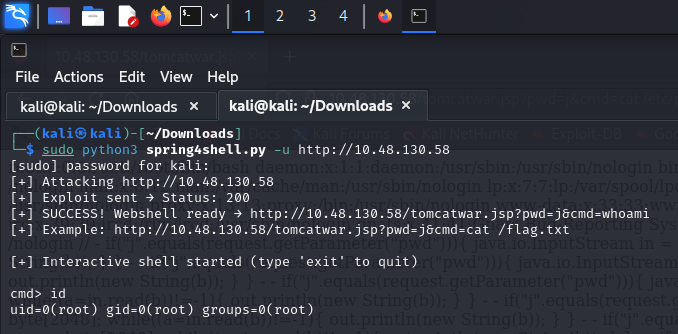
  4. Write a malicious JSP file (web shell) to disk

This ultimately allowed arbitrary code execution on the server.

βš™οΈ Exploitation Conditions

spring4shell

Spring4Shell was not universally exploitable. All of the following had to be true:

  • βœ” Running Java 9+
  • βœ” Using vulnerable Spring versions (5.3.0–5.3.17 or 5.2.0–5.2.19)
  • βœ” Deployed as a WAR file
  • βœ” Running on Apache Tomcat
  • βœ” Data binding enabled for request parameters

If packaged as a Spring Boot executable JAR, exploitation was typically not possible.


πŸ’₯ Potential Impact

If successfully exploited, an attacker could:

  • Upload a web shell (JSP)
  • Execute arbitrary system commands
  • Access sensitive application data
  • Pivot deeper into internal networks
  • Fully compromise the application server

πŸ“Š Severity & CVSS

MetricValue
CVE IDCVE-2022-22965
CVSS Score9.8 (Critical)
Attack VectorNetwork
Authentication Required❌ No
User Interaction❌ None
ImpactFull RCE

πŸ›  Mitigation & Patching

βœ… Official Fix

Upgrade to:

  • Spring Framework 5.3.18
  • Spring Framework 5.2.20

Spring Boot versions were also updated accordingly.


πŸ”’ Recommended Hardening

  • Prefer JAR packaging over WAR
  • Upgrade Java runtime
  • Restrict writable directories
  • Disable unnecessary binding fields
  • Monitor for suspicious file creation
  • Deploy Web Application Firewall (WAF)

πŸ—“ Timeline

DateEvent
March 2022Vulnerability reported
March 31, 2022Public disclosure
Same dayPatch released
Following daysSecurity scanning begins globally

πŸ”₯ Spring4Shell vs Log4Shell

FeatureSpring4ShellLog4Shell
FrameworkSpring FrameworkApache Log4j
CVE2022-229652021-44228
Exploit ComplexityModerate (requires conditions)Extremely Low
Default ExposureLimitedWidespread
CVSS9.810.0

Spring4Shell was serious, but Log4Shell had broader real-world exposure.


πŸ“Œ Summary

FieldValue
NameSpring4Shell
CVECVE-2022-22965
TypeRemote Code Execution
Affected SoftwareSpring Framework
SeverityCritical
Patch AvailableYes
Exploit ConditionsSpecific configuration required

⚠️ Final Notes

Spring4Shell demonstrated how complex object binding and reflection in modern frameworks can introduce unexpected attack surfaces.

While not as globally impactful as Log4Shell, it remains a critical vulnerability that required immediate patching in affected environments.


Download Tool


