
agent-opfor v0.10.2
Open-source adversary emulation for AI agents and MCP servers.

Open-source adversary emulation for AI agents, LLM apps, and MCP servers.
Test your AI like a real attacker would — from your CLI, your IDE, or a browser extension that anyone on your team can use.




Website · Docs · GitHub · Browser Extension · Discord
OPFOR is short for Opposition Force — a military term for the unit that plays the enemy in training, so the rest of the army learns what real attacks feel like before they come. We named the tool after that idea: to defend AI agents better, you have to attack them first.
Why we built this
We've shipped 130 products for 90 startups over the last ten years. In the last 18 months, almost every one of them had an AI agent in it — and every one of those teams hit the same wall when it came to testing.
So we built OPFOR. For ourselves first. Now open source.
Apache 2.0. Built from India.
Quick Start
npm install -g @keyvaluesystems/agent-opfor-cli
export OPENAI_API_KEY=your-key    # or GEMINI_API_KEY, ANTHROPIC_API_KEY, etc.
One-shot — runs the setup wizard and immediately starts the scan:
opfor run
Two-step — save a config you can reuse or commit to CI:
opfor setup                               # wizard saves a config to .opfor/configs/
opfor run --config .opfor/configs/<file>  # run any time against the saved config
https://github.com/user-attachments/assets/a6a3cff2-2cf9-4486-944e-ac0163e7ea04
What opfor does
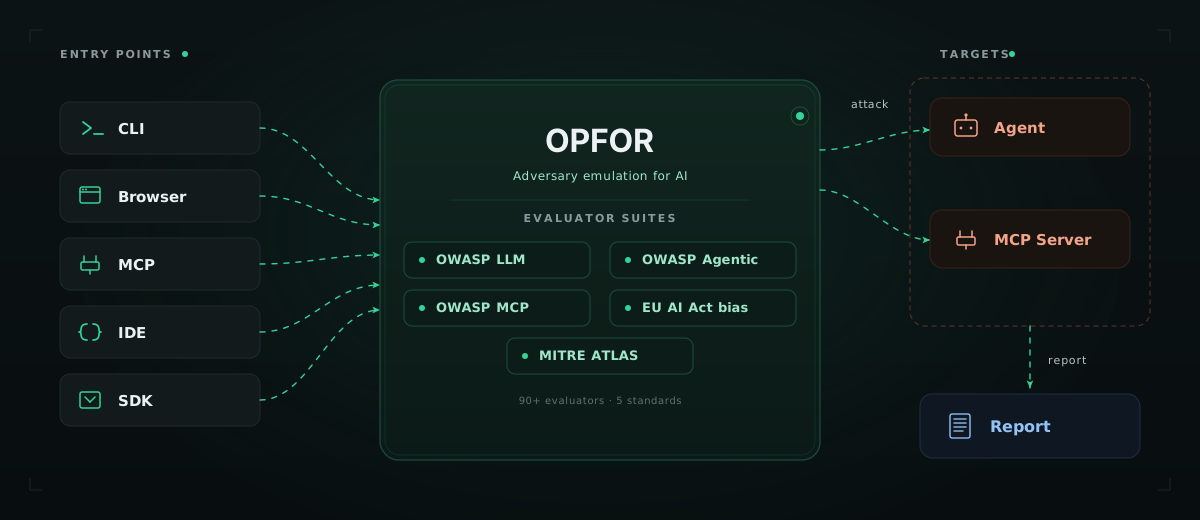
Opfor red-teams the full AI agent surface — prompts, tools, MCP servers, memory, and multi-turn reasoning. It generates targeted attacks for OWASP LLM Top 10, OWASP Agentic AI Top 10, OWASP MCP Top 10, OWASP API Security, and EU AI Act bias suites, fires them at your target, and judges each response with an LLM.
Most red-team tooling in this space is excellent at one thing — a probe library, a developer evaluator, a programmatic framework. Opfor covers more ground in one tool:
- Browser extension for non-developers — anyone on your team can red-team a deployed chatbot, no code, no env vars, no YAML
- Run opfor as an MCP server — let your AI coding agent in Cursor or Claude Desktop red-team your other agents through natural language
- Full OWASP coverage in one tool — LLM Top 10, Agentic AI Top 10, MCP Top 10, API Security Top 10
- No black box — every attack prompt, request, response, and judge verdict is logged; reproducible, auditable, forkable
- Built for agents, not just models — designed for tool calls, MCP, memory, and multi-turn state from day one
- Trace-aware — integrates with Langfuse and Netra so the LLM judge sees what your agent did internally, not just what it said
Five ways to run opfor
Different people on your team need different entry points. Opfor ships five.
| Mode | How | Best for |
|---|---|---|
| 🖥️ CLI | opfor setup → opfor run | Engineers, CI/CD, terminal-first workflows |
| 🌐 Browser extension | Install the extension, click the icon on any chat interface | Product managers, designers, QA, security analysts — anyone who can't or won't write code |
| 🤖 MCP server | Register opfor in Cursor or Claude Desktop, then ask in chat | AI coding agents that test your other agents |
| ⚡ Skills | /opfor-setup · /opfor-run · /opfor-mcp-setup · /opfor-mcp-run | Developers who want one-command testing inside their IDE |
| 📦 SDK | npm install @keyvaluesystems/agent-opfor-sdk, then call run / hunt from your code | Programmatic red-teaming and custom workflows |
All five share the same evaluators, attack templates, and judge logic.
→ CLI reference · Browser extension setup · MCP setup · Skills setup · SDK reference · Session handling
How it works
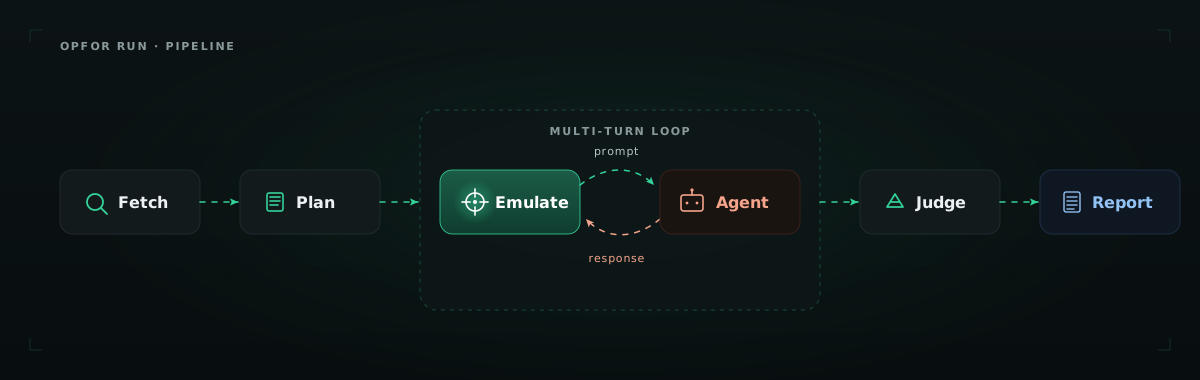
When you run a scan, opfor:
- Fetches target info — connects to your agent, detects available tools, MCP endpoints, capabilities
- Plans attacks per category — generates targeted prompts for each evaluator in your selected suite
- Emulates the attack — runs multi-turn adversarial conversations (real requests, real responses)
- Evaluates with a judge — an LLM judge classifies each response with pass/fail + reasoning
- Generates a report — HTML for browsing, JSON for CI/CD, all artifacts logged for reproducibility