
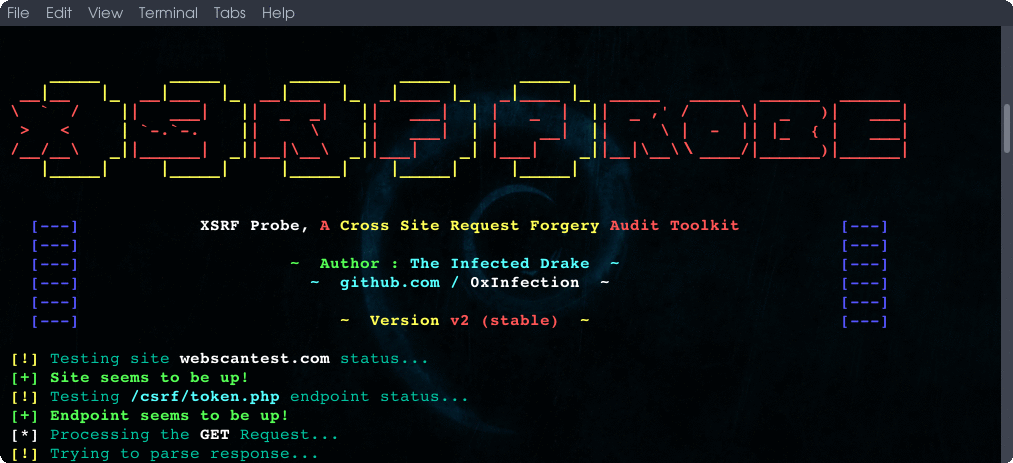
XSRFProbe v3.0.0
The Prime Cross Site Request Forgery (CSRF) Audit and Exploitation Toolkit.

XSRFProbe
The Prime Cross Site Request Forgery Audit & Exploitation Toolkit.

-blue.svg)

About
XSRFProbe is an advanced Cross Site Request Forgery (CSRF/XSRF) Audit and Exploitation Toolkit. Equipped with a powerful crawling engine and numerous systematic checks, it is able to detect most cases of CSRF vulnerabilities, their related bypasses and futher generate exploitable proof of concepts with each found vulnerability. For more info on how XSRFProbe works, see XSRFProbe Internals on wiki.
XSRFProbe Wiki • Getting Started • General Usage • Advanced Usage • XSRFProbe Internals • Gallery
Some Features
- Runs a full battery of systematic checks — backed by a response diffing/benchmark engine — before declaring an endpoint vulnerable.
- Detects and actively tampers with many Anti-CSRF token implementations: request-method switch, token removal, empty/duplicated values, non-session-bound tokens, double-submit cookies and custom-header tokens.
- Probes Referer and Origin validation with real-world bypasses (header removal, regex/subdomain tricks,
Origin: null) as well as method-override and Content-Type bypasses. - Analyses SameSite cookie protections, with optional subdomain enumeration (via crt.sh) for sibling-domain bypass testing.
- Works with a powerful crawler featuring deterministic, bounded crawling and scanning (configurable via
--max-urls,--max-depthand--crawl-timeout). - Optional headless Firefox (Selenium) integration for browser-dependent tests and auto-validation of generated PoCs.
- Accurate Token-Strength Detection and Analysis using entropy and encoding checks.
- Can generate both normal as well as maliciously exploitable CSRF proof of concepts.
- Out of the box support for custom cookie values, generic headers and a JSON report — each finding carries a severity rating and an exploitability precondition.
- The user is in control of everything whatever the scanner does.
- User-friendly interaction environment with full verbose support and detailed logging of errors, vulnerabilities and tokens.
Vulnerability Tests Performed:
Every check XSRFProbe runs has a unique identifier. The ID is shown in the console output (e.g. [T6] VULNERABLE: ...) and stored as the test_id field of each finding in the JSON report (alongside its severity and, where relevant, an exploitability note under details), so each finding maps back to the exact test that produced it.
| ID | Category | Check |
|---|---|---|
D1 | Token presence | No anti-CSRF token present (generic request forgery) |
D2 | Token presence | Login form lacks CSRF token (login CSRF) |
T2 | Token tampering | Validation tied to request method (GET ↔ POST switch) |
T3 | Token tampering | Token can be omitted entirely |
T4 | Token tampering | Token not tied to the user session (cross-session replay) |
T5 | Token tampering | Token tied to a non-session cookie (e.g. csrfKey) |
T6 | Token tampering | Naive double-submit cookie (cookie == body, no binding) |
T7 | Token tampering | Empty token value accepted |
T8 | Token tampering | Custom-header token can be omitted or forged |
M1 | Method / Content-Type | HTTP method override via _method parameter |
M2 | Method / Content-Type | HTTP method override via X-HTTP-Method-Override header |
M4 | Method / Content-Type | Validation bypass via alternate Content-Type |
R0 | Referer | Referer header not validated on form submission |
R1 | Referer | Referer validation bypassed by omitting the header |
R2a | Referer | Referer regex bypass — target as attacker subdomain |
R2b | Referer | Referer regex bypass — target in query string |
R2c | Referer | Referer regex bypass — target in path |
O1 | Origin | Origin validation bypassed with Origin: null |
O2 | Origin | Origin validation bypassed with a subdomain trick |
O3 | Origin | Origin validation bypassed by omitting the header |
S2 | SameSite (browser) | SameSite=Strict bypass via client-side redirect gadget |
S3 | SameSite (browser) | SameSite=Strict bypass via XSS on a sibling subdomain |
S4 | SameSite (browser) | SameSite=Lax bypass via cookie-refresh / OAuth flow |
C1 | Cookie posture | Cookie SameSite attribute analysis (None/Lax/Strict) |
C2 | Cookie posture | No SameSite attribute set on cookies |
E1 | Token strength | Token uses a weak/structured hash encoding |
A1 | Token strength | Post-scan token predictability / forgeability analysis |
S*checks require the optional headless-browser integration (--browser).T*/M*/R*/O*are HTTP-level checks gated by the response diffing/benchmark engine.
Gallery
Lets see some real-world scenarios of XSRFProbe in action:
Installation & Usage
For the full usage info, please take a look at the wiki's — General Usage and Advanced Usage.
Installing via Pypi:
XSRFProbe can be easily installed via a single command:
pip install xsrfprobe