
Skip to content
KitploitKITPLOIT
ToolsExploitsBlog
Log in
Einreichen
ToolsExploitsBlog
Einreichen

Hacking-, PenTest- und Cybersicherheits-Tools für Ihr Sicherheitsarsenal!

Kitploit ist ein Verzeichnis von Hacking-, Cybersicherheits- und Pentesting-Tools. Entdecken Sie die neuesten Projekt-Updates, um Schwachstellen zu finden, Systeme zu analysieren, Tests zu automatisieren und Ihre Sicherheit zu stärken.

FeedsKontaktDatenschutz© 2026 Kitploit

Tool-Verzeichnis

Kategorien

Alle Kategorien anzeigen
Loading categories
Tools/GitHubGitHub/maalfer/cve-2026-123158
Vulnerability AnalysisExploitationWeb Application ExploitationAuthenticationLearning & EducationLabs & Practice
GitHubmaalfer/cve-2026-123158

CVE-2026-123158

Python PoC exploit for CVE-2026-123158 ("sshole"), an OpenSSH authentication bypass on Alpine Linux without PAM, triggered by long passwords against musl crypt().

Repository anzeigen
51vor 21 TagenNoch nicht geprüft

Beliebteste

Alle anzeigen →

Entdecken Sie die meistgenutzten Tools unserer Community.

  • 1

    ghostlock-app

    yukonga/ghostlock-app

    GhostLock One-Tap Execution App (CVE-2026-43499)

    986
  • 2

    wifit3

    derv82/wifit3

    Wifite, aber nur USB & plattformübergreifend.

    784
  • 3

    OsintHunter

    letox4/osinthunter

    🎯 Das ultimative OSINT-Toolkit: Untersuchungsgraph, Konfidenzbewertung, Alias-Familien, Karte, Zeitleiste und Berichte. 49 Module, 400+ Websites, keine API-Schlüssel erforderlich.

    536
  • 4

    SafeLine

    chaitin/safeline

    Selbst gehosteter WAF und Reverse Proxy, der bösartigen HTTP-Verkehr filtert, SQL-Injection, XSS und Bot-Angriffe blockiert, mit Ratenbegrenzung und dynamischer HTML/JS-Verschlüsselung.

    465
  • 5

    jumpserver

    jumpserver/jumpserver

    JumpServer ist eine Open-Source-Plattform für Privileged Access Management (PAM), die DevOps- und IT-Teams bedarfsgesteuerten und sicheren Zugriff auf SSH-, RDP-, Kubernetes-, Datenbank- und RemoteApp-Endpunkte über einen Webbrowser bietet.

    391
  • 6

    mcp-reverse

    1llu50ry/mcp-reverse

    MCP-Server, der über 180 Reverse-Engineering-Tools bereitstellt und Ghidra, IDA, x64dbg, Frida sowie 56 weitere Backends mit nativen Binärparsern und einer Wissensdatenbank mit 4.200 Skills zusammenführt.

    367

Alle Tools erkunden

Durchsuchen Sie unsere Tool-Sammlung

Alle Tools anzeigen →
Teilen
Inhalt in der angeforderten Sprache nicht verfügbar. Englische Version wird angezeigt.

CVE-2026-123158 — SSH Authentication Bypass ("sshole") exploit

CVE-2026-123158 is an SSH authentication bypass vulnerability (SSH authentication bypass, login without a password) that affects OpenSSH compiled without PAM on Alpine Linux (musl libc). This repository contains the exploit / PoC (Proof of Concept) in Python that reproduces the flaw in a practical way.

Nicknamed "sshole", the vulnerability allows logging in via SSH to accounts without a real password without needing to know any credentials.

Keywords: CVE-2026-123158, sshole, OpenSSH exploit, Alpine Linux vulnerability, musl crypt bypass, SSH authentication bypass, SSH login without password, auth bypass PoC.

What is CVE-2026-123158?

The crypt() function of musl libc (the libc used by Alpine Linux) literally returns the * character when the submitted password exceeds 256 bytes and the hash stored in /etc/shadow is also * (account marked as "no valid password", typical of service or disabled accounts). OpenSSH, when compiled without PAM support, compares that result directly against the shadow field: when comparing "*" == "*" the server accepts the login without the attacker knowing any real password.

Impact: SSH authentication bypass / access without credentials on affected accounts.

Conditions required for the system to be vulnerable:

  • openssh-server compiled without PAM (--without-pam), as happens by default in many Alpine Linux images.
  • PasswordAuthentication yes in sshd_config.
  • An account with * in /etc/shadow (user without a real password assigned).
  • Any other account on the system with a $5$ or $6$ hash (necessary for musl to enter the vulnerable code path).

Exploit / PoC

pip install paramiko

python3 exploit.py <HOST> <PORT> <USER> [LEN]
# Ejemplo contra cuenta 'alice' con contraseña de 300 caracteres
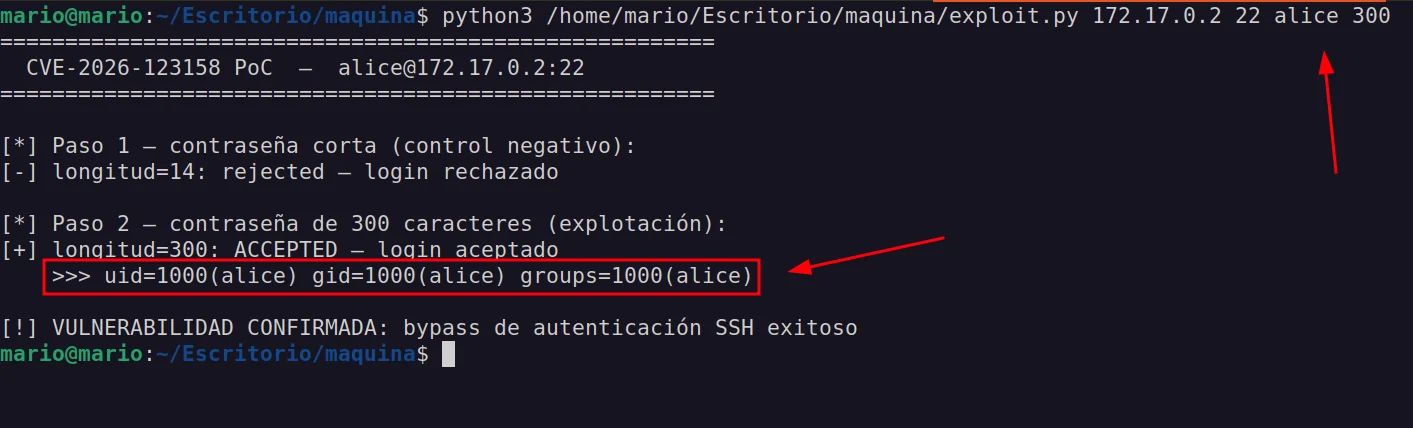
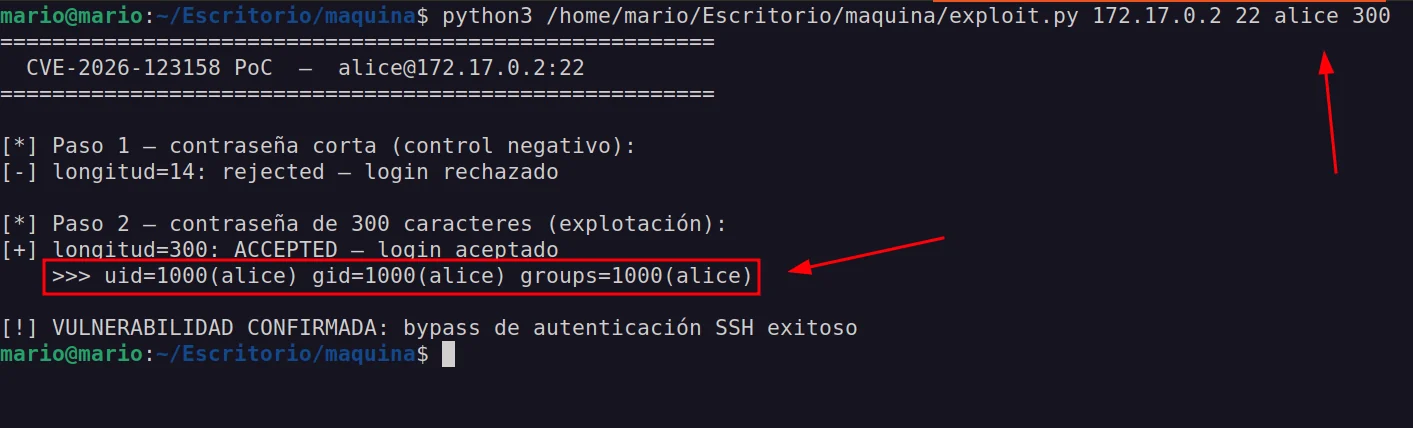
python3 exploit.py 172.17.0.2 22 alice 300

The script first sends a short password (negative control) and then a long password (>256 bytes) to trigger the musl crypt() bug and confirm whether the login is accepted without valid credentials.
Demo

Screenshot of the CVE-2026-123158 exploit (sshole): SSH authentication bypass on Alpine Linux via a long password

Mitigation

# Actualizar y reiniciar sshd
apk upgrade -U -a
rc-service sshd restart

# O deshabilitar autenticación por contraseña
echo "PasswordAuthentication no" >> /etc/ssh/sshd_config
rc-service sshd restart

Docker Lab

Available at DockerLabs / BunkerLabs — Eseeseache machine — image eseseache:latest, freely accessible, to practice exploiting CVE-2026-123158 in a controlled environment.

References

  • Eseeseache machine on DockerLabs / BunkerLabs — hands-on lab for the vulnerability.

For educational purposes. Do not use against systems without express authorization.

Tool herunterladen





