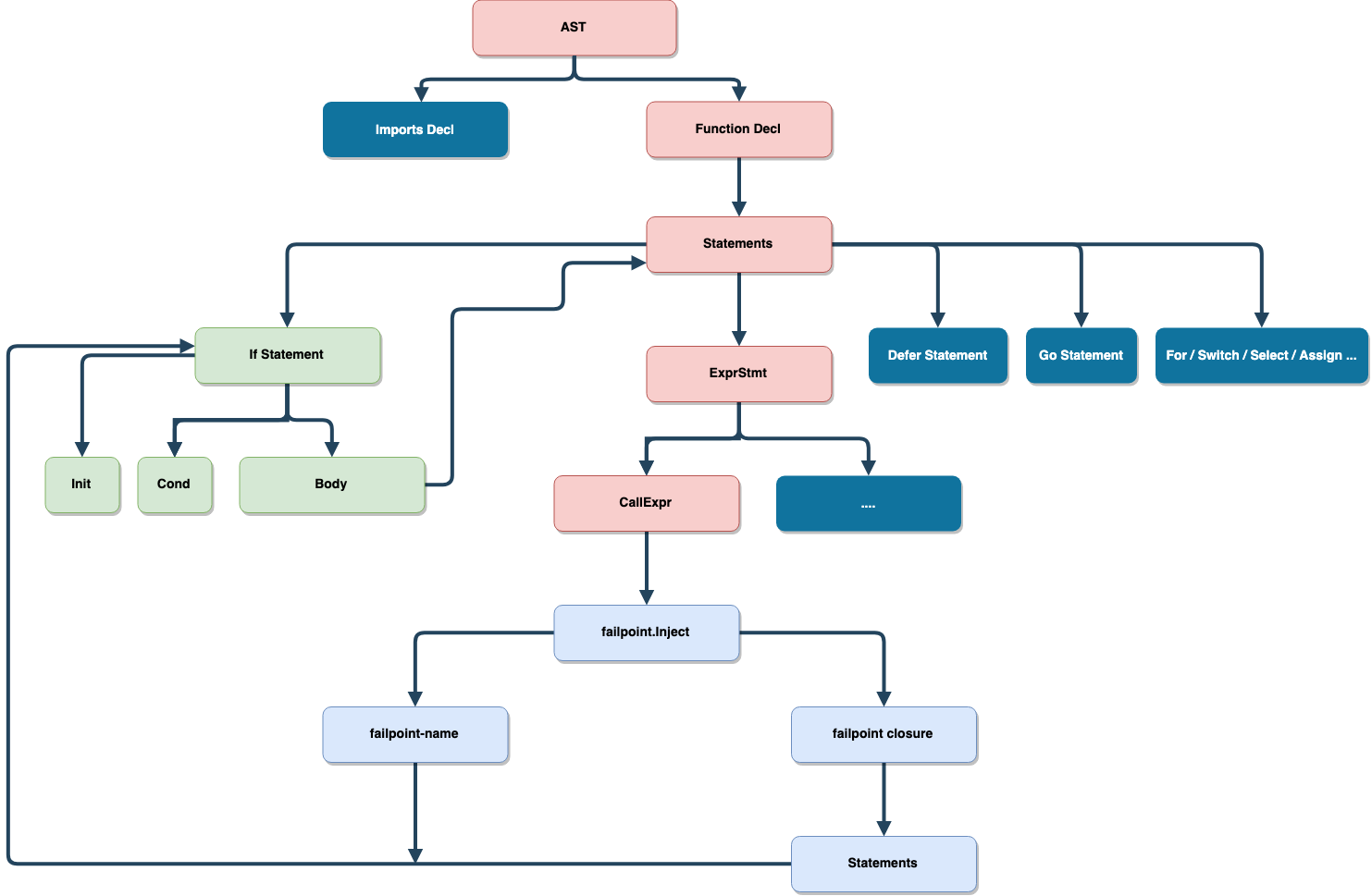
Golang 的 failpoints 实现。故障点用于以用户可控的方式在代码中添加可注入错误的位置。故障点是一段代码片段,仅当对应的故障点处于激活状态时才会执行。
failpoint-ctl)从源码构建 failpoint-ctl
git clone https://github.com/pingcap/failpoint.git
cd failpoint
make
ls bin/failpoint-ctl
向你的程序注入故障点,例如:
package main

import "github.com/pingcap/failpoint"

func main() {
    failpoint.Inject("testPanic", func() {
        panic("failpoint triggerd")
    })
}
使用 failpoint-ctl enable 转换你的代码
使用 go build 构建
使用 GO_FAILPOINTS 环境变量启用故障点
GO_FAILPOINTS="main/testPanic=return(true)" ./your-program
注意:GO_FAILPOINTS 不适用于 InjectCall 类型的标记。
如果你使用 go run 运行测试,别忘了在命令中加入生成的 binding__failpoint_binding__.go,例如:
GO_FAILPOINTS="main/testPanic=return(true)" go run your-program.go binding__failpoint_binding__.go
failpoint-toolexec)从源码构建 failpoint-toolexec
git clone https://github.com/pingcap/failpoint.git
cd failpoint
make
ls bin/failpoint-toolexec
向你的程序注入故障点,例如:
package main

import "github.com/pingcap/failpoint"

func main() {
    failpoint.Inject("testPanic", func() {
        panic("failpoint triggerd")
    })
}
使用独立的构建缓存以避免与未使用 failpoint-toolexec 的缓存混淆,然后构建
GOCACHE=/tmp/failpoint-cache go build -toolexec path/to/failpoint-toolexec
使用 GO_FAILPOINTS 环境变量启用故障点
GO_FAILPOINTS="main/testPanic=return(true)" ./your-program
你也可以使用 go run 或 go test,例如:
GOCACHE=/tmp/failpoint-cache GO_FAILPOINTS="main/testPanic=return(true)" go run -toolexec path/to/failpoint-toolexec your-program.go
用有效的 Golang 代码定义故障点,而不是注释或其他任何形式
故障点没有任何额外开销
故障点例程应可读可写,并应通过编译器检查
由故障点定义生成的代码易于阅读
与注入代码保持相同的行号(更易于调试)
支持使用 context.Context 进行并行测试
故障点
故障点是一段代码片段,仅当对应的故障点处于激活状态时才会执行。
如果执行了 failpoint.Disable("failpoint-name-for-demo"),该闭包将永远不会执行。
var outerVar = "declare in outer scope"
failpoint.Inject("failpoint-name-for-demo", func(val failpoint.Value) {
    fmt.Println("unit-test", val, outerVar)
})
标记函数
它只是一个空函数
易于编写/阅读
引入编译器检查,如果故障点代码无效,则无法在常规模式下编译
标记函数列表
func Inject(fpname string, fpblock func(val Value)) {}func InjectContext(fpname string, ctx context.Context, fpblock func(val Value)) {}func InjectCall(fpname string, args ...any) {}func Break(label ...string) {}func Goto(label string) {}func Continue(label ...string) {}func Fallthrough() {}func Return(results ...interface{}) {}func Label(label string) {}支持的故障点环境变量
可以通过导出符合以下模式的环境变量来启用故障点,这与 freebsd failpoint SYSCTL VARIABLES 非常相似
注意:InjectCall 不能通过环境变量启用。
[<percent>%][<count>*]<type>[(args...)][-><more terms>]
参数指定要执行的操作;可以是以下之一:
你可以在调用点调用 failpoint.Inject 来注入故障点,其中 failpoint-name 用于触发故障点,failpoint-closure 会被展开为 IF 语句的函数体。
failpoint.Inject("failpoint-name", func(val failpoint.Value) {
    failpoint.Return("unit-test", val)
})
转换后的代码如下所示:
if val, _err_ := failpoint.Eval(_curpkg_("failpoint-name")); _err_ == nil {
    return "unit-test", val
}
failpoint.Value 是通过 failpoint.Enable("failpoint-name", "return(5)") 传入的值,该值可以被忽略。
failpoint.Inject("failpoint-name", func(_ failpoint.Value) {
    fmt.Println("unit-test")
})
或者
failpoint.Inject("failpoint-name", func() {
    fmt.Println("unit-test")
})
转换后的代码如下所示:
if _, _err_ := failpoint.Eval(_curpkg_("failpoint-name")); _err_ == nil {
    fmt.Println("unit-test")
}
此外,故障点闭包可以是一个接收 context.Context 的函数。你可以利用 context.Context 做一些自定义操作,例如在并行测试或其他场景中控制故障点是否激活。例如:
failpoint.InjectContext(ctx, "failpoint-name", func(val failpoint.Value) {
    fmt.Println("unit-test", val)
})
转换后的代码如下所示:
if val, _err_ := failpoint.EvalContext(ctx, _curpkg_("failpoint-name")); _err_ == nil {
    fmt.Println("unit-test", val)
}
你可以忽略 context.Context,这将生成与上面非 context 版本相同的代码。例如:
failpoint.InjectContext(nil, "failpoint-name", func(val failpoint.Value) {
    fmt.Println("unit-test", val)
})
转换为:
if val, _err_ := failpoint.EvalContext(nil, _curpkg_("failpoint-name")); _err_ == nil {
    fmt.Println("unit-test", val)
}
你可以使用 failpoint.InjectCall 注入一个函数调用,这种类型的标记只能通过 failpoint.EnableCall 启用,并且必须在与 InjectCall 调用点相同的进程中调用。使用这种标记,你可以避免故障点代码污染你的源代码。参见 示例。
你可以通过 failpoint.WithHook 控制故障点
func (s *dmlSuite) TestCRUDParallel() {
    sctx := failpoint.WithHook(context.Backgroud(), func(ctx context.Context, fpname string) bool {
        return ctx.Value(fpname) != nil // Determine by ctx key
    })
    insertFailpoints = map[string]struct{} {
        "insert-record-fp": {},
        "insert-index-fp": {},
        "on-duplicate-fp": {},
    }
    ictx := failpoint.WithHook(context.Backgroud(), func(ctx context.Context, fpname string) bool {
        _, found := insertFailpoints[fpname] // Only enables some failpoints.
        return found
    })
    deleteFailpoints = map[string]struct{} {
        "tikv-is-busy-fp": {},
        "fetch-tso-timeout": {},
    }
    dctx := failpoint.WithHook(context.Backgroud(), func(ctx context.Context, fpname string) bool {
        _, found := deleteFailpoints[fpname] // Only disables failpoints.
        return !found
    })
    // other DML parallel test cases.
    s.RunParallel(buildSelectTests(sctx))
    s.RunParallel(buildInsertTests(ictx))
    s.RunParallel(buildDeleteTests(dctx))
}
如果你在循环上下文中使用故障点,你可能会用到其他标记函数。