
Skip to content
KitploitKITPLOIT
FerramentasBlog
Enviar
FerramentasBlog
Enviar

Ferramentas de Hacking, PenTest e Cibersegurança para o seu Arsenal de Segurança!

Kitploit é um diretório de ferramentas de hacking, cibersegurança e pentesting. Descubra as últimas atualizações de projetos para encontrar vulnerabilidades, analisar sistemas, automatizar testes e fortalecer sua segurança.

··Feeds·Contato·Privacidade·© 2026 Kitploit

Diretório de Ferramentas

Categorias

Ver todas as categorias
Loading categories
Ferramentas/GitHubGitHub/neo23x0/yaraqa
Análise EstáticaAnálise de VulnerabilidadesAnálise de CódigoAnálise de Malware
GitHubneo23x0/yaraqa

yaraQA

Analisador de regras YARA para melhorar a qualidade e o desempenho das regras

Ver Repositório
1178há 2 mesesRevisado pelo Kitploit

Mais Populares

Ver todos →

Descubra as ferramentas mais usadas pela nossa comunidade.

Explore todas as ferramentas

Navegue pela nossa coleção de ferramentas

Ver todas as ferramentas →
Compartilhar

yaraQA

Analisador de regras YARA para melhorar a qualidade e o desempenho das regras

Por quê?

Regras YARA podem ser sintaticamente corretas, mas ainda assim disfuncionais. O yaraQA tenta encontrar e relatar esses problemas ao autor ou mantenedor de um conjunto de regras YARA.

Os problemas que o yaraQA tenta detectar são, por exemplo:

  • regras sintaticamente corretas, mas que nunca correspondem devido a erros na condição (ex.: regra com uma string e 2 of them na condição)
  • regras que usam combinações de string e modificadores provavelmente erradas (ex.: $ = "\\Debug\\" fullword)
  • problemas de desempenho causados por átomos curtos, caracteres repetitivos ou loops (ex.: $ = "AA"; pode ser excluído da análise usando --ignore-performance)

Pretendo ampliar o conjunto de testes ao longo do tempo. Cada versão secundária incluirá novos recursos ou novos testes.

Instalar dependências

root@kitploit:~
pip install -r requirements.txt

Uso

root@kitploit:~
usage: yaraQA.py [-h] [-f yara files [yara files ...]] [-d yara files [yara files ...]] [-o outfile] [-b baseline] [-l level]
                 [--ignore-performance] [--debug]

YARA RULE ANALYZER

optional arguments:
  -h, --help            show this help message and exit
  -f yara files [yara files ...]
                        Path to input files (one or more YARA rules, separated by space)
  -d yara files [yara files ...]
                        Path to input directory (YARA rules folders, separated by space)
  -o outfile            Output file that lists the issues (JSON, default: 'yaraQA-issues.json') 
  -b baseline           Use a issues baseline (issues found and reviewed before) to filter issues
  -l level              Minium level to show (1=informational, 2=warning, 3=critical)
  --ignore-performance  Suppress performance-related rule issues
  --debug               Debug output

Experimente

root@kitploit:~
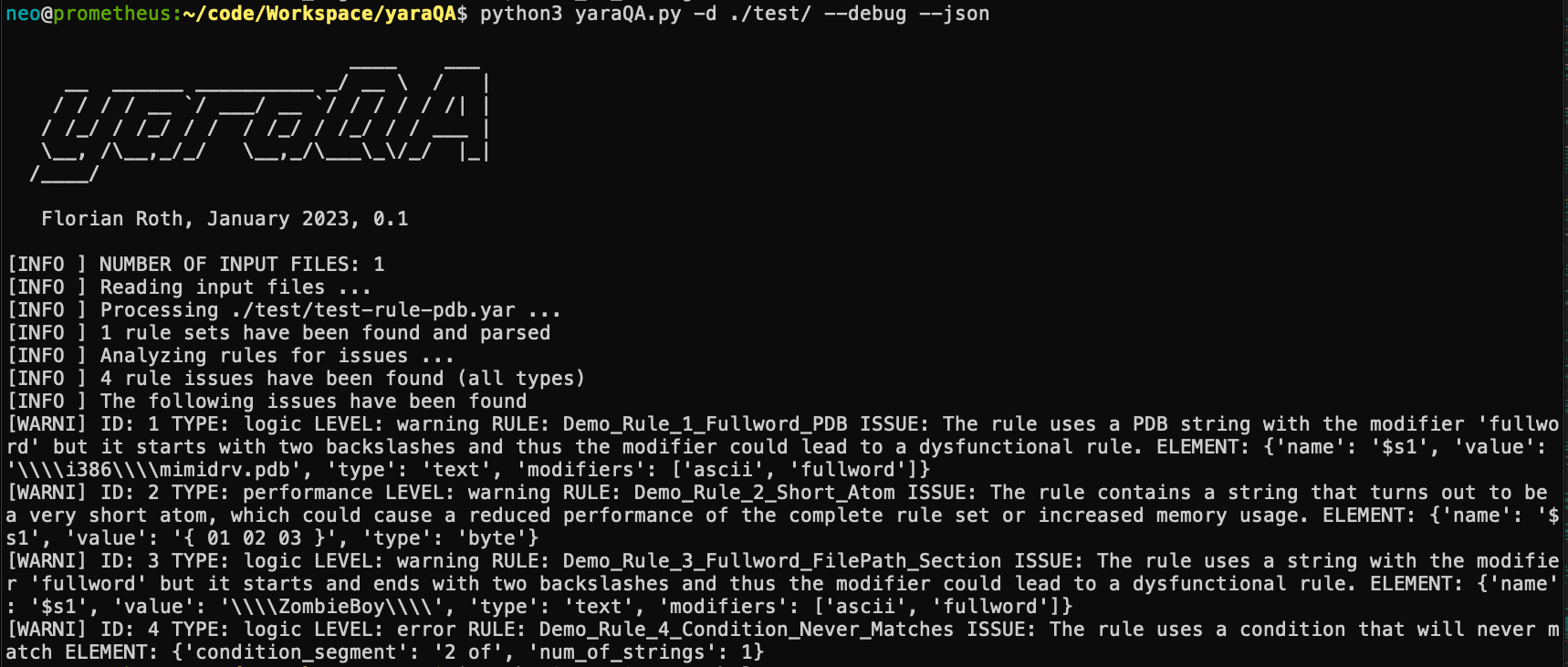
python3 yaraQA.py -d ./test/

Suprimir todos os problemas de desempenho e mostrar apenas problemas de detecção/lógica.

root@kitploit:~
python3 yaraQA.py -d ./test/ --ignore-performance

Suprimir todos os problemas de caráter informativo

root@kitploit:~
python3 yaraQA.py -d ./test/ -level 2

Usar uma linha de base para ver apenas novos problemas (não aqueles que você já revisou). O arquivo de linha de base é uma saída JSON antiga de um estado revisado.

root@kitploit:~
python3 yaraQA.py -d ./test/ -b yaraQA-reviewed-issues.json

Exemplos de Regras com Problemas

Exemplos de regras com problemas podem ser encontrados na pasta ./test.

Saída

O yaraQA escreve os problemas detectados em um arquivo chamado yaraQA-issues.json por padrão.

Esta listagem mostra um exemplo da saída gerada pelo yaraQA no formato JSON:

root@kitploit:~
[
    {
        "rule": "Demo_Rule_1_Fullword_PDB",
        "id": "SM1",
        "issue": "The rule uses a PDB string with the modifier 'wide'. PDB strings are always included as ASCII strings. The 'wide' keyword is unneeded.",
        "element": {
            "name": "$s1",
            "value": "\\\\i386\\\\mimidrv.pdb",
            "type": "text",
            "modifiers": [
                "ascii",
                "wide",
                "fullword"
            ]
        },
        "level": "info",
        "type": "logic",
        "recommendation": "Remove the 'wide' modifier"
    },
    {
        "rule": "Demo_Rule_1_Fullword_PDB",
        "id": "SM2",
        "issue": "The rule uses a PDB string with the modifier 'fullword' but it starts with two backslashes and thus the modifier could lead to a dysfunctional rule.",
        "element": {
            "name": "$s1",
            "value": "\\\\i386\\\\mimidrv.pdb",
            "type": "text",
            "modifiers": [
                "ascii",
                "wide",
                "fullword"
            ]
        },
        "level": "warning",
        "type": "logic",
        "recommendation": "Remove the 'fullword' modifier"
    },
    {
        "rule": "Demo_Rule_2_Short_Atom",
        "id": "PA2",
        "issue": "The rule contains a string that turns out to be a very short atom, which could cause a reduced performance of the complete rule set or increased memory usage.",
        "element": {
            "name": "$s1",
            "value": "{ 01 02 03 }",
            "type": "byte"
        },
        "level": "warning",
        "type": "performance",
        "recommendation": "Try to avoid using such short atoms, by e.g. adding a few more bytes to the beginning or the end (e.g. add a binary 0 in front or a space after the string). Every additional byte helps."
    },
    {
        "rule": "Demo_Rule_3_Fullword_FilePath_Section",
        "id": "SM3",
        "issue": "The rule uses a string with the modifier 'fullword' but it starts and ends with two backslashes and thus the modifier could lead to a dysfunctional rule.",
        "element": {
            "name": "$s1",
            "value": "\\\\ZombieBoy\\\\",
            "type": "text",
            "modifiers": [
                "ascii",
                "fullword"
            ]
        },
        "level": "warning",
        "type": "logic",
        "recommendation": "Remove the 'fullword' modifier"
    },
    {
        "rule": "Demo_Rule_4_Condition_Never_Matches",
        "id": "CE1",
        "issue": "The rule uses a condition that will never match",
        "element": {
            "condition_segment": "2 of",
            "num_of_strings": 1
        },
        "level": "error",
        "type": "logic",
        "recommendation": "Fix the condition"
    },
    {
        "rule": "Demo_Rule_5_Condition_Short_String_At_Pos",
        "id": "PA1",
        "issue": "This rule looks for a short string at a particular position. A short string represents a short atom and could be rewritten to an expression using uint(x) at position.",
        "element": {
            "condition_segment": "$mz at 0",
            "string": "$mz",
            "value": "MZ"
        },
        "level": "warning",
        "type": "performance",
        "recommendation": ""
    },
    {
        "rule": "Demo_Rule_5_Condition_Short_String_At_Pos",
        "id": "PA2",
        "issue": "The rule contains a string that turns out to be a very short atom, which could cause a reduced performance of the complete rule set or increased memory usage.",
        "element": {
            "name": "$mz",
            "value": "MZ",
            "type": "text",
            "modifiers": [
                "ascii"
            ]
        },
        "level": "warning",
        "type": "performance",
        "recommendation": "Try to avoid using such short atoms, by e.g. adding a few more bytes to the beginning or the end (e.g. add a binary 0 in front or a space after the string). Every additional byte helps."
    },
    {
        "rule": "Demo_Rule_6_Condition_Short_Byte_At_Pos",
        "id": "PA1",
        "issue": "This rule looks for a short string at a particular position. A short string represents a short atom and could be rewritten to an expression using uint(x) at position.",
        "element": {
            "condition_segment": "$mz at 0",
            "string": "$mz",
            "value": "{ 4d 5a }"
        },
        "level": "warning",
        "type": "performance",
        "recommendation": ""
    },
    {
        "rule": "Demo_Rule_6_Condition_Short_Byte_At_Pos",
        "id": "PA2",
        "issue": "The rule contains a string that turns out to be a very short atom, which could cause a reduced performance of the complete rule set or increased memory usage.",
        "element": {
            "name": "$mz",
            "value": "{ 4d 5a }",
            "type": "byte"
        },
        "level": "warning",
        "type": "performance",
        "recommendation": "Try to avoid using such short atoms, by e.g. adding a few more bytes to the beginning or the end (e.g. add a binary 0 in front or a space after the string). Every additional byte helps."
    },
    {
        "rule": "Demo_Rule_6_Condition_Short_Byte_At_Pos",
        "id": "SM3",
        "issue": "The rule uses a string with the modifier 'fullword' but it starts and ends with two backslashes and thus the modifier could lead to a dysfunctional rule.",
        "element": {
            "name": "$s1",
            "value": "\\\\Section\\\\in\\\\Path\\\\",
            "type": "text",
            "modifiers": [
                "ascii",
                "fullword"
            ]
        },
        "level": "warning",
        "type": "logic",
        "recommendation": "Remove the 'fullword' modifier"
    }
]

Capturas de tela

yaraQA

Baixar ferramenta