
Skip to content
KitploitKITPLOIT
도구블로그
제출
도구블로그
제출

해킹, 침투 테스트 및 사이버 보안 도구를 당신의 보안 무기고에!

Kitploit은 해킹, 사이버 보안 및 침투 테스트 도구 디렉토리입니다. 최신 프로젝트 업데이트를 발견하여 취약점을 찾고, 시스템을 분석하고, 테스트를 자동화하고, 보안을 강화하세요.

··피드·문의·개인정보·© 2026 Kitploit

도구 디렉토리

카테고리

모든 카테고리 보기
Loading categories
OWASP-Open-Source-Intelligence-Standard — An open, vendor-neutral verification standard for traceable, reviewable, and rights-aware open-source intelligence. Current release: OOVS v0.1.0. | Kitploit
도구/GitHubGitHub/owasp/owasp-open-source-intelligence-standard
OSINT (Open Source Intelligence)PrivacyThreat IntelligenceCurated ResourcesLabs & Practice
GitHubowasp/owasp-open-source-intelligence-standard

OWASP-Open-Source-Intelligence-Standard

An open, vendor-neutral verification standard for traceable, reviewable, and rights-aware open-source intelligence. Current release: OOVS v0.1.0.

저장소 보기

인기

모두 보기 →

커뮤니티에서 가장 많이 사용되는 도구를 찾아보세요.

모든 도구 탐색

도구 컬렉션을 둘러보세요

모든 도구 보기 →
공유
웹사이트
159일 전아직 검토되지 않음
요청한 언어로 콘텐츠를 사용할 수 없습니다. 영어 버전을 표시합니다.
OOVS, the OWASP OSINT Verification Standard. Evidence, not assertion. Version 0.1.0.

Open-source intelligence now informs decisions that affect liberty, safety, and national security.
OOVS is an open standard that makes those decisions defensible.

Every judgment traceable to its origin · every requirement testable against published criteria · AI output never mistaken for evidence

Latest release Validation status Ten requirements Ten acceptance tests

OWASP Incubator project Licensed CC BY-SA 4.0 Published site Python 3.10 or newer

Read the standard · The ten requirements · For evaluators · OWASP project page


The problem is not data. It is trust.

An intelligence product is only as good as the account you can give of it. Most open-source work cannot answer four questions under scrutiny:

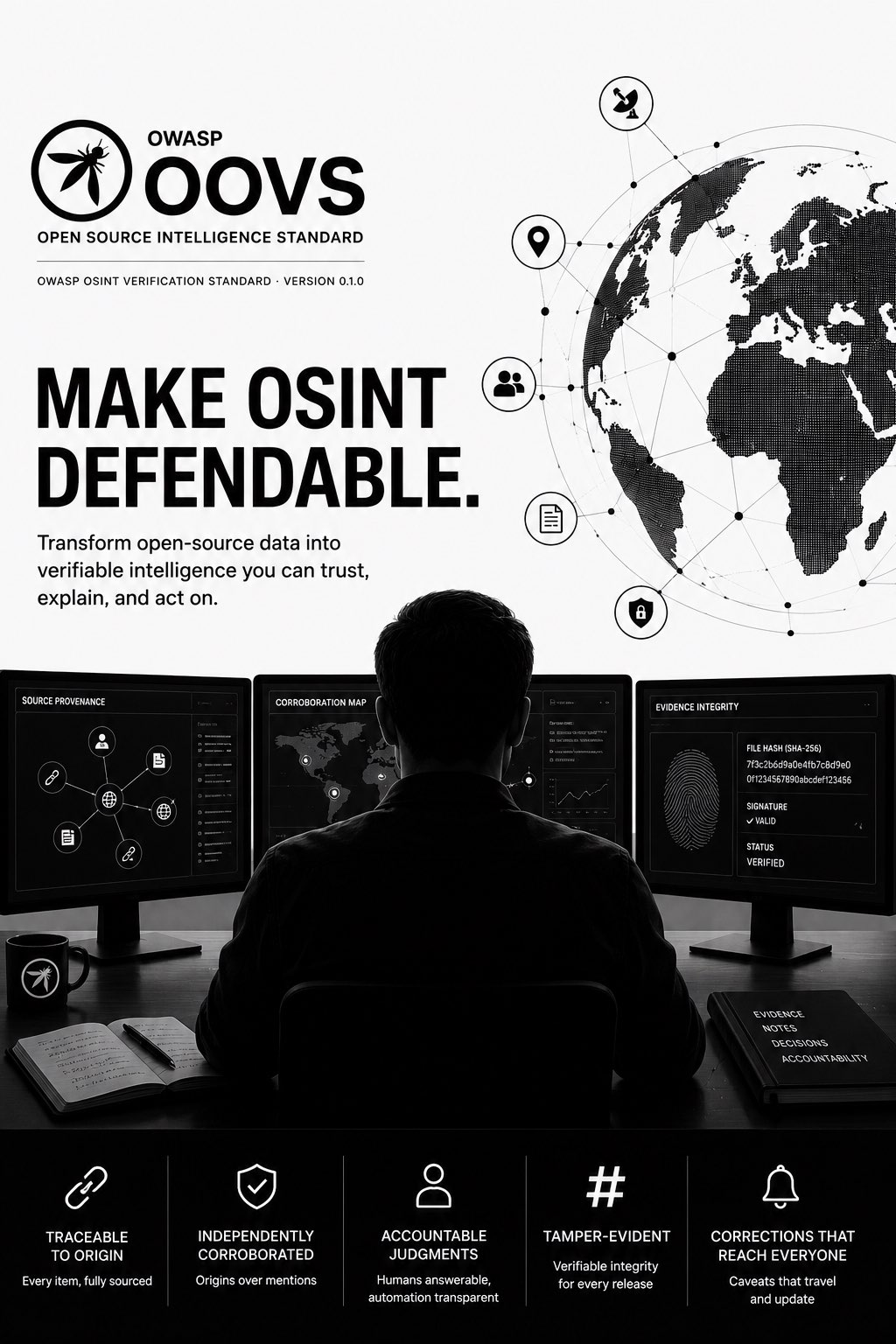
OOVS overview panel: an analyst reviewing source provenance, a corroboration map, and evidence integrity with a SHA-256 file hash marked verified, above five principles: traceable to origin, independently corroborated, accountable judgments, tamper-evident, and corrections that reach everyone.

What the standard asks of a working analyst.
Provenance traced to origin · corroboration established independently · judgments attributed to a named person
releases hashed so a recipient can check their copy · corrections that reach everyone who saw the original


Start here

Also worth reading: the release notes, the safety, rights, and misuse policy, governance, and how OOVS sits against prior art.


The ten requirements of OOVS v0.1.0

Each requirement states an obligation, the evidence that demonstrates it, how an assessor tests it, and what counts as failure. None depends on a particular tool, vendor, or platform.

Cite a requirement by its identifier, for example OWASP OOVS v0.1.0, OOVS-v0.1.0-04. The plain-language walkthrough explains each one without the normative wording.


How it holds together

Four panels from the overview: the OOVS data model showing source, claim, assertion and evidence with a JSON record; the provenance chain from harvest to reference with per-hop hashes; OOSIS as a standard layer between OSINT tools and case management, threat intelligence and reporting; and the mission areas served, being government, defence, intelligence, public safety and critical infrastructure.

What OOVS v0.1.0 gives you

The wider programme, and what is available now

The OWASP Open Source Intelligence Standard (OOSIS) is the programme. OOVS is its normative core.

Scope, and what this standard deliberately is not

OOVS assesses a defined workflow or product against published requirements. Within that scope it is designed to be used immediately by security teams, investigators, journalists, NGOs, researchers, and public-interest organisations.

Like other voluntary standards, OOVS is not a certification or accreditation scheme, does not determine legal compliance or evidentiary admissibility, and does not imply endorsement by any government, agency, court, or vendor.

It complements rather than replaces existing guidance:


Validate the repository

Every claim this repository makes about itself is checkable with one command.

root@kitploit:~
python3 -m venv .venv
source .venv/bin/activate
python3 -m pip install -r requirements-validation.txt
python3 scripts/validate_assets.py

Validation covers JSON Schema conformance, cross-file semantics, Markdown/JSON requirement parity, positive and expected-failure fixtures, local documentation links, and release-manifest file hashes. The same command runs in CI on every push.


Project leadership

Manish Tripathy — Project leader

Email the project leader GitHub profile

The authoritative leader record is the OWASP project page. Open review roles are listed in MAINTAINERS.md, and the project actively wants reviewers from different organisations, regions, and legal contexts.

Contributing

Read CONTRIBUTING.md, GOVERNANCE.md, and the Code of Conduct. Implementation results, assessor feedback, technique records, mappings, translations, and reviews are all welcome.

Use synthetic, consented, anonymised, or non-sensitive public examples. Do not submit personal data, live-case material, victim information, target lists, credentials, or harmful operational detail.

License

Copyright © 2026 OWASP Foundation and contributors.

Unless a file states otherwise, documentation and structured standard content in this repository are licensed under the Creative Commons Attribution-ShareAlike 4.0 International License (CC BY-SA 4.0). You may share and adapt the material, including commercially, provided you give appropriate credit, link to the license, indicate changes, and license your contributions under the same terms.


Overview video

Sixty seconds on why verification is the constraint, the data model that carries proof with every record, and the provenance chain that keeps a claim auditable back to its source.

OOVS overview: open-source intelligence is abundant, but the problem is not data, it is trust.

▶ Watch the full overview


OWASP and the OWASP logo are registered trademarks of the OWASP Foundation, Inc.
Incubator stage means the Foundation hosts this project; it is not a review or an endorsement of the content.
도구 다운로드
QuestionWhat OOVS requires
01Where did this come from?Origin, time, method, and handling history travel with every item, and originals stay distinguishable from copies
02Is it independently corroborated?Independence counted by distinct origins, not mentions. Reposts and machine restatements of one source never become confirmation through repetition
03Who is accountable for the judgment?Observation, inference, assumption, and unknown stated separately. Automated output is an aid, never a witness, and a named person stays answerable
04Does the caveat survive contact?Confidence, limits, and handling constraints travel to the point of action, and a correction can reach everyone who received the product

Read it

The normative text, ten requirements with objectives, evidence, procedures, and pass criteria.

oovs/v0.1/standard.md

Automate it

Requirements and acceptance tests published as data, with JSON Schema, so tooling can consume them.

requirements.json · tests.json

Record a result

A portable assessment format, with a worked synthetic example you can copy.

assessment.schema.json · example

IDRequirement
OOVS-v0.1.0-01Authorised purpose and proportionality
OOVS-v0.1.0-02Collection boundary and data minimisation
OOVS-v0.1.0-03Source provenance and integrity
OOVS-v0.1.0-04Source and claim assessment
OOVS-v0.1.0-05Corroboration and confidence
OOVS-v0.1.0-06Analytic transparency and reproducibility
OOVS-v0.1.0-07Rights, privacy, and safeguarding
OOVS-v0.1.0-08AI and automation assurance
OOVS-v0.1.0-09Dissemination and action controls
OOVS-v0.1.0-10Governance, audit, and improvement

Every record carries its own proof. A source, a claim, an assertion, and the evidence behind it travel together, with confidence and uncertainty stated rather than implied.

Every hop is recorded. Collected, normalised, verified, cited — each step carries a hash, so a claim stays auditable back to its origin.

One standard, many systems. OOVS describes a layer between the tools that gather and the systems that decide, rather than another platform to adopt.

Built for work that gets questioned. Government, defence, intelligence, public safety, and critical infrastructure, where a decision has to survive review.

CapabilityHow it is delivered
A testable assurance baselineTen L1 requirements with objectives, evidence, procedures, and pass criteria
Two clear assessment targetsA defined workflow or a defined intelligence product
Portable resultsJSON Schema for assessment output, plus a worked synthetic example
Automatable adoptionRequirements, tests, and schemas published as data, not only prose
Verification disciplineSource-origin checks so repeated reporting is not mistaken for independent corroboration
Rights-aware controlsPurpose, minimisation, provenance, safeguarding, AI accountability, dissemination, and correction
Interoperability groundingConservative mappings to established public guidance
AssetAvailable nowPurpose
OOVSv0.1.0 releasedNormative verification requirements, tests, and assessment format
OIG0.1 preview schema and synthetic graphMinimal graph model for provenance-preserving exchange
OTTM0.1 preview schema and first technique recordStructured technique and tool-capability vocabulary
OOTGScenario templatePractitioner testing scenarios with safe fixtures
Top 10, packs, benchmarks, landscape, translations, reference flowPublished method and design notesRoadmap items built on OOVS implementation evidence

The roadmap sequences the next release: a reproducible synthetic cyber-exposure/CTI vertical slice built on OOVS.

Prior artRelationship
Berkeley ProtocolInternational professional and ethical standards for digital open-source investigation
ICD 203 / ICD 206Analytic standards and sourcing requirements
W3C PROVProvenance data model
STIX/TAXIIThreat intelligence representation and exchange
CASE/UCOCyber-investigation ontology

OOVS is a standard, not an intelligence platform such as OpenCTI, MISP, or Aleph.