
Python codecs 확장: 모든 것을 인코딩/디코딩하기 위한 CLI 도구를 갖춘

CodExt는 (Python2-3 호환) 라이브러리로, 네이티브 codecs 라이브러리를 확장하여 (새로운 사용자 정의 인코딩 및 문자 매핑 추가) 120개 이상의 새로운 코덱을 제공하며, 이름은 CODecs EXTension에서 유래했습니다. 또한 여러 인코딩 계층을 디코딩하기 위한 추측 모드와 편의를 위한 CLI 도구를 제공합니다.```sh
$ pip install codext
새 코덱을 기여하고 싶으신가요? | 새 매크로를 기여하고 싶으신가요?
:----------------------------------:|:------------------------------------:
먼저 [문서](https://python-codext.readthedocs.io/en/latest/howto)를 확인하세요<br>그런 다음 새 코덱을 [PR](https://github.com/dhondta/python-codext/pulls)로 제출하세요 | [PR](https://github.com/dhondta/python-codext/pulls)로 업데이트된 버전의 [`macros.json`](https://github.com/dhondta/python-codext/blob/main/codext/macros.json)를 제출하세요
## :mag: 데모
<p align="center"><img src="https://assets.kitploit.com/production/public/readmes/4821/81514bb87e41cfa9d482c93830d7a2e579352988aae9b0934778095692265bde.gif" alt="명령줄에서 CodExt 사용하기"></p>
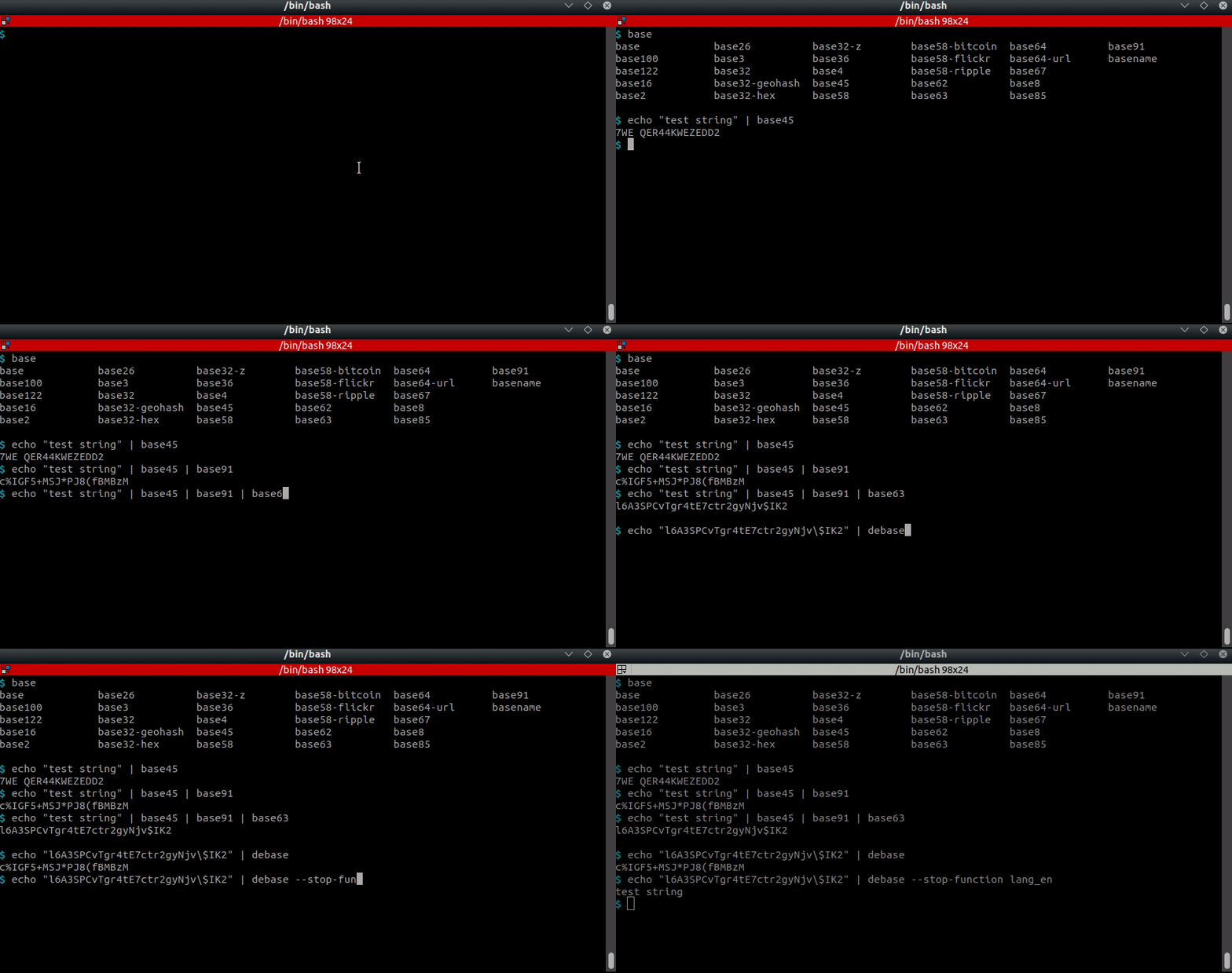
<p align="center"><img src="https://assets.kitploit.com/production/public/readmes/4821/fa4848c3f817288ed56845964755dbb4c4a0098c76af8a6ac6e5c89f849a8d5e.gif" alt="명령줄에서 base 도구 사용하기"></p>
<p align="center">명령줄 도구 unbase 사용하기</p>
## :computer: 사용법 (주요 CLI 도구) <a href="https://twitter.com/intent/tweet?text=CodExt%20-%20Encode%2Fdecode%20anything.%0D%0APython%20tool%20for%20encoding%20and%20decoding%20almost%20anything,%20including%20a%20guess%20feature%20based%20on%20AI.%0D%0Ahttps%3a%2f%2fgithub%2ecom%2fdhondta%2fpython-codext%0D%0A&hashtags=python,encodings,codecs,cryptography,morse,base,stegano,steganography,ctftools"><img src="https://img.shields.io/badge/Tweet%20(codext)--lightgrey?logo=twitter&style=social" alt="codext에 트윗하기" height="20"/></a>```session
$ codext -i test.txt encode dna-1
GTGAGCGGGTATGTGA
$ echo -en "test" | codext encode morse
- . ... -
$ echo -en "test" | codext encode braille
⠞⠑⠎⠞
$ echo -en "test" | codext encode base100
👫👜👪👫
$ echo -en "Test string" | codext encode reverse gnirts tseT
$ echo -en "Test string" | codext encode reverse morse --. -. .. .-. - ... / - ... . -
$ echo -en "Test string" | codext encode reverse morse dna-2 AGTCAGTCAGTGAGAAAGTCAGTGAGAAAGTGAGTGAGAAAGTGAGTCAGTGAGAAAGTCAGAAAGTGAGTGAGTGAGAAAGTTAGAAAGTCAGAAAGTGAGTGAGTGAGAAAGTGAGAAAGTC
$ echo -en "Test string" | codext encode reverse morse dna-2 octal 101107124103101107124103101107124107101107101101101107124103101107124107101107101101101107124107101107124107101107101101101107124107101107124103101107124107101107101101101107124103101107101101101107124107101107124107101107124107101107101101101107124124101107101101101107124103101107101101101107124107101107124107101107124107101107101101101107124107101107101101101107124103
$ echo -en "AGTCAGTCAGTGAGAAAGTCAGTGAGAAAGTGAGTGAGAAAGTGAGTCAGTGAGAAAGTCAGAAAGTGAGTGAGTGAGAAAGTTAGAAAGTCAGAAAGTGAGTGAGTGAGAAAGTGAGAAAGTC" | codext -d dna-2 morse reverse test string
### :twisted_rightwards_arrows: 매크로 사용하기```sh
$ codext add-macro my-encoding-chain gzip base63 lzma base64
$ codext list macros
example-macro, my-encoding-chain
$ echo -en "Test string" | codext encode my-encoding-chain
CQQFAF0AAIAAABuTgySPa7WaZC5Sunt6FS0ko71BdrYE8zHqg91qaqadZIR2LafUzpeYDBalvE///ug4AA==
$ codext remove-macro my-encoding-chain
$ codext list macros
example-macro
baseXX CLI tools) base 인코딩 다루기.```session $ echo "Test string !" | base122 *.7!ft9�-f9Â
$ echo "Test string !" | base91 "ONK;WDZM%Z%xE7L
$ echo "Test string !" | base91 | base85 B2P|BJ6A+nO(j|-cttl%
$ echo "Test string !" | base91 | base85 | base36 | base58-flickr QVx5tvgjvCAkXaMSuKoQmCnjeCV1YyyR3WErUUErFf
$ echo "Test string !" | base91 | base85 | base36 | base58-flickr | base58-flickr -d | base36 -d | base85 -d | base91 -d Test string !
(입력된 콘텐츠가 없습니다. 번역할 마크다운 내용을 제공해 주세요.)```session
$ echo "Test string !" | base91 | base85 | base36 | base58-flickr | unbase -m 3
Test string !
$ echo "Test string !" | base91 | base85 | base36 | base58-flickr | unbase -f Test
Test string !
codecs 나열.```session
$ codext list encodings
a1z26 adler32 affine alternative-rot ascii
atbash autoclave bacon barbie base
base1 base2 base3 base4 base8
<>
이름을 기준으로 코덱 찾기.```session
$ codext search bitcoin
base58
문자열 인코딩.```sesssion $ echo -en "This is a test" | codext encode polybius 44232443 2443 11 44154344
파일 인코딩 중.```session
$ echo -en "this is a test" > to_be_encoded.txt
$ codext encode base64 < to_be_encoded.txt > text.b64
$ cat text.b64
dGhpcyBpcyBhIHRlc3Q=
코덱 체이닝.```session $ echo -en "mrdvm6teie6t2cq=" | codext encode upper | codext decode base32 | codext decode base64 test
반복적으로 디코딩을 추측합니다.```session
$ echo -en "test" | codext encode base64 gzip | codext guess
Codecs: gzip
dGVzdA==
$ echo -en "test" | codext encode base64 gzip | codext guess gzip -i base
Codecs: gzip, base64
test
사용 가능한 코덱 목록을 가져옵니다.```python
import codext
codext.list() ['ascii85', 'base85', 'base100', 'base122', ..., 'tomtom', 'dna', 'html', 'markdown', 'url', 'resistor', 'sms', 'whitespace', 'whitespace-after-before']
Playing with some base encodings.
>>> codext.encode("this is a test", "base58-bitcoin")
'jo91waLQA1NNeBmZKUF'
>>> codext.encode("this is a test", "base58-ripple")
'jo9rA2LQwr44eBmZK7E'
>>> codext.encode("this is a test", "base58-url")
'JN91Wzkpa1nnDbLyjtf'
>>> codecs.encode("this is a test", "base100")
'👫👟👠👪🐗👠👪🐗👘🐗👫👜👪👫'
>>> codecs.decode("👫👟👠👪🐗👠👪🐗👘🐗👫👜👪👫", "base100")
'this is a test'```
Playing with some cryptography-based codecs.
```python
>>> codext.encode("This is a test !", "vigenere-MYSECRETKET")
'Ffaw kj e mowm !'
>>> codext.encode("This is a test !", "autoclave-SECRET")
'Llkj ml t amkb !'```
Encoding/decoding with various other codecs.
```python
>>> for i in range(8):
print(codext.encode("this is a test", "dna-%d" % (i + 1)))
GTGAGCCAGCCGGTATACAAGCCGGTATACAAGCAGACAAGTGAGCGGGTATGTGA
CTCACGGACGGCCTATAGAACGGCCTATAGAACGACAGAACTCACGCCCTATCTCA
ACAGATTGATTAACGCGTGGATTAACGCGTGGATGAGTGGACAGATAAACGCACAG
AGACATTCATTAAGCGCTCCATTAAGCGCTCCATCACTCCAGACATAAAGCGAGAC
TCTGTAAGTAATTCGCGAGGTAATTCGCGAGGTAGTGAGGTCTGTATTTCGCTCTG
TGTCTAACTAATTGCGCACCTAATTGCGCACCTACTCACCTGTCTATTTGCGTGTC
GAGTGCCTGCCGGATATCTTGCCGGATATCTTGCTGTCTTGAGTGCGGGATAGAGT
CACTCGGTCGGCCATATGTTCGGCCATATGTTCGTCTGTTCACTCGCCCATACACT
>>> codext.decode("GTGAGCCAGCCGGTATACAAGCCGGTATACAAGCAGACAAGTGAGCGGGTATGTGA", "dna-1")
'this is a test'
>>> codecs.encode("this is a test", "morse")
'- .... .. ... / .. ... / .- / - . ... -'
>>> codecs.decode("- .... .. ... / .. ... / .- / - . ... -", "morse")
'this is a test'
>>> with open("morse.txt", 'w', encoding="morse") as f:
f.write("this is a test")
14
>>> with open("morse.txt",encoding="morse") as f:
f.read()
'this is a test'
>>> print(codext.encode("An example test string", "baudot-tape"))
***.**
. *
***.*
* .
.*
* .*
. *
** .*
***.**
** .**
.*
* .
* *. *
.*
* *.
* *. *
* .
* *.
* *. *
***.
*.*
***.*
* .*```
## :page_with_curl: List of codecs
#### [BaseXX](https://python-codext.readthedocs.io/en/latest/enc/base)
- [X] `base1`: useless, but for the sake of completeness
- [X] `base2`: simple conversion to binary (with a variant with a reversed alphabet)
- [X] `base3`: conversion to ternary (with a variant with a reversed alphabet)
- [X] `base4`: conversion to quarternary (with a variant with a reversed alphabet)
- [X] `base8`: simple conversion to octal (with a variant with a reversed alphabet)
- [X] `base10`: simple conversion to decimal
- [X] `base11`: conversion to digits with a "*a*"
- [X] `base16`: simple conversion to hexadecimal (with a variant holding an alphabet with digits and letters inverted)
- [X] `base26`: conversion to alphabet letters
- [X] `base32`: classical conversion according to the RFC4648 with all its variants ([zbase32](https://philzimmermann.com/docs/human-oriented-base-32-encoding.txt), extended hexadecimal, [geohash](https://en.wikipedia.org/wiki/Geohash), [Crockford](https://www.crockford.com/base32))
- [X] `base36`: [Base36](https://en.wikipedia.org/wiki/Base36) conversion to letters and digits (with a variant inverting both groups)
- [X] `base45`: [Base45](https://datatracker.ietf.org/doc/html/draft-faltstrom-base45-04.txt) DRAFT algorithm (with a variant inverting letters and digits)
- [X] `base58`: multiple versions of [Base58](https://en.bitcoinwiki.org/wiki/Base58) (bitcoin, flickr, ripple)
- [X] `base62`: [Base62](https://en.wikipedia.org/wiki/Base62) conversion to lower- and uppercase letters and digits (with a variant with letters and digits inverted)
- [X] `base63`: similar to `base62` with the "`_`" added
- [X] `base64`: classical conversion according to RFC4648 with its variant URL (or *file*) (it also holds a variant with letters and digits inverted)
- [X] `base67`: custom conversion using some more special characters (also with a variant with letters and digits inverted)
- [X] `base85`: all variants of Base85 ([Ascii85](https://fr.wikipedia.org/wiki/Ascii85), [z85](https://rfc.zeromq.org/spec/32), [Adobe](https://dencode.com/string/ascii85), [(x)btoa](https://dencode.com/string/ascii85), [RFC1924](https://datatracker.ietf.org/doc/html/rfc1924), [XML](https://datatracker.ietf.org/doc/html/draft-kwiatkowski-base85-for-xml-00))
- [X] `base91`: [Base91](http://base91.sourceforge.net) custom conversion
- [X] `base100` (or *emoji*): [Base100](https://github.com/AdamNiederer/base100) custom conversion
- [X] `base122`: [Base100](http://blog.kevinalbs.com/base122) custom conversion
- [X] `base-genericN`: see [base encodings](https://python-codext.readthedocs.io/en/latest/enc/base) ; supports any possible base
This category also contains `ascii85`, `adobe`, `[x]btoa`, `zeromq` with the `base85` codec.
#### [Binary](https://python-codext.readthedocs.io/en/latest/enc/binary)
- [X] `baudot`: supports CCITT-1, CCITT-2, EU/FR, ITA1, ITA2, MTK-2 (Python3 only), UK, ...
- [X] `baudot-spaced`: variant of `baudot` ; groups of 5 bits are whitespace-separated
- [X] `baudot-tape`: variant of `baudot` ; outputs a string that looks like a perforated tape
- [X] `bcd`: _Binary Coded Decimal_, encodes characters from their (zero-left-padded) ordinals
- [X] `bcd-extended0`: variant of `bcd` ; encodes characters from their (zero-left-padded) ordinals using prefix bits `0000`
- [X] `bcd-extended1`: variant of `bcd` ; encodes characters from their (zero-left-padded) ordinals using prefix bits `1111`
- [X] `excess3`: uses Excess-3 (aka Stibitz code) binary encoding to convert characters from their ordinals
- [X] `gray`: aka reflected binary code
- [X] `manchester`: XORes each bit of the input with `01`
- [X] `manchester-inverted`: variant of `manchester` ; XORes each bit of the input with `10`
- [X] `rotateN`: rotates characters by the specified number of bits (*N* belongs to [1, 7] ; Python 3 only)
#### [Checksums](https://python-codext.readthedocs.io/en/latest/enc/checksums)
- [X] `adler`: Adler32 algorithm (relies on `zlib`)
- [X] `crc`: CRC of lengths 8, 10-17, 21, 24, 30-32, 40, 64, 82 with a variety of polynoms
- [X] `luhn`: Luhn mod N algorithm
#### [Common](https://python-codext.readthedocs.io/en/latest/enc/common)
- [X] `a1z26`: keeps words whitespace-separated and uses a custom character separator
- [X] `cases`: set of case-related encodings (including camel-, kebab-, lower-, pascal-, upper-, snake- and swap-case, slugify, capitalize, title)
- [X] `dummy`: set of simple encodings (including integer, replace, reverse, word-reverse, substite and strip-spaces)
- [X] `octal`: dummy octal conversion (converts to 3-digits groups)
- [X] `octal-spaced`: variant of `octal` ; dummy octal conversion, handling whitespace separators
- [X] `ordinal`: dummy character ordinals conversion (converts to 3-digits groups)
- [X] `ordinal-spaced`: variant of `ordinal` ; dummy character ordinals conversion, handling whitespace separators
#### [Compression](https://python-codext.readthedocs.io/en/latest/enc/compressions)
- [X] `gzip`: standard Gzip compression/decompression
- [X] `lz77`: compresses the given data with the algorithm of Lempel and Ziv of 1977
- [X] `lz78`: compresses the given data with the algorithm of Lempel and Ziv of 1978
- [X] `pkzip_deflate`: standard Zip-deflate compression/decompression
- [X] `pkzip_bzip2`: standard BZip2 compression/decompression
- [X] `pkzip_lzma`: standard LZMA compression/decompression
> :warning: Compression functions are of course definitely **NOT** encoding functions ; they are implemented for leveraging the `.encode(...)` API from `codecs`.
#### [Cryptography](https://python-codext.readthedocs.io/en/latest/enc/crypto)
- [X] `affine`: aka Affine Cipher
- [X] `atbash`: aka Atbash Cipher
- [X] `autoclave`: aka Autoclave/Autokey Cipher (variant of Vigenere Cipher)
- [X] `bacon`: aka Baconian Cipher
- [X] `barbie-N`: aka Barbie Typewriter (*N* belongs to [1, 4])
- [X] `beaufort`: aka Beaufort Cipher (variant of Vigenere Cipher)
- [X] `citrix`: aka Citrix CTX1 password encoding
- [X] `phillips`: aka Phillips Cipher (polyalphabetic block cipher with 8 key squares)
- [X] `polybius`: aka Polybius Square Cipher
- [X] `railfence`: aka Rail Fence Cipher
- [X] `rotN`: aka Caesar cipher (*N* belongs to [1,25])
- [X] `scytaleN`: encrypts using the number of letters on the rod (*N* belongs to [1,[)
- [X] `shiftN`: shift ordinals (*N* belongs to [1,255])
- [X] `trithemius`: aka Trithemius Cipher (variant of Vigenere Cipher)
- [X] `vigenere`: aka Vigenere Cipher
- [X] `xorN`: XOR with a single byte (*N* belongs to [1,255])
> :warning: Crypto functions are of course definitely **NOT** encoding functions ; they are implemented for leveraging the `.encode(...)` API from `codecs`.
#### [Hashing](https://python-codext.readthedocs.io/en/latest/enc/hashing)
- [X] `blake`: includes BLAKE2b and BLAKE2s (Python 3 only ; relies on `hashlib`)
- [X] `crypt`: Unix's crypt hash for passwords (Python 3 and Unix only ; relies on `crypt`)
- [X] `md`: aka Message Digest ; includes MD4 and MD5 (relies on `hashlib`)
- [X] `sha`: aka Secure Hash Algorithms ; includes SHA1, 224, 256, 384, 512 (Python2/3) but also SHA3-224, -256, -384 and -512 (Python 3 only ; relies on `hashlib`)
- [X] `shake`: aka SHAKE hashing (Python 3 only ; relies on `hashlib`)
> :warning: Hash functions are of course definitely **NOT** encoding functions ; they are implemented for convenience with the `.encode(...)` API from `codecs` and useful for chaning codecs.
#### [Languages](https://python-codext.readthedocs.io/en/latest/enc/languages)
- [X] `braille`: well-known braille language (Python 3 only)
- [X] `ipsum`: aka lorem ipsum
- [X] `galactic`: aka galactic alphabet or Minecraft enchantment language (Python 3 only)
- [X] `leetspeak`: based on minimalistic elite speaking rules
- [X] `morse`: uses whitespace as a separator
- [X] `navajo`: only handles letters (not full words from the Navajo dictionary)
- [X] `radio`: aka NATO or radio phonetic alphabet
- [X] `southpark`: converts letters to Kenny's language from Southpark (whitespace is also handled)
- [X] `southpark-icase`: case insensitive variant of `southpark`
- [X] `tap`: converts text to tap/knock code, commonly used by prisoners
- [X] `tomtom`: similar to `morse`, using slashes and backslashes
#### [Others](https://python-codext.readthedocs.io/en/latest/enc/others)
- [X] `dna`: implements the 8 rules of DNA sequences (N belongs to [1,8])
- [X] `letter-indices`: encodes consonants and/or vowels with their corresponding indices
- [X] `markdown`: unidirectional encoding from Markdown to HTML
#### [Steganography](https://python-codext.readthedocs.io/en/latest/enc/stegano)
- [X] `hexagram`: uses Base64 and encodes the result to a charset of [I Ching hexagrams](https://en.wikipedia.org/wiki/Hexagram_%28I_Ching%29) (as implemented [here](https://github.com/qntm/hexagram-encode))
- [X] `klopf`: aka Klopf code ; Polybius square with trivial alphabetical distribution
- [X] `resistor`: aka resistor color codes
- [X] `rick`: aka Rick cipher (in reference to Rick Astley's song "*Never gonna give you up*")
- [X] `sms`: also called _T9 code_ ; uses "`-`" as a separator for encoding, "`-`" or "`_`" or whitespace for decoding
- [X] `whitespace`: replaces bits with whitespaces and tabs
- [X] `whitespace_after_before`: variant of `whitespace` ; encodes characters as new characters with whitespaces before and after according to an equation described in the codec name (e.g. "`whitespace+2*after-3*before`")
#### [Web](https://python-codext.readthedocs.io/en/latest/enc/web)
- [X] `html`: implements entities according to [this reference](https://dev.w3.org/html5/html-author/charref)
- [X] `url`: aka URL encoding
## :clap: Supporters
[](https://github.com/dhondta/python-codext/stargazers)
[](https://github.com/dhondta/python-codext/network/members)
<p align="center"><a href="#top"><img src="https://img.shields.io/badge/Back%20to%20top--lightgrey?style=social" alt="Back to top" height="20"/></a></p>