 d-diaa/swordstamp
Semantic Watermarking with Order-Robust Detection over Sub-sentence Units

SwordStamp adds order-robust detection and semantic-span units to embedding-based semantic watermarks. This artifact contains the exact paper configuration, generation and detection code, the unchanged attack suite, quality evaluation, and deterministic result extraction and plotting.
Paper: Semantic Watermarking with Order-Robust Detection over Sub-sentence Units (arXiv:2608.27666)
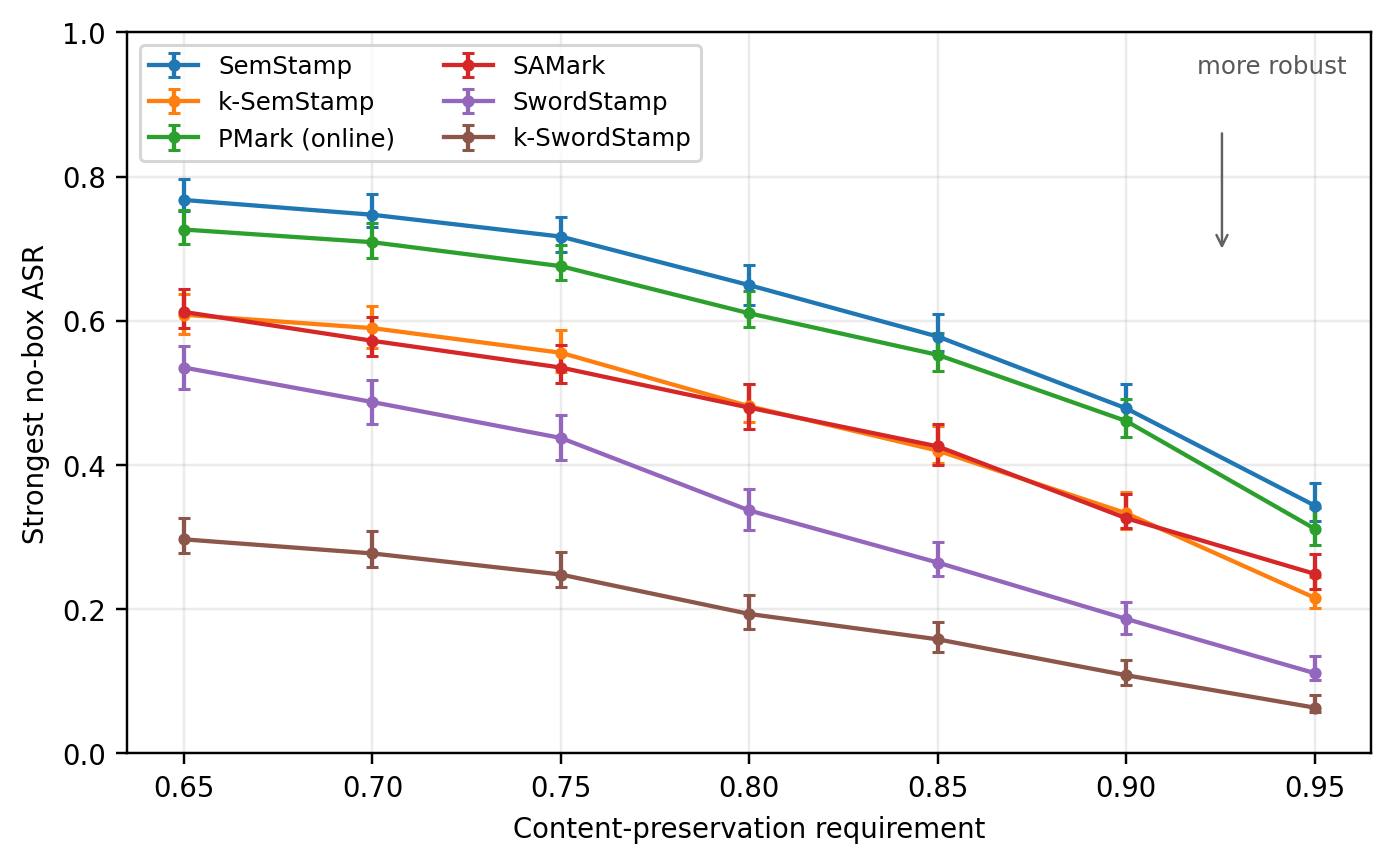
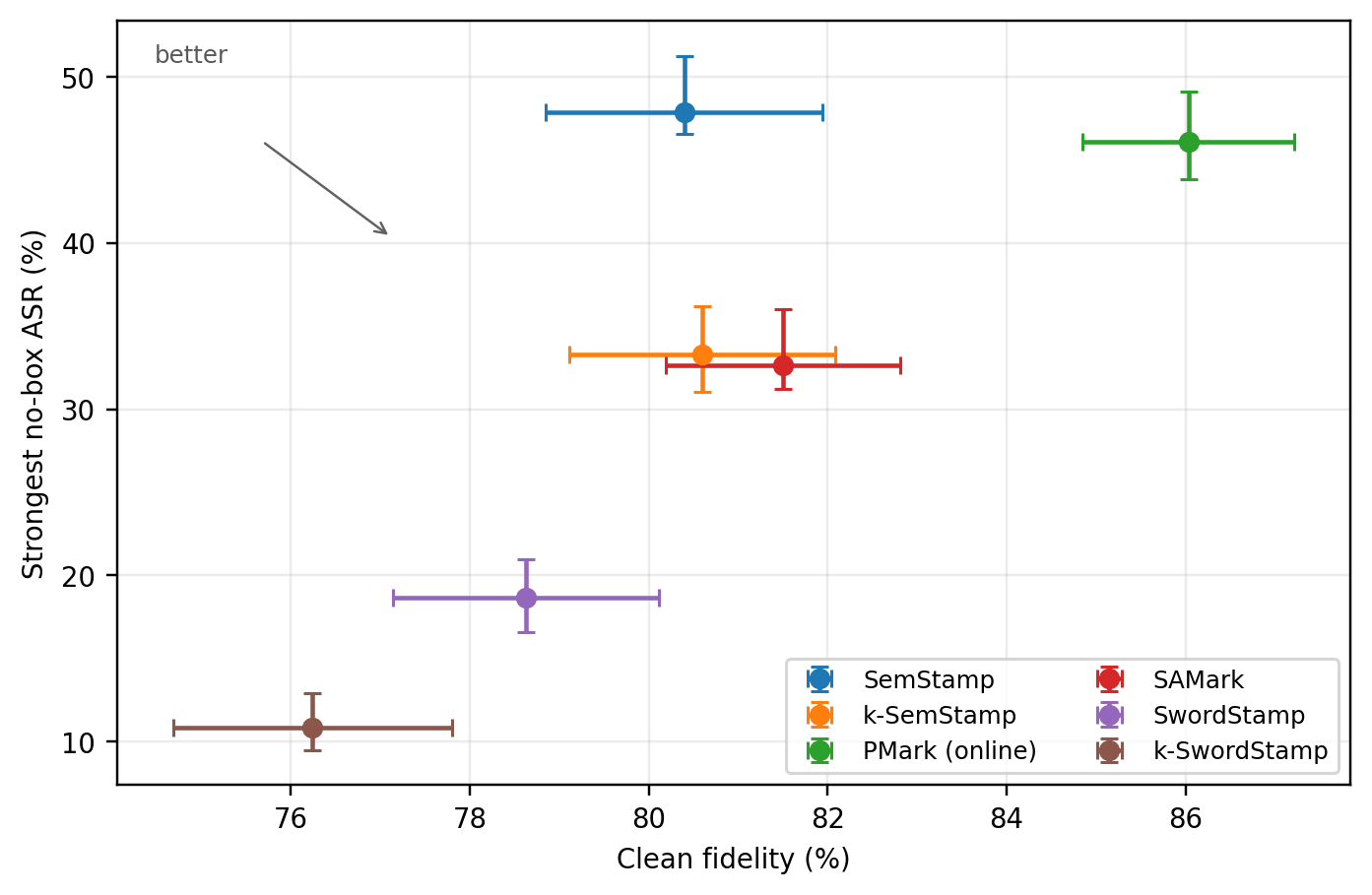
At 5% false-positive rate and a 90% content-preservation requirement, the scheme-specific embedding displacement attack (EDA-S) achieves:
| Watermark | EDA-S attack success rate |
|---|---|
| SemStamp | 47.9% |
| k-SemStamp | 33.3% |
| PMark | 46.1% |
| SAMark | 32.6% |
| SwordStamp | 18.7% |
| k-SwordStamp | 10.8% |
Relative to their published baselines, SwordStamp and k-SwordStamp reduce EDA-S success by 29.2 and 22.5 percentage points, at clean-fidelity costs of 1.8 and 4.4 points. Their clean detection rates are 94.9% and 97.0%. Under the stronger detector-access EDA-D stress test, maximum quality-gated success is 39.7% on k-SwordStamp versus 65.5% on k-SemStamp.
These results cover English news continuations, one provider model, two provider encoders, and one EDA paraphraser/surrogate pair.
visualization consumes only the compiled CSV/Parquet bundle. It fails on
missing paper cells rather than drawing a partial figure.
uv sync --frozen --only-group plot --no-install-project
uv run --no-sync python -m visualization extract \
  --bundle results/paper --output results/paper
uv run --no-sync python -m visualization render \
  --bundle results/paper --output results/paper
This writes auditable tables under results/paper/tables/ and seven figures in
PNG and PDF under results/paper/figures/. The anonymous review branch includes
the compiled bundle; a full run on the release branch creates the same files
with python -m visualization compile.
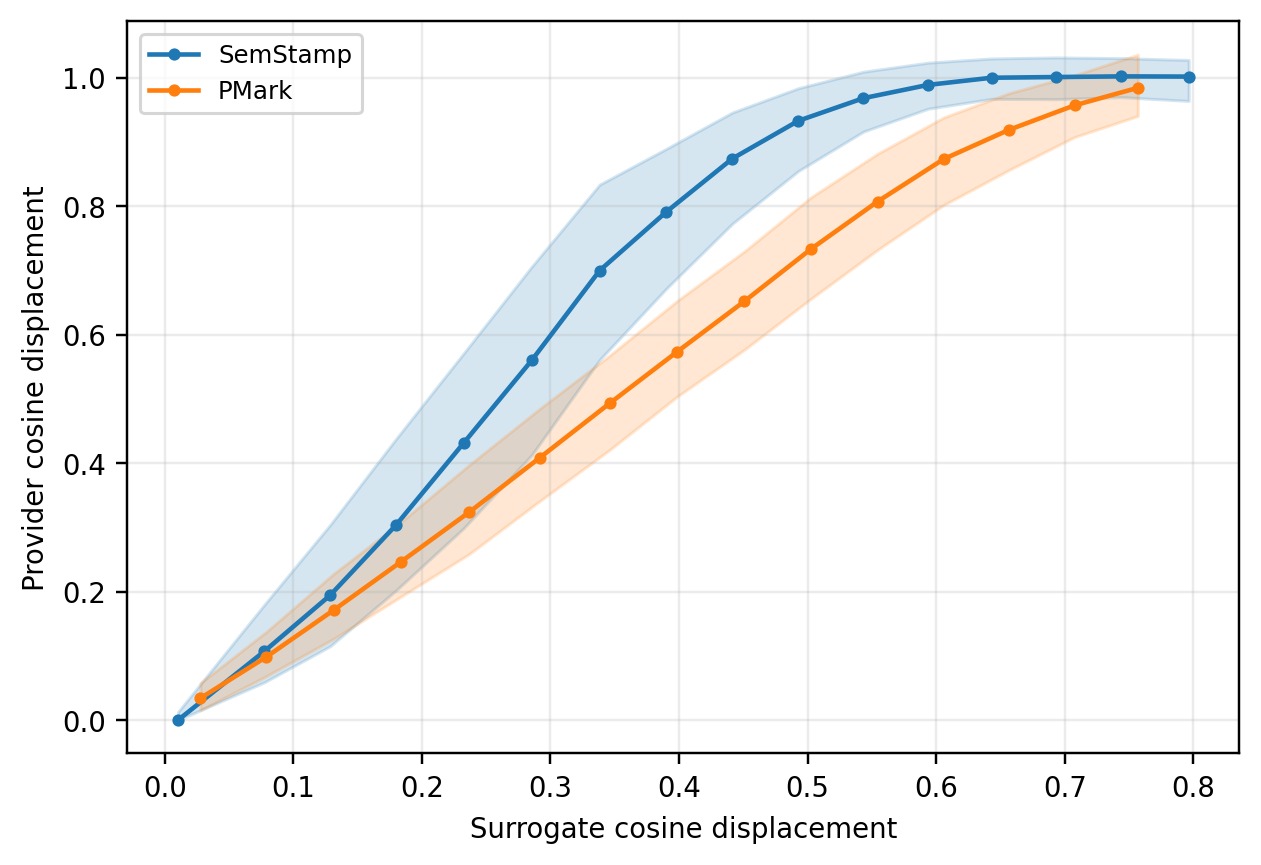
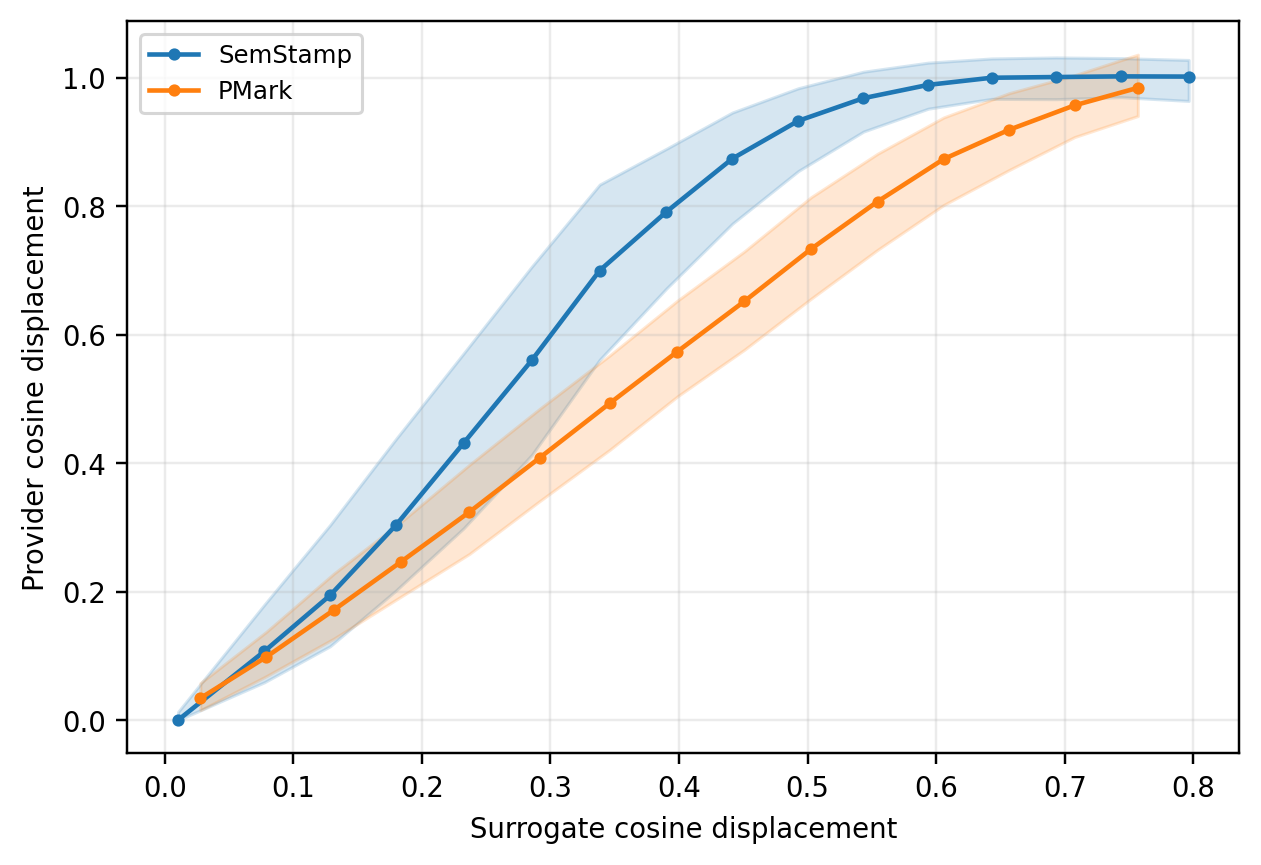
The embedding displacement attack (EDA) is an adaptive whole-text paraphrasing
attack. At each output unit it
samples K continuations and keeps the candidate with the largest cosine
displacement from its source anchor under a surrogate encoder. Because every
candidate continues the full rewrite prefix, one objective can reword content,
reorder it, and split or merge detector units.
No-box EDA sees the marked text and the public watermark design. It does not query the detector or generator and receives no secret key, provider encoder, or quality oracle.
| Variant | Anchor and unit | Configuration |
|---|---|---|
| EDA-P | positional sentence | adaptive, anchor=positional, attacker unit sentence |
| EDA-S | target's public design | positional sentences for SemStamp, k-SemStamp, and PMark; bag/sentence for SAMark; bag/semspan for both SwordStamp variants |
| EDA-D | provider detector | oracle; inherits the defender encoder, partition, and segmentation |
For bag anchoring, the paper uses attack.bag_agg=min: maximize distance from
the nearest source anchor. Reported no-box runs use
Qwen/Qwen2.5-3B-Instruct, BAAI/bge-base-en-v1.5,
K={1,2,4,8,16,32,64}, temperature 1.0, top-p 0.95, at most 96 tokens per
candidate, and at most 512 rewrite tokens.
Other watermark designers can call EDA directly:
from attacks.paraphrasing.adaptive import adaptive_attack_paraphrase

attacked = adaptive_attack_paraphrase(
    texts,
    base_model="Qwen/Qwen2.5-3B-Instruct",
    surrogate_model="BAAI/bge-base-en-v1.5",
    num_candidates=32,
    anchor="positional",       # EDA-P; use "bag" for an order-robust design
    bag_agg="min",
    segmentation_type="sentence",
    segmentation_backend="nltk",
)
For the paper's SwordStamp-aware EDA-S, set anchor="bag",
segmentation_type="semspan", semcut_max_words=15, and
semcut_window=5. Within this repository the equivalent CLI is:
uv run python -m attacks DATA_PATH --config PRESET \
  --set attack.paraphraser=adaptive \
  --set attack.custom_model=Qwen/Qwen2.5-3B-Instruct \
  --set attack.surrogate_model=BAAI/bge-base-en-v1.5 \
  --set attack.num_candidates=32 \
  --set attack.anchor=bag --set attack.bag_agg=min \
  --set segmentation.attacker_type=semspan \
  --set segmentation.attacker_backend=nltk
DATA_PATH is always the base corpus and PRESET identifies the watermarked
cell. See attacks/README.md for all retained attacks and configuration fields.
config/paper.py is the single source of truth. For each of LSH and k-means,
scripts/experiments/swordstamp.sh runs this five-rung additive ladder with 64
provider candidates:
The grid contains only these ten cells and one no-watermark baseline. PMark is
online-only; SAMark uses one flag pattern per run. EDA-D budgets are
K={4,8,16,32,64}.
The comparison submodules adapt the public PMark and SAMark evaluation sources only at their dataset/result boundaries and shared false-positive calibration; the watermark algorithms are unchanged.
Prerequisites are Git, uv, Python 3.11, CUDA for model runs, access to the pinned model revisions, and scratch storage.
git clone --recurse-submodules [email protected]:D-Diaa/SwordStamp.git
cd SwordStamp
bash scripts/setup.sh
uv run --frozen python scripts/check_artifact.py
Prepare the deterministic, disjoint C4 partitions:
uv run --frozen python scripts/prepare_c4.py --output-dir data
Install and configure the pinned scheduler. The installer prints its user-level side effects before changing anything:
bash scripts/install_gpu_scheduler.sh --print-plan
bash scripts/install_gpu_scheduler.sh --yes
gpu-scheduler init --gpus 0,1
gpu-scheduler start
Preview, then submit every physical shard:
for shard in c4-val-def-256 c4-val-def-256b c4-val-def-512; do
  BASE="data/$shard" DRY_RUN=1 bash scripts/experiments/swordstamp.sh
  BASE="data/$shard" DRY_RUN=1 bash scripts/experiments/pmark.sh
  BASE="data/$shard" DRY_RUN=1 bash scripts/experiments/samark.sh
done
# Remove DRY_RUN=1 after inspecting the exact DAGs.
Compile, extract, and render:
uv run --frozen python -m visualization all \
  --bundle results/paper --output results/paper
The scheduler supplies CUDA_VISIBLE_DEVICES; do not select GPUs by probing
nvidia-smi. Full reproduction is a multi-day GPU workload. ARTIFACT.md
lists hardware, model revisions, expected outputs, and the claim-to-command
map. scripts/experiments/README.md documents resume and force behavior.
