 bunnybuzz/enigma
Native C++ reverse-engineering engine with disassembly, decompilation, and analysis pipeline for PE/ELF binaries, featuring interactive GUI and Ghidra-compatible decompiler.

Give AI agents access to real binary-analysis capabilities — not just reverse-engineering prompts.



Enigma is a native C++ reverse-engineering engine inspired by Ghidra's analysis pipeline. It provides the core capabilities needed to inspect, disassemble, analyze, and decompile executable binaries, with an architecture intended to make those capabilities usable by AI agents as well as by human analysts.
Traditional reverse-engineering workflows often make the analyst navigate a GUI, inspect individual instructions, follow references, and manually connect findings. Enigma's direction is different: expose the underlying analysis capabilities so an agent can perform focused investigations, follow evidence across a program, and report what it finds — while a human can inspect and direct the work.
Enigma is an analysis engine, not an LLM and not merely a prompt collection. Its analysis is performed by native tooling; an AI agent provides the reasoning and orchestration around those capabilities.
SHA-256 verified identical to the source: "4D0AC76047ADA91AF8ADECE92D151D691CF6661C384FDB4C690EB0B20D6D6CEB"
Enigma's loading pipeline supports multiple executable and object-file formats:
.gzf, .gbf, and .repThe engine maintains a program model containing memory, instructions, functions, symbols, references, data types, relocations, and related analysis state.
Analysis capabilities include:
Enigma includes a Qt-independent control-flow model and a Function Graph view.
Terminology: a Function Graph represents control flow within a function. It is distinct from a program-wide Call Graph, which represents caller/callee relationships between functions.
Enigma integrates Ghidra's native C++ decompiler library and provides a native C++ program model around it.
Available functionality includes C-like decompilation, type information, function signatures, symbols, comments, and other program metadata used during analysis.
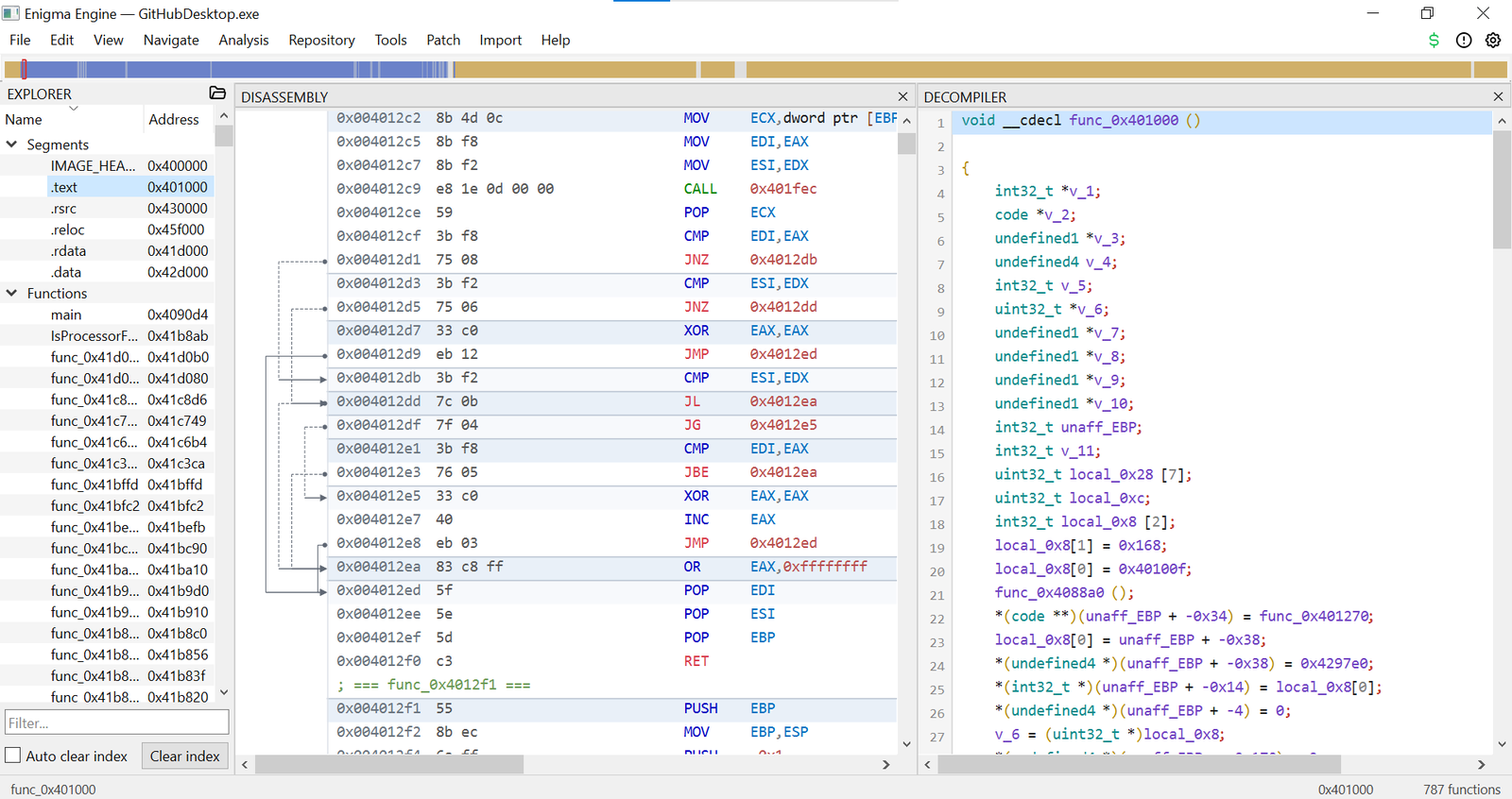
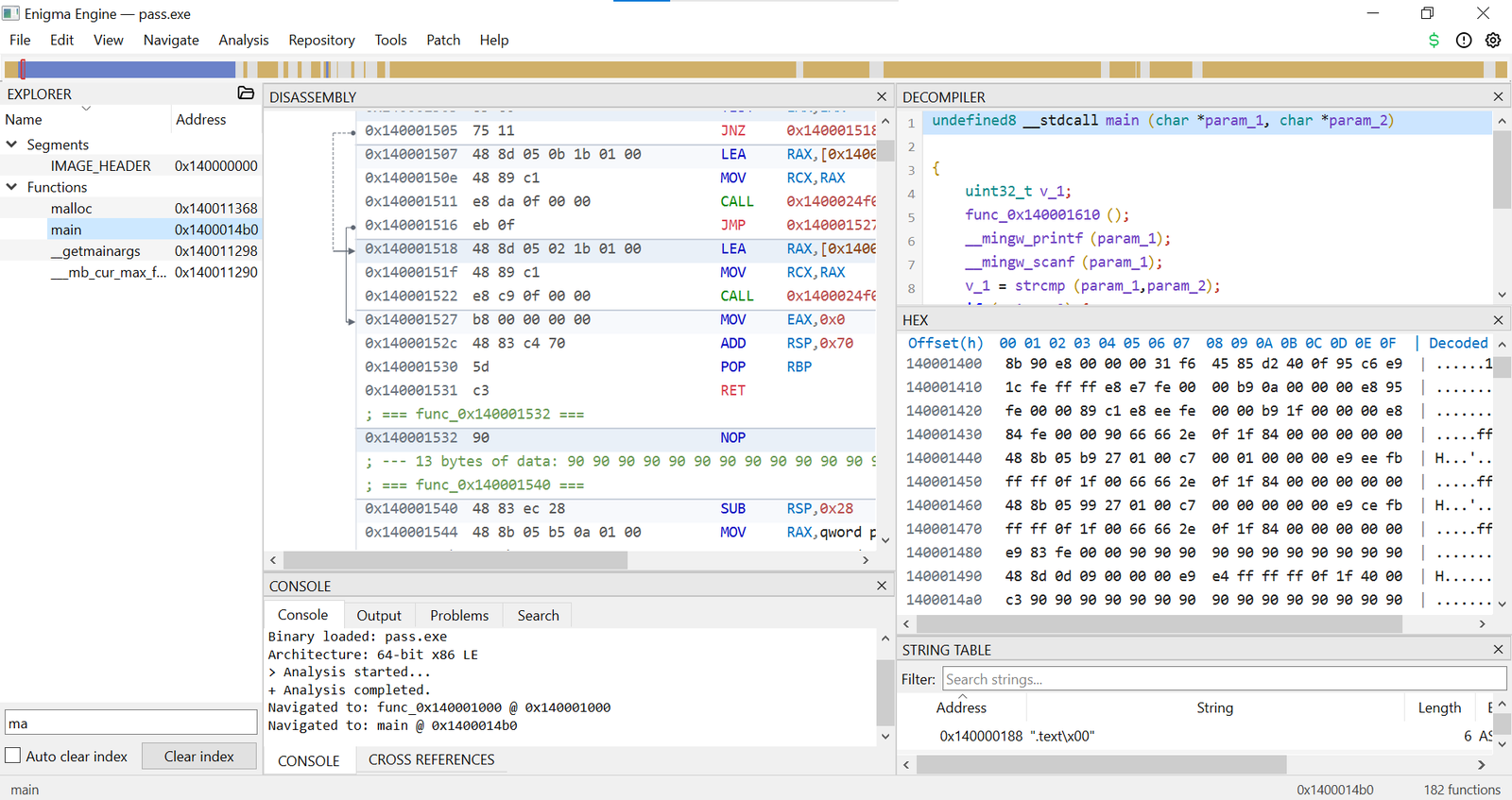
The Qt 6 interface provides a human-inspection environment for the engine:
The GUI is one way to inspect and direct analysis; it is not the definition of the engine itself.
Enigma is being developed around an agent-oriented workflow. The goal is to let an AI agent use reverse-engineering capabilities as concrete operations rather than imitate a human clicking through a desktop application.
An agent-assisted investigation can be organized as follows:
The repository includes agent-facing instructions. The exact operations available to an agent depend on the tools and interfaces present in the installed Enigma build. Consult the repository's current agent instructions and each tool's help output; do not assume that a separate MCP server or dynamic plugin interface is available unless it is explicitly provided by the build.
flowchart TD
    A[Executable or project] --> B[Binary loader / project importer]
    B --> C[Native program model]
    C --> D[Disassembly and P-code]
    D --> E[Automatic analysis]
    E --> F[Functions, symbols, types, references]
    F --> G[Control-flow model]
    F --> H[Decompiler]
    G --> I[Function Graph]
    C --> J[Project storage]
    D --> K[Agent-facing tools and workflows]
    E --> K
    G --> K
    H --> K
    F --> K
    K --> L[AI agent orchestration]
    I --> M[Human inspection through Qt GUI]
    H --> M
    D --> M
Enigma uses selected Ghidra technologies where they provide the low-level processor and decompilation functionality required by the project. The surrounding program model, analysis pipeline, storage layer, loaders, and Qt interface are implemented natively in Enigma.
| Component | Origin |
|---|---|
| Native decompiler library | Ghidra C++ decompiler |
| SLEIGH processor specifications | Ghidra |
| Program model | Native Enigma C++ implementation |
| Memory, symbols, references, and data-type systems | Native Enigma C++ implementation |
| Analysis pipeline | Native Enigma C++ implementation |
| Binary loading | Native Enigma implementation |
| Project storage | Native Enigma implementation |
| Desktop interface | Native Qt 6 implementation |
flatcgit clone https://github.com/BunnyBuzz/Enigma.git
cd Enigma/Enigma-Engine
cmake -B build -G Ninja -DCMAKE_BUILD_TYPE=Release -DENABLE_GUI=ON
cmake --build build
ctest --test-dir build --output-on-failure