 arpsyndicate/puncia
Panthera(P.)uncia - Official CLI utility for Subdomain Center & Exploit Observer.




Puncia is the official command-line client for two A.R.P. Syndicate intelligence APIs — point it at a domain, a brand, or a vulnerability ID and get structured JSON back in seconds, no browser required:
$ puncia subdomain arpsyndicate.io
╭──────────────────────────────────────────────────────────────────────╮
│ Panthera(P.)uncia v0.36                                              │
│ subdomain recon · brand impersonation · exploit intel · sbom analysis│
│ A.R.P. Syndicate — https://www.arpsyndicate.io                       │
╰──────────────────────────────────────────────────────────────────────╯
[
  "advisories.arpsyndicate.io",
  "asm.arpsyndicate.io",
  "blog.arpsyndicate.io",
  ...
]

$ puncia sbom bom.json ./out
puncia ━━━━━━━━━━━━━━━━━━━━━━━━━━━━━━━━━━━━━━━━ 100% (128/128) 0:00:41
Please note that although these results can sometimes be pretty inaccurate & unreliable, they can greatly differ from time to time due to their self-improvement capabilities.
Aggressive rate-limits can be avoided with an API key: https://www.arpsyndicate.io/pricing.html
pip3 install punciapip3 install .pip3 install puncia
# subdomain footprint of a target (shadow IT / attack surface / takeover recon)
puncia subdomain example.com
# lookalike / typosquat / brand-impersonation domains
puncia replica example.com
# what's known about a CVE
puncia exploit CVE-2021-44228
puncia <mode> <query> [output] [--match M] [--domain D] [--limit N] [--offset N]
                               [--crawl] [--api-key K] [--concurrency N]
                               [--timeout S] [--retries N] [--quiet]
Run puncia --help for the full reference. Results are printed to stdout; the
banner, progress bars, warnings and errors all go to stderr, so
puncia subdomain example.com > out.json always yields clean, valid JSON.
Exit codes: 0 success · 1 request or input error · 2 usage error.
(PAID) Store an API key (storekey) - puncia storekey <api-key>
~/.puncia with 0600 permissions. $PUNCIA_API_KEY overrides it,
which is usually what you want in CI.(FREEMIUM) Query Domains, clustered by domain (subdomain / cuttlefish engine) - puncia subdomain <domain> <output-file>
subdomain/replica/keyword walk every page and merge
them for you. Pass --offset (with or without --limit) to fetch exactly
one raw page yourself instead, e.g. for a resumable or streaming walk:
puncia subdomain bigco.com --limit 50000 --offset 0
# stderr prints: note: more results available — continue with --offset 50000
puncia subdomain bigco.com --limit 50000 --offset 50000
import asyncio
import puncia

async def main():
   # Without an API key (ratelimited)
   print(await puncia.query_api("exploit", "CVE-2021-3450"))
   print(await puncia.query_api("subdomain", "arpsyndicate.io"))

   # With an API key
   await puncia.store_key("ARPS-xxxxxxxxxx")
   api_key = await puncia.read_key()
   print(await puncia.query_api("subdomain", "arpsyndicate.io", apikey=api_key))
   print(await puncia.query_api("replica", "arpsyndicate.io", match="exact", apikey=api_key))
   print(await puncia.query_api("enrich", "CVE-2021-3450", apikey=api_key))
   print(await puncia.query_api("noncve", "exploitable", apikey=api_key))

   # Static endpoints (unauthenticated, unlimited)
   print(await puncia.query_api("subdomain", "^HEALTH"))
   print(await puncia.query_api("exploit", "^STATS"))

   # Live crawl, with the outcome surfaced via a callback
   await puncia.query_api(
       "subdomain", "bigco.com", apikey=api_key, crawl=True,
       on_crawl=lambda h: print("crawl status:", h.get("X-Crawl-Status")),
   )

   # Write straight to disk
   await puncia.query_api("subdomain", "arpsyndicate.io", "out.json", apikey=api_key)

asyncio.run(main())
Failures raise puncia.PunciaError; an empty result ({} / []) is returned
as-is rather than being treated as an error. Reuse one session across many
queries by passing session= and a shared limiter=, exactly as
process_bulk() does.
from puncia import PunciaError, query_api

try:
    data = await query_api("exploit", "CVE-2021-3450", apikey=api_key)
except PunciaError as exc:
    print(f"lookup failed: {exc}")
git clone https://github.com/ARPSyndicate/puncia && cd puncia
pip install --upgrade pip     # editable installs need pip >= 21.3
pip install -e ".[dev]"
pytest                        # 42 offline tests, no API calls or network access
The test suite is fully offline — it covers URL construction, output-path containment, SBOM parsing, bulk planning and ratelimiter timing without touching the network, so it is safe to run in any environment.
--limit--offset--crawl supplements stored results
with a live discovery pass. A given domain is only actually re-crawled
once every ~6h — requests inside that window get the cached crawl result
instantly. Puncia reports the outcome on stderr:
crawl: fresh, 12 newly discovered name(s) (also partial / cooldown /
disabled).
puncia subdomain bigco.com --crawl
(FREEMIUM) Query Replica Domains, clustered by brand (replica / octopus engine) - puncia replica <domain> --match <prefix|exact|substring> <output-file>
(FREEMIUM) Query by Keyword, clustered by keyword (keyword / ammonites engine) - puncia keyword <keyword> --match <exact|prefix> <output-file>
--domain:
puncia keyword blog --domain bandcamp.comQuery Exploit & Vulnerability Identifiers (exploit)
puncia exploit ^WATCHLIST_IDES <output-file>puncia exploit ^WATCHLIST_INFO <output-file>puncia exploit ^WATCHLIST_TECH <output-file>puncia exploit ^STATS <output-file>puncia exploit ^HEALTH <output-file>puncia exploit <eoidentifier> --match <substring|prefix|exact> <output-file>(FREEMIUM) Enrich CVE/GHSA Identifiers (enrich) - puncia enrich <cve-id/ghsa-id> <output-file>
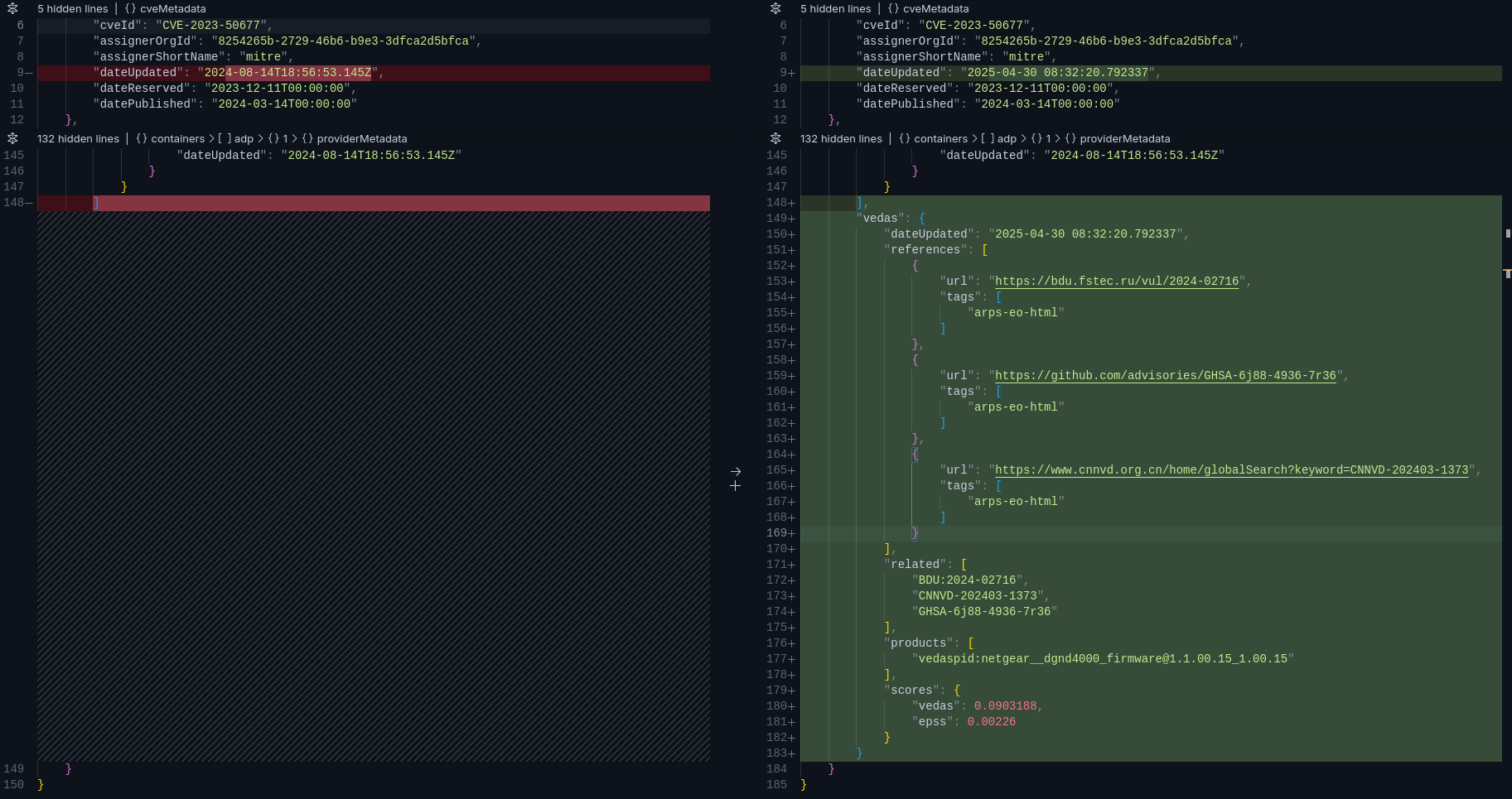
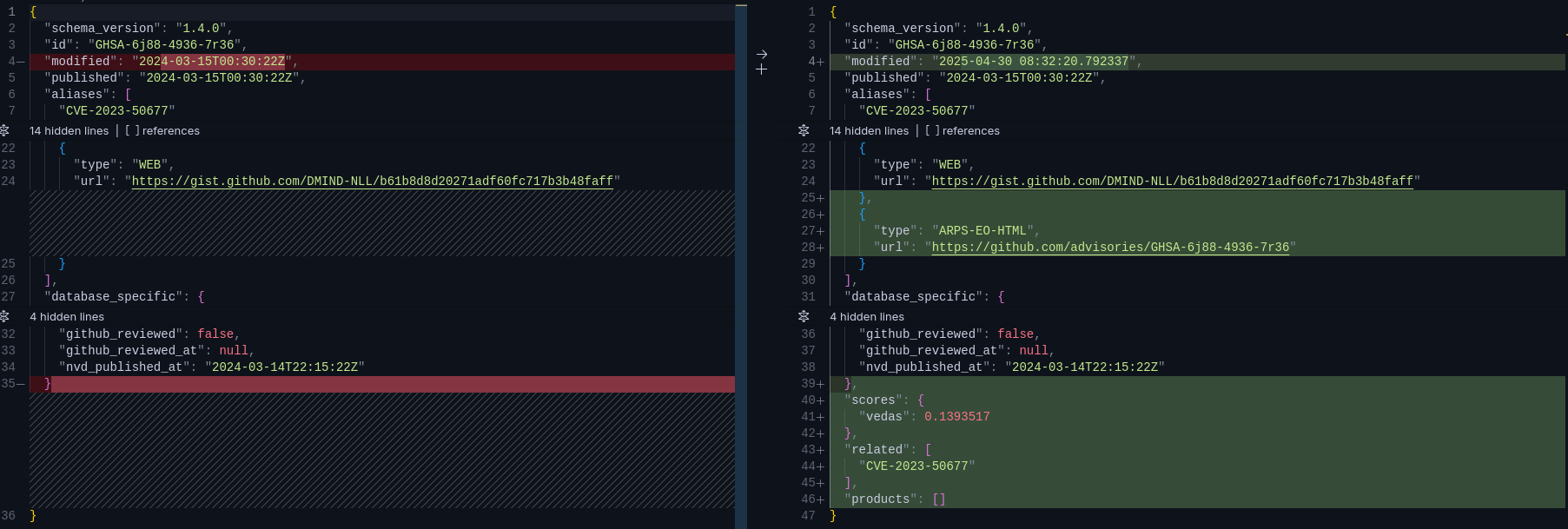
enrich=true only takes effect for CVE-/GHSA- identifiers; it merges
the full upstream advisory record with EPSS + VEDAS scoring.(PAID) Non-CVE Identifiers by VEDAS group (noncve) - puncia noncve <browser/china/russia/europe/exploitable> <output-file>
(FREE) Subdomain Center service health (^HEALTH) - puncia subdomain ^HEALTH <output-file>
Multiple Queries (bulk/sbom)
puncia bulk <json-file> <output-directory>
{
    "subdomain": [
        "domainA.com",
        "domainB.com"
    ],
    "replica": [
        "domainA.com",
        "domainB.com"
    ],
    "keyword": [
        "keywordA",
        "keywordB"
    ],
    "exploit": [
        "eoidentifierA",
        "eoidentifierB"
    ],
    "enrich": [
        "eoidentifierA",
        "eoidentifierB"
    ]
}
puncia sbom <json-file> <output-directory>Bulk and SBOM runs de-duplicate queries, cap parallelism at --concurrency
(default 10), and — when no API key is present — pace requests to stay inside
the free-tier budget automatically.
(FREEMIUM) External Import
