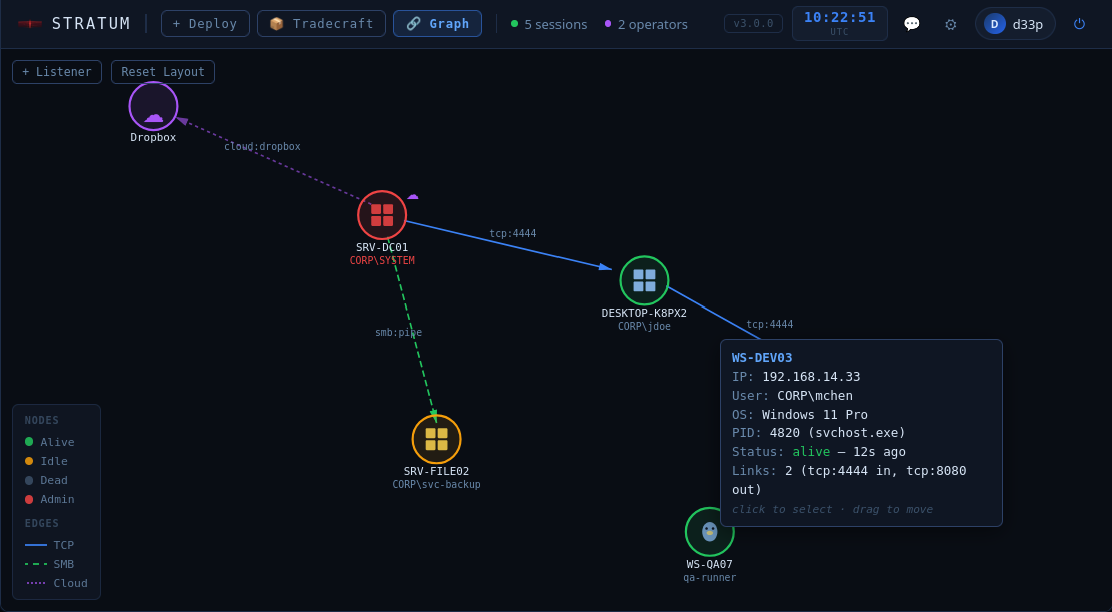
Cloud dead-drop C2 framework — RSA-4096 + AES-256-GCM, 5 cloud providers, Rust-only agents, P2P mesh, persistence engine, credential harvesting
Cloud Persistence Framework · v3.0.2
A fallback foothold that routes through infrastructure defenders can't block.




Your primary C2 goes silent. The domain gets blacklisted. The beacon gets flagged. The EDR kills the process. You're out.
You need a second channel — one that was never going to get blocked in the first place.
What if command-and-control traffic looked exactly like an employee syncing files to Dropbox?
That's Stratum. Commands and responses travel as ordinary files inside a cloud storage folder. The agent never connects to attacker infrastructure. The only observable traffic is HTTPS to a provider the target's firewall already whitelists — because blocking Dropbox or OneDrive means blocking every employee who uses it.
No teamserver. No attacker-owned domain. No suspicious TLS certificate. Nothing to block.
  OPERATOR                   CLOUD PROVIDER               TARGET
  ────────                   ─────────────                ──────
                             /Machine1/
  WebGUI ──HTTPS──►          input.txt   🔒  ◄── poll ── agent
                             output.txt  🔒  ──► read ──┘
                             heartbeat.txt    (encrypted beacon)
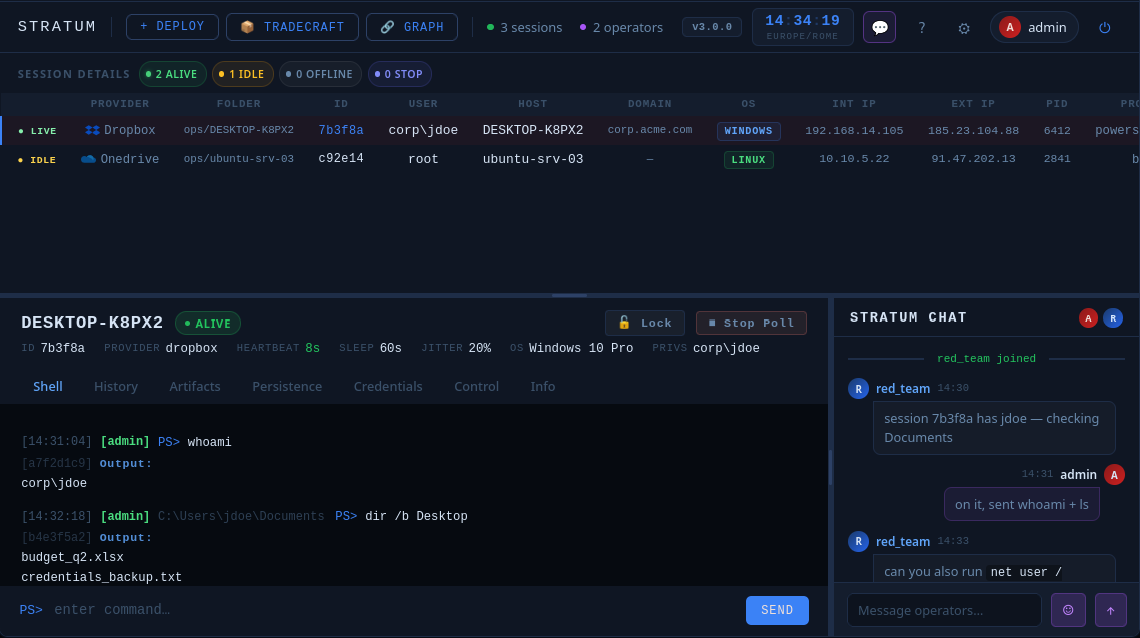
The agent wakes on a configurable interval (+ log-normal jitter), reads the input file, executes, encrypts the response, uploads it, and sleeps. Everything encrypted end-to-end with RSA-4096-OAEP + AES-256-GCM. The operator's IP never appears in any network log on the target side.
| Provider | Notes | |
|---|---|---|
 | Dropbox | OAuth2 refresh token · Business and personal accounts |
 | Microsoft OneDrive | Microsoft Graph API · Personal and M365 accounts |
 | Google Drive | Google Drive API v3 · OAuth2 service flow |
 | SharePoint Online | Microsoft Graph API · M365 tenant sites |
 | S3-compatible | AWS S3 · DigitalOcean Spaces · Backblaze B2 · any S3 endpoint |
All five share the same wire format, the same RSA keypair, and the same operator session. Switch provider mid-engagement in minutes without touching the agent. No other open-source framework ships this out of the box.
A SOC that wants to stop C2 blocks the teamserver domain or fronted infrastructure. A SOC that wants to stop Stratum has to block Dropbox, OneDrive, Google Drive, SharePoint, and S3 simultaneously. That's not a firewall rule — it's a business decision no enterprise is going to make. The dead-drop architecture doesn't try to evade detection. It operates on infrastructure the defender has already decided to trust, permanently.
| Format | Platform | Dependencies |
|---|---|---|
.exe / .dll | Windows | None — Rust-compiled PE (MSVC-ABI), no interpreter, no PowerShell in process tree |
.elf | Linux | None — Rust-compiled musl-static, runs on any x86_64 Linux |
.bin | Linux / Windows | x64 PIC shellcode — drop into any external loader or injector |
The wizard generates all of them. You answer prompts; it compiles, encrypts, and packages. No compiler flags, no env vars, no manual key management.
| Mode | How it works | Best for |
|---|---|---|
| staged-enc | Minimal stub on target. On first run: fetches one-time bootstrap key from cloud, decrypts full agent in memory, deletes key from cloud. Payload never touches disk in cleartext. | Standard engagements — smallest initial artifact, key destroyed on delivery |
| stageless-enc | Full agent embedded in single delivery file, encrypted with a stub-baked key. No cloud key fetch needed after delivery. | Air-gapped or restricted networks — single self-contained file |
| stageless-plain | Agent in cleartext. Commands and responses remain fully encrypted in transit. | Labs and controlled environments |
All modes share the same post-execution behaviour: the stub caches an HW-fingerprinted encrypted blob locally so subsequent runs load from disk without touching the cloud.
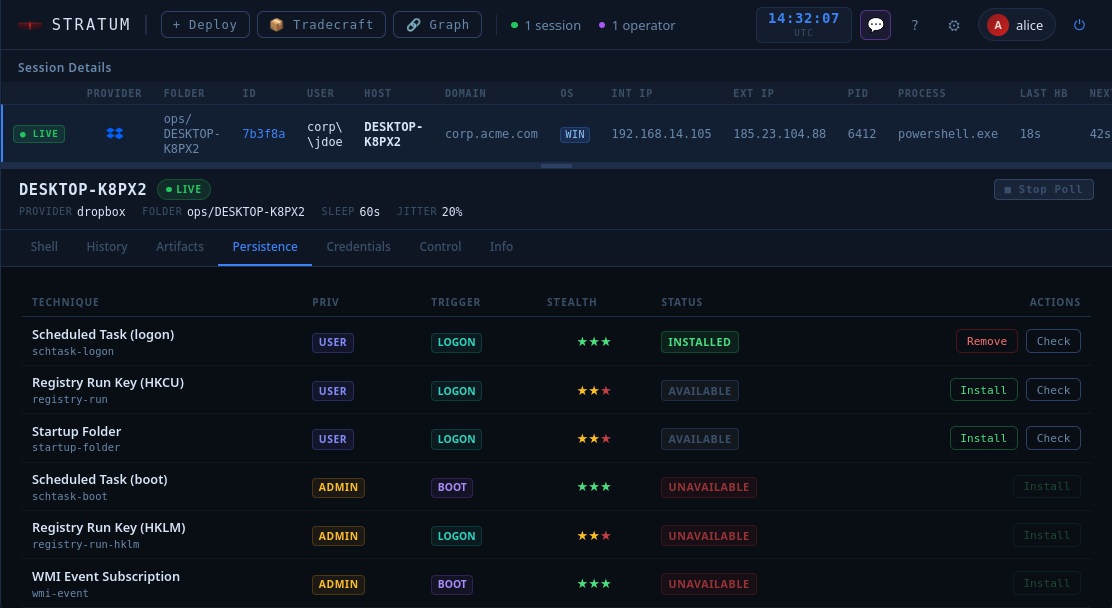
Before touching a single registry key or cron entry, run /persist probe. The agent checks every available technique at the current privilege level and returns a feasibility report. Non-destructive — no artifacts left behind.
/persist probe
  ✓ schtask-logon   — feasible (SYSTEM)
  ✓ registry-run    — feasible
  ✗ schtask-boot    — requires elevation
  ✓ startup-folder  — feasible
  ...
Pick what works, install it, remove it cleanly when done. The WebGUI tracks every installed technique per session. /kill tears everything down — persistence, binary, cloud artifacts — in one command.
Kill date, maintenance window, log-normal jitter, one-time bootstrap key — all configured once in the wizard and compiled into the agent permanently. Nothing to manage during the engagement, nothing to forget to clean up at the end.
Stratum is not a replacement for Cobalt Strike, Sliver, or Havoc. It's the layer underneath them.
  Day 1: deploy Stratum alongside your primary C2
  Day 4: primary beacon gets flagged, process killed
  Day 4: open Stratum session, assess what happened
  Day 4: re-introduce primary C2 via Stratum shell
  Day 5: back to full access
Your primary C2 handles post-exploitation. Stratum handles survival. It's the channel that was never going to get detected because it was never trying to hide — it just looks like Dropbox.
This is the same paradigm used in the wild by threat actors documented in 2025–2026: TukTuk (Dropbox + Arweave dead-drop), NarwhalRAT/APT37 (pCloud), COBALT MIRAGE/Drokbk (GitHub). Stratum brings the same architecture to the red team side as a proper framework, not a one-off implant.