zegl/kube-score
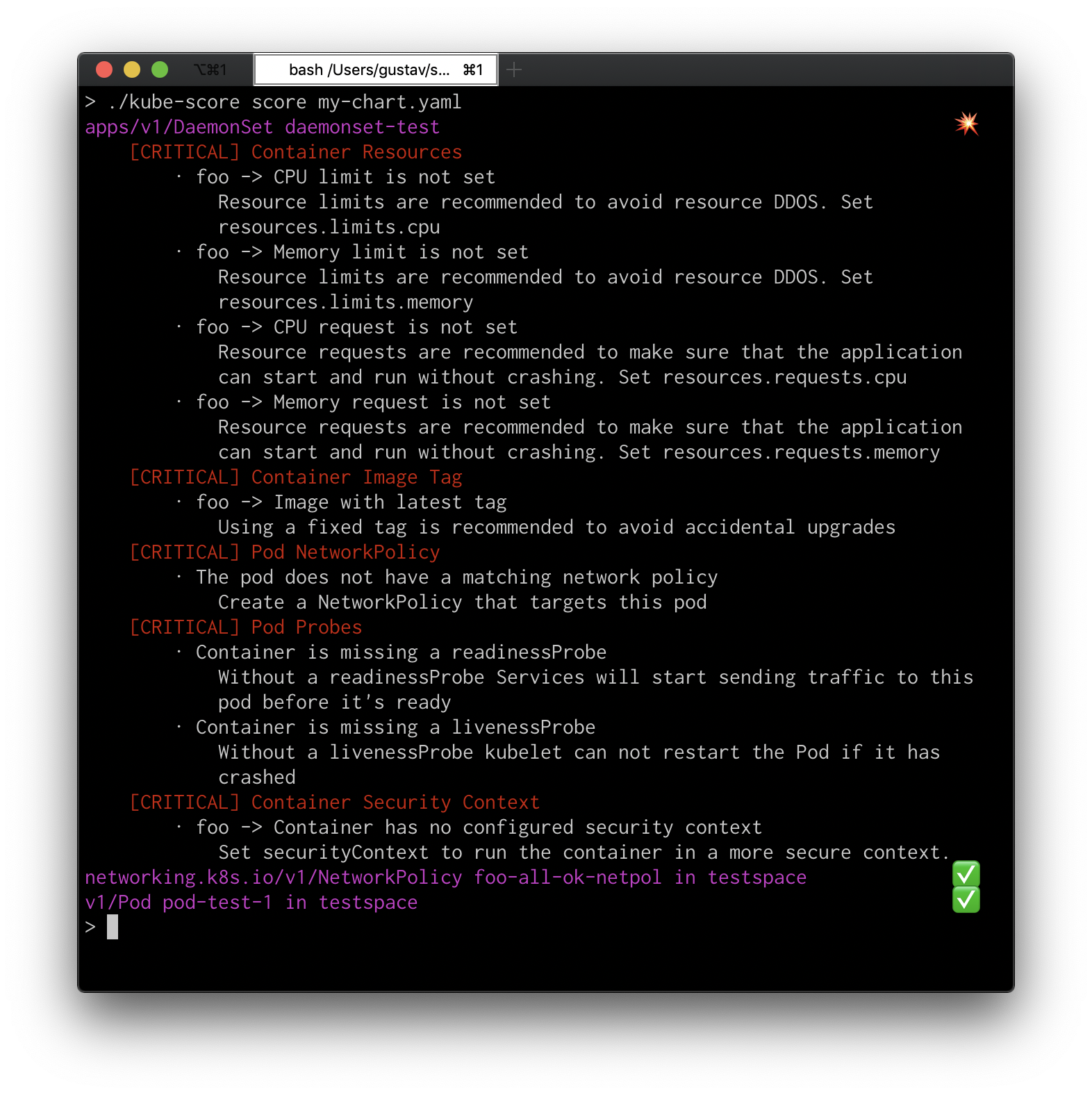
Analisi degli oggetti Kubernetes con raccomandazioni per migliorare affidabilità e sicurezza. kube-score previene attivamente tempi di inattività e bug nei tuoi YAML e Charts Kubernetes. Analisi statica del codice per Kubernetes.






kube-score è uno strumento che esegue l'analisi statica del codice delle definizioni degli oggetti Kubernetes.
L'output è un elenco di raccomandazioni su cosa puoi migliorare per rendere la tua applicazione più sicura e resiliente.
Puoi provare kube-score nel browser con la demo online (sorgente).
kube-score è facile da installare ed è disponibile dalle seguenti fonti:
| Distribuzione | Comando / Link |
|---|---|
| Binari precompilati per macOS, Linux e Windows | GitHub releases |
| Docker | docker pull zegl/kube-score (Docker Hub) |
| Homebrew (macOS e Linux) | brew install kube-score |
| Krew (macOS e Linux) | kubectl krew install score |
Per un elenco completo dei controlli, vedi README_CHECKS.md.
NetworkPolicy, si raccomandano regole sia di egress che di ingressPodDisruptionPolicy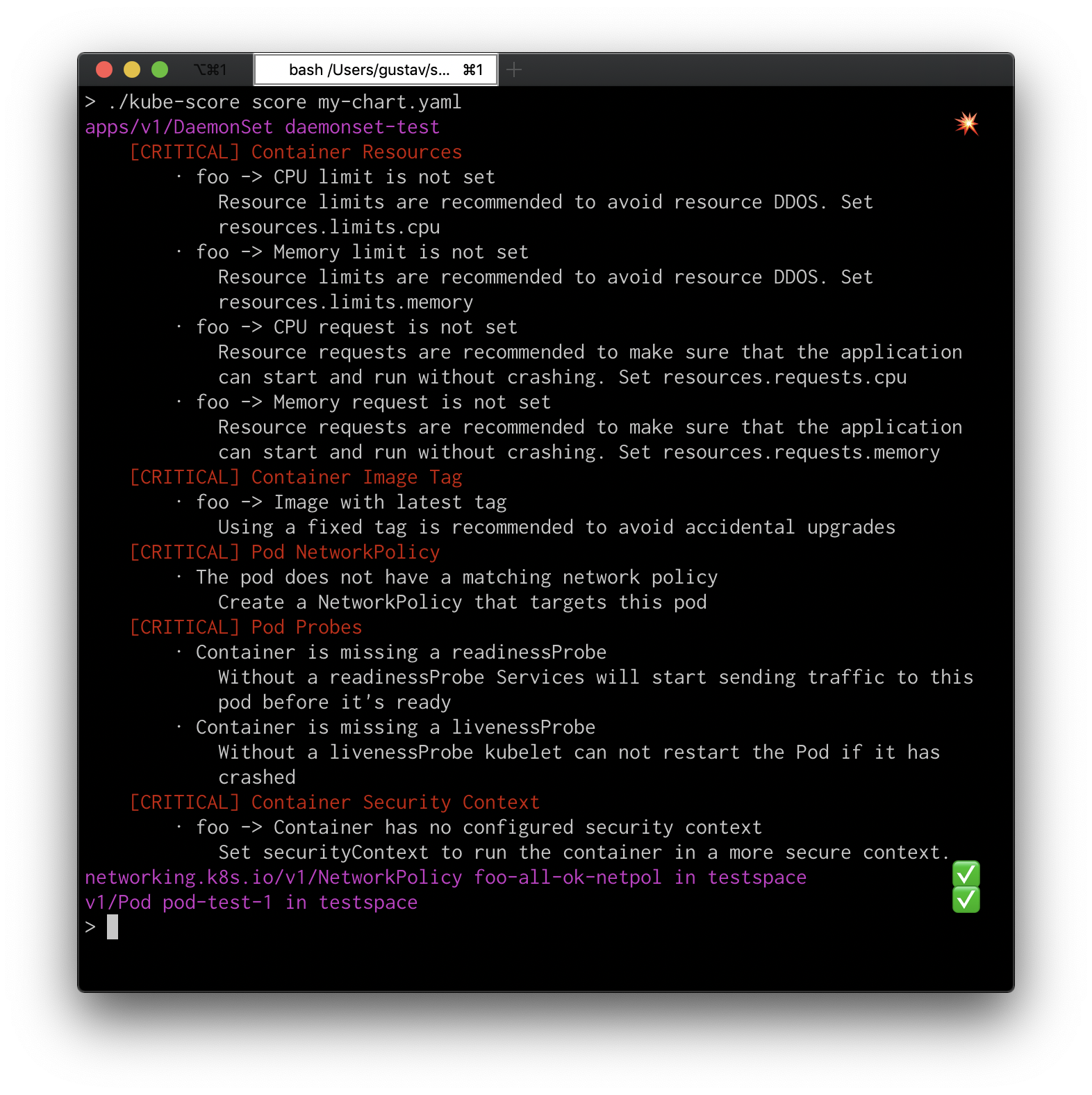
kube-score può essere eseguito nel tuo ambiente CI/CD e terminerà con codice di uscita 1 se viene trovato un errore critico. Il livello di trigger può essere cambiato a warning con l'argomento --exit-one-on-warning.
L'input a kube-score dovrebbero essere tutte le applicazioni che distribuisci nello stesso namespace per il miglior risultato.
helm template my-app | kube-score score -
kustomize build . | kube-score score -
kube-score score my-app/*.yaml
kube-score score my-app/deployment.yaml my-app/service.yaml
kubectl api-resources --verbs=list --namespaced -o name \
  | xargs -n1 -I{} bash -c "kubectl get {} --all-namespaces -oyaml && echo ---" \
  | kube-score score -
docker run -v $(pwd):/project zegl/kube-score:latest score my-app/*.yaml
Usage of kube-score:
kube-score [action] --flags

Actions:
	score	Checks all files in the input, and gives them a score and recommendations
	list	Prints a CSV list of all available score checks
	version	Print the version of kube-score
	help	Print this message

Flags for score:
      --disable-ignore-checks-annotations   Set to true to disable the effect of the 'kube-score/ignore' annotations
      --disable-optional-checks-annotations Set to true to disable the effect of the 'kube-score/enable' annotations
      --enable-optional-test strings        Enable an optional test, can be set multiple times
      --exit-one-on-warning                 Exit with code 1 in case of warnings
      --help                                Print help
      --ignore-container-cpu-limit          Disables the requirement of setting a container CPU limit
      --ignore-container-memory-limit       Disables the requirement of setting a container memory limit
      --ignore-test strings                 Disable a test, can be set multiple times
      --kubernetes-version string           Setting the kubernetes-version will affect the checks ran against the manifests. Set this to the version of Kubernetes that you're using in production for the best results. (default "v1.18")
  -o, --output-format string                Set to 'human', 'json', 'ci' or 'sarif'. If set to ci, kube-score will output the program in a format that is easier to parse by other programs. Sarif output allows for easier integration with CI platforms. (default "human")
      --output-version string               Changes the version of the --output-format. The 'json' format has version 'v2' (default) and 'v1' (deprecated, will be removed in v1.7.0). The 'human' and 'ci' formats has only version 'v1' (default). If not explicitly set, the default version for that particular output format will be used.
  -v, --verbose count                       Enable verbose output, can be set multiple times for increased verbosity.
I test possono essere ignorati nell'intera esecuzione del programma, con il flag --ignore-test.
Un test può anche essere ignorato per oggetto, aggiungendo l'annotazione kube-score/ignore all'oggetto. Il valore dovrebbe essere una stringa separata da virgole dei ID test.
Esempio:
Testare questo oggetto disabiliterà temporaneamente il test service-type, che avvisa contro l'uso di servizi di tipo NodePort.
apiVersion: v1
kind: Service
metadata:
  name: node-port-service-with-ignore
  namespace: foospace
  annotations:
    kube-score/ignore: service-type
spec:
  selector:
    app: my-app
  ports:
  - protocol: TCP
    port: 80
    targetPort: 8080
  type: NodePort
I test opzionali possono essere abilitati nell'intera esecuzione del programma, con il flag --enable-optional-test.
Un test può anche essere abilitato per oggetto, aggiungendo l'annotazione kube-score/enable all'oggetto. Il valore dovrebbe essere una stringa separata da virgole dei ID test.
Esempio:
Testare questo oggetto abiliterà il test container-seccomp-profile. Inoltre, anche più test definiti da kube-score/ignore vengono ignorati contemporaneamente.