 moonnull/cve-2022-2590-analysis
Analisi approfondita di CVE-2022-2590, una variante di Dirty COW nello shmem del kernel Linux, comprendente causa principale, condizione di gara ed exploit proof-of-concept.

versione del kernel Linux: Linux/x86 6.0.0-rc1 (commit 37887783b3fef877bf34b8992c9199864da4afcb)
questa vulnerabilità consente all'attaccante di scrivere contenuto arbitrario in una pagina di memoria condivisa di sola lettura, facendo soddisfare i controlli della funzione can_follow_write_pte, che verifica FOLL_FORCE, FOLL_COW e pte_dirty, usando UFFDIO_CONTINUE.
/*
 * FOLL_FORCE can write to even unwritable pte's, but only
 * after we've gone through a COW cycle and they are dirty.
 */
static inline bool can_follow_write_pte(pte_t pte, unsigned int flags)
{
	return pte_write(pte) ||
		((flags & FOLL_FORCE) && (flags & FOLL_COW) && pte_dirty(pte));
}
La funzione qui sopra determina se una pte è scrivibile.
La pte è considerata scrivibile se soddisfa una delle seguenti condizioni:
Per soddisfare la condizione 2, devono essere impostati i seguenti tre flag:
FOLL_FORCE
static ssize_t mem_rw(struct file *file, char __user *buf,
			size_t count, loff_t *ppos, int write)
{
	...

	flags = FOLL_FORCE | (write ? FOLL_WRITE : 0);

	while (count > 0) {
		size_t this_len = min_t(size_t, count, PAGE_SIZE);

		if (write && copy_from_user(page, buf, this_len)) {
			copied = -EFAULT;
			break;
		}

		this_len = access_remote_vm(mm, addr, page, this_len, flags); // __get_user_pages with FOLL_FORCE on
		if (!this_len) {
			if (!copied)
				copied = -EIO;
			break;
		}

		...
}
La funzione sopra esegue operazioni di lettura/scrittura su /proc/<pid>/mem.
Usando questa funzione, puoi raggiungere la funzione __get_user_pages con il flag FOLL_FORCE attivo.
Sebbene FOLL_FORCE sia pensato per essere usato in ptrace, la sua necessità è stata dimostrata nel commit seguente: https://github.com/torvalds/linux/commit/f511c0b17b081562dca8ac5061dfa86db4c66cc2
FOLL_COW
/*
* mmap_lock must be held on entry.  If @locked != NULL and *@flags
* does not include FOLL_NOWAIT, the mmap_lock may be released.  If it
* is, *@locked will be set to 0 and -EBUSY returned.
*/
static int faultin_page(struct vm_area_struct *vma,
	unsigned long address, unsigned int *flags, bool unshare,
	int *locked)
{
  ...

  /*
  * The VM_FAULT_WRITE bit tells us that do_wp_page has broken COW when
  * necessary, even if maybe_mkwrite decided not to set pte_write. We
  * can thus safely do subsequent page lookups as if they were reads.
  * But only do so when looping for pte_write is futile: in some cases
  * userspace may also be wanting to write to the gotten user page,
  * which a read fault here might prevent (a readonly page might get
  * reCOWed by userspace write).
  */
  if ((ret & VM_FAULT_WRITE) && !(vma->vm_flags & VM_WRITE))
    *flags |= FOLL_COW;
  return 0;
}
L'operazione OR con FOLL_COW nella funzione faultin_page può essere utilizzata ed è parte della patch per Dirty COW.
static long __get_user_pages(struct mm_struct *mm,
 		unsigned long start, unsigned long nr_pages,
 		unsigned int gup_flags, struct page **pages,
 		struct vm_area_struct **vmas, int *locked)
 {
 	...
 retry:
 		/*
 		 * If we have a pending SIGKILL, don't keep faulting pages and
 		 * potentially allocating memory.
 		 */
 		if (fatal_signal_pending(current)) {
 			ret = -EINTR;
 			goto out;
 		}
 		cond_resched();

 		page = follow_page_mask(vma, start, foll_flags, &ctx); // can_follow_write_pte
 		if (!page || PTR_ERR(page) == -EMLINK) {
 			ret = faultin_page(vma, start, &foll_flags,
 					   PTR_ERR(page) == -EMLINK, locked); // flags |= FOLL_COW
 			switch (ret) {
 			case 0:
 				goto retry; // try follow page again
 			case -EBUSY:
 			case -EAGAIN:
 				ret = 0;
 				fallthrough;
 			case -EFAULT:
 			case -ENOMEM:
 			case -EHWPOISON:
 				goto out;
 			}
 			BUG();
 		} else if (PTR_ERR(page) == -EEXIST) {
    ...
 }
Per raggiungere la funzione can_follow_write_pte con il flag FOLL_COW attivo, devi chiamare la funzione faultin_page all'interno della funzione __get_user_pages, saltare all'etichetta retry e chiamare di nuovo la funzione faultin_page.
pte_dirty
Questa condizione può essere soddisfatta grazie al commit seguente: https://github.com/torvalds/linux/commit/9ae0f87d009ca6c4aab2882641ddfc319727e3db
/*
* Install PTEs, to map dst_addr (within dst_vma) to page.
*
* This function handles both MCOPY_ATOMIC_NORMAL and _CONTINUE for both shmem
* and anon, and for both shared and private VMAs.
*/
int mfill_atomic_install_pte(struct mm_struct *dst_mm, pmd_t *dst_pmd,
		     struct vm_area_struct *dst_vma,
		     unsigned long dst_addr, struct page *page,
		     bool newly_allocated, bool wp_copy)
{
 	...

 	_dst_pte = mk_pte(page, dst_vma->vm_page_prot);
 	_dst_pte = pte_mkdirty(_dst_pte); // set pte dirty unconditionally
 	if (page_in_cache && !vm_shared)
 		writable = false;

 	...
}
Grazie alla patch precedente, è possibile installare incondizionatamente una pte per la pagina di memoria condivisa di sola lettura con il flag dirty.
Se questi tre flag sono soddisfatti, la funzione can_follow_write_pte restituirà true.
static struct page *follow_page_pte(struct vm_area_struct *vma,
		unsigned long address, pmd_t *pmd, unsigned int flags,
		struct dev_pagemap **pgmap)
{
	...

	// true && !true == false
	if ((flags & FOLL_WRITE) && !can_follow_write_pte(pte, flags)) {
		pte_unmap_unlock(ptep, ptl);
		return NULL;
	}

	page = vm_normal_page(vma, address, pte); // get read-only shared memory page

	...

out:
	pte_unmap_unlock(ptep, ptl);
	return page;
no_page:
	pte_unmap_unlock(ptep, ptl);
	if (!pte_none(pte))
		return NULL;
	return no_page_table(vma, flags);
}
La funzione follow_page_pte restituisce la pagina di memoria condivisa di sola lettura.
Quello che segue è lo scenario di race condition dimostrato dal PoC, che verrà introdotto più avanti.
| madvise e read | UFFDIO_CONTINUE ioctl | pwrite |
|---|---|---|
| madvise // zap the page | ||
| shmem_fault // read fault | ||
| handle_userfault | ||
| userfaultfd_continue | ||
| mcontinue_atomic_pte | ||
| ret = shmem_getpage(inode, pgoff, &page, SGP_NOALLOC); // get page | ||
| mfill_atomic_install_pte | ||
| _dst_pte = pte_mkdirty(_dst_pte); // make pte dirty | ||
| set_pte_at(dst_mm, dst_addr, dst_pte, _dst_pte); // install pte | mem_rw | |
| access_remote_vm // with FOLL_FORCE | ||
| __get_user_pages | ||
| can_follow_write_pte // no FOLL_COW, return 0 | ||
| faultin_page | ||
| flags | ||
| retry: | ||
| follow_page_pte | ||
| madvise // zap the page | ||
| shmem_fault // read fault | ||
| handle_userfault | ||
| userfaultfd_continue | ||
| mcontinue_atomic_pte | ||
| ret = shmem_getpage(inode, pgoff, &page, SGP_NOALLOC); // get page | ||
| mfill_atomic_install_pte | ||
| _dst_pte = pte_mkdirty(_dst_pte); // make pte dirty | ||
| set_pte_at(dst_mm, dst_addr, dst_pte, _dst_pte); // install pte | ||
| can_follow_write_pte // return 1 | ||
| copy_to_user(buf, page, this_len) // write content to read-only page |
Le routine madvise e read vengono eseguite due volte; la prima esecuzione induce un retry di __get_user_pages, mentre la seconda porta follow_page_pte a restituire la pagina puntata dalla pte che è stata resa dirty da mfill_atomic_install_pte.
Puoi controllare il reproducer di David Hildenbrand al link sopra.
Tuttavia, poiché il reproducer rende difficile riconoscere l'esatto scenario di race condition, ho modificato il reproducer per favorire un'esecuzione più lineare e, di conseguenza, ho modificato anche il codice sorgente del kernel Linux.
.config:
...
CONFIG_USERFAULTFD=y
CONFIG_HAVE_ARCH_USERFAULTFD_WP=y
CONFIG_HAVE_ARCH_USERFAULTFD_MINOR=y
...
PoC: (poc.c)
Patch: (poc_deayzl.patch)
Per il test, è necessario eseguire i seguenti passi preliminari. (Le istruzioni nel reproducer di david dicono che il percorso del file è /tmp/foo. Ma tmpfs non è memoria condivisa nella versione attuale, quindi la registrazione di userfaultfd fallisce)
sudo -s
echo "asdf" > /dev/shm/foo
chmod 0404 /dev/shm/foo
exit
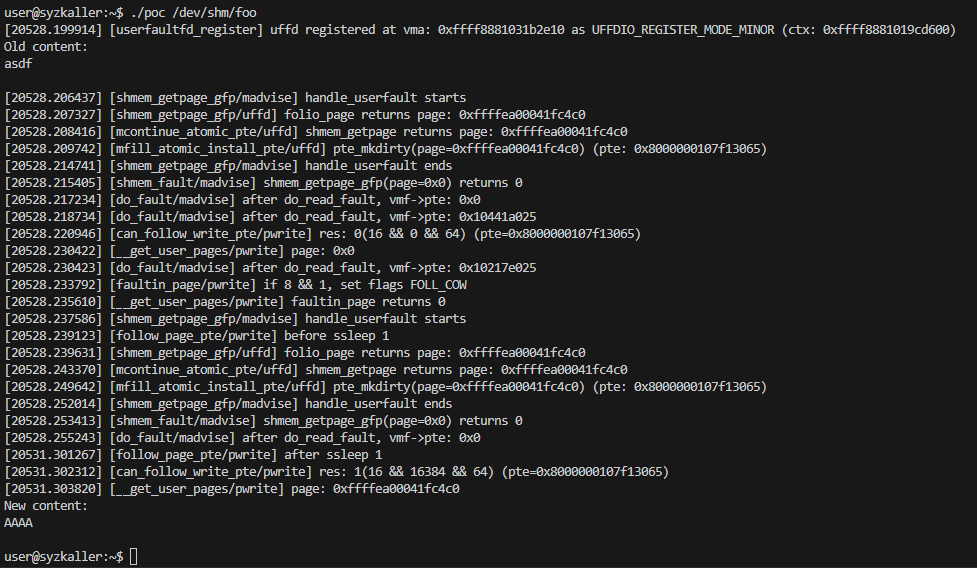
Dopo aver eseguito il PoC, vedrai la seguente schermata.
lore.kernel patch v1: https://lore.kernel.org/linux-mm/[email protected]/#r
lore.kernel patch v2: https://lore.kernel.org/all/[email protected]/T/#u
