
Skip to content
KitploitKITPLOIT
StrumentiBlog
Invia
StrumentiBlog
Invia

Strumenti di Hacking, PenTest e Cybersecurity per il tuo Arsenale di Sicurezza!

Kitploit è una directory di strumenti di hacking, cybersecurity e pentesting. Scopri gli ultimi aggiornamenti dei progetti per trovare vulnerabilità, analizzare sistemi, automatizzare i test e rafforzare la tua sicurezza.

··Feed·Contatto·Privacy·© 2026 Kitploit

Directory degli strumenti

Categorie

Vedi tutte le categorie
Loading categories
bluing — Uno strumento di raccolta intelligence per hackerare Bluetooth | Kitploit
Strumenti/GitHubGitHub/fo-000/bluing
Sicurezza AndroidRicognizioneSicurezza BluetoothSicurezza IoTRaccolta InformazioniSicurezza Wireless
GitHubfo-000/bluing

bluing

Uno strumento di raccolta intelligence per hackerare Bluetooth

Vedi Repository
1.0k1303 anni faRevisionato da Kitploit

Più Popolari

Vedi tutti →

Scopri gli strumenti più utilizzati dalla nostra community.

Esplora tutti gli strumenti

Sfoglia la nostra collezione di strumenti

Vedi tutti gli strumenti →
Condividi

Bluing

Uno strumento di raccolta intelligence per hackerare il Bluetooth

Inglese · 简体中文

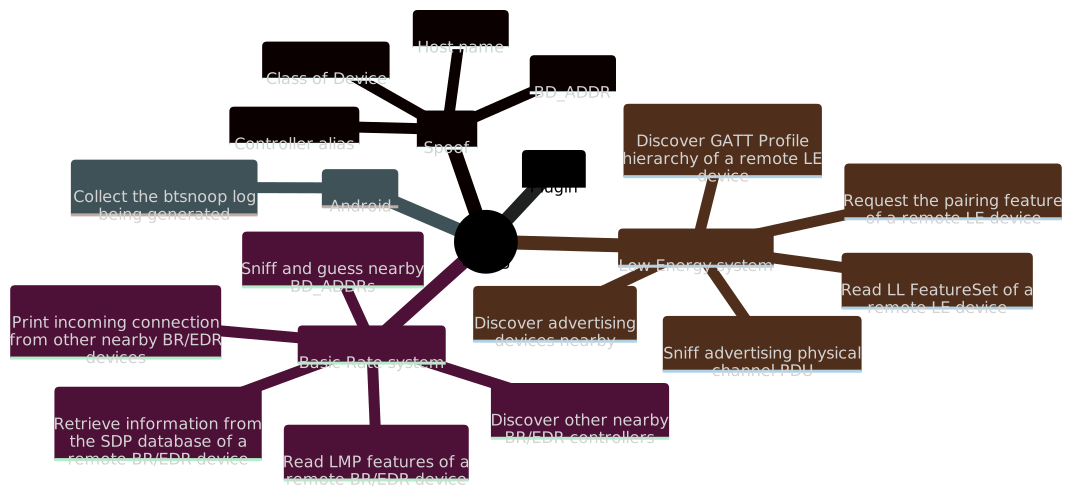
Bluing (precedentemente bluescan) è uno strumento di raccolta intelligence per il Bluetooth scritto principalmente in Python. Può aiutarci a curiosare nella struttura interna del Bluetooth, che è un protocollo complesso, o a violare dispositivi Bluetooth. Ecco le principali caratteristiche dello strumento:
Installazione

Bluing dipende parzialmente da BlueZ, lo stack del protocollo Bluetooth ufficiale di Linux. Pertanto è supportato solo su Linux. Il seguente comando viene utilizzato per installare le dipendenze:```sh sudo apt install python3-pip python3-dev libcairo2-dev libgirepository1.0-dev
libbluetooth-dev libdbus-1-dev bluez-tools python3-cairo-dev
rfkill meson patchelf bluez ubertooth adb python-is-python3

root@kitploit:~
Attualmente, bluing è distribuito tramite [PyPI](https://pypi.org/project/bluing/) e **supporta solo Python 3.10**. Di seguito è riportato un comando di installazione:```sh
sudo pip3.10 install bluing

Utilizzo

  • Dio disse: «Sia colorato», e colorato fu.
  • Forse vorresti una breve panoramica dell'hardware consigliato.
$ bluing --help
root@kitploit:~
An intelligence gathering tool for hacking Bluetooth

Usage:
    bluing [-h | --help]
    bluing (-v | --version)
    bluing [-i <hci>] --clean BD_ADDR
    bluing --flash-micro-bit
    bluing <command> [<args>...]

Arguments:
    BD_ADDR    Bluetooth device address

Options:
    -h, --help           Print this help and quit
    -v, --version        Print version information and quit
    -i <hci>             HCI device
    --clean              Clean cached data of a remote device
    --flash-micro-bit    Download the dedicated firmware to micro:bit(s)

Commands:
    br         Basic Rate system, includes an optional Enhanced Data Rate (EDR) extension
    le         Low Energy system
    android    Android Bluetooth stack
    spoof      Spoof with new local device information
    plugin     Manage plugins

Run `bluing <command> --help` for more information on a command.

Comando br: sistema Basic Rate

$ bluing br --help
root@kitploit:~
Usage:
    bluing br [-h | --help]
    bluing br [-i <hci>] [--inquiry-len=<n>] --inquiry
    bluing br [-i <hci>] --sdp BD_ADDR
    bluing br [-i <hci>] --local --sdp
    bluing br [-i <hci>] --lmp-features BD_ADDR
    bluing br [-i <hci>] --local --lmp-features
    bluing br [-i <hci>] --stack BD_ADDR
    bluing br [-i <hci>] --local --stack
    bluing br [-i <hci>] [--inquiry-scan] --mon-incoming-conn
    bluing br --org=<name> --timeout=<sec> --sniff-and-guess-bd-addr

Arguments:
    BD_ADDR    BR/EDR Bluetooth device address

Options:
    -h, --help                   Print this help and quit
    -i <hci>                     HCI device
    --local                      Target a local BR/EDR device instead of a remote one
    --inquiry                    Discover other nearby BR/EDR controllers
    --inquiry-len=<n>            Maximum amount of time (added to --ext-inquiry-len=<n>) 
                                 specified before the Inquiry is halted.
                                     Time = n * 1.28 s
                                     Time range: 1.28 to 61.44 s
                                     Range of n: 0x01 to 0x30 [default: 8]
    --ext-inquiry-len=<n>        Extended_Inquiry_Length measured in number of 
                                 Baseband slots.
                                     Interval Length = n * 0.625 ms (1 Baseband slot)
                                     Time Range: 0 to 40.9 s
                                     Range of n: 0x0000 to 0xFFFF [default: 0]
    --sdp                        Retrieve information from the SDP database of a 
                                 remote BR/EDR device
    --lmp-features               Read LMP features of a remote BR/EDR device
    --stack                      Determine the Bluetooth stack type of a remote BR/EDR device
    --mon-incoming-conn          Print incoming connection from other nearby BR/EDR devices
    --inquiry-scan               Enable the Inquiry Scan
    --sniff-and-guess-bd-addr    Sniff SAPs of BD_ADDRs over the air, then guess the 
                                 address based on the organization name. Need at 
                                 least one Ubertooth device
    --org=<name>                 An organization name in the OUI.txt
    --timeout=<sec>              Timeout in second(s)

--inquiry: Scopri altri controller BR/EDR nelle vicinanze

$ sudo bluing br --inquiry
root@kitploit:~
[INFO] Discovering other nearby BR/EDR Controllers on hci0 for 10.24 sec

BD_ADDR: B0:C9:52:45:33:13 (GUANGDONG OPPO MOBILE TELECOMMUNICATIONS CORP.,LTD)
Page scan repetition mode: 1 (R1)
Reserved: 0x02
CoD: 0x5a020c
    Service Class: 0b1011010000
        Telephony
        Object Transfer
        Capturing
        Networking
    Major Device Class: 0b00010, Phone
Clock offset: 0x50D5
RSSI: -61
Extended inquiry response: 
    Complete Local Name: old man phone
    Complete List of 16-bit Service Class UUIDs
        0x1105 OBEXObjectPush
        0x110a AudioSource
        0x110c A/V_RemoteControlTarget
        0x110e A/V_RemoteControl
        0x1112 Headset - Audio Gateway (AG)
        0x1115 PANU
        0x1116 NAP
        0x111f HandsfreeAudioGateway
        0x112d SIM_Access
        0x112f Phonebook Access - PSE
        0x1200 PnPInformation
        0x1132 Message Access Server
    Complete List of 32-bit Service Class UUIDs
        None
    Complete List of 128-bit Service Class UUIDs
        A49EAA15-CB06-495C-9F4F-BB80A90CDF00
        00000000-0000-0000-0000-000000000000
... ...


[INFO] Requesting the names of all discovered devices...
B0:C9:52:45:33:13 : old man phone
... ...

--sdp: Recupera informazioni dal database SDP di un dispositivo BR/EDR remoto

$ sudo bluing br --sdp 34:13:46:23:6A:4D
root@kitploit:~
Scanning ⠋
Number of service records: 18 

Service Record
0x0000: ServiceRecordHandle (uint32)
    0x0001000d
0x0001: ServiceClassIDList (sequence)
    0x1105: OBEXObjectPush
0x0004: ProtocolDescriptorList (sequence)
    0x0100: L2CAP
    0x0003: RFCOMM
        channel: 0x0c
    0x0008: OBEX
0x0005: BrowseGroupList (sequence)
    0x1002: PublicBrowseRoot
0x0009: BluetoothProfileDescriptorList (sequence)
    0x1105: OBEXObjectPush v1.2
0x0100: ServiceName (guess) (text)
    OBEX Object Push 
0x0200: GoepL2CapPsm (guess) (uint16)
	0x1023
0x0303: SupportedFormatsList (guess) (sequence)
    0x01: vCard 2.1
    0x02: vCard 3.0
    0x03: vCal 1.0
    0x04: iCal 2.0
    0xff: Any type of object
... ...

--lmp-features: Leggi le funzionalità LMP di un dispositivo BR/EDR remoto

$ sudo bluing br --lmp-features 6A:8D:99:33:56:AE
root@kitploit:~
Version
    Version:
        Bluetooth Core Specification 5.2 (LMP)
        Bluetooth Core Specification 5.2 (LL)
    Manufacturer name: HiSilicon Technologies CO., LIMITED
    Subversion: 33561 

LMP features
    3 slot packets: True
    5 slot packets: True
    Encryption: True
    Slot offset: True
    Timing accuracy: True
    Role switch: True
    Hold mode: False
    Sniff mode: True
    Previously used: False
    Power control requests: True
    Channel quality driven data rate (CQDDR): True
    ... ...

Extended LMP features
Page 1
    Secure Simple Pairing (Host Support): True
    LE Supported (Host): True
    Simultaneous LE and BR/EDR to Same Device Capable (Host): True
    Secure Connections (Host Support): True
Page 2
    Connectionless Slave Broadcast - Master Operation: False
    Connectionless Slave Broadcast - Slave Operation: False
    Synchronization Train: False
    Synchronization Scan: False
    HCI_Inquiry_Response_Notification event:  True
    ... ...

--mon-incoming-conn: Mostra connessioni in arrivo da altri dispositivi BR/EDR nelle vicinanze

$ sudo bluing br --inquiry-scan --mon-incoming-conn
root@kitploit:~
[INFO] Inquiry_Scan_Interval: 4096, 2560.0 ms
       Inquiry_Scan_Window:   4096, 2560.0 ms
[INFO] Inquiry Scan and Page Scan enabled

A0:DE:0F:99:EF:78 incoming
    CoD: 0x5a020c
        Service Class: 0b1011010000
            Telephony
            Object Transfer
            Capturing
            Networking
        Major Device Class: 0b00010, Phone
    link type: 0x01 - ACL
... ...

--sniff-and-guess-bd-addr: Sniffa e indovina indirizzi BD_ADDR vicini via etere

$ bluing br --org='Huawei Device Co., Ltd.' --timeout=600 --sniff-and-guess-bd-addr
root@kitploit:~
[INFO] Possible BD_ADDR for ??:??:99:4C:45:C3
        24:A7:99:4C:45:C3

[INFO] Possible BD_ADDR for ??:??:E4:2D:69:EE
        BC:1A:E4:2D:69:EE
        D0:05:E4:2D:69:EE
        30:AA:E4:2D:69:EE

[INFO] Possible BD_ADDR for ??:??:15:60:81:7F
        64:23:15:60:81:7F
        D4:74:15:60:81:7F
... ...

Comando le: sistema Low Energy

$ bluing le --help
root@kitploit:~
Usage:
    bluing le [-h | --help]
    bluing le [-i <hci>] [--scan-type=<type>] [--timeout=<sec>] [--sort=<key>] --scan
    bluing le [-i <hci>] --pairing-feature [--timeout=<sec>] [--addr-type=<type>] PEER_ADDR
    bluing le [-i <hci>] --ll-feature-set [--timeout=<sec>] [--addr-type=<type>] PEER_ADDR
    bluing le [-i <hci>] --gatt [--io-cap=<name>] [--addr-type=<type>] PEER_ADDR
    bluing le [-i <hci>] --local --gatt
    bluing le [-i <hci>] --mon-incoming-conn
    bluing le [--device=</dev/tty>] [--channel=<num>] --sniff-adv

Arguments:
    PEER_ADDR    LE Bluetooth device address

Options:
    -h, --help            Print this help and quit
    -i <hci>              HCI device
    --scan                Discover advertising devices nearby
    --scan-type=<type>    The type of scan to perform. active or passive [default: active]
    --sort=<key>          Sort the discovered devices by key, only support RSSI 
                          now [default: rssi]
    --ll-feature-set      Read LL FeatureSet of a remote LE device
    --pairing-feature     Request the pairing feature of a remote LE device
    --timeout=<sec>       Duration of the LE scanning, but may not be precise [default: 10]
    --gatt                Discover GATT Profile hierarchy of a remote LE device
    --io-cap=<name>       Set IO capability of the agent. Available value: 
                              DisplayOnly, DisplayYesNo, KeyboardOnly, NoInputNoOutput, 
                              KeyboardDisplay (KeyboardOnly) [default: NoInputNoOutput]
    --addr-type=<type>    Type of the LE address, public or random
    --sniff-adv           Sniff advertising physical channel PDU. Need at least 
                          one micro:bit (or other supported NRF51 device specified with --device)
    --channel=<num>       LE advertising physical channel, 37, 38 or 39 [default: 37,38,39]
    --device=</dev/tty>   Device to use, comma separated (e.g., /dev/ttyUSB0,/dev/ttyUSB1,/dev/ttyUSB2)
                          Only needed if using NRF51 devices other than micro:bit (e.g., Bluefruit)

--scan: Scopri dispositivi in advertising nelle vicinanze

$ sudo bluing le --scan
root@kitploit:~
[WARNING] You might want to spoof your LE address before doing an active scan
[INFO] LE active scanning on hci0 for 10 sec
Scanning ⠴

----------------LE Devices Scan Result----------------
Addr:        74:A3:4A:D4:78:55 (ZIMI CORPORATION)
Addr type:   public
Connectable: True
RSSI:        -68 dBm
General Access Profile:
    Flags: 
        LE General Discoverable Mode
        BR/EDR Not Supported
    Service Data - 16-bit UUID: 
        UUID: 0x95FE
        Data: 9055990701b743e34aa3740e00
    Appearance: 0000
    Tx Power Level: 0 dBm (pathloss 68 dBm)
    Complete Local Name: Mesh Mi Switch
... ...

--ll-feature-set: Leggi il LL FeatureSet di un dispositivo LE remoto

$ sudo bluing le --ll-feature-set --addr-type=public 18:D9:8F:77:24:F1
root@kitploit:~
[INFO] Reading LL FeatureSet of 18:D9:8F:77:24:F1 on hci0
Reading ⠼
LE LL Features:
    LE Encryption: True
    Connection Parameters Request Procedure: False
    Extended Reject Indication: False
    Slave-initiated Features Exchange: False
    LE Ping: False
    LE Data Packet Length Extension: True
    LL Privacy: False
    Extended Scanner Filter Policies: False
    LE 2M PHY: False
    Stable Modulation Index - Transmitter: False
    Stable Modulation Index - Receiver: False
    ... ...

--pairing-feature: Richiedi la caratteristica di pairing di un dispositivo LE remoto

$ sudo bluing le --pairing-feature --addr-type=public 18:D9:8F:77:24:F1
root@kitploit:~
[INFO] Requesting pairing feature of 18:D9:8F:77:24:F1 on hci0
Requesting ⠧
Pairing Response
    IO Capability: 0x03 - NoInputNoOutput
    OOB data flag: 0x00 - Not Present
    AuthReq: 0x01
    Maximum Encryption Key Size: 16
Initiator Key Distribution: 0x00
        EncKey:  False
        IdKey:   False
        SignKey: False
        LinkKey: False
        RFU:     0b0000
Responder Key Distribution: 0x01
        EncKey:  True
        IdKey:   False
        SignKey: False
        LinkKey: False
        RFU:     0b0000

--gatt: Scopri la gerarchia del profilo GATT di un dispositivo LE remoto

$ sudo bluing le --gatt --addr-type=public 18:D9:8F:77:24:F1Connecting ⠋ Discovering all primary services ⠏ Discovering all characteristics of service 0x0001 ⠹ ... ... Discovering all descriptors of characteristic 0x0002 ⠼ ... ... Reading value of the descriptor 0x0013 ⠴ ... ...

----------------GATT Scan Result---------------- Number of services: 6

Service (0x0100 - 0x0112, 7 characteristics) Declaration Handle: 0x0100 Type: 2800 (Primary Service declaration) Value: 1812 (Human Interface Device) Permissions: Read (no authen/author)

root@kitploit:~
<span style="font-weight: bold; color: #ecc179">Characteristic</span> (2 descriptors)
    <span style="font-weight: bold; color: #ecc179">Declaration</span>
        Handle: 0x010d
        Type:   2803 (Characteristic declaration)
        Value:
            Properties: <span style="font-weight: bold; color: #9fab76">Read, Write Without Response, Write, Notify</span>
            Handle:     <span style="font-weight: bold; color: #9fab76">0x010e</span>
            UUID:       <span style="font-weight: bold; color: #9fab76">2A4D</span> (<span style="font-weight: bold; color: #9fab76">Report</span>)
        Permissions: Read (no authen/author)

    <span style="font-weight: bold; color: #ecc179">Value</span>
        Handle: 0x0302
        Type:   4A02 (Unknown)
        Value:  <span style="font-weight: bold; color: #c35956">Read Not Permitted</span>
        Permissions: Higher layer specific

    <span style="font-weight: bold; color: #ecc179">Descriptor</span>
        Handle: <span style="font-weight: bold; color: #9fab76">0x010f</span>
        Type:   <span style="font-weight: bold; color: #9fab76">2902</span> (<span style="font-weight: bold; color: #ecc179">Client Characteristic    Configuration declaration</span>)
        Value:  <span style="font-weight: bold; color: #9fab76">b'\x00\x00'</span>
        Permissions: Read (no authen/author), Write (higher layer specifies authen/author)

--sniff-adv: Sniff advertising physical channel PDU

$ sudo bluing le --sniff-adv
root@kitploit:~
[INFO] Using micro:bit /dev/ttyACM2 on channel 37
[INFO] Using micro:bit /dev/ttyACM1 on channel 38
[INFO] Using micro:bit /dev/ttyACM0 on channel 39
[INFO] micro:bit 38 < Ready -> Start
[INFO] micro:bit 37 < Ready -> Start
[INFO] micro:bit 39 < Ready -> Start
[38] [ADV_NONCONN_IND]
random AdvA: 28:7A:88:B2:35:0B
[39] [ADV_IND]
public AdvA: A4:E4:72:B1:CB:8D
[37] [SCAN_REQ]
random ScanA: 6A:90:0C:07:3E:14
random AdvA: 7D:9B:A8:5A:F2:81
... ...

android command: Android Bluetooth stack

$ bluing android --help
root@kitploit:~
Usage:
    bluing android [-h | --help]
    bluing android [-t <id>] --collect-btsnoop-log [-o <file>]

Options:
    -h, --help               Display this help and quit
    -t <id>                  Use android device with given transport id. This option 
                             will be ignored when only one device is available
    --collect-btsnoop-log    Collect the btsnoop log being generated to a local file, 
                             default ./btsnoop_hci.log
    -o <file>                Place the output into  [default: ./btsnoop_hci.log]

--collect-btsnoop-log: Collect the btsnoop log being generated

$ bluing android -t 3 --collect-btsnoop-log -o btsnoop_hci.log; file btsnoop_hci.log
root@kitploit:~
btsnoop_hci.log: BTSnoop version 1, HCI UART (H4)

spoof command: Spoof with new local device information

$ bluing spoof --help
root@kitploit:~
Usage:
    bluing spoof [-h | --help]
    bluing spoof [-i <hci>] --bd-addr=<BD_ADDR>
    bluing spoof [-i <hci>] --cls-of-dev=<num>
    bluing spoof --host-name=<name>
    bluing spoof [-i <hci>] --alias=<alias>

Options:
    -h, --help             Print this help and quit
    -i <hci>               HCI device
    --bd-addr=<BD_ADDR>    Spoof with a new BD_ADDR
    --cls-of-dev=<num>     Spoof with a new Class of Device
    --host-name=<name>     Spoof with a new host name
    --alias=<alias>        Spoof with a new alias

--bd-addr=<BD_ADDR>: Spoof with a new BD_ADDR

This feature is currently based on spooftooph, which can be installed by runing sudo apt install spooftooph if you are using it on Kali Linux. However, if you are using this feature on Ubuntu, you will need to manually compile and install spooftooph.

$ sudo bluing spoof --bd-addr=AA:BB:CC:DD:EE:FF
root@kitploit:~
[WARNING] The original HCI device number may have been changed
[INFO] BD_ADDR changed: 11:22:33:44:55:66 -> AA:BB:CC:DD:EE:FF

--cls-of-dev=<num>: Spoof with a new Class of Device

$ sudo bluing spoof --cls-of-dev=0x6c0100
root@kitploit:~
No output when successful

--host-name=<name>: Spoof with a new host name

$ sudo bluing spoof --host-name=Bluing
root@kitploit:~
No output when successful

--alias=<alias>: Spoof with a new controller alias

$ sudo bluing spoof --alias='Bluing Alias'
root@kitploit:~
No output when successful

plugin command: Manage plugins

$ bluing plugin --help
root@kitploit:~
Usage:
    bluing plugin [-h | --help]
    bluing plugin <command> [<args>...]

Options:
    -h, --help    Display this help and quit

Commands:
    list         List installed plugins
    install      Install a plugin
    uninstall    Uninstall a plugin
    run          Run a plugin

Recommended Hardware

Bluetooth adapter

Many features of bluing require access to at least 1 Bluetooth adapter. Although it is possible to use the adapter that comes with the Linux physical machine or make the Linux virtual machine exclusive to an adapter of the host machine, it is still recommended to use an external USB Bluetooth adapter for more stability, such as Parani UD100-G03.

Original micro:bit (optional)

Bluing requires at least 1 original micro:bit when sniffing advertising physical channel PDUs (le --sniff-adv), and it is recommended to use 3 of them at the same time. These micro:bits need to run the dedicated firmware provided by bluing. After connecting the micro:bits to Linux, the pre-built firmware can be flashed by executing the following command:

root@kitploit:~
bluing --flash-micro-bit

While less convenient to use than the micro:bit, but more accessible to purchase, more generic NRF51 adapters can be supported as well. Support has been added for the Adafruit Bluefruit LE Friend and the BLE400 boards. To use these, they will need to be flashed using SWD. This tool does not support flashing these devices. Additionally, the tool cannot automatically identify these devices. Instead the --devices option needs to identify the ports connected to computer.

Ubertooth One (optional)

When sniffing and guessing nearby BD_ADDRs (br --sniff-and-guess-bd-addr), bluing requires an Ubertooth One.

FAQ

rfkill cannot find hci0

The following is the exception message:```txt Exception: Can't find the ID of hci0 in rfkill

root@kitploit:~
Questa eccezione potrebbe essere causata dalla mancanza di supporto per le opzioni `-r` e `-n` nella vecchia versione di rfkill, ad esempio:
  
<pre>
$ <span style="font-weight: bold; color: #9fab76">cat</span> /etc/os-release | <span style="font-weight: bold; color: #9fab76">head</span> -n 2
NAME="Ubuntu"
VERSION="16.10 (Yakkety Yak)"

$ <span style="font-weight: bold; color: #9fab76">rfkill</span> --version
rfkill 0.5-1ubuntu3 (Ubuntu)
</pre>

A questo punto, l'aggiornamento di rfkill a una versione più recente può risolvere il problema, come ad esempio:

<pre>
$ <span style="font-weight: bold; color: #9fab76">cat</span> /etc/os-release | <span style="font-weight: bold; color: #9fab76">head</span> -n 2
PRETTY_NAME="Kali GNU/Linux Rolling"
NAME="Kali GNU/Linux"

$ <span style="font-weight: bold; color: #9fab76">rfkill</span> --version
rfkill from util-linux 2.38.1
</pre>

### Il comando di gestione `scanend` non è stato eseguito

Di seguito è riportato un messaggio di errore:```txt
ERROR: Failed to execute management command 'scanend' (code: 11, error: Rejected)

Prova a riavviare il servizio Bluetooth per risolvere il problema:

root@kitploit:~
sudo systemctl restart bluetooth.service
Scarica lo strumento

... ...