 chenaotian/cve-2022-0185
CVE-2022-0185 POC, Docker e analisi scritta

[toc]
ID della vulnerabilità: CVE-2022-0185
Punteggio della vulnerabilità:
Prodotto vulnerabile: Linux kernel - syscall fsconfig
Versione interessata: Linux kernel 5.1-rc1 ~ 5.16.2
Condizioni di sfruttamento: locale su Linux; capacità CAP_SYS_ADMIN (ottenibile direttamente con unshare, quindi nessuna limitazione)
Effetto dello sfruttamento: escalation dei privilegi locali; fuga dal container
Ottenere il codice sorgente: git clone git://kernel.ubuntu.com/ubuntu/ubuntu-focal.git -b Ubuntu-hwe-5.11-5.11.0-27.29_20.04.1 --depth 1
o https://mirrors.edge.kernel.org/pub/linux/kernel/v5.x/
Docker per la compilazione del kernel 5.X: chenaotian/kernelcompile
Docker per l'analisi della vulnerabilità: chenaotian/cve-2022-0185
Preparati due kernel: uno della distribuzione, uno compilato manualmente
Installare qemu, gdb, gdb-peda, ecc.
File relativi alla vulnerabilità in /root/cve-2022-0185
boot_exp.sh per avviare l'exploit e verificare l'ambiente di debug, kernel senza simboli 5.11.0-44 della distribuzioneboot_poc.sh per avviare il PoC e verificare l'ambiente, può far crashare il kernel ma non eseguire l'exploit, kernel compilato con simboli 5.13exp, codice sorgente dell'exploit (autore: BitsByWill), compilare direttamente exploit_fuse.Ambiente qemu: https://github.com/chenaotian/CVE-2022-0185/tree/main/qemuANDexp
Ambiente di esecuzione dell'exploit su macchina virtuale Ubuntu 20.04 utilizzando l'exploit originale exploit
Preparare una macchina virtuale Ubuntu 20.04, quindi sostituire il kernel:```shell apt-get install linux-image-5.11.0-44-generic
grep menuentry /boot/grub/grub.cfg vim /etc/default/grub #修改 GRUB_DEFAULT 选项为上面结果中想要启动内核的下标 update-grub #如果不生效的话则直接进入/boot 目录将之前的内核相关文件(带之前内核编号的文件)全部删掉,然后启动时候报找不到内核,然后手动选择内核启动也可以
#编译exp make fuse ./exploit
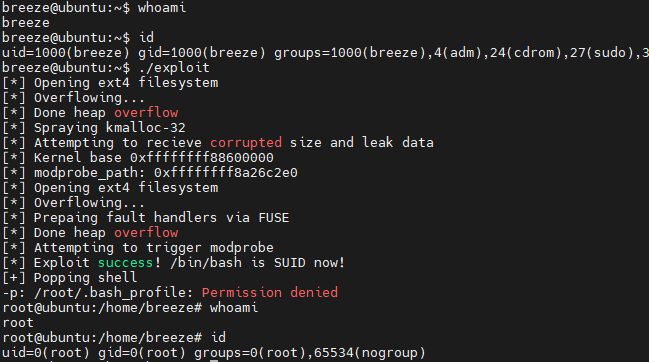
Effetto di elevazione dei privilegi
## Principio della vulnerabilità
La vulnerabilità si verifica nella chiamata di sistema `fsconfig` con l'opzione `FSCONFIG_SET_STRING`, utilizzata per configurare un contesto di filesystem già aperto. **Il prerequisito è possedere il privilegio `CAP_SYS_ADMIN`**:
> Lo scopo principale di `fsopen` è creare un contesto di filesystem e associarlo a un descrittore di file, restituendo il descrittore. Dopo `fsopen`, viene utilizzato `fsconfig`. Come si può intuire dal nome, con `fsopen` abbiamo creato un contesto di filesystem, e `fsconfig` serve probabilmente per configurare il contenuto di quel contesto. In effetti, `fsconfig` è principalmente dedicato a questa attività di configurazione, ma oltre al contesto di filesystem supporta anche altre operazioni.
### Punto di innesco della vulnerabilità
Innanzitutto, la vulnerabilità si trova nella funzione `legacy_parse_param`:
linux-5.11\fs\fs_context.c : 502 : legacy_parse_param```c
static int legacy_parse_param(struct fs_context *fc, struct fs_parameter *param)
{
struct legacy_fs_context *ctx = fc->fs_private;
unsigned int size = ctx->data_size;
size_t len = 0;
··· ···
··· ···
switch (param->type) {
case fs_value_is_string:
len = 1 + param->size;
fallthrough;
··· ···
}
if (len > PAGE_SIZE - 2 - size) //此处边界检查有问题
return invalf(fc, "VFS: Legacy: Cumulative options too large");
if (strchr(param->key, ',') ||
(param->type == fs_value_is_string &&
memchr(param->string, ',', param->size)))
return invalf(fc, "VFS: Legacy: Option '%s' contained comma",
param->key);
if (!ctx->legacy_data) {
ctx->legacy_data = kmalloc(PAGE_SIZE, GFP_KERNEL); //在第一次时会分配一页大小
if (!ctx->legacy_data)
return -ENOMEM;
}
ctx->legacy_data[size++] = ',';
len = strlen(param->key);
memcpy(ctx->legacy_data + size, param->key, len);
size += len;
if (param->type == fs_value_is_string) {
ctx->legacy_data[size++] = '=';
memcpy(ctx->legacy_data + size, param->string, param->size); //拷贝,可能越界
size += param->size;
}
ctx->legacy_data[size] = '\0';
ctx->data_size = size;
ctx->param_type = LEGACY_FS_INDIVIDUAL_PARAMS;
return 0;
}
Il punto cruciale è la successiva memcpy, che copierà il param->string da noi passato in ctx->legacy_data. La verifica del superamento dei limiti di copia si trova nel controllo (len > PAGE_SIZE - 2 - size) precedente. Questo controllo è problematico: il tipo di dato utilizzato è size_t, ovvero unsigned int. Se size > PAGE_SIZE - 2, si verifica un overflow intero con inversione, causando len < PAGE_SIZE - 2 - size, e quindi il superamento della verifica. Durante la copia successiva, size è maggiore di PAGE_SIZE - 2, provocando un superamento dei limiti nella copia.
Alcune strutture dati utilizzate:```c struct fs_context { const struct fs_context_operations ops; struct mutex uapi_mutex; / Userspace access mutex */ struct file_system_type *fs_type; void fs_private; / The filesystem's context */ void *sget_key; struct dentry root; / The root and superblock */ struct user_namespace user_ns; / The user namespace for this mount */ struct net net_ns; / The network namespace for this mount */ const struct cred cred; / The mounter's credentials / struct p_log log; / Logging buffer */ const char source; / The source name (eg. dev path) */ void security; / Linux S&M options / void s_fs_info; / Proposed s_fs_info / unsigned int sb_flags; / Proposed superblock flags (SB_) / unsigned int sb_flags_mask; / Superblock flags that were changed / unsigned int s_iflags; / OR'd with sb->s_iflags / unsigned int lsm_flags; / Information flags from the fs to the LSM / enum fs_context_purpose purpose:8; enum fs_context_phase phase:8; / The phase the context is in / bool need_free:1; / Need to call ops->free() / bool global:1; / Goes into &init_user_ns / bool oldapi:1; / Coming from mount(2) */ };
struct legacy_fs_context { char legacy_data; / Data page for legacy filesystems */ size_t data_size; enum legacy_fs_param param_type; };
struct fs_parameter { const char key; / Parameter name / enum fs_value_type type:8; / The type of value here */ union { char *string; void *blob; struct filename *name; struct file *file; }; size_t size; int dirfd; };
### Percorso di chiamata

Qui analizziamo lo stack di chiamate di funzione. Prima di tutto, l'entry point è sicuramente la system call `fsconfig`:

linux-5.11\fs\fsopen.c : 314 : SYSCALL_DEFINE5(fsconfig,...```c
SYSCALL_DEFINE5(fsconfig,
		int, fd,
		unsigned int, cmd,
		const char __user *, _key,
		const void __user *, _value,
		int, aux)
{
	struct fs_context *fc;
	struct fd f;
	int ret;
	int lookup_flags = 0;

	struct fs_parameter param = {
		.type	= fs_value_is_undefined,
	};

	··· ···
	f = fdget(fd);
	if (!f.file)
		return -EBADF;
	ret = -EINVAL;
	if (f.file->f_op != &fscontext_fops)
		goto out_f;
