 beenuar/aisoc
Self-hostable AI SOC that fuses security alerts, auto-triages via agentic AI, runs MITRE ATT&CK investigations, and logs every agent decision in a replayable ledger.


An open-source, self-hostable AI Security Operations Center. It ingests your security telemetry, detects and correlates threats, investigates them with AI agents whose reasoning is fully auditable, and proposes responses a human approves.



Telemetry arrives from your security tools. AiSOC normalizes it, runs the 2603 executable rules of its 6991-rule library, groups what fires into incidents, investigates each one with an AI agent whose every prompt and tool call is recorded, and proposes an action. New threat intelligence re-sweeps the history you already collected. A human approves before anything runs.
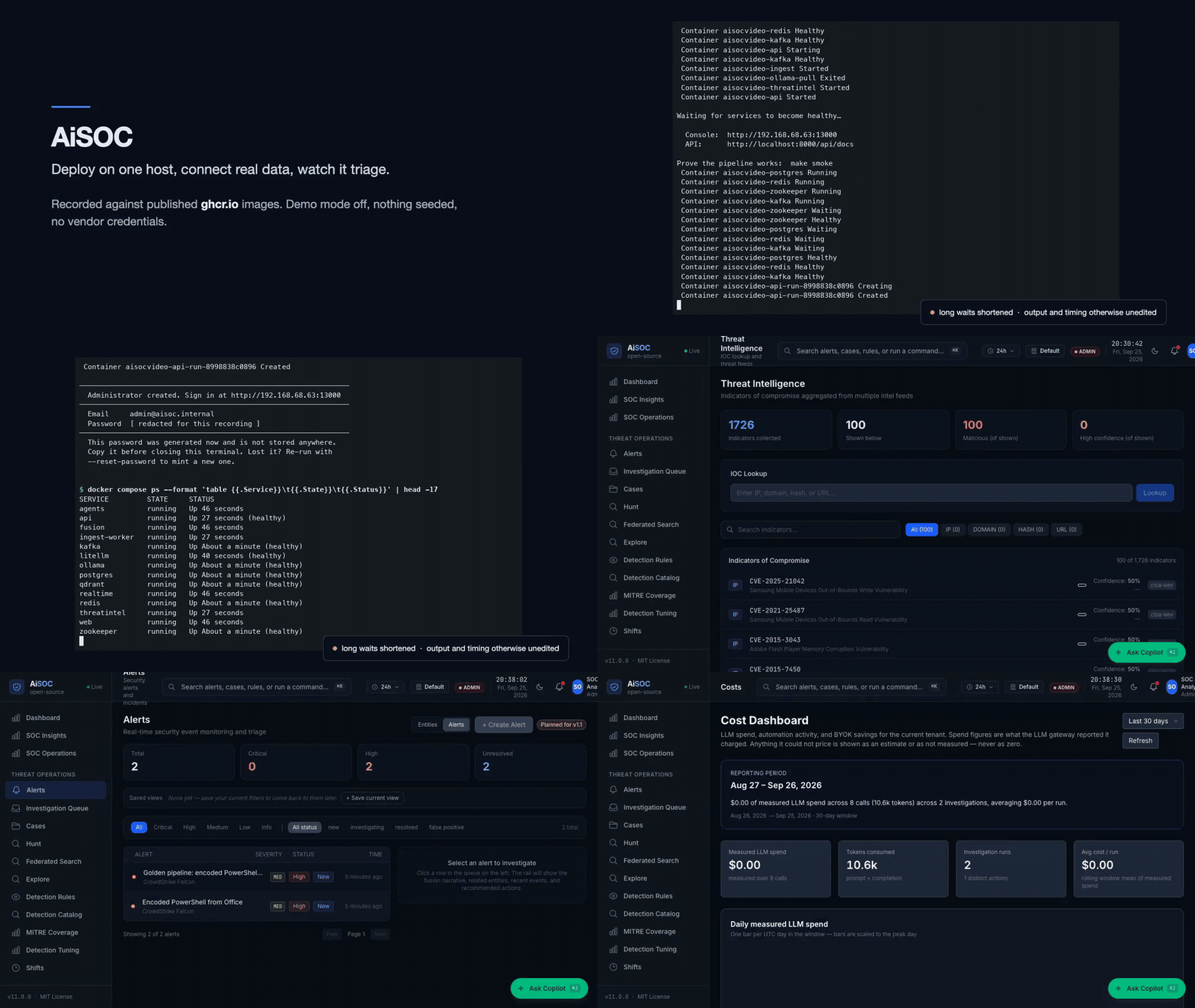
Watch the full three minutes — install to AI verdict on one server, against the published images. Terminal waits are shortened, which the recording says on screen. (step by step)
Stills from earlier runs under the same rules — no seeded rows, no demo mode, no mockups. The events were authored to be representative; everything downstream is the product doing its job. (what is real)
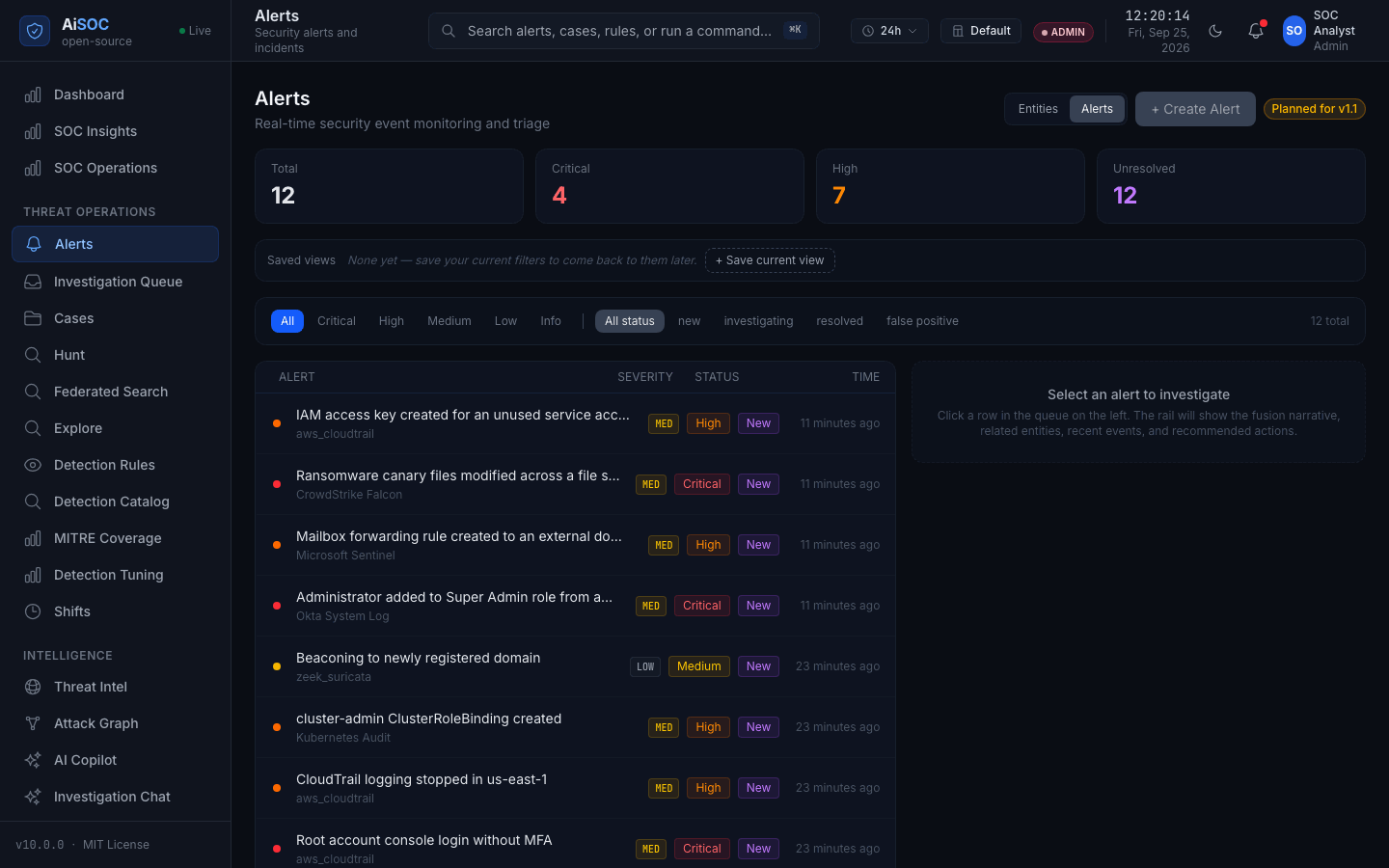 | 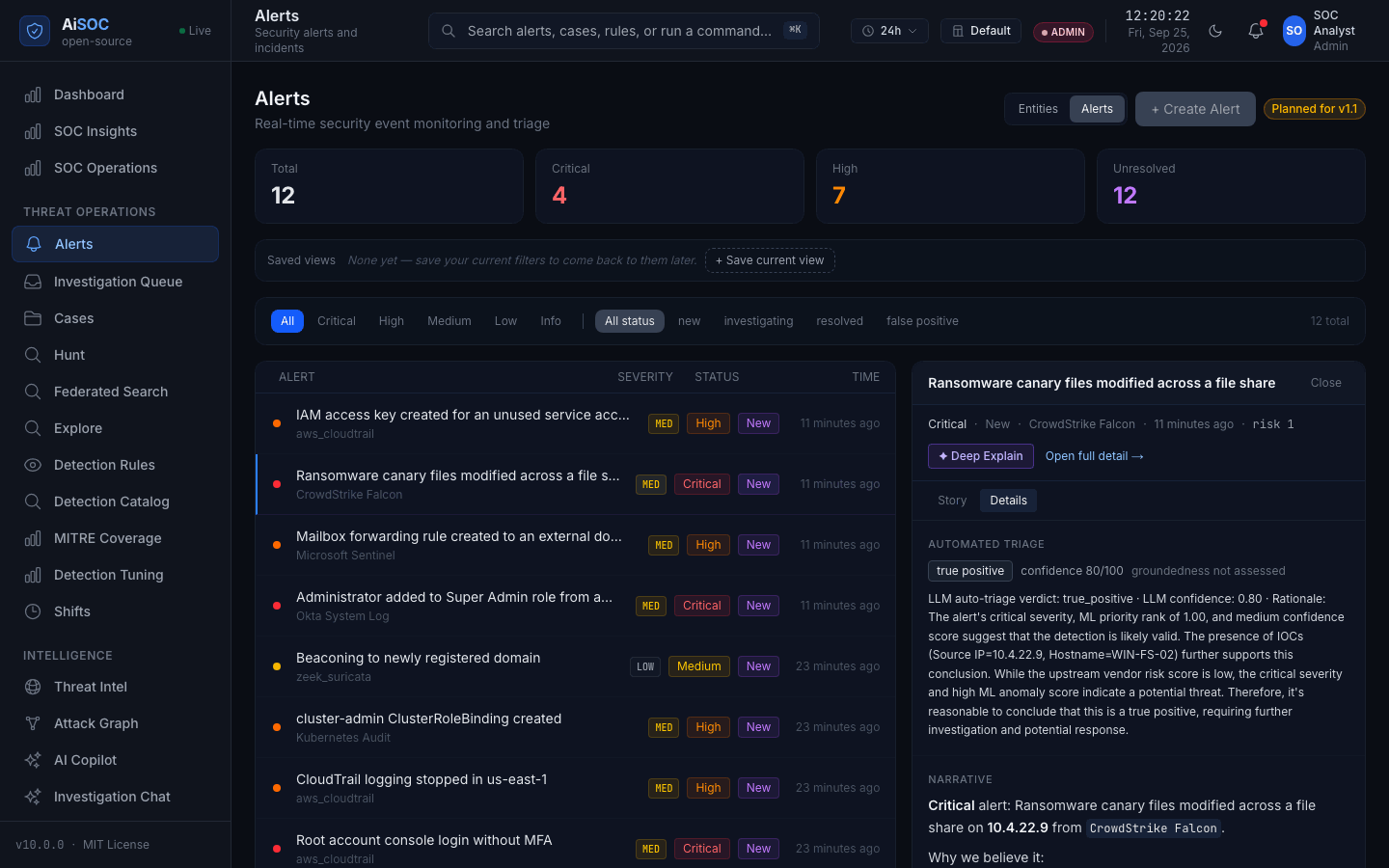 |
| Alerts — each attributed to the connector that fed it. | Automated triage — the bundled local model's verdict, confidence and rationale, verbatim. |
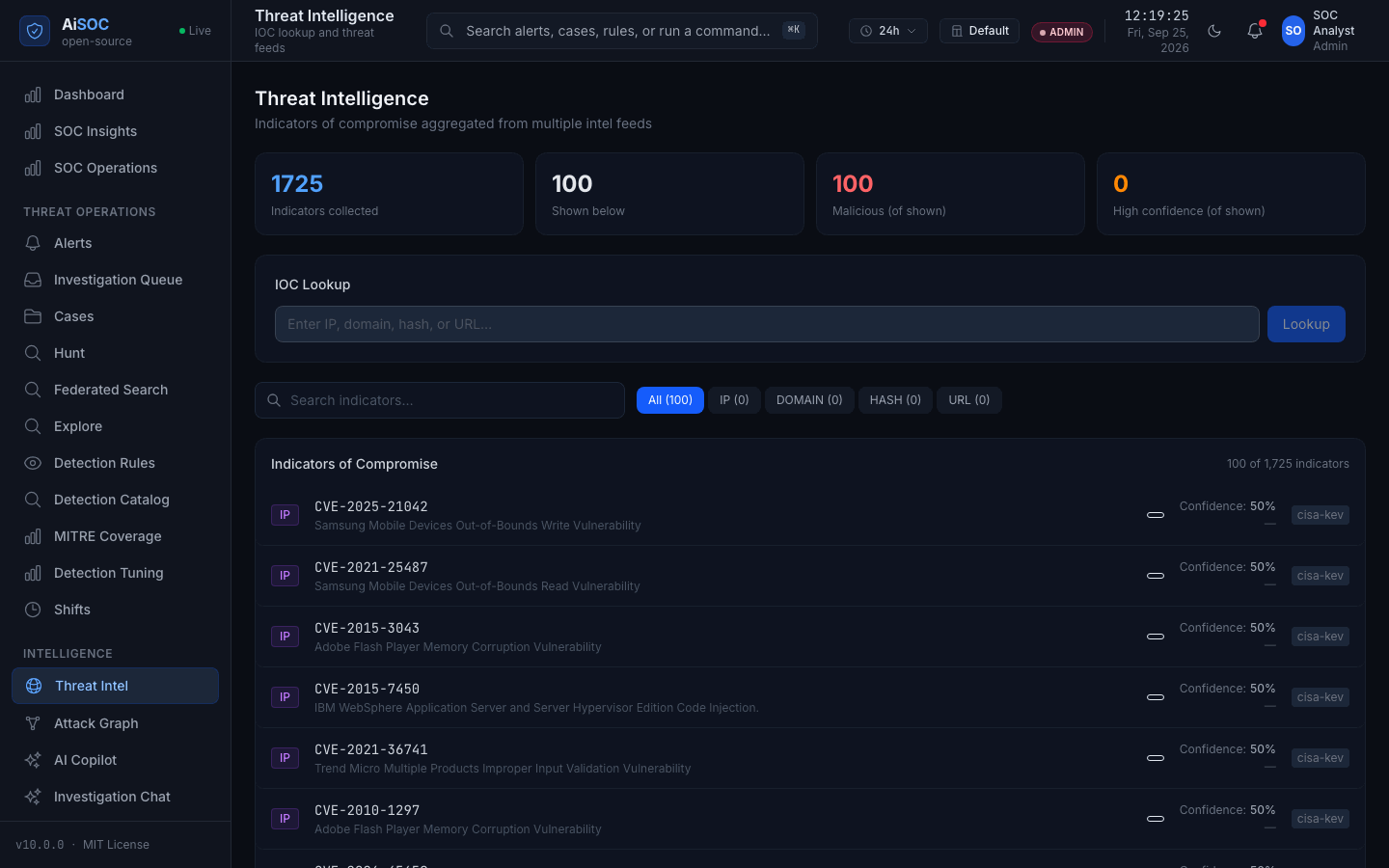 | 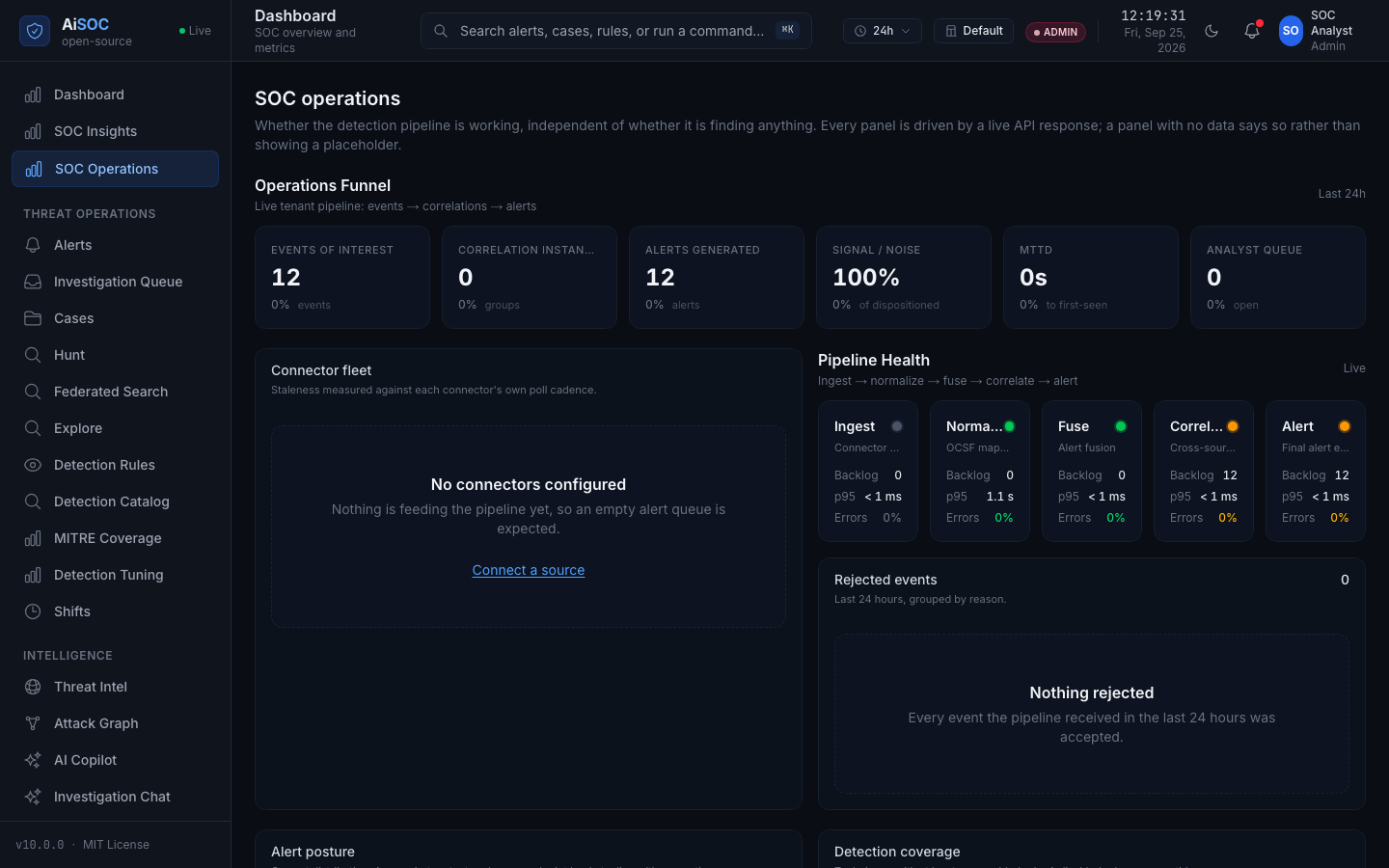 |
| Threat intelligence — the real CISA KEV catalog, minutes after boot, with no API key. | SOC operations — with nothing connected yet, and it says so rather than showing a placeholder. |
git clone https://github.com/beenuar/AiSOC && cd AiSOC
make up
Needs Docker Compose v2 with 8 GB memory and 20 GB free disk in the Docker VM, plus python3
(3.9+) and bash — make doctor checks all of it, and
Installation says what each number
was measured against. The first run downloads a ~2 GB language model into a named volume; only
make clean fetches it again.
make up also creates .env and generates the eleven secrets in it — the credential vault,
the session signing key, the five service-to-service credentials and the four datastore passwords — then
creates an administrator and prints its password. That password is generated on your machine, shown once, and stored nowhere:
copy it, or mint a new one with make bootstrap ARGS=--reset-password.
Then prove it actually works. make smoke posts one real event to the ingest API, follows it
through Kafka, detection, correlation and Postgres, and reads the alert back out of the public API.
Every stage reports PASS or FAIL:
$ make smoke
[PASS] raw telemetry accepted by ingest
[PASS] event traversed the spine and became an alert
[PASS] alert is retrievable by id from the API
Open http://localhost:3000 and sign in with the credentials make up printed (API docs at
http://localhost:8000/api/docs). On a server, set AISOC_CONSOLE_URL in .env — make up then
prints that address rather than localhost, which is the one people can browse to. Stuck?
make doctor.
make demo loads a synthetic dataset — the pipeline shape, not real activity, and never a benchmark, a customer or an incident. Every row is is_synthetic = true and labelled in the console.
Two ways in. Push, with a credential from make ingest-token (the tenant comes from it, not from a header):
curl -X POST http://localhost:8081/v1/ingest/batch \
  -H 'Content-Type: application/json' -H "Authorization: Bearer $AISOC_INGEST_TOKEN" \
  -d '{"connector_id":"edr-1","connector_type":"crowdstrike","source_format":"json",
       "events":[{"severity":"high","title":"Encoded PowerShell from Office",
                  "host":"WIN-FIN-01","process_name":"powershell.exe"}]}'
Or pull, by configuring one of 84 click-and-connect data connectors in Settings →
Connectors (needs the full profile). Those with vendor-specific normalization and live
setup docs include Splunk, Microsoft Sentinel, Elastic, CrowdStrike, Okta, AWS (GuardDuty /
CloudTrail / Security Hub), Wiz, and Kubernetes audit logs — full list in the
connector docs. Without a
vendor profile a connector still ingests through a generic mapping that resolves host, user
and source IP from the usual spellings.
Ingest normalizes to a common shape and Kafka carries it. Then fusion runs 2603 executable detection rules, of 6991 on disk, and decides what becomes an alert, correlation groups related alerts, an agent investigates and writes its reasoning to the Investigation Ledger, and a human approves any response. Separately, new threat intelligence sweeps the lake for sightings you already collected, and a hypothesis becomes a hunt without anyone writing a query — the model fills a closed schema and every value it supplies is bound as a parameter, so it cannot express a query at all.
