 alejandro-llanes/http_bridge
Ponte proxy SOCKS5-to-HTTP che tunnelizza flussi TCP arbitrari (SSH, SMTP, TLS) attraverso richieste HTTP standard, consentendo l'oscuramento del traffico di rete e l'elusione del firewall.

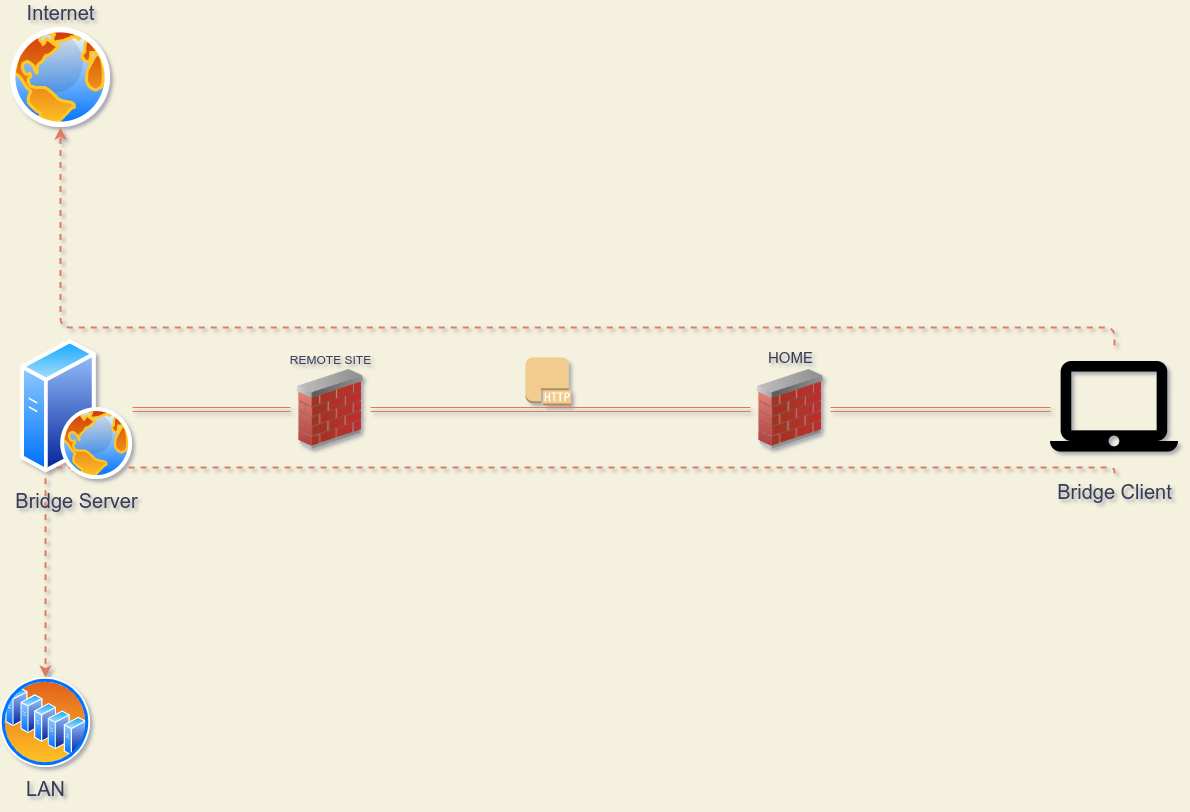
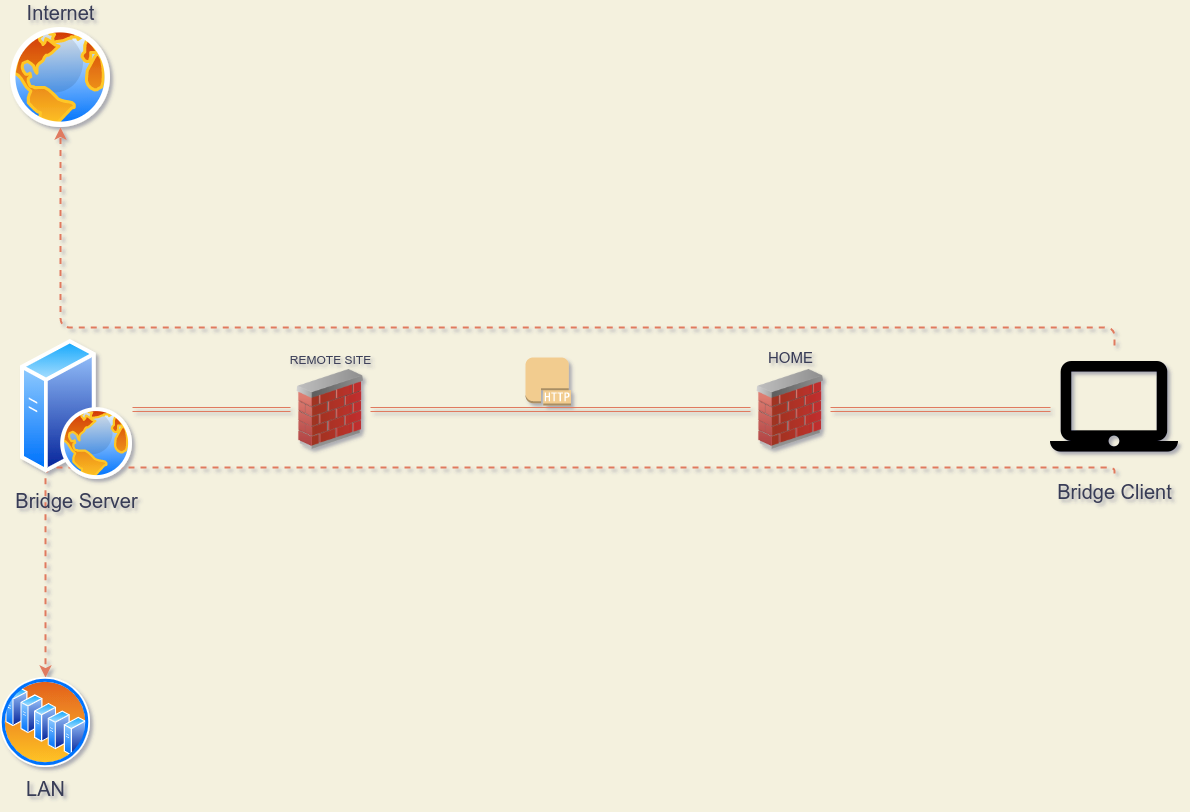
Ho scritto questo programma come prova di concetto per testare l'idea di poter inviare pacchetti di flusso TCP tramite semplici richieste HTTP come PUT, PATCH, POST, GET, senza utilizzare un proxy come il metodo CONNECT. Inoltre, come esercizio pratico per affinare le mie capacità da principiante nel linguaggio Rust.
Questo strumento è composto da due parti: il server e un client.
Il server è semplicemente un file PHP con una logica per mantenere connessioni stateful utilizzando socket TCP e gestire le richieste HTTP in arrivo; al momento questa logica funziona solo su server Linux.
L'ho testato con Apache+mod_php, nginx+php-fpm e il server PHP integrato (php -S).
Il client è un server Socks5 che ascolta le connessioni in arrivo dei client, impacchetta i byte string e invia la richiesta HTTP al server; una volta ricevuta la risposta, la riscrive al client.
Questo client è scritto in Rust, ho preso in prestito l'implementazione Socks5 da questo progetto v2socks, quindi grazie a ylxdzsw.
Proxychains è necessario per eseguire questo esempio.
Carica il file server hbserver/hbserver.php su un server web funzionante con supporto PHP, oppure esegui un server locale come segue; questo avvierà un container Docker in ascolto sulla porta 8080.
docker run --rm -it --net host --name apache-webserver -v "$PWD/hbserver:/app -v "$PWD/tools/ports.conf:/etc/apache2/ports.conf" webdevops/php-apache:7.3
Il client deve essere compilato, quindi è necessario avere un compilatore Rust installato o ottenerne uno da rustup
cd client &&\
cargo build &&\
./target/debug/hbsc
Configura proxychains per puntare alla porta socks5 locale:
echo "socks5 127.0.0.1 1986" >> $HOME/.proxychains/proxychains.conf
Con tutto in posizione, alcuni test:
icanhazip.com
alejandro@0x2e ~ $ proxychains curl -v icanhazip.com
[proxychains] config file found: /home/alejandro/.proxychains/proxychains.conf
[proxychains] preloading /usr/lib64/libproxychains.so.4.14
*   Trying 224.0.0.1:80...
* Connected to icanhazip.com (127.0.0.1) port 80 (#0)
> GET / HTTP/1.1
> Host: icanhazip.com
> User-Agent: curl/7.72.0
> Accept: */*
>
* Mark bundle as not supporting multiuse
< HTTP/1.1 200 OK
< Date: Thu, 25 Feb 2021 18:08:04 GMT
< Content-Type: text/plain
< Content-Length: 15
< Connection: close
< Set-Cookie: __cfduid=dd994605ef1b77d0aa6dc46b6fdbb4c8d1614276484; expires=Sat, 27-Mar-21 18:08:04 GMT; path=/; domain=.icanhazip.com; HttpOnly; SameSite=Lax
< Access-Control-Allow-Origin: *
< Access-Control-Allow-Methods: GET
< X-RTFM: Learn about this site at http://bit.ly/icanhazip-faq
< X-THANK-YOU: Many thanks to the fine people at Cloudflare for keeping this site afloat!
< cf-request-id: 087bf977730000e790d13c4000000001
< Server: cloudflare
< CF-RAY: 62735e9f1ec9e790-MDE
< alt-svc: h3-27=":443"; ma=86400, h3-28=":443"; ma=86400, h3-29=":443"; ma=86400
<
XXX.33.235.XXX
* Closing connection 0
http://httpbin.org/headers
alejandro@0x2e ~ $ proxychains curl -v http://httpbin.org/headers
[proxychains] config file found: /home/alejandro/.proxychains/proxychains.conf
[proxychains] preloading /usr/lib64/libproxychains.so.4.14
*   Trying 224.0.0.1:80...
* Connected to httpbin.org (127.0.0.1) port 80 (#0)
> GET /headers HTTP/1.1
> Host: httpbin.org
> User-Agent: curl/7.72.0
> Accept: */*
>
* Mark bundle as not supporting multiuse
< HTTP/1.1 200 OK
< Date: Thu, 25 Feb 2021 18:05:51 GMT
< Content-Type: application/json
< Content-Length: 173
< Connection: keep-alive
< Server: gunicorn/19.9.0
< Access-Control-Allow-Origin: *
< Access-Control-Allow-Credentials: true
<
{
  "headers": {
    "Accept": "*/*",
    "Host": "httpbin.org",
    "User-Agent": "curl/7.72.0",
    "X-Amzn-Trace-Id": "Root=1-6037e6ff-06059b933c2d8c495ecee43a"
  }
}
* Connection #0 to host httpbin.org left intact
https://mozilla.org
alejandro@0x2e ~ $ proxychains curl -v https://mozilla.org
[proxychains] config file found: /home/alejandro/.proxychains/proxychains.conf
[proxychains] preloading /usr/lib64/libproxychains.so.4.14
*   Trying 224.0.0.1:443...
* Connected to mozilla.org (127.0.0.1) port 443 (#0)
* ALPN, offering h2
* ALPN, offering http/1.1
* successfully set certificate verify locations:
*   CAfile: /etc/ssl/certs/ca-certificates.crt
  CApath: /etc/ssl/certs
* TLSv1.3 (OUT), TLS handshake, Client hello (1):
* TLSv1.3 (IN), TLS handshake, Server hello (2):
* TLSv1.3 (IN), TLS handshake, Encrypted Extensions (8):
* TLSv1.3 (IN), TLS handshake, Certificate (11):
* TLSv1.3 (IN), TLS handshake, CERT verify (15):
* TLSv1.3 (IN), TLS handshake, Finished (20):
* TLSv1.3 (OUT), TLS change cipher, Change cipher spec (1):
* TLSv1.3 (OUT), TLS handshake, Finished (20):
* SSL connection using TLSv1.3 / TLS_AES_256_GCM_SHA384
* ALPN, server accepted to use h2
* Server certificate:
*  subject: CN=mozilla.org
*  start date: Jan  1 19:11:54 2021 GMT
*  expire date: Apr  1 19:11:54 2021 GMT
*  subjectAltName: host "mozilla.org" matched cert's "mozilla.org"
*  issuer: C=US; O=Let's Encrypt; CN=R3
*  SSL certificate verify ok.
* Using HTTP2, server supports multi-use
* Connection state changed (HTTP/2 confirmed)
* Copying HTTP/2 data in stream buffer to connection buffer after upgrade: len=0
* Using Stream ID: 1 (easy handle 0x562758dbab60)
> GET / HTTP/2
> Host: mozilla.org
> user-agent: curl/7.72.0
> accept: */*
>
* TLSv1.3 (IN), TLS handshake, Newsession Ticket (4):
* TLSv1.3 (IN), TLS handshake, Newsession Ticket (4):
* old SSL session ID is stale, removing
* Connection state changed (MAX_CONCURRENT_STREAMS == 128)!
< HTTP/2 301
< date: Thu, 25 Feb 2021 18:03:56 GMT
< content-type: text/html
< content-length: 162
< location: https://www.mozilla.org/
< strict-transport-security: max-age=60; includeSubDomains
< x-backend-server: TS
< cache-control: max-age=3600
< x-frame-options: SAMEORIGIN
< content-security-policy: frame-ancestors 'none'
<
<html>
<head><title>301 Moved Permanently</title></head>
<body>
<center><h1>301 Moved Permanently</h1></center>
<hr><center>nginx</center>
</body>
</html>
* Connection #0 to host mozilla.org left intact
smtp.gmail.com
alejandro@0x2e ~ $ proxychains nc -v smtp.gmail.com 25
[proxychains] config file found: /home/alejandro/.proxychains/proxychains.conf
[proxychains] preloading /usr/lib64/libproxychains.so.4.14
Connection to smtp.gmail.com 25 port [tcp/smtp] succeeded!
220 smtp.gmail.com ESMTP z1sm4022921qtu.83 - gsmtp
EHLO smtp.gmail.com
250-smtp.gmail.com at your service, [XXX.33.235.XXX]
250-SIZE 35882577
250-8BITMIME
250-STARTTLS
250-ENHANCEDSTATUSCODES
250-PIPELINING
250-CHUNKING
250 SMTPUTF8
^C
alejandro@0x2e ~ $ proxychains ssh  localhost 'ps axl --sort=-pcpu|tail -n 5'
[proxychains] config file found: /home/alejandro/.proxychains/proxychains.conf
[proxychains] preloading /usr/lib64/libproxychains.so.4.14
Password:
4     0  65375   1242  20   0   9516  6988 -      Ss   ?          0:00 sshd: alejandro [priv]
5  1000  65420  65375  20   0   9516  4320 -      S    ?          0:00 sshd: alejandro@notty
0  1000  65421  65420  20   0 218168  3260 -      Ss   ?          0:00 bash -c ps axl --sort=-pcpu|tail -n 5
4  1000  65422  65421  20   0 220568  3484 -      R    ?          0:00 ps axl --sort=-pcpu
0  1000  65423  65421  20   0 216756   748 -      S    ?          0:00 tail -n 5
alejandro@0x2e ~ $
