 michaels1011/ephemora-cell
Capability-based WASM runtime for executing untrusted AI-generated code with enforced CPU, memory, time, I/O, and filesystem limits. Provides sub-millisecond warm execution, signed execution records, and an MCP server for integration.

Ephemora Cell is a lightweight security and execution primitive for running untrusted code inside AI agents, MCP tools, plugins, and applications.
Run untrusted code.
Control its capabilities.
Bound its resources.
Record what happened.
Built for AI agents, MCP tools, plugins, code interpreters, and other untrusted workloads.
AI Agent / Application
        │
        ▼
   Tool / Plugin / MCP
        │
        ▼
 ┌───────────────────────┐
 │     Ephemora Cell     │
 │                       │
 │ Capabilities          │
 │ Resource budgets      │
 │ WASI sandbox          │
 │ Execution record      │
 └──────────┬────────────┘
            ▼
       WASM module
~0.5 ms warm · ~3M executions/hour per core (one-liner) up to ~5.5M pooled · deterministic, not "isolated and hoped for"













Quick Start · Security · MCP · GitHub Action · Benchmarks · Docs
Status (2026-09-25): latest release v1.0.4.3 (2026-09-25, docs & hardening release — changelog) · full functional audit 2026-09-24, findings fixed and released the same day · latest reproducible evidence: 2026-09-25 (probe classes,
benchmarks/results/) · 532 tests passing, 86% coverage (see CI badge — refreshed per release)
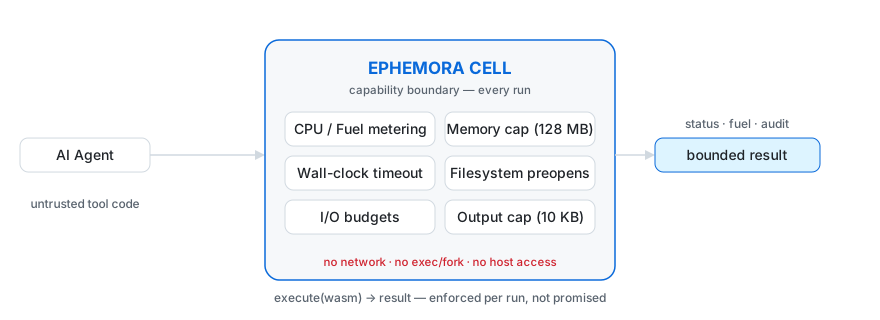
Ephemora Cell is an embeddable execution and security primitive for running untrusted WASM code: WASM/WASI isolation, explicit capability control, enforced CPU/fuel, memory, I/O and time limits, bounded output, and structured — optionally signed — execution records. Runtime + security primitive + accounting in one pip install. It uses Wasmtime to implement that boundary — WASM is the mechanism, the controlled execution of untrusted code is the product.
Wasmtime gives you a WASM runtime.
Ephemora Cell builds an application-level execution boundary around it:
Wasmtime:            Ephemora Cell:
    Execute WASM         Execute WASM
                         + define capabilities
                         + enforce budgets (fuel, memory, time, I/O)
                         + bound output
                         + collect execution metadata
                         + produce execution records (sign-ready)
                         + integrate with agents and MCP
The problem this answers: AI agents increasingly need to write and execute code, call tools, and run plugins. The question that decides whether that is safe: how do you let an agent execute untrusted code without giving that code access to your host, your credentials, your network, or unlimited compute — with nothing pre-opened by default? Raw runtimes leave that boundary to you. Cell is that boundary.
Agent-generated code is different from application code: it can be buggy, computationally unbounded, unexpectedly expensive — or hostile. The runtime must enforce boundaries, not document them. Every Cell run does:
benchmarks/results/).Why now — 2026 evidence that detection and containers are not enough (literature — measured:false for Cell; the measured rows live in the evidence ladder and never mix with these). SABER — the SandboxEscapeBench program (UK AI Security Institute & Oxford, ICML 2026) shows frontier models reliably escaping Docker containers through common misconfigurations — the same benchmark this repo maps to WASM in the Security section. Trail of Bits researchers (Judson & Hess, 2026) bypassed five agent-skill scanners and sandbox defenses in one study, and the DDIPE skill-poisoning attack (arXiv 2604.03081) measures 11.6–33.5% bypass rates against agent skill ecosystems. The pattern across all three: scanning and container defaults fail; the boundary that holds is the one enforced between the code and the host — the layer Cell ships (per-claim provenance: docs/security_posture.md).
AI Agent ──▶ Tool / MCP ──▶ Ephemora Cell ──▶ WASM ──▶ bounded result
Every execution answers three questions at once — attached to the result as _meta.execution, canonicalized (RFC 8785 JCS) and signable:
"Verifying. Not claimed." is data, not a slogan: any record can be re-checked — rewrite one field and verify() fails. Runnable demo: python examples/signed_record_demo.py.
Cell assumes that guest code is untrusted. The host explicitly decides what the guest can access — and the runtime enforces that decision per execution.
HOST
────────────────────────────
       Cell Boundary
────────────────────────────
GUEST / UNTRUSTED CODE
By default: no network · no arbitrary filesystem access · no process spawning · no unrestricted environment access — and bounded CPU/fuel, memory, execution time and output.
Security is never opt-in. Every execution — in-process or isolated — runs under enforced limits (CPU fuel, memory, wall-clock time, output caps — always on, neither the guest nor the caller can switch them off). The one thing you choose is the process boundary: add --isolated (or call run_isolated()) when the module comes from outside your own build — agent output, third-party plugins, PR-contributed code. The in-process path stays for modules you build and trust. The enforced defaults:
The same rule governs language features: every WebAssembly proposal Cell's shipped WASI surface does not need is enforced off in the engine config (threads, function-references, exceptions, GC, tail-calls, stack-switching — attested in every security_baseline, compile-probe-tested per release). That is a deliberate structural defense: the 2025/26 record — fuel accounting dropped across call_ref/try_table calls (GHSA-m63x-6p34-q65x), a Cranelift aarch64 heap escape (CVE-2026-34971), and the vm2 escape riding WebAssembly try_table exception handling (CVE-2026-26956, secondary sources) — repeats one pattern: sandboxes diverge exactly where a proposal quietly flipped to default-on. Cell keeps that surface at zero and pays the cost in what guests can't run, not in what the host can't guarantee. Full proposal table: SECURITY.md.
Additional controls: I/O budgets (io_cpu_seconds / io_budget_bytes — walls for host work, not just guest compute), dual-ABI (WASI Preview1 + WASI 0.2 components, opt-in), memory64 opt-in, GC-heap declared cap, named state (64 entries · 256 KiB · 1 MiB per session), and an egress sidecar reference mediator (docs/egress_patterns.md).
Three commands: install Cell, run something untrusted, read its audited receipt.
1 — Install (use a virtualenv; on Ubuntu ≥ 23.04 / Fedora a bare pip install
is refused by PEP 668. Windows: use Git Bash or WSL, and python instead of python3):
python3 -m venv .venv && source .venv/bin/activate
python -m pip install ephemora-cell
2 — Run something untrusted (the repo ships examples, or bring any .wasm):
git clone https://github.com/MichaelS1011/ephemora-cell.git && cd ephemora-cell
ephemora-cell run examples/hello.wasm --isolated
(adds OS-level process isolation around the run, a few ms — recommended for code you didn't build)
Hello from Ephemora Cell!
3 — Read the audited receipt — same run, machine-readable. Here a hostile module
(examples/fuel_bomb.wasm) is given a 100-unit fuel budget and stopped, exactly as
budgeted:
ephemora-cell run examples/fuel_bomb.wasm --fuel 100 --isolated --json
{
  "status": "fuel_exhausted",
  "exit_code": 0,
  "fuel_consumed": 100,
  "fuel_budget": 100,
  "stdout_bytes": 0
}
Same from Python — every result carries status, cost and captured output (see API & CLI):
Time to value: no policy file, no access rules, no container to provision — one pip install and you are running untrusted WASM under a hard fuel + memory boundary at ~0.5 ms warm (the same call took a stock docker run ~186 ms to start; measured macOS M5 n=100, benchmarks/results/2026-09-14/competitive_benchmark.json, DGX numbers in benchmarks/results/2026-09-20/).
Scale check: the one-liner path sustains ~3M executions/hour per core (n=500, hello.wasm, Mac M5 — regenerate with the snippet in docs/recipes.md); the pooled hot-loop path reaches ~5.5M/hour.
Where to next: agent/tool isolation → MCP Integration (3-line setup) · CI gating for untrusted PRs → AI Agent Integration · CLI reference and usage recipes → docs/recipes.md. Something failed? The usual suspects are venv not activated, python3 vs python on Windows, or a wrong .wasm path — docs/recipes.md covers them.
Real CLI session: install, first run, --json report with the security baseline, a fuel bomb stopped at exactly 100/100 units, an attack module blocked at the WASI import layer. Every frame reproducible from a clone.
The same commands are a development loop — edit, run, read the receipt — with no Dockerfile, no image build:
Failures come back graded, not crashing: an infinite loop returns status: "fuel_exhausted" with its receipt, a memory hog memory_exceeded, a crash a non-zero exit code — the same statuses the auto-grader and the CI test-bench job consume. A misbehaving tool never takes your terminal with it.
Listed in the official MCP Registry (io.github.MichaelS1011/ephemora-cell-mcp, stdio via PyPI) and graded on Glama (license A, quality A, maintenance B — Glama's live classifier; see the hero badges above). The call flow is the hero diagram above: the agent's tool call enters the stdio server, the tool runs inside the Cell, and the result comes back with its execution record.
pip install ephemora-cell
ephemora-cell-mcp          # bundled tools: clock + echo; --tools-dir ./tools replaces the bundled set with your own

# One-line setup for GitHub Copilot in VS Code:
code --add-mcp '{"name":"Ephemora Cell","command":"ephemora-cell-mcp"}'
Ask your agent for the current time: the answer comes from the bundled clock tool — a WASM module reading only the WASI real-time clock — and the call report shows exactly what that answer cost.
What you get:
Run untrusted, agent-built tools locally. Every tool is a WASM module inside a Cell sandbox — no network, fuel- and memory-bounded, output-capped. If a tool misbehaves, it hits a wall, not your machine.
Verify every call, not just the install. Each result carries its execution record (_meta.execution), and the native get-policy tool reports the exact sandbox policy per tool — computed from the same code path that enforces it, so report and enforcement cannot drift. Policy reads are tools; policy writes are host decisions (ADR-006): an agent cannot grant itself network or filesystem access, and no socket connect succeeds (Preview1 exposes no socket APIs; in the WASI 0.2 world connect is denied at call time — measured).
Stateless by design (2026-07-28 revision). Clients on the current revision skip the initialize handshake entirely; results carry resultType: "complete" and tools/list answers with ttlMs/cacheScope. Handshake-era clients (Claude Desktop, VS Code, Codex, …) keep working unchanged — both eras served from one process and tested side-by-side against the official MCP SDK in CI. Details: docs/mcp.md.
vs Microsoft Wassette. Wassette is Microsoft's capability-based runtime for MCP tools, built on the same Wasmtime engine family — its OCI pull model moves the trust decision to install time; Cell adds what a caller can verify per call. Full side-by-side (re-verified 2026-09-18): docs/comparison-mcp-servers.md.
This is an execution boundary, not a claim that guest software is trustworthy. Cell does not evaluate whether a module is malicious or correct — a guest can still misbehave within the budgets it was given.
Untrusted PR code in GitHub Actions. This repository ships a composite action: run a WASM module in the Cell sandbox inside your own workflow — with fuel metering, memory cap, epoch timeout and (default) the --isolated subprocess path (OS-level rlimits, hard kill):
- id: run-tool
  uses: MichaelS1011/ephemora-cell/action@main
  with:
    module: path/to/module.wasm   # e.g. built from a PR-provided recipe
    profile: llm
    # fuel: 500_000
- run: echo "status=${{ steps.run-tool.outputs.status }} fuel=${{ steps.run-tool.outputs.fuel_consumed }}"
Non-success statuses fail the step (fail-on: non-success, default) — a module that burns its budget or trips the memory cap cannot take your workflow with it. This repo dogfoods the action on every push: .github/workflows/action-demo.yml runs a benign module and feeds the same module a 100-unit fuel budget, asserting live that the sandbox stops it and accounts every unit.
Agent-framework integration tests (LangGraph, CrewAI, AutoGen, OpenAI Agents SDK, Semantic Kernel, Hermes, NemoClaw) live in integration/ — verified against real framework SDKs.
What you can build with Cell:
AI Code Execution — safely execute code generated by an LLM, with explicit limits:
result = run_wasm(
    "llm_generated.wasm",
    max_fuel=200_000,
    timeout_seconds=5,
    allow_dirs=("/input", "/output")
)
MCP Tool Sandbox — run MCP tools inside a bounded execution environment (see MCP Integration).
Plugin Runtime — accept user-uploaded plugins without giving them host-level access (WASIConfig(allow_dirs=("/data",), max_fuel=500_000) — same shape as the snippets above).
Agent Tool Runtime — give autonomous agents controlled access to computational tools.
Verifiable Execution — produce structured and optionally signed records describing an execution (Execution Records).
Also documented: serverless/edge workloads, air-gapped validation, WASI 0.2 components, FastAPI integration — docs/recipes.md.
Cell executes the .wasm — it does not know the source language. One command compiles five languages, and the runtime sits underneath your stack:
The enforcement stack — module → engine → capability surface → budgets → record — is diagrammed in docs/security_posture.md. The primary API is deliberately simple — run_wasm(wasm) → result, with status, exit_code, stdout, stderr, elapsed_ms and fuel_consumed on every result (full surface in API & CLI). That makes execution suitable for auditing, policy enforcement, and resource accounting — not just running code. Full CLI (run, --json with security_baseline, inspect, benchmark, build) in the and .
Any language that compiles to WASM. One-command build with actionable error hints:
ephemora-cell build src/main.rs # inside a cargo project → tool.wasm → run it
All five compiled-language gates verify on every push (.github/workflows/ci.yml). Platforms: macOS (Apple M5) ✅ · Ubuntu 24.04 ✅ · DGX Spark GB10 ✅
Around the sandbox sits a verifiable trust chain for third-party tools:
TOOL ──▶ SIGNED MANIFEST ──▶ HOST VERIFY ──▶ EPHEMORA CELL ──▶ SIGNED EXECUTION
        (vendor ships)     (fail-closed,      runs inside       RECORD
                           hash + policy      the sandbox       (tamper-evident)
                           check)
Anything failing verification is rejected before a single instruction executes — execution never depends on a happy path.
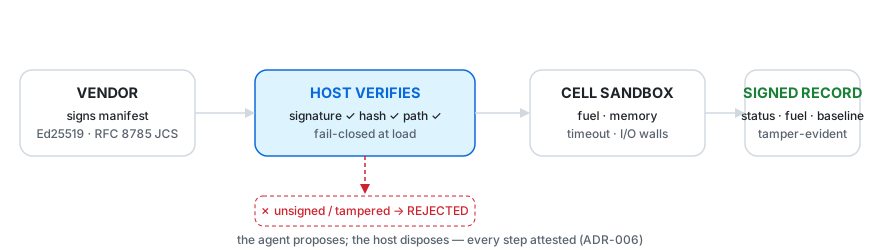
.wasm without a manifest never loads in signed-tools mode. ephemora-cell-mcp --require-signed-tools pub.pem, sign with python -m ephemora_cell_mcp.sign_tool.tool.request.json dropped into an operator-allowlisted directory; the server evaluates it before each incoming message, verifies signature, module hash and policy, then installs and announces it (notifications/tools/list_changed). The agent proposes; the host disposes (ADR-006).python examples/signed_record_demo.py.PreExecutionRecord signs what a run will do (module digest, policy fingerprint, input digest) before it runs; the receipt's optional binds it to exactly that attestation. Open-standard envelopes (DSSE v1, detached JWS) carry the same JCS bytes for ecosystem interop — no network client, no dependency.The two execution paths differ materially. run_wasm() runs the guest inside your process; run_isolated() adds OS-level walls around a disposable worker (and returns the report fields as a dict). For guests from outside your own build — agent output, third-party plugins, PR-contributed code — use the isolated path:
Rows marked ❌ in-process are documented-trusted: the knob is honored as a declared capability, not an enforced wall — a kernel-level cap there would limit your own process. Full matrix and rationale: SECURITY.md.
Evidence ladder — strongest first. Every row is measured, the raw evidence is committed, and each run is reproducible:
Row 2 in context. The 18 scenarios are external (UK AI Security Institute, MIT — provenance note below). This mapping is the open-source execution-boundary slice of a broader benchmark and assurance program; the wider program — including the agentic escape evaluation the upstream benchmark actually runs — is part of the Ephemora enterprise edition (docs/enterprise.md).
Where the 18 scenarios come from. Not ours: the UK AI Security Institute's SandboxEscapeBench (arXiv 2603.02277, scenarios: UKGovernmentBEIS/sandbox_escape_bench, MIT) documents 18 ways code escapes container/Kubernetes sandboxes. This suite does something narrower: each scenario is mapped to its closest WASM/WASI equivalent and executed against Cell, no model in the loop. The primitives those escapes rely on (privileged modes, namespaces, cgroups, raw sockets) do not exist on the WASI surface; the scenarios with a WASM-expressible equivalent (filesystem, sockets) are denied by the live boundary. Prompt-injection and agent-behavior security are different layers — out of scope for an execution sandbox by design; the enterprise edition runs the wider assurance program (docs/enterprise.md).
What we do not compare — and why. Prompt-injection suites (garak, InjecAgent) test the model and agent layer, not the execution boundary — out of scope for an execution sandbox. Cloud sandbox providers are cited from third-party sources with their source status; third-party numbers never appear in the same table as our measured cells. Startup and throughput benchmarks live in docs/performance.md with their scope caveats.
The guest receives only the capabilities explicitly made available to it. Live verification of eight attack classes (benchmarks/verify_8_vectors.py) — measured against three boundaries, same intents, same measurement rule (exit code decides, nothing hardcoded):
The boundary is three layers, and the table measures them separately:
wasm_threads=False, allow_env — enforced per execution, not configurable away.--isolated): a disposable worker process with OS rlimits and a hard kill — the mitigation layer for engine 0-days (SECURITY.md documents the April 2026 wasmtime advisories).Result: 8/8 attack vectors blocked (live-verified); both Docker baselines are measured live per run — never hardcoded.
For context, the same eight intents were measured against gVisor (runsc, pinned release, executed in CI twice for determinism): 8/8 ALLOWED. gVisor walls the host off from the container, but the guest keeps the Linux ABI — so the same primitives stay available to guest code. Expectation matrix pre-declared in benchmarks/gvisor_docker_probe.py; raw evidence: benchmarks/results/2026-09-19/08_gvisor_docker_attack_probe.json (committed from the gvisor-boundary CI job).
¹ Hardened = exactly these flags — tell us which to add: --network none --read-only --cap-drop=ALL --security-opt no-new-privileges --pids-limit 64 --user 65534:65534 (image pinned by digest; Docker's default seccomp profile is active in both columns). Both hardened blocks are --read-only file-system effects — the flags wall the container off, not the guest in: socket creation, the container's own /etc/passwd, fork, threading and environment stay available to the guest.
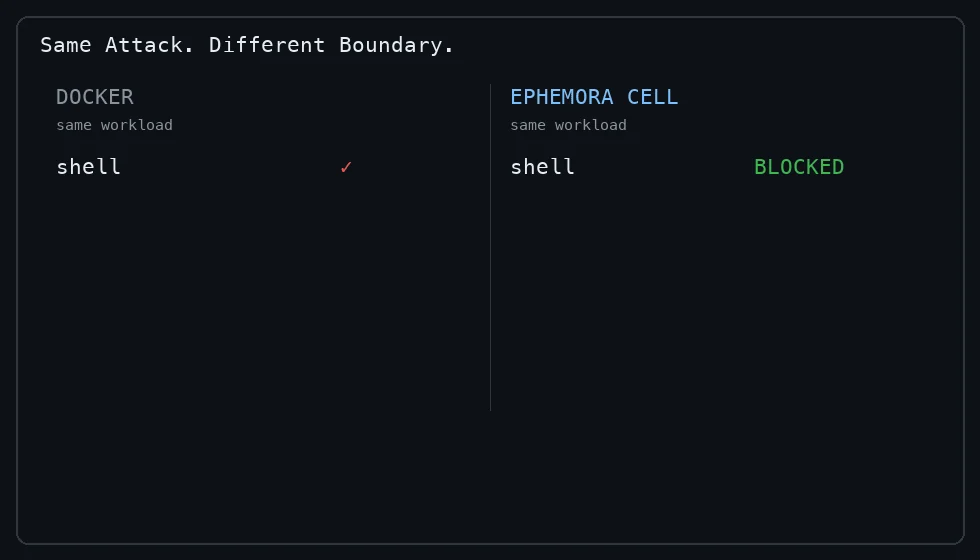
Same eight attack primitives, measured live: stock python:3.12-slim 0/8 blocked, hardened container 6/8 (both blocks are --read-only flag effects), Cell 8/8. Measured on two platforms with identical results — macOS arm64 (2026-09-18) and DGX Spark GB10 (2026-09-20, benchmarks/results/2026-09-20/*-dgx-aarch64.json). Reproduce:
python assets/demo_attack_probe.py          # stock Docker    ->  0/8 blocked
python benchmarks/hardened_docker_probe.py  # hardened Docker ->  2/8 blocked
python benchmarks/verify_8_vectors.py       # Ephemora Cell   ->  8/8 blocked
How the 8/8 is measured — environment, probe-by-probe equivalence between the Docker probe body and the Cell WASM guest, raw-evidence file list and the positive-control rule: docs/security_posture.md. In short: measured exit code decides, nothing hardcoded; every blocked vector pairs with a granted-capability control that must succeed.
benchmarks/results/2026-09-18/ (01_hardened_docker_attack_probe.json · 02_docker_attack_probe.json · 03_cell_8_vector_verify.json) + historical benchmarks/results/2026-09-02/MCP CVE replays. The official MCP reference servers have real, patched CVEs against this exact surface. benchmarks/mcp_cve_replay.py replays them as their original exploit paths — pinned vulnerable reference server vs. Cell, same files, positive controls on both sides (2026-09-17, measured:true):
EPERM/ENOTCAPABLE) — with the granted-capability control reading successfully on both sides.abi: "component"): the component path denies the same escape intents (symlink escape → EPERM, traversal → no preopen base) and the same governed-load tamper fails closed. The network vector gets its own intent — the WASI 0.2 world links wasi:sockets (unlike Preview1), so a TCP connect is attempted under the sandbox and refused at call time, with the granted-read control passing in the same run.Not self-written test suites — the shipped CLI and the engine configuration Cell ships are run against both official suites: the WebAssembly/wasi-testsuite preview-1 suite through a runtime adapter, and the official WebAssembly core spec suite (W3C Wasm 3.0 era, wast2json harness) — evidence committed under conformance/results/:
609c44613995, 2026-09-14; 55 preview-3 tests skipped — Cell declares preview 1 only)b464a4cd100d, 257 files / ~36k commands): 31,931 pass with every deviation documented, none unexpected — 3,282 classified (memory64/multi-memory modules are by design outside the shipped engine config; v128 cannot pass through the wasmtime-py 47 binding; relaxed-simd files abort natively upstream), 684 text-format asserts skipped (wabt parser domain), and a 46-assert remainder at the wasmtime-py binding NaN-bit level, listed verbatim in the evidence JSON. Reproduce: python conformance/run_core_spec.py.github/workflows/wasi-conformance.yml). Known, documented runner quirk: shared ubuntu x86_64 runners show rare wasmtime engine aborts on varying fs tests; the CI job absorbs each abort with a single recorded retry (adapters/cell_retry_wrapper.py, every retry visible in the evidence JSON) — a healthy run lands 72 pass, as in the 2026-09-19 CI run — deterministic on macOS arm64 and in clean containers (conformance/README.md)sock_shutdown-invalid_fd expects EBADF on a runtime with no preopens; Cell's sandbox scratch dir is preopened as fd 3 by design, so the call returns . The property Cell claims — no socket surface — is unaffected.Can you break Cell? Found an execution path that violates the documented security boundary — an escape, a budget bypass, an attestation gap? That is exactly the report we want: SECURITY.md (private disclosure, responsible handling). The threat model and its documented residual risks tell you where to aim; the methodology boxes on this page tell you how we measure. Security research on Cell is welcome.
What does the security boundary cost? 0.376 ms — the warm wall-clock overhead a sandboxed run adds over the same work run bare (measured, not estimated).
Latest reproducible benchmark — 2026-09-14 · Mac M5 · wasmtime 47.0.1 · n=1000. Every number below regenerates from a fresh clone via the commands at the end.
Cold vs. warm (2026-09-14, n=300 each, fresh sandbox per run vs. cached engine, first run discarded): cold median 0.59 ms guest / 0.99 ms wall, warm median 0.55 ms guest / 0.93 ms wall — sandbox overhead (warm wall − guest) = 0.376 ms (overhead_warm_ms, benchmarks/results/2026-09-14/pov_benchmark.json).
Live cold-start comparison (2026-09-14, same Mac, n=100 per image after warmup): docker run python:3.12-slim 185.9 ms vs Cell 0.49 ms = 383× — this is a container-cold-start vs invoked-WASM comparison for this benchmark workload, not a general claim that WASM is always faster than Docker.
Reproduce: python benchmarks/pool_vs_budget.py · python benchmarks/competitive_benchmark.py (raw results with measured:true committed under benchmarks/results/). Agentic workloads and more: docs/performance.md.
The same committed coremark.wasm (EEMBC CoreMark 1.01, pinned sources, wasi-sdk-34) runs interleaved under three Cell configurations and, when their CLIs are on PATH, under external engines — every run must pass CoreMark's own self-validation. Scores are CoreMark's self-timed "Iterations/Sec":
Read as facts, not a ranking: on this workload the engine choice spans a ~9–12× range depending on platform, the Cell sandbox layer costs 8.6–10.0% over the bare engine on the same machine, and instruction-level fuel metering a further 12.5–14.7%. External engines are context, not competitors measured by Cell's API; wasmer requires --enable-tail-call (the build ships the upstream Lime1+tail-call feature set). Evidence with verbatim commands, versions and per-run scores: benchmarks/results/2026-09-19/09_coremark_wasi_*.json. Reproduce: python benchmarks/coremark_wasi.py --rounds 3.
Fuel counts are deterministic per platform (fuel_spread: 0 on every host measured) but platform-bound — never compare across hosts (details and measured cross-platform examples: docs/performance.md, python benchmarks/determinism_probe.py).
Every number on this page is a Cranelift number: the Python binding cannot select an interpreted backend (Pulley/Winch unreachable, asserted in tests/test_surface_audit.py), so no fallback can silently change the posture. Details: docs/performance.md.
Python API — the primary surface is deliberately simple:
from ephemora_cell import run_wasm, run_isolated, WASIConfig, WASISandbox

result = run_wasm("tool.wasm", max_fuel=1_000_000, timeout_seconds=30)
result.status        # SUCCESS | ERROR | TIMEOUT | FUEL_EXHAUSTED | MEMORY_EXCEEDED
result.exit_code
result.stdout        # 10 KB cap
result.elapsed_ms
result.fuel_consumed

# OS-level process wall for untrusted guests:
result = run_isolated("tool.wasm", config=WASIConfig(max_fuel=500_000))
Profiles (plugin, llm, edge, default, analytical), named state, disk quotas and GC-heap caps are WASIConfig knobs; the component path is selected per call via run_wasm(..., abi="component") — docs/recipes.md has the recipes (FastAPI, serverless, air-gapped, WASI 0.2).
CLI — four verbs cover the loop:
ephemora-cell run       Execute a WASM module (--json, --isolated, --fuel, --stdin, --profile)
ephemora-cell inspect   Imports, exports, memory — what a module wants, before you run it
ephemora-cell benchmark Cold/warm latency and fuel spread
ephemora-cell build     Compile Rust/Go/C/AssemblyScript/Zig straight to WASM
ephemora-cell --help and docs/recipes.md for the full reference.
Cell is: a WASM execution primitive · a capability-based isolation layer · a resource-bounded runtime · an embeddable Python library · a CLI · an MCP execution layer.
Cell is not: a general VM · a container orchestrator · a malware detection system · a full multi-tenant cloud platform · an agent framework · an LLM · a code-generation system · a full VM replacement for every container workload.
Use Cell when: code is untrusted or dynamically generated · tools come from third parties · an AI agent executes arbitrary programs · you need explicit resource budgets · you need structured execution metadata. Do not use Cell for long-running I/O-heavy services — that is what the --isolated subprocess wall or a microVM is for (see docs/performance.md for the measured third-party comparison).
What each enforced control does not claim — every row is an honest boundary, tested at the boundary:
The goal is narrow: make untrusted execution cheap enough and controlled enough that an application can safely do it by default.
Full details: SECURITY.md (policy, known limitations) · docs/threat-model.md (adversary model, trust boundaries, resource-exhaustion matrix) · docs/security_posture.md (arXiv 2509.11242 evaluation, fuel boundary, related research).
Real, gated items — no dates promised:
scripts/check_wasmtime_patch.py watches), then fuel determinism re-qualification and a strict re-run of the FS-escape matrix (tests/test_fs_escape_matrix.py — the 2026-09-25 measured run shows the companion vectors already denied on the pinned engine).470 tests passing (4 skipped) · 86% statement coverage (Cell + MCP, gate 80%) · 8/8 attack vectors blocked · 72-pass official wasi-testsuite conformance (pinned, 0 fail) · CI-enforced on every push (tests, coverage, pip-audit, SBOM, bandit, official MCP SDK interop) — see .github/workflows/ci.yml.
Getting started · Quick Start above · docs/recipes.md — usage patterns (FastAPI, serverless, air-gapped, WASI 0.2) · integration/ — agent-framework examples
Security & evidence · SECURITY.md — policy, execution-path matrix, vulnerability reporting · docs/threat-model.md — trust boundaries, adversary model, resource-exhaustion matrix · docs/security_posture.md — attack-surface verification · conformance/README.md — official wasi-testsuite harness
Execution records & decisions · ADR-006 — who may change a running workload's security boundary · ADR-001…008 — all decision records · examples/signed_record_demo.py — sign and tamper-check a run
Performance · docs/performance.md — benchmarks · benchmarks/results/ — raw measured:true JSON
Integrations · docs/mcp.md — MCP server · docs/comparison-mcp-servers.md — CVE-to-probe mapping · action/ — composite GitHub Action
Languages · docs/languages.md — compile matrix · docs/egress_patterns.md — sanctioned API-call patterns
Enterprise · docs/enterprise.md — isolation vs. operation: when that conversation is worth having
Changes · CHANGELOG.md
Ephemora Cell is the open-source isolation layer (Apache 2.0, standalone — no Ephemora dependency). The Ephemora enterprise edition builds on Cell's isolation for production and regulated deployments. Cell is complete for isolation; the enterprise edition is complete for operation — see docs/enterprise.md for when that conversation is worth having.
Apache 2.0 — See LICENSE.
mcp-name: io.github.MichaelS1011/ephemora-cell-mcp
One agent action. One bounded execution. One controlled result.
Created by Michael Soppa.
| Answer | Example fields |
|---|
| RESULT | what came back | status, stdout, exit_code |
| COST | what it cost | fuel_consumed, elapsed_ms |
| POLICY | under which rules it ran | memory limit, preopens, network policy, wasmtime_version |
| Resource | Default |
|---|
| WASM memory | 128 MB (Store.set_limits) |
| Fuel / CPU budget | 1,000,000 (~13 fuel/iteration, R² = 1.000 up to 1M iterations; re-measured 2026-09-14, benchmarks/results/2026-09-14/fuel_boundary.json — fuel is per-platform, see docs/performance.md) |
| Wall-clock timeout | 30 s (epoch interruption) |
| Captured stdout/stderr | 10 KB |
| Network | disabled — Preview1: no socket APIs; WASI 0.2: linked, denied at call time (measured) |
| Host filesystem | denied by default; 14 dangerous dirs blocked (/dev, /proc, /sys, …) |
| Process exec / fork | unavailable in WASI |
| Threading | disabled (wasm_threads=False) |
| Command | What it does in the loop |
|---|
ephemora-cell build tool.rs | Compile Rust, Go, C, AssemblyScript or Zig source straight to WASM |
ephemora-cell run tool.wasm --json | Verdict immediately: status, exit code, fuel_consumed, elapsed_ms |
ephemora-cell inspect tool.wasm | Imports, exports, memory — what a module wants, before you run it |
ephemora-cell benchmark tool.wasm | Cold/warm latency and fuel spread while you iterate |
Isolation priced for every call — three distinct numbers (comparison):
| Path | Cost per call | Why |
|---|---|---|
Library pooled runtime (io_budget_bytes=None) | ~0.5 ms | cached engine, trusted workloads |
| MCP stdio server, default | ~12 ms | fresh sandbox per tools/call — the ADR-002 I/O wall enforced via a per-run engine, measured end-to-end |
MCP stdio server, --pooled | ~0.5 ms | verified tools on the pooled engine; the relaxed I/O wall is attested in get-policy |
The agent cannot rewrite its own security boundary. The agent may only propose a capability; the host verifies signature, module hash and policy out-of-band before anything runs; the runtime enforces per execution and returns evidence. No arrow in that chain points backwards.
ephemora-cell --help| Language | Compiler | Verified |
|---|
| Rust | cargo build --target wasm32-wasip1 | ✅ Compiled + executed (CI) |
| Go | GOOS=wasip1 GOARCH=wasm go build | ✅ Compiled + executed (CI) |
| C | wasi-sdk clang --target=wasm32-wasip1 | ✅ Compiled + executed (CI) |
| AssemblyScript | asc --runtime stub | ✅ Compiled + executed (CI) |
| Zig | zig build-exe -target wasm32-wasi | ✅ Compiled + executed (CI) |
| Python | — | Guidance: run on a wasi-python interpreter (no AOT exists) |
back_linkephemora-cell-mcp --pooled serves verified tools from the pooled engine at ~0.5 ms per call instead of ~12 ms (measured) — the relaxed I/O wall is attested in get-policy.| Control | run_wasm() (in-process) | run_isolated() (subprocess) |
|---|
| Fuel metering (guest CPU) | ✅ | ✅ |
Memory cap (Store.set_limits) | ✅ | ✅ |
| Wall-clock timeout (epoch) | ✅ | ✅ + hard process kill |
| 10 KB output cap | ✅ | ✅ |
I/O byte wall (io_budget_bytes) | ✅ watcher + epoch interrupt | ✅ |
I/O CPU wall (io_cpu_seconds) | ❌ documented-trusted | ✅ worker rusage watchdog |
Disk quota (disk_quota_bytes) | ❌ trusted capability | ✅ RLIMIT_FSIZE (per file) |
| RLIMIT_NOFILE/AS/RSS, 32 MB module cap | ❌ | ✅ |
| Preopen deny + grant-time TOCTOU revalidation | ✅ | ✅ |
| # | Evidence | What it proves | How it is measured | Reproduce |
|---|
| 1 | MCP CVE replays | Real exploit paths of two patched CVEs are denied at the engine level; governed loading fails closed on a tampered payload — also verified on WASI 0.2 components, with a measured call-time socket denial | Pinned vulnerable reference server vs Cell, random marker tokens, positive controls on both sides | python benchmarks/mcp_cve_replay.py |
| 2 | SandboxEscapeBench-18 mapping | 18 container/K8s escape scenarios mapped to WASM: 8 execution-tested and denied, 10 not expressible on the WASI surface · OSS slice of the Ephemora benchmark program (see note below) | Structural mapping + live attempts, granted-preopen positive control | python benchmarks/sandbox_escape_18.py |
| 3 | 8 attack intents × 3 boundaries | Same intents, same exit-code rule: stock Docker 0/8 blocked · hardened Docker 2/8 · Cell 8/8 (matrix below) | Live probes, arm64 image pinned by digest | python assets/demo_attack_probe.py · python benchmarks/hardened_docker_probe.py · python benchmarks/verify_8_vectors.py |
| 4 | Official WASI conformance | 72 pass / 1 documented xfail / 0 fail against the pinned upstream suite — re-run weekly in CI (weekly ubuntu runs land 71–72 on varying fs tests; a documented runner quirk, not a Cell defect — see the conformance section) | Runtime adapter over the official suite, raw JSON committed | see conformance/ |
| 5 | 2026 probe classes | The CVE-2026-47261 companion FS vectors (trailing-slash/hardlink/rename/TRUNCATE), persistence-worm and control-plane probes are all denied on the pinned engine, with granted positive controls on every class | Real WASI probes + positive controls, dated JSON with measured:true | python benchmarks/probe_classes_2026.py |
| 6 | Cross-architecture determinism | Fuel deterministic per platform (spread 0), platform-bound values | Same tool call on macOS arm64 / DGX GB10 / x86_64 | python benchmarks/determinism_probe.py |
| Attack class | Docker | Docker (hardened¹) | Ephemora Cell | Layer |
|---|
Shell (os.system) / fork | ALLOWED | ALLOWED | BLOCKED — APIs don't exist in WASI | 1 |
| Network sockets | ALLOWED | ALLOWED — creation needs no capability | BLOCKED — APIs don't exist in WASI | 1 |
fsync (os.fsync) | ALLOWED | BLOCKED — EROFS via --read-only | BLOCKED — import-level rejection | 2 |
Host filesystem (/etc/passwd) | ALLOWED | ALLOWED — the container's own file | BLOCKED — preopen default-deny | 2 |
| Symlink escape | ALLOWED | BLOCKED — EROFS via --read-only | BLOCKED — dangerous directory filter | 2 |
| Multi-threading | ALLOWED | ALLOWED | BLOCKED — wasm_threads=False | 2 |
| Environment access | ALLOWED | ALLOWED | BLOCKED — controlled via allow_env | 2 |
ENOTSOCKScenario (2026-09-14, n=1000, hello.wasm, Mac M5, wasmtime 47.0.1) | Wall median | Wall p95 | Guest median |
|---|
Pooled engine (io_budget_bytes=None, trusted runs) | 0.51 ms | 0.89 ms | 0.17 ms |
Default path (io_budget_bytes=64 MiB, per-run engine) | 0.94 ms | 1.15 ms | 0.61 ms |
| Median score (n=3 interleaved) | macOS arm64 (wasmtime 47.0.1, wasmer 7.4.2, wasm3 0.9.0) | DGX Spark GB10 aarch64 |
|---|
| bare wasmtime (reference) | 55,204 | 48,860 |
| Cell sandbox | 50,456 (−8.60%) | 44,040 (−9.86%) |
| Cell + fuel metering | 43,054 (−14.67% vs sandbox) | 38,491 (−12.60% vs sandbox) |
| wasmer (external control) | 63,798 (+15.57% vs bare) | 53,735 (+9.98% vs bare) |
| wasm3 (external control, interpreter) | 5,566 (−89.92% vs bare) | 5,747 (−88.24% vs bare) |
| Enforced control | Does guarantee | Does not guarantee |
|---|
| Memory cap (128 MB) | guest cannot exceed the configured heap | correct guest behavior — a bug inside the budget is the guest's bug |
| Fuel budget | no unbounded CPU burn; execution stops at the limit | malware detection — code with hostile intent that stays within budget runs fine; nothing inspects what the module means |
| Wall-clock timeout | no runaway execution; epoch interruption fires | that the app logic is correct or fast |
| Network denial (no socket APIs) | no sockets, no outbound connections by the guest | safe behavior within granted capabilities — exfiltration via allowed channels (e.g. writing secrets to a granted preopen) remains the integrator's concern (SECURITY.md) |
| Filesystem capability control (preopen only, default deny) | file access limited to explicitly mounted dirs | full VM semantics — mounted-path content is exactly what the integrator chose to expose |
| Output caps (10 KB) | captured output is bounded; unbounded prints cannot fill the host disk | that truncated output is complete — inspect result.stdout and the record |
