Skip to content
KitploitKITPLOIT
OutilsExploitsBlog
Log in
Soumettre
OutilsExploitsBlog
Soumettre

Outils de Hacking, PenTest et Cybersécurité pour votre Arsenal de Sécurité !

Kitploit est un répertoire d'outils de hacking, de cybersécurité et de pentesting. Découvrez les dernières mises à jour des projets pour trouver des vulnérabilités, analyser des systèmes, automatiser les tests et renforcer votre sécurité.

FluxContactConfidentialité© 2026 Kitploit

Répertoire d'outils

Catégories

Voir toutes les catégories
Loading categories
CVE-2026-123158 — Python PoC exploit for CVE-2026-123158 ("sshole"), an OpenSSH authentication bypass on Alpine Linux without PAM, triggered by long passwords against musl crypt(). | Kitploit
Outils/GitHubGitHub/maalfer/cve-2026-123158
Vulnerability AnalysisExploitationWeb Application ExploitationAuthenticationLearning & EducationLabs & Practice
GitHubmaalfer/cve-2026-123158

CVE-2026-123158

Python PoC exploit for CVE-2026-123158 ("sshole"), an OpenSSH authentication bypass on Alpine Linux without PAM, triggered by long passwords against musl crypt().

Voir le dépôt
51il y a 22 joursPas encore vérifié

Populaires

Voir tout →

Découvrez les outils les plus utilisés par notre communauté.

  • 1

    ghostlock-app

    yukonga/ghostlock-app

    # Application d'exécution en un clic GhostLock (CVE-2026-43499)

    996
  • 2

    wifit3

    derv82/wifit3

    Wifite mais uniquement USB et multiplateforme.

    817
  • 3

    Callisto

    jetp1ane/callisto

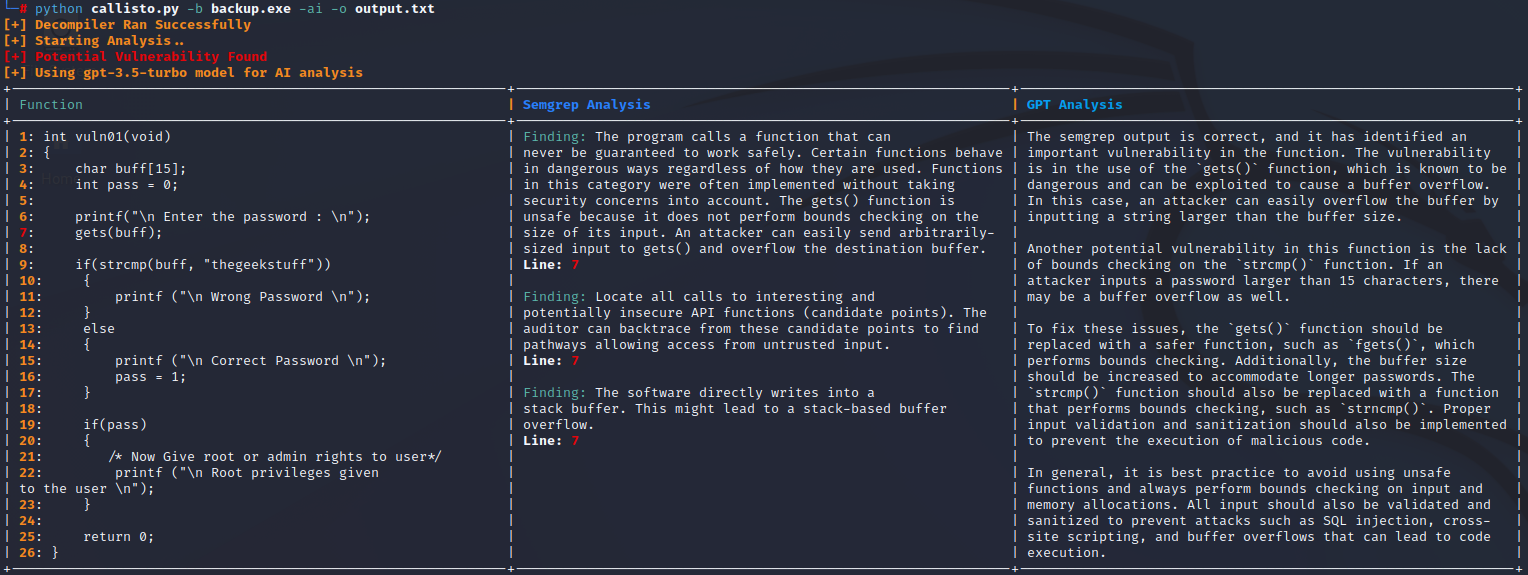
    Outil automatisé d'analyse de vulnérabilités binaires qui décompile des exécutables via Ghidra, analyse du pseudo-code C avec Semgrep, et valide les résultats en utilisant GPT-3.5-Turbo pour réduire les faux positifs.

    795
  • 4

    OsintHunter

    letox4/osinthunter

    🎯 La boîte à outils OSINT ultime : graphe d'enquête, notation de confiance, familles d'alias, carte, chronologie et rapports. 49 modules, plus de 400 sites, aucune clé API requise.

    525
  • 5

    mcp-reverse

    1llu50ry/mcp-reverse

    Serveur MCP exposant plus de 180 outils de rétro-ingénierie qui agrègent Ghidra, IDA, x64dbg, Frida et 56 autres backends avec des analyseurs de binaires natifs et une base de connaissances de 4 200 compétences.

    379
  • 6

    DFRoot

    a2333c/dfroot

    Outil de root Android pour Samsung Galaxy S25 Ultra (SM-S938B) qui enchaîne DirtyFrag CVE-2026-43284 et CVE-2026-43499 pour obtenir le root automatiquement au démarrage via KernelSU.

    324

Explorer tous les outils

Parcourez notre collection d'outils

Voir tous les outils →
Partager
Contenu non disponible dans la langue demandée. Affichage de la version anglaise.

CVE-2026-123158 — SSH Authentication Bypass ("sshole") exploit

CVE-2026-123158 is an SSH authentication bypass vulnerability (SSH authentication bypass, login without a password) that affects OpenSSH compiled without PAM on Alpine Linux (musl libc). This repository contains the exploit / PoC (Proof of Concept) in Python that reproduces the flaw in a practical way.

Nicknamed "sshole", the vulnerability allows logging in via SSH to accounts without a real password without needing to know any credentials.

Keywords: CVE-2026-123158, sshole, OpenSSH exploit, Alpine Linux vulnerability, musl crypt bypass, SSH authentication bypass, SSH login without password, auth bypass PoC.

What is CVE-2026-123158?

The crypt() function of musl libc (the libc used by Alpine Linux) literally returns the * character when the submitted password exceeds 256 bytes and the hash stored in /etc/shadow is also * (account marked as "no valid password", typical of service or disabled accounts). OpenSSH, when compiled without PAM support, compares that result directly against the shadow field: when comparing "*" == "*" the server accepts the login without the attacker knowing any real password.

Impact: SSH authentication bypass / access without credentials on affected accounts.

Conditions required for the system to be vulnerable:

  • openssh-server compiled without PAM (--without-pam), as happens by default in many Alpine Linux images.
  • PasswordAuthentication yes in sshd_config.
  • An account with * in /etc/shadow (user without a real password assigned).
  • Any other account on the system with a $5$ or $6$ hash (necessary for musl to enter the vulnerable code path).

Exploit / PoC

pip install paramiko

python3 exploit.py <HOST> <PORT> <USER> [LEN]
# Ejemplo contra cuenta 'alice' con contraseña de 300 caracteres
python3 exploit.py 172.17.0.2 22 alice 300

The script first sends a short password (negative control) and then a long password (>256 bytes) to trigger the musl crypt() bug and confirm whether the login is accepted without valid credentials.
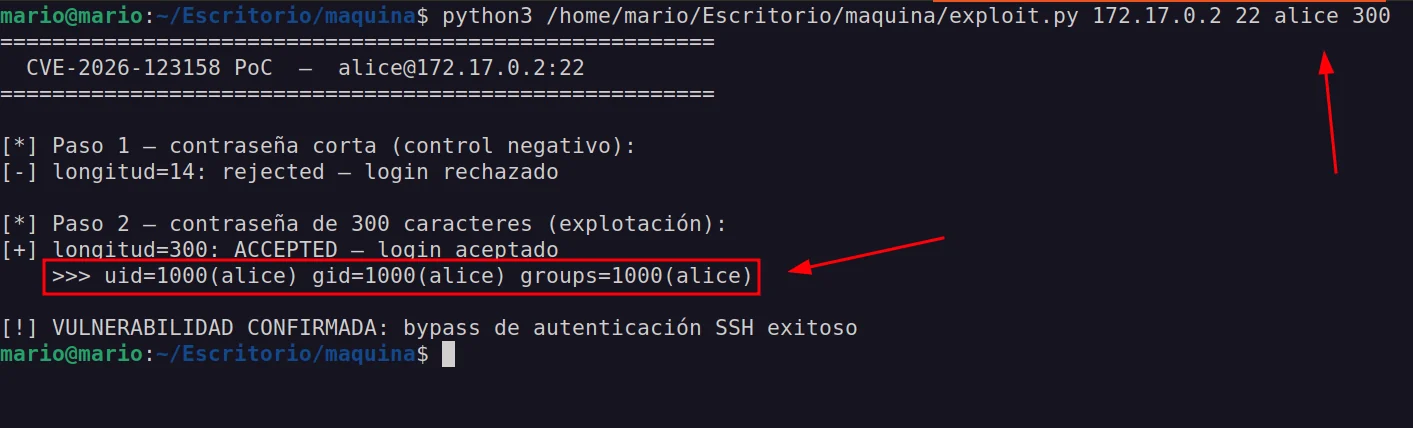
Demo

Screenshot of the CVE-2026-123158 exploit (sshole): SSH authentication bypass on Alpine Linux via a long password

Mitigation

# Actualizar y reiniciar sshd
apk upgrade -U -a
rc-service sshd restart

# O deshabilitar autenticación por contraseña
echo "PasswordAuthentication no" >> /etc/ssh/sshd_config
rc-service sshd restart

Docker Lab

Available at DockerLabs / BunkerLabs — Eseeseache machine — image eseseache:latest, freely accessible, to practice exploiting CVE-2026-123158 in a controlled environment.

References

  • Eseeseache machine on DockerLabs / BunkerLabs — hands-on lab for the vulnerability.

For educational purposes. Do not use against systems without express authorization.

Télécharger l’outil